Tunxi Old Street
屯溪老街 · Túnxī Lǎojiē
Quick answer
This is the easiest site in the Huangshan area for a foreigner, because it is the only one with no process: no ticket, no passport check, no gate, no queue. Carry cash as well as your phone, since small craft and tea shops vary in what they accept, and ask the price before you commit to anything. English on the older shopfronts is limited, which is worth knowing before you set out to be choosy.
Why visit
- 1 No ticket, no gate and no queue - the only site in the Huangshan area you can simply walk into
- 2 A kilometre of Ming and Qing Huizhou carved architecture with shopfronts still trading on the ground floor, not a roped-off monument
- 3 Named as a China Historical and Cultural Street in 2009, alongside Beijing's Guozijian Street and Suzhou's Pingjiang Road
- 4 The street that is Huangshan's gateway, sitting close to both the airport and the main rail station
- 5 The practical place to buy red, black and green tea, and to try tea tofu, before heading into the mountains
- 6 Home to the Tongde Ren pharmacy and the Dai Zhen memorial hall, both listed cultural properties
Essential tips for foreigners
- Go in the morning. It is a shopping street, so the shops need to be trading for it to be worth anything, and mid-morning is when it is busy without being shoulder to shoulder.
- Buy tea here, not on the mountain. It is the most-cited destination in Tunxi precisely because the tea is good and the prices are better than the summit shops, where everything is marked up for altitude and convenience.
- Do not mistake it for the villages. This is a commercial street. If you want preserved Huizhou architecture, Hongcun and Xidi are the real thing and this street is the shopping that surrounds them.
- Carry cash as well as your phone. Small tea and craft shops vary in what they will accept, and you cannot rely on every one of them taking a foreign card.
- Ask the price before committing. This is ordinary practice on any Chinese shopping street and it costs nothing to do it here.
Suggested route
- 09:00 15 min Arrive mid-morning, when the tea and food shops have opened but the tour groups have not all arrived
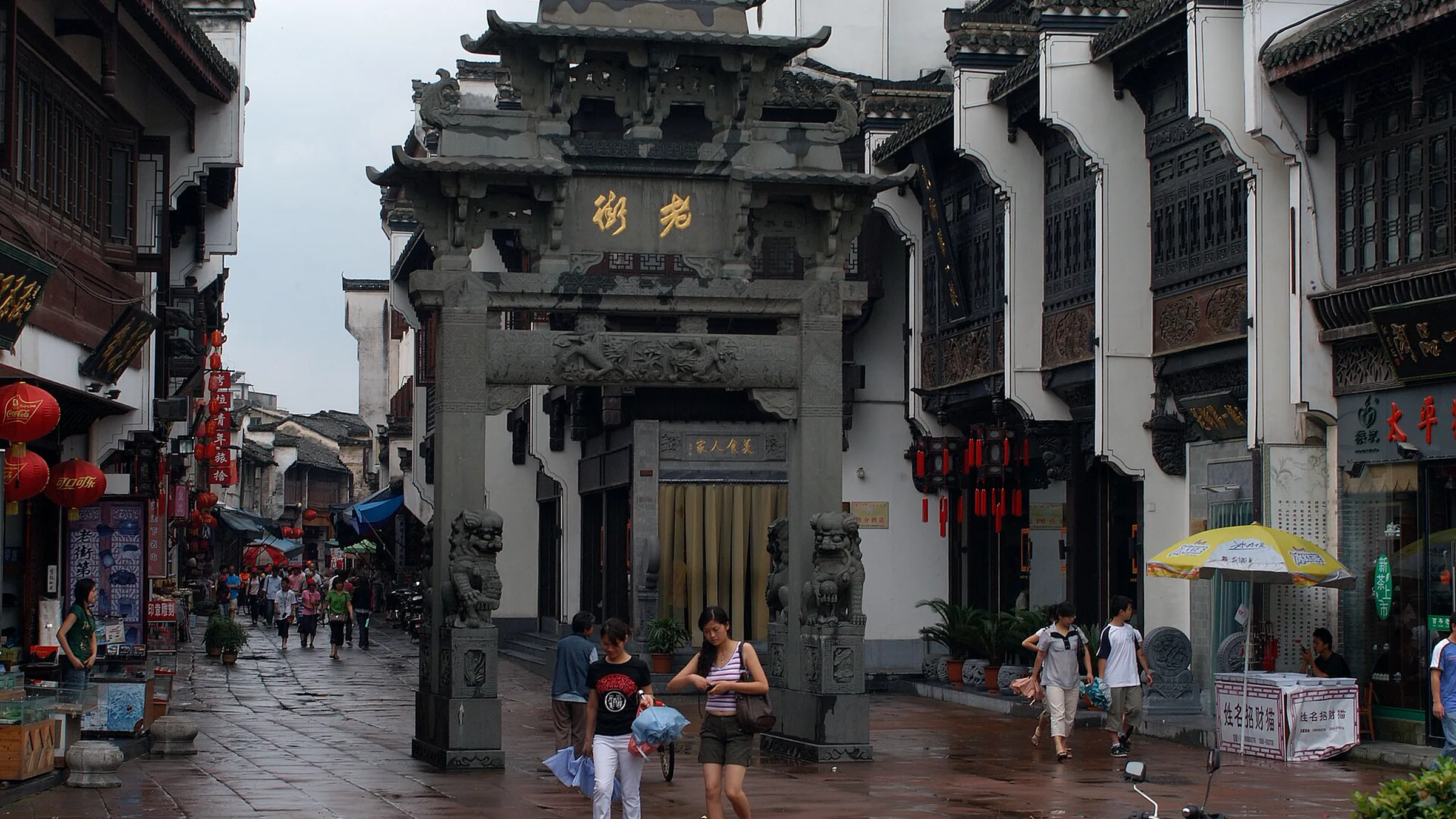
- 09:15 20 min Start at the Laojie archway at the main end of the street and walk into it
- 09:35 20 min Walk the length of the street once end to end before stopping anywhere, so you can see what is on offer before you buy
- 09:55 45 min Go back to whichever tea shop looked best and buy tea; compare two or three rather than taking the first
- 10:40 40 min Browse the jade, calligraphy and scholar's-object shops along the carved timber frontages
- 11:20 1 hour Eat, with tea tofu as the thing to try, at a Huizhou restaurant on the street
- 12:20 20 min Finish with anything you did not buy earlier, and move on towards the mountain or the villages
A street, not a site
The first thing to understand about Tunxi Old Street is that it is not a heritage site with an entrance. It is a public street about a kilometre long in the middle of Huangshan city, lined on both sides with buildings that are still shops, still trading, and still privately or commercially owned. You can walk in at any hour, you do not need a ticket, and there is nothing to check.
That makes it the easiest thing on a Huangshan itinerary and the least demanding. It is also, for that reason, the thing most likely to disappoint you if you were expecting a preserved monument. The criticism that the street is over-commercialised is fair and it is the standard view: there is a great deal of souvenir volume here, and the genuine Huizhou architecture you came to the region for is a two-hour drive away in the villages.
Judge it on that basis and it is good. Judge it as an alternative to Hongcun or Xidi and it is not close.
What is actually preserved here
The substance is in the architecture, not in the shopping. Both sides of the street carry Ming and Qing dynasty Huizhou buildings, and the feature worth pausing over is the timber work on the upper storeys: deep lattice screens, relief-carved panels running the length of the facade, and tiered upturned eaves. None of that is visible if you are looking at the goods on the pavement.
The buildings are not fenced off or roped away, which is why this street is worth walking even if you buy nothing. It is the only place in the Huangshan area where you can see this much preserved Huizhou townscape at street level without a ticket.
A small number of individual structures carry formal protection, including the Tongde Ren pharmacy and the historic Old Street building complex, both listed at municipal or provincial level, and the Maohuai Hall. There is also the Dai Zhen memorial hall, dedicated to the Qing-dynasty scholar who came from this district.
Why it has the status it does
In 2009 the street was selected as a China Historical and Cultural Street, and the company it keeps is instructive: it was named alongside Beijing’s Guozijian Street and Suzhou’s Pingjiang Road. Those are chosen for the same reason - a surviving historic street where the urban grain is still intact - and between them they cover a scholar’s quarter, a canal town and a merchant town.
The recognition is real and it is about conservation rather than commerce. It does not change the fact that this is also the most shopped-at street in the region.
The tea is the reason to stop
If you buy one thing here, make it tea. The street’s standing reputation in travel guides is specifically about high-quality red, black and green tea at reasonable prices, and it is a reputation the guidebooks earned from the fact rather than the other way round.
This is worth contrasting with the mountain. Food and drink on Huangshan summit carry an altitude and convenience premium that is well documented - the same bottled water costs several times more at the top as at the foot. Buying tea here, before you go up, is both cheaper and a better use of the trip. Tea tofu is the other local thing worth trying.
Compare more than one shop. The tea trade is competitive enough on a street this size that the difference between a tourist shop and a good local one is worth two minutes of walking.
Where it sits in your trip
Tunxi Old Street is at the centre of the city that is the gateway to the mountain, and it is close to both the main railway station and the airport. That makes it the natural first thing to do on an arrival afternoon or an early morning before you leave, and it is the kind of place where an hour and a half disappears without being planned.
It is also where you are most likely to be given a bad steer about the region. Guides that send you here for authentic Huizhou architecture are sending you to a shopping street. If you have a day for Hongcun and a day for Xidi, spend them there and come here for tea and for an hour.
What to look at, because it is above your head
The trap on this street is that everything worth seeing is on the upper floors and everybody is looking at the ground.
Both sides carry the carved timber and stonework that defines Huizhou town architecture, and the specific things to search for are the relief-carved panels running along the facade lintels, the deep wooden lattice screens across the upper storeys, and the tiered eaves with their upturned corners stacked one above another. The whitewashed wall and the dark tile roof are the easy part; they are the uniform of every building on the street and they are not the reason to look up.
The rhythm of it matters more than any single building. These are shopfronts, so the architecture has been designed to be read from the pavement by someone walking past at a glance, which is why the carving is concentrated in horizontal bands rather than scattered. Walk the full length once without stopping, then go back to the two or three facades that caught you.
How to buy the tea without overpaying
Tea is the one purchase here worth planning rather than browsing, so it is worth knowing how to do it.
Compare before you buy. There are many tea shops on a street this length and they are competing with each other for the same customers, which means the spread between a tourist-facing shop and a good local one is real.
Know what you are asking for. Red, black and green is the broad split, and within each there is a further split by place of origin. The most famous tea associated with this city is a green one, and asking for it by name is a better test of a shop than asking for a recommendation.
Ask for it by weight. Chinese tea is sold by weight, and knowing the unit you are being quoted in prevents the single most common misunderstanding.
Buy the smaller quantity first. If you have not drunk this tea before, a small amount is the sensible test, and you can always come back to the same shop.
A thousand years of street, and what survived
The street is described as originating in the Song dynasty, with a history of more than a thousand years, and the buildings standing on it are described as Ming and Qing Huizhou carved architecture. Those two facts sit together awkwardly, because a thousand-year-old street would be remarkable anywhere and this one is, by the standards of the places people actually queue for, quite young.
The honest reading is that the street’s role is old and its fabric is not. A commercial street that has run continuously since the Song would have been rebuilt repeatedly along the way, and the Ming and Qing buildings are the generations of that rebuilding that survived - often because they were the ones worth keeping. That is still an unusual thing to be able to walk down, and it is still the reason for the designation, but it is a different claim from “a thousand-year-old street”.
A naming note that trips people up
The city is called Huangshan, the district and the street are called Tunxi, and guides use both without explanation. The city was called Tunxi until 1987, when it was renamed for the mountain to promote tourism to it. The old name simply stayed in the district and the street.
So if a map, a booking or a driver uses Tunxi and another uses Huangshan, they are almost certainly talking about the same place, and it is worth checking that before you spend an hour finding the wrong one of them.
Best photo spots
-
The Laojie archway at the main entrance · Early morning before the crowd builds
The grey stone paifang with guardian lions and the two characters for Old Street on the plaque is the one unmistakable marker of the place, and it frames the street behind it. Wide and early if you want it without people.
-
The carved timber frontages on the east side · Mid-morning, when raking light picks out the relief carving
The upper storeys are deep lattice screens and carved relief panels that you cannot see at all from the middle of the crowd. Look up rather than at the goods.
-
Down the length of the pedestrian street · Late afternoon when the light comes down the axis
The street is straight and narrow, which stacks shopfronts, lanterns and paving into a strong one-point composition. Wet paving after rain doubles the lantern reflections.
-
The tea shopfronts · Whenever they are trading
The tea trade is what the street is actually known for, and the shopfronts selling it are the part of the visit with real substance behind it rather than souvenir volume.
Frequently asked questions
Is Tunxi Old Street free?
Yes, entirely. There is no ticket, no gate and no pass. You only spend money on what you choose to buy, and buying nothing there is a perfectly normal way to spend an hour.
Is Tunxi Old Street worth visiting?
It is worth an hour or two and it is genuinely good for tea and for seeing Huizhou shopfront architecture at ground level. What it is not is a preserved monument. It is a working commercial street, and if you have already booked a trip to Hongcun or Xidi it adds very little to the architecture itself.
What can I buy on Tunxi Old Street?
Antiques and curios, jade, calligraphy and painting, the scholar's four treasures, tea, Huizhou-style food and souvenirs. The tea is the item with the strongest claim on the place, in red, black and green, and it is the reason the street is on most itineraries.
How do I get to Tunxi Old Street?
It runs through the centre of Tunxi District in Huangshan city, close to both the main rail station and the airport, so it is the natural first stop on arrival. It is a pedestrian street, so walk in rather than trying to drive it.
Can I eat on Tunxi Old Street?
Yes, and the tea tofu is the thing to try. There are Huizhou-style restaurants along the street; one of the better-known, Laojie Diyilou, displays photographs of its dishes at the entrance so you can see what you are ordering, which is a useful trick when the menu is not in English.
Why is the city called Huangshan but the district called Tunxi?
The city took the name of the mountain. It was called Tunxi until 1987, when it was renamed to promote tourism to Huangshan mountain. The old name survives in the district and the street, which is why guides and maps use both and travellers assume they are different places.
Sources
- 屯溪老街 — Chinese Wikipedia (a pedestrian street in Tunxi District, Huangshan, Anhui, originating in the Song dynasty with over a thousand years of history, about one kilometre long, lined with well-preserved Ming and Qing Huizhou carved architecture, shops for antiques jade calligraphy scholar's objects Huizhou restaurants and food, the Dai Zhen memorial hall, and its 2009 selection as a China Historical and Cultural Street alongside Beijing's Guozijian Street and Suzhou's Pingjiang Road) · Wikipedia
- Tunxi Old Street — Wikidata Q11043618 (administrative containment in Tunxi District, Anhui; note that this item carries no P625 coordinate, which is why OpenStreetMap and geotagged photography were used instead) · Wikidata
- Huangshan — English Wikipedia (Huangshan City was renamed from Tunxi in 1987 to promote tourism to the mountain) · Wikipedia
- Huangshan — Wikivoyage (Laojie as the most-cited destination in Tunxi, described as over-commercialised next to the more authentic villages of Hongcun and Xidi, valued for high-quality red black and green tea at reasonable prices and for tea tofu, the Laojie Diyilou restaurant, the Old Street International Youth Hostel, and the airport and rail stations being close by) · Wikivoyage
- Tunxi Old Street on OpenStreetMap (pedestrian way 62287276 tagged 屯溪老街 / Old Street, centre 29.7105830 / 118.3009139, inside Laojie Subdistrict, Tunxi District) · openstreetmap.org
- File:Tunxi.jpg — Wikimedia Commons (own work released to the public domain, Emitchan), the source file for the hero image of the Laojie archway · Wikimedia Commons