
People's Park + Heming Teahouse Guide: Chengdu's Living Room
People's Park in central Chengdu: free entry, 100-year-old Heming Teahouse, the famous weekend marriage market where parents post handwritten ads for adult children. The best place to see Chengdu's slow pace.
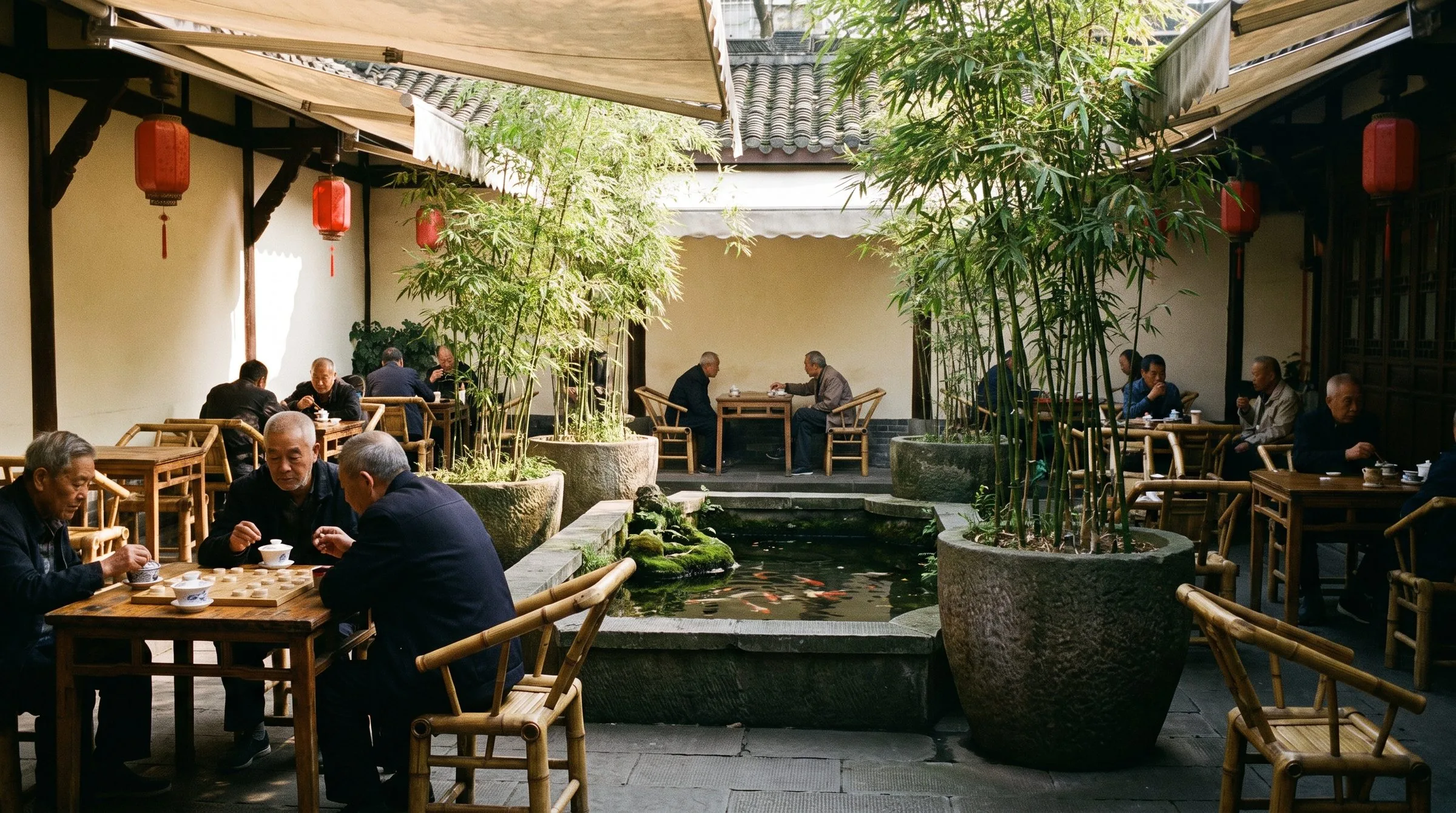
People’s Park (人民公园, Rénmín Gōngyuán) is the living room of Chengdu. It’s an 11-hectare free public park in the heart of the city, famous for the 100-year-old Heming Teahouse (鹤鸣茶社) and the unique weekend “marriage market” where parents post handwritten personal ads for their adult children. The park is the single best place in Chengdu to feel the city’s famously slow pace.
It’s a different experience from the touristy Wuhou Shrine or the Kuanzhai Alley teahouses. The locals come here. The teahouse has 100-year-old wooden tables under awnings, and an afternoon of tea + chess + people-watching is the most Chengdu thing you can do for ¥20.
Plan your visit
- Entry: Free.
- Hours: 6:00-22:00. Teahouse operates roughly 8:00-21:00.
- Subway: People’s Park Station (Line 2/4 transfer) is 5 min walk. Xinnanmen Station (Line 1) is also close.
- Best time: Weekday afternoon 14:00-17:00 for quiet teahouse sitting. Saturday or Sunday morning 9:00-12:00 to see the marriage market.
- Allow 2-3 hours if you want to sit at the teahouse and people-watch.
The 3 main attractions
Heming Teahouse (鹤鸣茶社)
The 100-year-old teahouse is the heart of the park. Wooden tables and bamboo chairs under awnings, surrounded by bamboo plants and old trees. ¥15-30 for a pot of tea (refilled with hot water as you drink). Locals sit for 2-3 hours. The teahouse has a few waitstaff in traditional dress, but otherwise it’s a no-frills, all-atmosphere experience.
The teahouse has a few rules:
- No tipping (it’s communal service, not a restaurant)
- No loud music (it’s a quiet space)
- Sit anywhere (tables are first-come, first-served; the waitstaff will help you find a spot)
- Snacks OK — you can bring your own or buy from the park snack stalls
The teahouse is open from 8 AM to 9 PM. Mornings are dominated by elderly locals doing tai chi and drinking their morning tea. Afternoons are calmer, mostly tourists and couples.
Marriage Market (相亲角)
Every Saturday and Sunday morning, parents in the park post handwritten personal ads for their adult children. The ads are on cardboard or paper, with the child’s age, height, education, job, and sometimes photos. Parents walk around reading the ads, sometimes striking up conversations with other parents.
The market is at the eastern entrance of the park, near the tea house. It’s not a tourist attraction per se, but it’s a uniquely Chinese cultural phenomenon that has been covered in many documentaries. Foreigners are welcome to walk through, but reading the ads is more polite than taking photos of parents (photos of the ads themselves are fine).
The park itself
11 hectares of free public park, with:
- Large central pond with lotus flowers in summer, golden ginkgo trees in autumn
- Walking paths through the bamboo and willow trees
- Open-air exercise areas where locals do tai chi, fan dance, and ballroom dance
- Chess tables where the elderly play Chinese chess
- Snack stalls with local Chengdu street food (cheap, ¥5-20)
The park is the most authentic slice of Chengdu life you’ll see as a tourist. Go in the morning, find a bench, and just watch.
What to do
Sit at Heming Teahouse for an hour
The core Chengdu experience. Order a pot of tea (¥15 for jasmine, ¥25 for the local bamboo-leaf green), sit, people-watch. The waitstaff will keep refilling your pot with hot water for as long as you stay. Most tourists stay 1-2 hours. The teahouse is a quiet, contemplative space.
Walk the marriage market
Saturday or Sunday morning 9-12. The “ads” are on the wall near the eastern entrance. Read a few, talk to a parent if you speak any Chinese, and observe. The market is a uniquely Chinese cultural experience that has no real equivalent in the West. The ads are frank: “Male, 32, programmer, 175cm, owns apartment, looking for female 25-30, university educated.”
Try a local snack
The park has a few food stalls near the teahouse. Local specialties:
- Three Cannons (三大炮) — glutinous rice balls, ¥10
- Sweet Water Noodles (甜水面) — cold spicy wheat noodles, ¥15
- Lung Ching Tea (龙井茶) — if you want a more refined tea than the teahouse’s standard
- Popcorn (爆米花) — old-school Chinese street snack, sweet or savory, ¥10
Watch locals do tai chi
Early morning (6-8 AM) and early evening (18-20) are peak times for public exercise. Tai chi, fan dance, line dancing, and ballroom dancing. Anyone is welcome to join.
What to skip
- The “sightseeing” part of the park — there isn’t really one. The park is for sitting and watching, not for monuments. Don’t expect a big attraction.
- The teahouse on weekends — gets crowded with the marriage market crowd. Weekday afternoons are calmer.
- Photos of parents — taking photos of people’s personal ads is fine; taking photos of the parents themselves is rude.
Practical tips
- Cash + WeChat Pay work everywhere. Foreign cards rarely accepted.
- Photography is welcome. The teahouse, the marriage market ads, and the park’s natural scenery are all great photo subjects.
- Dress for the season. Chengdu is hot and humid in summer, cool and damp in winter. The teahouse is well-heated in winter, well-ventilated in summer.
- Avoid weekends if you want quiet teahouse time. Saturday and Sunday mornings are the marriage market; afternoons are busy with families. Weekday afternoons are the calmest.
- Free wifi is patchy. Bring a Chinese SIM or eSIM.
Common questions
Is People’s Park worth visiting if I only have 2 days in Chengdu?
Yes — it’s the single best 2-3 hour “experience” stop in central Chengdu, and it’s free. After the pandas (or instead of, if pandas are too much logistics), People’s Park + Heming Teahouse is the most Chengdu thing you can do.
Can foreigners sit at the teahouse?
Yes, absolutely. The teahouse is open to everyone. Order a pot of tea, sit, and stay as long as you want. The waitstaff won’t bother you, the locals are friendly, and the experience is the same as anyone else’s.
How long is the marriage market active?
Saturday and Sunday mornings, 9 AM to noon. If you go Saturday or Sunday afternoon, the market is gone. If you go weekday, the market is not active at all.
Is the teahouse tea good?
It’s fine — standard Sichuan-style green tea, refilled with hot water. It’s not high-end tea, but it’s not the point. The point is the atmosphere, the ¥20 price, and the 2-3 hours of doing nothing.
Heming Teahouse + Chengdu essentials
Heming Teahouse ¥30 tea credit, Panda Base day tour with English guide, Jinli + Wuhou Shrine combo, and hotel booking in one cart. English interface, foreign cards accepted, e-voucher to phone. The 'Chengdu 3-day classic' bundle is the most efficient for first-timers.
Heming from $5 · Hotel from $78/night
Verified August 2026 by TravelHubChina Editorial. We re-check prices and policy details monthly so the data doesn’t drift.
FAQ
-
How much does it cost to enter People’s Park in Chengdu?
Entry to the 11-hectare park is free. A pot of tea at the 100-year-old Heming Teahouse runs ¥15-30 (¥15 jasmine, ¥25 local bamboo-leaf green), and the waitstaff will keep refilling your pot with hot water as long as you stay. -
What is Heming Teahouse and is it foreigner-friendly?
Heming Teahouse (鹤鸣茶社) is a 100-year-old teahouse in the heart of the park with wooden tables, bamboo chairs, and bamboo plants. It is open to everyone, the locals are friendly, and the experience is the same for any visitor. Just order a pot of tea and stay as long as you want. -
When is the famous marriage market active in People’s Park?
The marriage market (相亲角) runs only on Saturday and Sunday mornings, 9:00-12:00, at the eastern entrance near the teahouse. Weekday afternoons have no market at all. Reading the handwritten personal ads is fine, but the article advises against photographing the parents themselves. -
What are the rules at Heming Teahouse?
No tipping, no loud music, sit anywhere first-come first-served (waitstaff will help), and snacks are OK (bring your own or buy from park stalls). The teahouse is a quiet, contemplative space. -
How do I get to People’s Park by metro?
Take Line 2 or Line 4 to People’s Park Station, about a 5 minute walk. Line 1 to Xinnanmen Station is also close. -
What is the best time of day to visit People’s Park?
Weekday afternoon 14:00-17:00 for quiet teahouse sitting, or Saturday/Sunday morning 9:00-12:00 to see the marriage market. Early morning (6-8 AM) and early evening (18:00-20:00) are peak times for watching locals do tai chi, fan dance, and ballroom dance. -
How long do I need at People’s Park?
2-3 hours is ideal. Order a pot of tea at Heming, sit for 1-2 hours, walk the park, and try a few snacks. The article calls it the most Chengdu thing you can do for ¥20, and the single best 2-3 hour experience stop in central Chengdu. -
What local snacks can I try in the park?
Three Cannons (三大炮, glutinous rice balls, ¥10), Sweet Water Noodles (甜水面, cold spicy wheat noodles, ¥15), Lung Ching Tea (龙井茶) if you want a more refined tea, and old-school popcorn (爆米花, sweet or savory, ¥10).
Related guides
- Culture & Practical
Hefang Ancient Street + Southern Song Imperial Street: Walking Guide (2026)
Hefang Street (河坊街) and the Southern Song Imperial Street (南宋御街) are restored Qing-era shopping streets in central Hangzhou. Free to walk, packed with tea shops, silk, snacks, and the 1908 Hu Qing Yu Tang pharmacy museum.
6min read
- Culture & Practical
Is It Safe to Travel to China in 2026? The Complete Foreigner's Safety Guide
Comprehensive 2026 safety guide for China travel: crime statistics, region-specific risks, scams targeting foreigners, US State Department advisory, LGBTQ+ safety, female solo travel, health and medical care, embassy registration, and 5-step arrival safety checklist. Plus: is it safe to travel to China right now in 2026 (yes, with normal precautions).
12min read
- Culture & Practical
Chinamaxxing 2026: 12 Chinese Lifestyle Experiences Every Foreigner Should Try
Chinamaxxing is the 2026 trend of foreign visitors going deep into Chinese daily life — hot water, ba duan jin qigong, hanfu, mahjong, tea ceremony, foot baths, and more. 12 hands-on experiences with where to try each one, what to expect, and how to book.
9min read
- Culture & Practical
LGBTQ+ Travel in China 2026: Safety, Apps, Cities & Practical Guide
Practical LGBTQ+ travel guide for China in 2026 — legal status (homosexuality is legal, no same-sex marriage), social attitudes by city, dating apps (Blued, Tantan, Aloha), the 3 most LGBTQ+-friendly cities (Shanghai, Beijing, Chengdu), nightlife, healthcare, family considerations, and 5 ready-made LGBTQ+-friendly city profiles. Updated 2026-08-21 with current legal status and city-by-city social attitudes.
- Culture & Practical
Solo Female Travel in China 2026: The Honest Safety Guide Foreigners Don't Get
China is statistically one of the safer large countries for solo female travelers, but the safety profile is different from Western countries. What works in Tokyo or Paris may not work in Beijing. The 2026 honest guide: 8 specific safety scenarios (DiDi at night, hostel vs hotel, walking alone, foreigner-targeted scams, hostel harassment, menstruation access, dating safety, embassy backup), ranked by frequency and risk. Includes the 5 phrases every solo female traveler should learn, and the 2 scenarios where you should NOT go alone.
5min read
- Culture & Practical
Beijing Hutongs: A Complete Guide to the City's Ancient Alleyways (History, Map, How to Visit)
Complete guide to Beijing's hutongs: the 700-year history from Yuan dynasty to today, why hutongs are disappearing, the 6 best hutong areas to visit as a foreigner, how to navigate them on foot or by rickshaw, the etiquette rules, and how to experience the real local hutong life (not the tourist-trap version).
8min read