
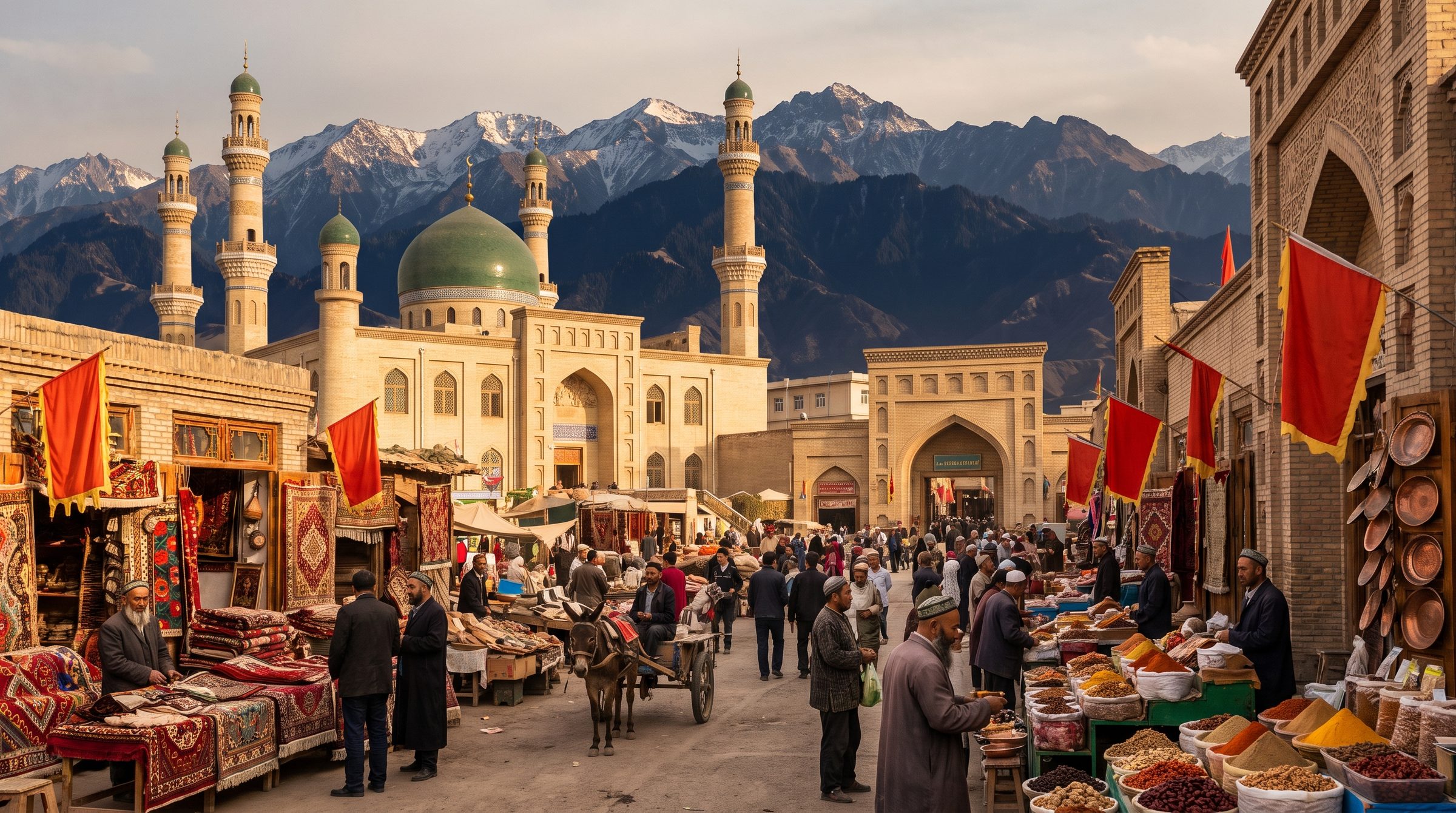
Urumqi Xinjiang Travel Guide 2026: Silk Road, Uyghur Food, Altash, Kashgar
Urumqi Xinjiang travel guide for first-time visitors: Uyghur food and culture, Tianchi Lake, Xinjiang Regional Museum, Kashgar day trip, how to get to Urumqi from Beijing/Shanghai, costs, and Silk Road history.
Urumqi (乌鲁木齐, Wūlǔmùqí) is the capital of Xinjiang Uyghur Autonomous Region in the far northwest of China. The city sits at 800m elevation at the northern foot of the Tianshan Mountains, 2,500 km west of Beijing, and has a population of about 4 million, of whom roughly 1 million are ethnic Uyghur. Urumqi is the largest city in Central Asia and was historically one of the most important waypoints on the Silk Road — Marco Polo passed through in 1273, calling it “a noble city, the metropolis of the province of Tangut.” Today, Urumqi is the gateway to a Silk Road experience that no other Chinese city can offer: Uyghur food, Islamic architecture, the Tianchi Lake, and the option to extend to Turpan, Kashgar, or even the Pamir plateau.
This is a practical guide for first-time visitors in 2026: how to get to Urumqi, the 4-day route including Tianchi Lake and Turpan, Uyghur food, the security context, and the optional Kashgar extension.
Quick facts
- Elevation: 800m (city center), 1,900m (Tianchi Lake)
- Population: ~4 million
- Language: Standard Mandarin (Putonghua) is the official language; Uyghur is widely spoken; Kazakh is also spoken in the northern suburbs; English is limited outside the international hotels
- Currency: Chinese yuan (¥, CNY). $1 = ¥7.20 in 2026
- Time zone: UTC+8 (China Standard Time). Xinjiang informally uses the unofficial Xinjiang Time (UTC+6), but all official schedules, flights, and trains run on Beijing Time
- Best season: May to October
- Visa: standard Chinese tourist visa (L). 240-hour visa-free transit applies (Urumqi is on the list)
- Distance from Beijing: 2,500 km (1h30m flight, 30+ hour train)
- UNESCO Heritage: Xinjiang has 6 UNESCO sites, including the Silk Roads: the Routes Network of Chang’an-Tianshan Corridor (2014) and the Tianchi Lake Bogda Peak area
The Silk Road context
Urumqi sits on the northern Silk Road, the trade route that connected Chang’an (today’s Xi’an) to Rome, Bukhara, and the Mediterranean from the 2nd century BC to the 14th century AD. The route split at Dunhuang: the northern route went through Hami, Turpan, Urumqi, and the Ili Valley into Kazakhstan; the southern route went through Khotan and the Taklamakan Desert to Kashgar. Both routes converged again at Kashgar to cross the Pamir into Central Asia.
Urumqi itself is relatively modern — it became a major trading post only after the Qing dynasty reconquest of Xinjiang in the 18th century. The older Silk Road waypoints are an hour or two outside the city: Turpan (2h drive), which has the best-preserved ancient Silk Road ruins, and Kashgar (1.5h flight or 24h drive), which has the most intact Uyghur old town.
Getting to Urumqi
Fly into Urumqi Diwopu Airport (URC)
Urumqi Diwopu International Airport is 16 km northwest of the city center. Direct domestic flights:
| City | Flight time | Daily flights | Round-trip price |
|---|---|---|---|
| Beijing (PEK) | 4h 30m | 10+ | $300-500 |
| Shanghai (PVG) | 5h | 8+ | $350-600 |
| Guangzhou (CAN) | 5h 30m | 6+ | $400-650 |
| Chengdu (CTU) | 4h | 4 | $300-500 |
| Xi’an (XIY) | 3h 30m | 4 | $250-450 |
| Chongqing (CKG) | 4h 30m | 3 | $300-500 |
| Kashi/Kashgar (KHG) | 1h 30m | 4 | $200-300 |
| Hotan (HTN) | 1h 30m | 2 | $200-350 |
| Yining (YIN) | 1h 30m | 3 | $150-250 |
International direct flights:
| City | Flight time | Frequency | Round-trip price |
|---|---|---|---|
| Almaty (ALA), Kazakhstan | 1h 30m | 5+ weekly | $200-400 |
| Nur-Sultan/Astana (NQZ), Kazakhstan | 2h | 4 weekly | $250-450 |
| Bishkek (FRU), Kyrgyzstan | 2h | 3 weekly | $200-400 |
| Osh (OSS), Kyrgyzstan | 2h 30m | 2 weekly | $250-450 |
| Islamabad (ISB), Pakistan | 3h | 2 weekly | $300-500 |
| Dushanbe (DYU), Tajikistan | 3h | 2 weekly | $350-550 |
| Moscow (DME), Russia | 6h | 3 weekly | $500-800 |
| Dubai (DXB), UAE | 5h | 4 weekly | $450-750 |
| Istanbul (IST), Turkey | 6h 30m | 3 weekly | $500-850 |
Urumqi is a major hub for Central Asia, which makes it a useful gateway for travelers combining China and the Stans. The Almaty, Nur-Sultan, and Bishkek flights are reliable and affordable.
Airport bus ¥10 to the city center (Hongguangshan Station). Taxi ¥50-70 fixed price.
High-speed rail
Urumqi is connected to the eastern Chinese high-speed rail network via Lanzhou (the Lanzhou-Xinjiang HSR, opened 2014). The journey from Lanzhou to Urumqi is 11 hours, $130-200 second class. From Beijing or Shanghai, the total train journey is 30+ hours — not practical for most visitors. The flight is the standard option.
4-day Urumqi route
This is the standard 4-day Urumqi + Tianchi Lake + Turpan route. It assumes you arrive in the morning of Day 1 and depart on Day 4 evening.
Day 1: Arrive Urumqi, Xinjiang Regional Museum, Grand Bazaar, Uyghur food
- Morning: arrive Urumqi Diwopu Airport, transfer to hotel. Hotel check-in usually requires passport ID scan and a security form — this is standard.
- 10 AM: walk to the Xinjiang Regional Museum (新疆维吾尔自治区博物馆, free, 9:30 AM - 6:30 PM, closed Mondays). The star exhibit is the Hall of Mummies — the Tarim mummies, 4,000-year-old preserved human remains found in the Tarim Basin, with distinctly Caucasian features (light hair, long noses). They predate the Han Chinese by 2,000 years and have rewritten the history of the Silk Road. Allow 2-3 hours. Other halls cover the Silk Road history, Uyghur culture, and modern Xinjiang.
- Lunch: walk to the International Grand Bazaar (国际大巴扎) and eat at a Uyghur restaurant inside or nearby.
- Afternoon: explore the International Grand Bazaar, the largest bazaar in Central Asia. 8,000+ shops in Islamic-style buildings, with everything from dried fruits and nuts to silk scarves, carpets, jade, and musical instruments. The architecture is the highlight — the main square has the tallest Islamic minaret in China (60m), and the surrounding buildings are modeled on Kashgar and Samarkand. Allow 2 hours.
- Evening: dinner at a recommended Uyghur restaurant (see below). Try the lamb kebabs, polo, and the dapanji (big plate chicken). ¥80-150 per person.
Day 2: Tianchi Lake day trip (2h drive each way)
- 8 AM: hotel breakfast. Pre-booked agency car picks you up (or join a day trip group at the Grand Bazaar).
- 9 AM: depart Urumqi. The drive to Tianchi Lake is 110 km north, 2 hours, on a good road through the Tianshan foothills and the Bogda range.
- 11 AM: arrive Tianchi Lake (天池, ¥215 entry + ¥60 mandatory shuttle bus). The lake is 1,900m elevation, a deep blue-green mirror surrounded by spruce forest, with the snow-capped Bogda Peak (5,445m) rising in the background. The lake is 4 km long and 1.5 km wide, with a 20 km walking path around the perimeter.
- Lunch: at a Kazakh yurt restaurant by the lake — try the lamb kebab, the hand-pulled noodles, and the kumis (fermented mare’s milk).
- Afternoon: optional boat ride on the lake (¥80-120, 1 hour) or horseback riding (¥150-300, 1-2 hours) along the lakeshore. Or just walk the perimeter path.
- 3 PM: depart for the return to Urumqi. The drive back is 2 hours.
- 5 PM: arrive Urumqi. Free evening.
Day 3: Turpan day trip (2h drive each way)
- 8 AM: hotel breakfast. Pre-booked agency car picks you up.
- 9 AM: depart Urumqi. The drive to Turpan is 200 km southeast, 2 hours, through the Tianshan foothills and the Flaming Mountains.
- 10 AM: arrive Turpan. The Turpan basin is 154m below sea level — one of the lowest points in China. The climate is extreme: 40°C+ in summer, dry and warm in spring and fall.
- First stop: Jiaohe Ancient City (交河故城, ¥70, 1 hour) — the best-preserved earthen city in the world, occupied from 200 BC to the 14th century. The city sits on a 30m-high river island and was a major Silk Road stop. The streets, houses, and temples are still visible.
- Second stop: Karez underground water system (坎儿井, ¥40, 1 hour) — a 2,000-year-old Persian-derived qanat (underground irrigation channel) that turned the Turpan desert into a vineyard. 1,000+ km of channels, with vertical wells every 30-50m for maintenance. The Karez museum explains the system.
- Lunch: at a Uyghur family restaurant in Turpan, with a chance to try the famous Turpan raisins, the sweet Turpan melons (best in August-September), and the hand-pulled noodles.
- Third stop: Grape Valley (葡萄沟, ¥75, summer only) — a 8-km-long valley of vineyards and Uyghur villages. Walk through the trellised vines, sample the grapes and raisins, and buy dried fruits. The valley is one of the most photogenic places in Xinjiang.
- Fourth stop: Flaming Mountains (火焰山, free view from the road) — the red sandstone ridges made famous by the Ming dynasty novel Journey to the West. The surface temperature can reach 70°C+ in summer; in winter the rocks are dusted with snow.
- 5 PM: depart Turpan. Return to Urumqi by 7 PM.
- Evening: dinner in Urumqi.
Day 4: Free day in Urumqi OR Kashgar day trip OR depart
- Option A: Free day in Urumqi — climb Hongguang Mountain (红山公园, ¥30, ¥50 cable car) for the panoramic view over the city and the Tianshan. Or visit the Xinjiang Silk Road Museum (free) for a deeper dive into the Silk Road history. Or shop for souvenirs — dried fruits, nuts, silk scarves, carpets, jade.
- Option B: Kashgar day trip (喀什) — fly Urumqi-Kashgar (1h 30m, $200-300 round-trip), visit Id Kah Mosque (the largest mosque in China, ¥45), the Old Town (free, walk the narrow alleys with mud-brick buildings), and the Old Town Sunday market if your timing aligns. Return to Urumqi the same evening (last flight ~9 PM) or stay overnight in Kashgar.
- Option C: Depart Urumqi — fly to your next destination. Most travelers fly to Beijing (4h30m) or Shanghai (5h) for the next leg.
Uyghur food — the culinary highlight
Uyghur cuisine is the most underrated regional cuisine in China. It is also one of the oldest, with roots in the Persian, Turkish, and Indian food traditions of the Silk Road. The dishes are heavy on lamb, bread, rice, and dairy, with vegetables and spices in supporting roles. Most restaurants in Urumqi serve Uyghur food, and you can find it throughout China now (search for “新疆菜” or “维吾尔族餐厅”).
Must-try dishes
| Dish | Chinese | Price | What it is |
|---|---|---|---|
| Lamb kebabs | 羊肉串 | ¥5-10 each | The Uyghur national dish. Skewered lamb fat and meat grilled over charcoal, served with cumin and chili. The cumin-heavy version is the local standard. |
| Polo / pilaf | 手抓饭 | ¥30-50 | Mutton with carrots, onions, and rice cooked in oil. The classic Uyghur one-dish meal. |
| Samsa | 烤包子 | ¥5-10 each | Baked buns with mutton and onion filling, sold from tandoor ovens. |
| Naan | 馕 | ¥3-8 each | Round flatbread, sold from tandoor ovens. Plain, sesame, walnut, or with herbs. The Uyghur staple. |
| Laghman | 拉面 | ¥25-40 | Hand-pulled noodles in a tomato-lamb broth. Comes in many variations. |
| Dapanji | 大盘鸡 | ¥80-150 | Big plate chicken: chicken with potatoes, peppers, and hand-pulled noodles. A Xinjiang signature, served on a giant plate. |
| Yogurt | 酸奶 | ¥5-15 | The Uyghur style is thicker and tarter than Chinese yogurt, often served with sugar or jam. |
| Samsa | 烤包子 | ¥5-10 | The other Uyghur pastry classic, baked mutton and onion buns. |
| Youtazi | 油塔子 | ¥5-10 | Layered steamed bread, often served with the meal. |
| Honey and yogurt drink | 蜂蜜酸奶 | ¥10-20 | A Uyghur specialty, a mix of yogurt, honey, and sometimes ice. |
Recommended Uyghur restaurants in Urumqi
- 阿里木 (Alimujiang Uyghur Restaurant): popular street food, kebabs and naan, ¥40-80 per person.
- 一品拉面 (Yipin Lamian): hand-pulled noodle specialist, ¥30-50 per person.
- 阿布拉的馕 (Abla Naan): the most famous naan bakery in Urumqi, ¥5-10 per naan.
- 领馆巷 (Lingguang Lane / Consulate Lane): a street of small Uyghur restaurants near the old Consulate area, ¥40-80 per person. Most authentic.
- 大巴扎里面 (Inside the Grand Bazaar): 20+ Uyghur restaurants inside the bazaar, ranging from street food to mid-range dining, ¥30-100 per person. Tourist-friendly, decent quality.
- 海尔巴格 (Hai Er Ba Ge): the most famous upscale Uyghur restaurant, ¥150-300 per person. Worth the splurge for the décor and the dance show.
- Tash Kurghan: a smaller, lesser-known Uyghur restaurant near the museum, ¥60-120 per person.
Muslim-friendly (halal)
All Uyghur restaurants are halal by default. Pork is not served in any Uyghur restaurant. For broader halal travel context, see the China Muslim travel halal guide.
Dietary restrictions
Urumqi is one of the easiest Chinese cities for Muslim travelers. Every Uyghur restaurant is halal. For broader dietary context, see the China dietary restrictions guide.
Security and the 2026 context
Xinjiang is a sensitive region. The current security environment is tight — expect ID checks at hotels, train stations, and tourist sites. The main tourist areas (Urumqi, Turpan, Kashgar Old Town, the major Silk Road sites) are well-patrolled and foreigner-friendly, and the Chinese government actively encourages tourism to Xinjiang. Practical implications for foreign travelers:
- Carry your passport at all times. Hotels, tourist sites, train stations, and even some restaurants will ask for it.
- Expect a security form at hotel check-in. This is normal. The form records your passport, visa, and itinerary. The hotel keeps a copy.
- ID checks are routine. Don’t be alarmed if you are asked to show your passport at a tourist site. The checks are quick.
- Photography is restricted in some areas. Military installations, police stations, and certain government buildings cannot be photographed. Look for signs. The general rule: if in doubt, ask.
- Avoid political topics. Discussing Xinjiang politics with strangers, including hotel staff, can lead to official questioning. The official Chinese position is that the current security measures are necessary for counter-terrorism; the official Western position is more critical. Foreigners are not required to take a position, but arguing either side is risky.
- Travel permits for the far west. Kashgar prefecture, the Pamir plateau, the Wakhan Corridor, and Tashkurgan require an additional Travel Permit (边境证), arranged through a Xinjiang tour agency 15-20 days in advance. Urumqi, Turpan, and Kashgar city do NOT require a separate permit.
- Internet is heavily monitored. Use a VPN with caution, ideally for short tasks only. See the China VPN guide for current recommendations.
- The 240-hour visa-free transit applies to Urumqi. Urumqi is on the list. See the China 240-hour visa-free guide for full rules.
For broader safety context, see the China travel safety guide.
Where to stay in Urumqi
Urumqi has a range of hotels from budget guesthouses to international 5-star chains. Most are in the central Shayibake or Tianshan districts near the Grand Bazaar and the museum.
International 5-star (¥800-1,800 / $110-250 per night)
- Sheraton Urumqi Hotel (喜来登乌鲁木齐): the top international hotel, near Hongguangshan Park, 360+ rooms, the best breakfast in town. ¥1,000-1,800/night.
- Hilton Urumqi (希尔顿乌鲁木齐): newer, in the central business district, 380+ rooms, ¥900-1,500/night.
- Jin Jiang International Hotel Urumqi: 4-star near the Grand Bazaar, ¥600-1,000/night.
Mid-range (¥350-700 / $50-100 per night)
- Hanting Express Urumqi (various locations): reliable budget chain, ¥250-450/night.
- Jinjiang Inn Urumqi (various locations): ¥200-350/night.
- Urumqi Yilong Hotel: mid-range Uyghur-style hotel near the Grand Bazaar, ¥400-700/night.
What to look for in a Urumqi hotel
- Security and ID verification: all hotels in Xinjiang do a full passport scan and security form on check-in. The form records your passport, visa, and itinerary. This is normal but takes 10-15 minutes.
- Air conditioning and heating: critical in summer (40°C+) and winter (-10 to -15°C). The international hotels have the best climate control.
- English-speaking staff: only at the international hotels. Budget places have very limited English.
- In-room WiFi: standard in all hotels, but slow. Use a VPN for international sites.
Getting around Urumqi
DiDi
DiDi works in Urumqi — download and set up before arrival. See the using DiDi guide for setup. DiDi is the easiest way to get between the central area and the airport, and within the city center.
Taxi
Taxis are cheap and abundant. ¥10-20 for most trips in the central area, ¥50-70 to the airport. Drivers speak limited English — have your hotel write the destination in Chinese characters. Most taxis use meters in Urumqi, unlike some other Chinese cities.
BRT (Bus Rapid Transit)
Urumqi has a BRT (Bus Rapid Transit) system with dedicated lanes running north-south through the city. ¥1-2 per ride, English signage, foreigner-friendly. Covers the central area and the airport route.
Metro
Urumqi Metro Line 1 (purple, 2018) runs east-west through the city center. ¥2-5 per ride, English signage. The line connects the airport area to the city center.
Private car for day trips
For Tianchi Lake and Turpan day trips, you need a private car with driver. Arrange through your hotel or a tour agency (¥600-1,500 per day for sedan, ¥800-1,800 for 7-seater). The driver speaks limited English; a separate guide is ¥300-500 per day. Most agencies offer combined packages.
Kashgar day trip and extension
Kashgar (喀什) is the most culturally distinct city in China. 4,000 km west of Beijing, it sits at the western edge of the Taklamakan Desert and was the meeting point of the Chinese, Indian, Persian, and Mediterranean branches of the Silk Road. The Old Town is the best-preserved traditional Islamic city in Central Asia, with 2,000+ years of continuous habitation.
How to get to Kashgar
- Flight: URC to Kashgar (KHG), 1h 30m, $200-300 round-trip, 4+ daily flights.
- Train: URC to Kashgar, 24 hours on the southern Xinjiang rail line, $60-100 hard sleeper. Not practical for a day trip.
- Drive: URC to Kashgar via the southern Taklamakan route (1,500 km, 18-20 hours) or the northern Tianshan route (2,000 km, 22-24 hours). Not practical for a day trip.
What to see in Kashgar (1-2 day whirlwind)
- Id Kah Mosque (艾提尕尔清真寺): the largest mosque in China, founded 1442, capacity 10,000+ worshippers. ¥45 entry. Open 8 AM - 8 PM (closed during prayer times).
- Old Town (老城): free, walk the narrow alleys with mud-brick buildings, hidden courtyards, and the traditional Uyghur craftsmen (blacksmiths, woodcarvers, cobblers). The Old Town is being partially demolished for redevelopment, so the experience is fading — visit soon.
- Old Town Sunday Market (大巴扎): every Sunday, the largest traditional market in Central Asia, with 20,000+ visitors, livestock section, textiles, dried fruits, musical instruments, and food stalls. Free.
- Abakh Khoja Mausoleum (香妃墓): the tomb of the 17th-century Uyghur leader, ¥30, 1 hour.
- Karakul Lake: an optional 4-hour round-trip drive south into the Pamir foothills (3,600m elevation), the lake is a stunning blue mirror with the snow-capped Kongur Tagh range rising behind. ¥100 entry + ¥200-300 for the shared taxi.
Where to stay in Kashgar
- Kashgar Tianhai International Hotel (喀什天海国际): the top hotel, 4-star, near Id Kah Mosque, ¥500-800/night.
- Kashgar Old Town Hostel: budget option in a converted Uyghur courtyard house, ¥150-300/night.
- Seman Hotel: 4-star near the Old Town, ¥400-700/night.
The Tarim mummies — a historical note
The Xinjiang Regional Museum’s mummies are the most important archaeological exhibit in Central Asia. The Tarim mummies — 4,000-year-old preserved human remains found in the Tarim Basin — have redrawn the history of the Silk Road. They are Caucasoid, not Mongoloid: light hair, long noses, tall statures, and European-style clothing and weavings. The most famous is the Cherchen Man, dated to about 1,000 BC, whose body is so well preserved that the tattoos on his calves are still visible.
The mummies predate the Han Chinese by 2,000 years, and they predate the known Silk Road by 1,000 years. They suggest that the Tarim Basin was inhabited by an Indo-European population (probably Tocharian, related to the ancestors of the modern Uyghurs’ distant cousins) who had trade and cultural contact with the Mediterranean and the Indus Valley long before the Han Chinese opened the Silk Road. The mummies also have some genetic and material connections to the ancient Celts (the Cherchen Man was found wearing a tartan-patterned wool skirt), which has led to a popular theory that the Tocharians may have been Celtic in origin — though this is contested.
Budget breakdown: 4-day Urumqi
For a mid-range traveler (mid-range hotel, festival tickets, 2 day trips):
| Item | Cost (per person) |
|---|---|
| Hotel (3 nights, mid-range) | ¥1,200-2,100 ($170-290) |
| Tianchi Lake day trip (car, driver, entry, lunch) | ¥600-1,000 ($85-140) |
| Turpan day trip (car, driver, entry, lunch) | ¥800-1,200 ($110-170) |
| Xinjiang Regional Museum | Free |
| Grand Bazaar | Free |
| Kashgar day trip (flight, transfer, guide) | ¥1,500-2,500 ($210-350) |
| Meals (4 days, mid-range) | ¥400-700 ($55-95) |
| Local transport (DiDi, taxis) | ¥150-300 ($20-40) |
| Total ground (4 days) | ¥4,500-7,500 ($625-1,040) |
| Urumqi round-trip flight from Beijing | ¥2,000-3,500 ($280-500) |
| International flight to Urumqi (US round-trip) | $1,200-1,800 |
| Total trip (5-6 days from abroad) | $1,800-3,000 per person |
Budget travelers can do it for $1,000-1,400. Mid-range for $1,500-2,500. Luxury travelers (Sheraton Urumqi, private 4WD for day trips, private guide, Kashgar overnight at Tianhai International) will spend $3,500-6,000 total.
Practical tips
Money and payment
Urumqi is fully cashless in the central area. Alipay and WeChat Pay are accepted in 95% of shops, hotels, and restaurants. Set up Alipay before arrival — see the Alipay setup guide. Carry ¥200-500 in cash for small purchases and taxis. ATMs are widely available in the central area; they accept foreign Visa and Mastercard with a daily limit of ¥2,500-5,000 per transaction.
Language
Standard Mandarin (Putonghua) is the official language and is widely spoken. Uyghur is the main minority language and is widely spoken in the Uyghur neighborhoods and restaurants. English is limited outside the international hotels. Download Pleco and Google Translate with the Chinese offline pack before arrival. See the essential Chinese phrases guide for the most useful 20 phrases.
Connectivity
VPN: access to Google, Instagram, WhatsApp, Facebook, and most Western news sites is blocked in China. Download and configure a VPN before arrival. Note: VPN use is more sensitive in Xinjiang than in the rest of China. Use a VPN with caution, ideally for short tasks only. See the China VPN guide for current recommendations.
SIM card: buy a China Unicom or China Mobile SIM at the airport or any carrier store. eSIM via Airalo or Holafly also works. See the eSIM setup guide and the essential apps guide.
Cultural etiquette
- Ask before photographing Uyghur people, especially women. Many Uyghur women do not want to be photographed. The Old Town has signs asking for no photography in certain alleys.
- Remove shoes when entering a mosque. The prayer hall of Id Kah Mosque requires modest dress — long pants, long sleeves, head covered for women.
- Do not eat pork in Uyghur neighborhoods or restaurants. All Uyghur food is halal by default.
- Be respectful during prayer times. The five daily prayer times are at dawn, noon, afternoon, sunset, and night. Tourist sites will close briefly during the noon prayer.
- Friday is the main prayer day. Id Kah Mosque is closed to non-Muslim visitors on Friday mornings. Plan your visit accordingly.
- For broader etiquette, see the China cultural etiquette guide and the China travel etiquette guide.
Photography
Photography is generally allowed except in military installations, police stations, certain government buildings, and inside the Id Kah Mosque prayer hall. The Old Town alleys and the Grand Bazaar are excellent for street photography. The Tarim mummies in the museum are the most important cultural photographs of the trip.
Health and safety
Urumqi is safe for foreign visitors who follow the security protocols. The main medical center is the Xinjiang Medical University Hospital. Most hotels have a doctor on call. Travel insurance that covers high-altitude (if you extend to the Pamir plateau) and emergency evacuation is essential — World Nomads, SafetyWing, and IMG all offer Xinjiang-specific plans.
For broader safety context, see the China travel safety guide.
Best time to visit (detail)
| Month | Temperature (Urumqi) | Conditions | Crowds |
|---|---|---|---|
| January | -15 to -8°C | Cold, snowy, ski season | Low |
| February | -12 to -5°C | Cold, occasional snow | Low |
| March | -3 to 6°C | Cool, windy | Low |
| April | 6 to 17°C | Mild, blooming | Moderate |
| May | 13 to 24°C | Warm, dry | High |
| June | 19 to 30°C | Warm, dry | High |
| July | 22 to 32°C | Hot, dry (40°C+ in Turpan) | High |
| August | 21 to 31°C | Hot, dry (grape and melon season) | High |
| September | 14 to 25°C | Warm, dry, harvest season | High (best) |
| October | 5 to 15°C | Cool, dry | Moderate (best) |
| November | -4 to 5°C | Cold, dry | Low |
| December | -12 to -5°C | Cold, dry, ski season | Low |
May to October is the standard travel season. September and October are the sweet spot: warm days, cool nights, harvest season for the grapes and melons, fewer crowds than July-August. November to April is winter: cold but very quiet. Avoid the Uyghur religious holidays of Eid al-Fitr and Eid al-Adha unless you specifically want the cultural experience — most businesses close for 3 days.
Frequently asked practical questions
Do I need a Chinese visa for Urumqi? Yes, the standard Chinese tourist visa (L) is required for most nationalities. The 240-hour visa-free transit (54 nationalities) applies — Urumqi is on the list. See the China 240-hour visa-free guide for details.
Can I use Alipay in Urumqi? Yes, Alipay works everywhere in the central area. See the Alipay setup guide for setup.
Do I need a Chinese SIM card? Recommended. Buy a SIM at the airport or a carrier store. eSIM also works. See the eSIM guide and the essential apps guide.
What about the western scenic wonder destinations comparable to Urumqi? The Silk Road experience of Urumqi is unique in China. For related Silk Road history, see the Mogao Caves guide (Dunhuang) and the Jiuzhaigou guide (Sichuan). For a broader comparison, see the China scenic wonders comparison.
Is Urumqi expensive? Mid-range, comparable to other Chinese second-tier cities. The international flights and the day trips are the biggest costs. See the China budget 2026 guide for cost comparisons.
Is Urumqi family-friendly? Yes — Urumqi is one of the best Chinese cities for cultural family travel. Children love the Grand Bazaar, the Tianchi Lake boat ride, and the Uyghur food. For broader family travel planning, see the China family vacation guide.
Is Urumqi accessible for disabled visitors? The central area, the museum, the Grand Bazaar, and the international hotels are accessible. The Tianchi Lake and Turpan day trips require walking on uneven paths and stairs. Contact your tour agency in advance for specific accommodations.
Urumqi is one of the great cross-cultural travel experiences in Asia — a Han Chinese city with a million-strong Uyghur minority, a Silk Road waypoint that still has the food and the architecture to prove it, and a gateway to the most distinct corner of China. The logistics are more involved than Beijing or Shanghai (the visa, the security context, the language barrier), but the cultural reward is unmatched on the eastern Silk Road. Plan ahead, eat everything, and let the city do the rest.
Step by step
-
Apply for the standard Chinese visa and confirm Xinjiang security rules
Apply for a Chinese tourist visa (L) at your nearest Chinese consulate 30+ days before travel. The visa is the same as for any other Chinese destination. After arrival, expect routine ID checks at hotels, train stations, and tourist sites — carry your passport at all times. The main tourist areas (Urumqi, Turpan, Kashgar Old Town, the major Silk Road sites) are well-patrolled and foreigner-friendly. For the far western regions (Kashgar prefecture, the Pamir plateau, the Wakhan Corridor, Tashkurgan) you need a Travel Permit (边境证) arranged through a Xinjiang tour agency 15-20 days in advance.
-
Fly into Urumqi Diwopu Airport (URC)
Urumqi Diwopu International Airport is 16 km northwest of the city center. Direct domestic flights: Beijing (4h30m, $300-500 round-trip), Shanghai (5h, $350-600), Guangzhou (5h30m, $400-650), Chengdu (4h, $300-500), and a growing list of secondary cities. International direct flights: Almaty (Kazakhstan, 1h30m, $200-400), Nur-Sultan (Kazakhstan, 2h, $250-450), Bishkek (Kyrgyzstan, 2h, $200-400), Islamabad (Pakistan, 3h, $300-500), Dushanbe (Tajikistan, 3h, $350-550), and seasonal flights from Moscow, Dubai, and Istanbul. Airport bus ¥10 to the city; taxi ¥50-70.
-
Day 1: Xinjiang Regional Museum + Grand Bazaar + Uyghur food
Morning: Xinjiang Regional Museum (新疆维吾尔自治区博物馆, free, 9:30 AM - 6:30 PM, closed Mondays). The star exhibit is the mummies hall — the Tarim mummies, 4,000-year-old preserved human remains with distinctly Caucasian features, found in the Tarim Basin. Allow 2-3 hours. Afternoon: walk the International Grand Bazaar (国际大巴扎, free, open 9 AM - 10 PM), the largest bazaar in Central Asia, with 8,000+ shops in a series of Islamic-style buildings. Sample Uyghur street food, buy dried fruits, nuts, and silk scarves. Evening: dinner at a Uyghur restaurant — try the kebabs, polo (pilaf), and hand-pulled noodles. ¥60-120 per person.
-
Day 2: Tianchi Lake day trip (2h drive each way)
Tianchi Lake (天池, Heavenly Lake) is 110 km north of Urumqi, 2h drive each way. The lake sits at 1,900m elevation on the north slope of Bogda Peak (5,445m) — a UNESCO World Heritage site. ¥215 entry + ¥60 mandatory shuttle bus. Allow 6-8 hours total. The lake is a deep blue-green mirror surrounded by spruce forest, with the snow-capped Bogda Peak rising behind. Boat ride on the lake ¥80-120 (1 hour). The Kazakh yurts at the lakeside offer traditional horseback riding (¥150-300, 1-2 hours) and lamb kebab lunch. The return drive passes through the dramatic Fukang desert and the Bogda range.
-
Day 3: Turpan day trip (2h drive each way)
Turpan (吐鲁番) is 200 km southeast of Urumqi, 2h drive each way through the Tianshan foothills and the Flaming Mountains. The Turpan basin is 154m below sea level — one of the lowest points in China. Must-sees: Jiaohe Ancient City (交河故城, ¥70), the best-preserved earthen city in the world, occupied from 200 BC to the 14th century; Karez underground water system (坎儿井, ¥40), the 2,000-year-old Persian-derived qanat irrigation that turned the desert into a vineyard; the Flaming Mountains (火焰山, free view from the road), the red sandstone ridges made famous by Journey to the West; Grape Valley (葡萄沟, ¥75, summer only), the vineyard valley where Uyghur families sell raisins and fresh grapes. Day trip ¥600-1,000 per person including car, driver, and guide.
-
Day 4: Free day in Urumqi OR Kashgar day trip OR depart
If you have a 4th day, choose one: free day in Urumqi (Hongguang Mountain for the panoramic view, ¥30, ¥50 cable car, ¥30 cable car to the top of the mountain; or the Xinjiang Silk Road Museum; or the Urmqi Red Mountain Park), or a 1.5h flight to Kashgar for a single-day whirlwind tour (1.5h flight URC-KKH, $200-300 round-trip, Id Kah Mosque ¥45, Old Town free, Sunday market free). The Sunday market in Kashgar (Sunday only) is the largest traditional market in Central Asia and worth the trip if your timing aligns. Otherwise, spend Day 4 shopping, dining, and resting before flying out.
-
Eat Uyghur: kebabs, polo, naan, and the hand-pulled noodle
Uyghur cuisine is the highlight of Xinjiang for most visitors. Try: 1) lamb kebabs (羊肉串, ¥5-10 each, the local standard), 2) polo/pilaf (手抓饭, ¥30-50 per plate, mutton with carrots, onions, and rice cooked in oil), 3) samsa (烤包子, ¥5-10 each, baked buns with mutton and onion), 4) naan (馕, ¥3-8 each, round flatbread, sold from tandoor ovens), 5) laghman (拉面, ¥25-40, hand-pulled noodles in a tomato-lamb broth), 6) dapanji (大盘鸡, ¥80-150, big plate chicken — chicken with potatoes, peppers, and hand-pulled noodles), 7) yogurt (酸奶, ¥5-15, often served with sugar or jam). Recommended restaurants: 阿里木 (Alimujiang Uyghur Restaurant, Uyghur street food), 一品拉面 (Yipin Lamian, hand-pulled noodles), 阿布拉的馕 (Abla Naan, fresh-baked naan).
-
Get around: DiDi works, taxis are cheap, the BRT is foreigner-friendly
Urumqi has a small but reliable public transport network. DiDi works in Urumqi — download and set up before arrival. Taxis are cheap (¥10-20 for most trips in the central area). The Urumqi BRT (Bus Rapid Transit) has dedicated lanes and runs north-south through the city; ¥1-2 per ride, English signage. The Urumqi Metro Line 1 (purple, 2018) runs east-west through the city center; ¥2-5 per ride, English signage. For day trips to Tianchi and Turpan, you need a private car with driver — arrange through your hotel or a tour agency (¥600-1,500 per day). For broader transit context, see the using DiDi guide.
FAQ
-
Is Xinjiang safe for foreign tourists in 2026?
Yes for foreign tourists who follow the security protocols. The current security environment in Xinjiang is tight but tourism is actively encouraged by the Chinese government, and the main tourist areas (Urumqi, Turpan, Kashgar Old Town, the major Silk Road sites) are well-patrolled and foreigner-friendly. Expect ID checks at hotels, train stations, and tourist sites. Carry your passport at all times. The far western regions (Kashgar prefecture, the Pamir plateau, the Wakhan Corridor) require an additional Travel Permit (边境证) which must be arranged through a tour agency 15-20 days in advance. -
Do I need a visa for Urumqi and Xinjiang?
Yes, the standard Chinese tourist visa (L) is required for most nationalities. The 240-hour visa-free transit (54 nationalities) lets you transit through mainland China visa-free for 240 hours. Urumqi is on the list of permitted transit cities — you can fly into Urumqi from an international hub (Almaty, Nur-Sultan, Bishkek, Islamabad) and exit to another Chinese city, or vice versa. For most visitors, the standard L visa is still the easier option. See the China 240-hour visa-free guide for full rules. -
How do I get to Urumqi from Beijing or Shanghai?
Direct flights from Beijing (4h30m, $300-500 round-trip), Shanghai (5h, $350-600), Guangzhou (5h30m, $400-650), and Chengdu (4h, $300-500). Urumqi Diwopu Airport (URC) is 16 km northwest of the city center, 30 min by airport bus (¥10) or 30 min by taxi (¥50-70). Urumqi is also a major rail hub but the train from Beijing takes 30+ hours; the flight is the practical option. -
What is the best time to visit Urumqi and Xinjiang?
May to October is the standard travel season. June to August is peak (warm, dry, stable weather, all sites open). September and October are the best — warm days, cool nights, harvest season for the grapes and melons, fewer crowds. November to April is winter (cold, -10 to -15°C, occasional snow, fewer sites accessible) but the Urumqi area has the International Ski Resort and the hot springs open year-round. Avoid the Uyghur religious holidays of Eid al-Fitr and Eid al-Adha unless you specifically want the cultural experience — most businesses close for 3 days. -
How much does a Urumqi trip cost in 2026?
Budget $60-100 per day per person excluding international flights. A 4-day Urumqi trip with Tianchi Lake day trip and Turpan day trip: $350-500 ground costs (3 nights mid-range hotel, Tianchi Lake ¥215 + ¥60 shuttle, museum free, day trips, meals). Add international flight to Urumqi ($600-1,500 round-trip from the US, $300-600 from Europe or Central Asia). Total trip from abroad: $1,200-2,000 per person for 5-6 days. Budget travelers can do it for $800-1,200; mid-range for $1,500-2,000; luxury for $3,500+.
Related guides
-
Beijing Hutongs: A Complete Guide to the City's Ancient Alleyways (History, Map, How to Visit)
Complete guide to Beijing's hutongs: the 700-year history from Yuan dynasty to today, why hutongs are disappearing, the 6 best hutong areas to visit as a foreigner, how to navigate them on foot or by rickshaw, the etiquette rules, and how to experience the real local hutong life (not the tourist-trap version).
-
Beijing Hutong Rickshaw Tour: The Complete Guide (2026)
Everything you need to know about Beijing's hutong rickshaw tours: the history of the rickshaw, the 3 main rickshaw stands, how to negotiate a fair price (¥150-300/hour), the 4 most popular routes, what the rickshaw driver typically explains, how to avoid the commission-shop scams, and whether to do a self-walk or rickshaw tour.
-
10 Best Beijing Hutongs to Visit (Beyond the Tourist Traps)
Beyond the crowded Nanluoguxiang: 10 specific hutongs worth visiting, from the most authentic residential alleys to the most photogenic, with what makes each one unique, exact addresses, how to get there, and when to visit. Includes a printable walking map.