
Huangguoshu Falls Guide: China's Largest & Water Curtain Cave
Huangguoshu Waterfall in Guizhou is China's largest (77.8m tall, 101m wide) with 18 waterfalls in the park. Covers tickets, transport, 1-day plan.
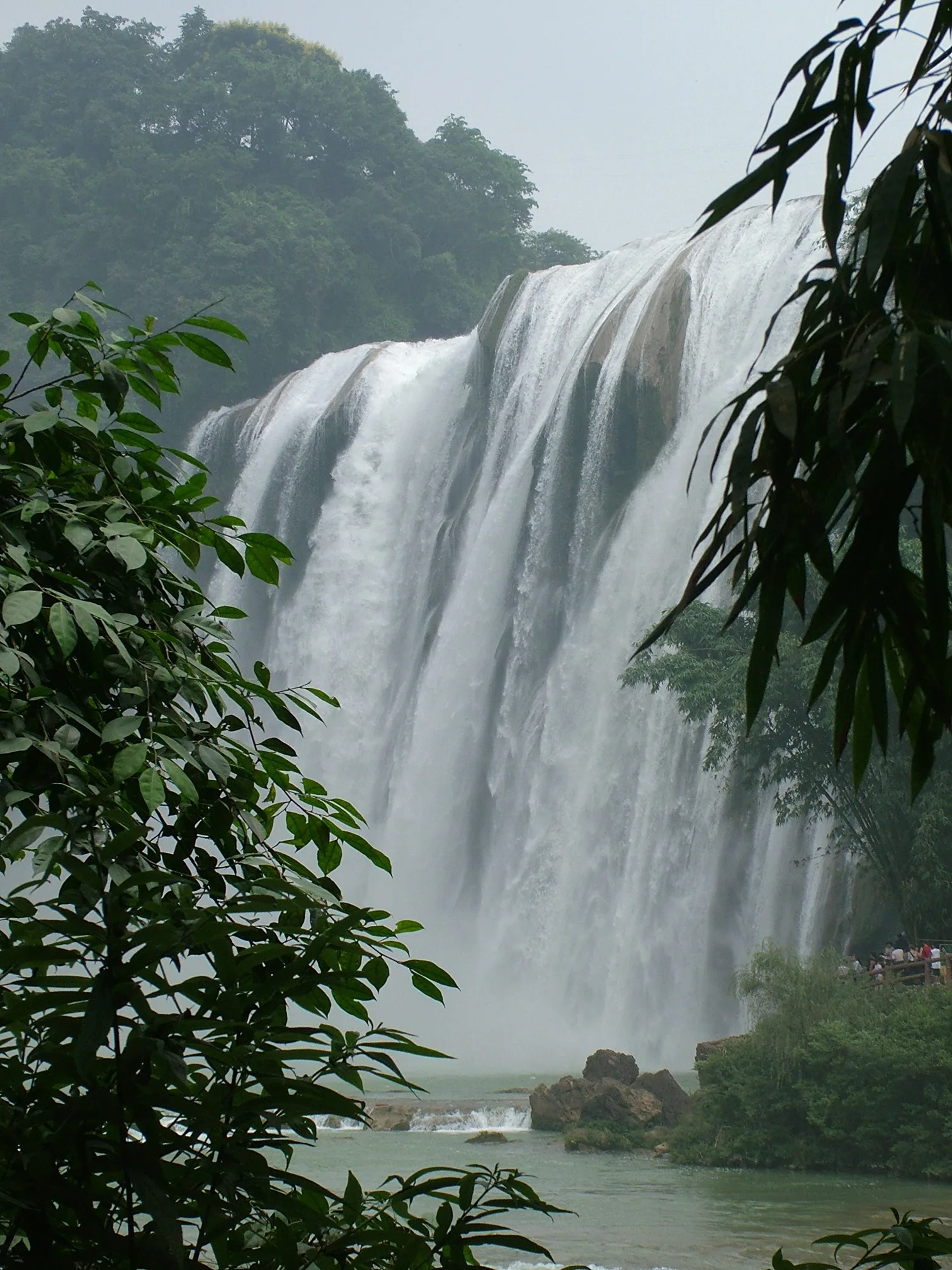
Huangguoshu Waterfall (黄果树瀑布, Huang Guoshu Pubu) is a 77.8m tall, 101m wide curtain waterfall on the Baishui River in Anshun Prefecture, western Guizhou. The falls are part of the 163 sq km Huangguoshu National Park, which contains 18+ named waterfalls, the largest collection of waterfalls in any Chinese national park. The Main Falls is the 5th largest waterfall in Asia by width, after those in Vietnam, Laos, China-Yunnan, and China-Tibet. For broader context, see our China scenic wonders comparison and the best time to visit China guide (June-October for peak flow).
The park is built on a karst limestone landscape, with hundreds of caves, underground rivers, and natural bridges formed over millions of years. The most-photographed feature is the Water Curtain Cave (水帘洞), a 134m long cave on the cliff face behind the Main Falls. Visitors can walk through the cave and look out at the falling water through 6 viewing windows. The cave walk is one of the few places in the world where you can stand behind a major waterfall and look out through the water. Most visitors fly to Guiyang or Anshun — see our China domestic flights guide for booking tips, and our China high-speed rail guide if you’re coming from the east.
The park has been a major tourist destination since the 1980s, with annual visitors exceeding 4 million in 2024. The Main Falls is at its most dramatic in June-August during the rainy season, when the flow can reach 700 cubic meters per second. In winter, the flow drops to about 100 cubic meters per second, and the falls are narrower and clearer, but the Water Curtain Cave walk is more pleasant without the mist.
How to plan your 1-day trip
Morning - Main Falls and Water Curtain Cave
Arrive at the park gate by 8:00 AM. Buy the ¥160 entry + ¥50 shuttle. Take the shuttle to the Main Falls stop. Spend 2 hours at the three viewing levels (lower, middle, upper). Walk through the Water Curtain Cave (30 minutes). Return to the shuttle for the next site.
Lunch - Doupotang
Take the shuttle to Doupotang (8 km, 15 minutes). Lunch at the on-site restaurant (Guizhou rice noodles or hot pot, ¥30-50 per person). Walk the 1 km flat path to the 105m Doupotang Waterfall. Allow 1.5 hours total.
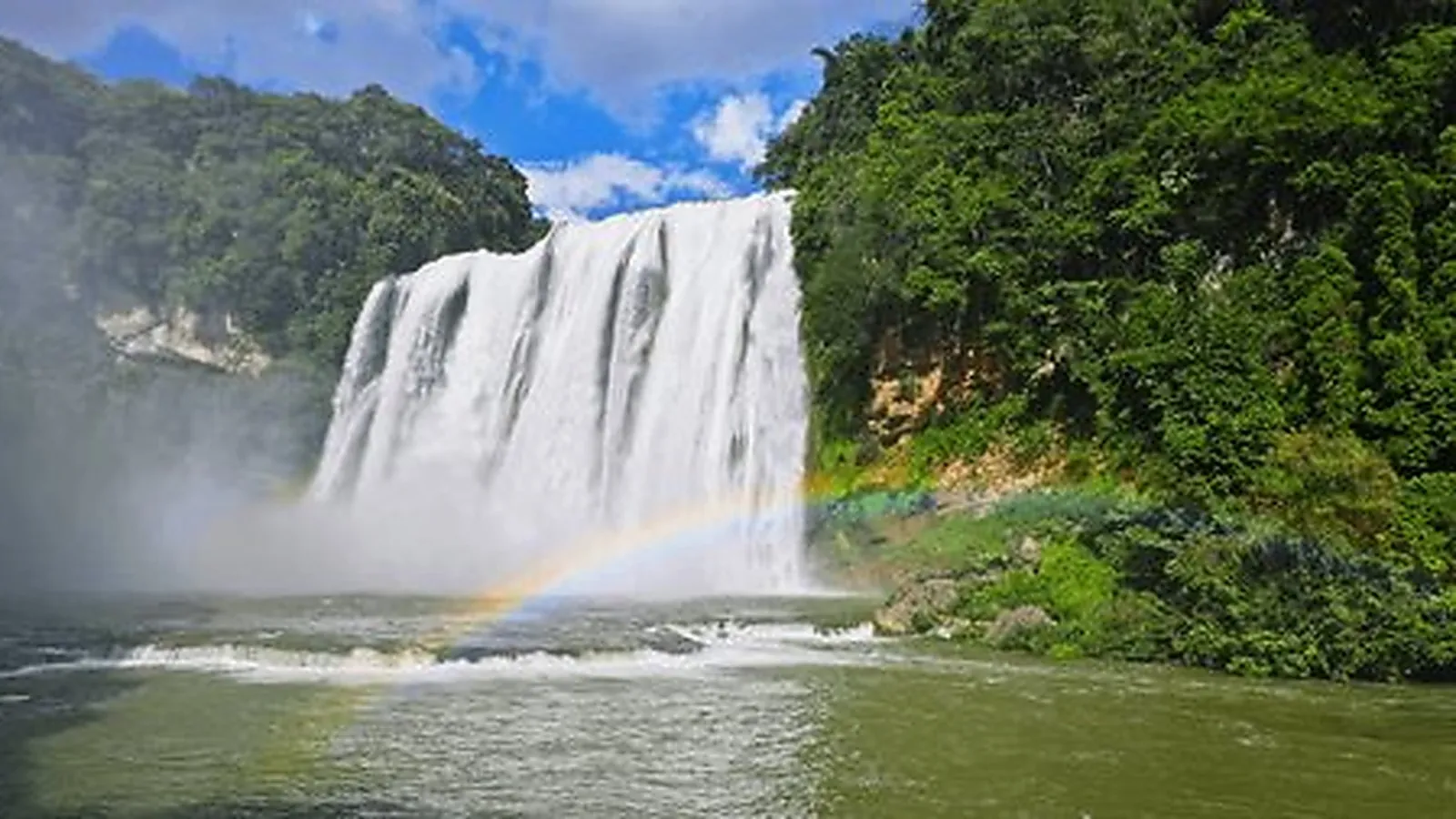
Photo: Wikimedia Commons / CC BY-SA. Source

Afternoon - Tianxing Bridge
Take the shuttle to Tianxing Bridge (7 km, 15 minutes). Walk the 3 km loop through the karst formations and the Silver Chain Waterfall. Allow 3 hours. Most photogenic in late afternoon when the sun is on the waterfall side.
Evening - Return to Guiyang
Take the shuttle back to the main gate. Drive 2 hours to Guiyang. Or stay 1 night in Huangguoshu town for a relaxed start the next day.
Tickets, booking, and payment
Major sites and their 2026 entry fees:
- Huangguoshu National Park entry - ¥160 per person (peak May 1 to October 31), ¥150 off-peak. Single entry, valid 2 calendar days.
- Park shuttle bus - ¥50 per person, mandatory. Runs every 15-20 minutes, 7:30 AM to 5:30 PM.
- Balinghe Bridge viewpoint (optional) - ¥80 entry, ¥30 shuttle. The world’s highest bridge (1,250m above the Beipan River), 30 km from the park.
- Xingyi Wanfenglin (optional side trip) - ¥80 entry, ¥20 shuttle. 4 hours drive west.
- Tianlong Tunpu (optional side trip) - ¥80 entry. 1 hour drive from Guiyang.
How to book:
- At the gate - passport required, cash or Alipay/WeChat. No foreigner surcharge.
- Trip.com - English, accepts Visa/Mastercard, 5% service fee. Most comprehensive booking platform for Huangguoshu + Xingyi tour packages.
- Alipay mini-program - search 黄果树, pick the date. E-ticket loads into Alipay wallet.
Free entry: Children under 1.2m, seniors over 65 (with passport). Most sites give 50% student discount with Chinese ID.
What is NOT included:
- Balinghe Bridge entry (¥80) and shuttle (¥30)
- Xingyi Wanfenglin entry (¥80) and shuttle (¥20)
- Tianlong Tunpu entry (¥80)
- Driver-guide (¥500-700 per day for the Guiyang-Huangguoshu round trip)
- Meals (¥30-80 per person at park restaurants)
Getting there and around
By air: Guiyang Longdongbao Airport (KWE). Direct flights from Beijing (3h, 5-6 daily), Shanghai (2h 30m, 6-7 daily), Guangzhou (1h 45m, 5-6 daily), Shenzhen (1h 45m, 4-5 daily), Chengdu (1h 30m, 4-5 daily). Round trip from Beijing is ¥1,500-2,800. The airport is 12 km east of downtown Guiyang; airport bus ¥20, taxi ¥60-80.
Alternative airport: Anshun (AVA), 45 km from the park. Direct flights from Beijing (3h, 1-2 daily), Shanghai (3h, 1-2 daily), Guangzhou (2h, 1-2 daily). Round trip from Beijing is ¥1,200-2,500. Best for visitors who want to skip the Guiyang drive.
By car (self-drive): From Guiyang, the G60 highway runs west, 130 km to the park, 2 hours, all paved. Car rental in Guiyang is ¥300-500/day for a sedan, ¥600-800/day for a 4WD. Most of the route is on a divided highway with good signage.
By bus: Tourist bus from Guiyang Tourism Bus Station, 2.5 hours, ¥80-100, runs 4-5 times daily. Buses depart 7:30 AM, 8:30 AM, 9:30 AM, 10:30 AM, 1:00 PM. Returns from the park at 2:00 PM, 3:30 PM, 5:00 PM, 6:30 PM.
Inside the park: Park shuttle is mandatory. The three core sites (Main Falls, Doupotang, Tianxing Bridge) are 7-8 km apart. The shuttle runs every 15-20 minutes and is included in the ¥50 shuttle fee. Walking between sites is not allowed; the roads are for shuttle buses only.
When to go and what to expect
June to August (peak flow). Peak season. The waterfall is at its most dramatic, with 500-700 cubic meters per second. The mist from the plunge pool reaches 50-100m and can be felt at the lower viewpoint. The Water Curtain Cave is most active. Crowds are highest. Book hotels 2 weeks ahead. Temperatures: 22C to 30C, with humid afternoons.
September to October (post-rainy). Excellent time. The flow is still strong (300-500 cubic meters per second) but the crowds thin out. The water is the cleanest after the summer silt settles. Temperatures: 15C to 25C, comfortable hiking weather.
November to February (winter, low flow). Quiet, beautiful, low water. The flow is 100-200 cubic meters per second; the falls are narrower but clearer. The surrounding forest is green. The Water Curtain Cave walk is more pleasant. Temperatures: 5C to 15C, cool but not cold. Best for photographers who want empty viewing platforms.
March to May (spring, low flow). Off-peak. The flow is at its lowest (50-100 cubic meters per second). The falls can look thin. Most photographers and tour operators consider this the least photogenic season. The Tianxing Bridge karst formations are still impressive. Temperatures: 12C to 22C.
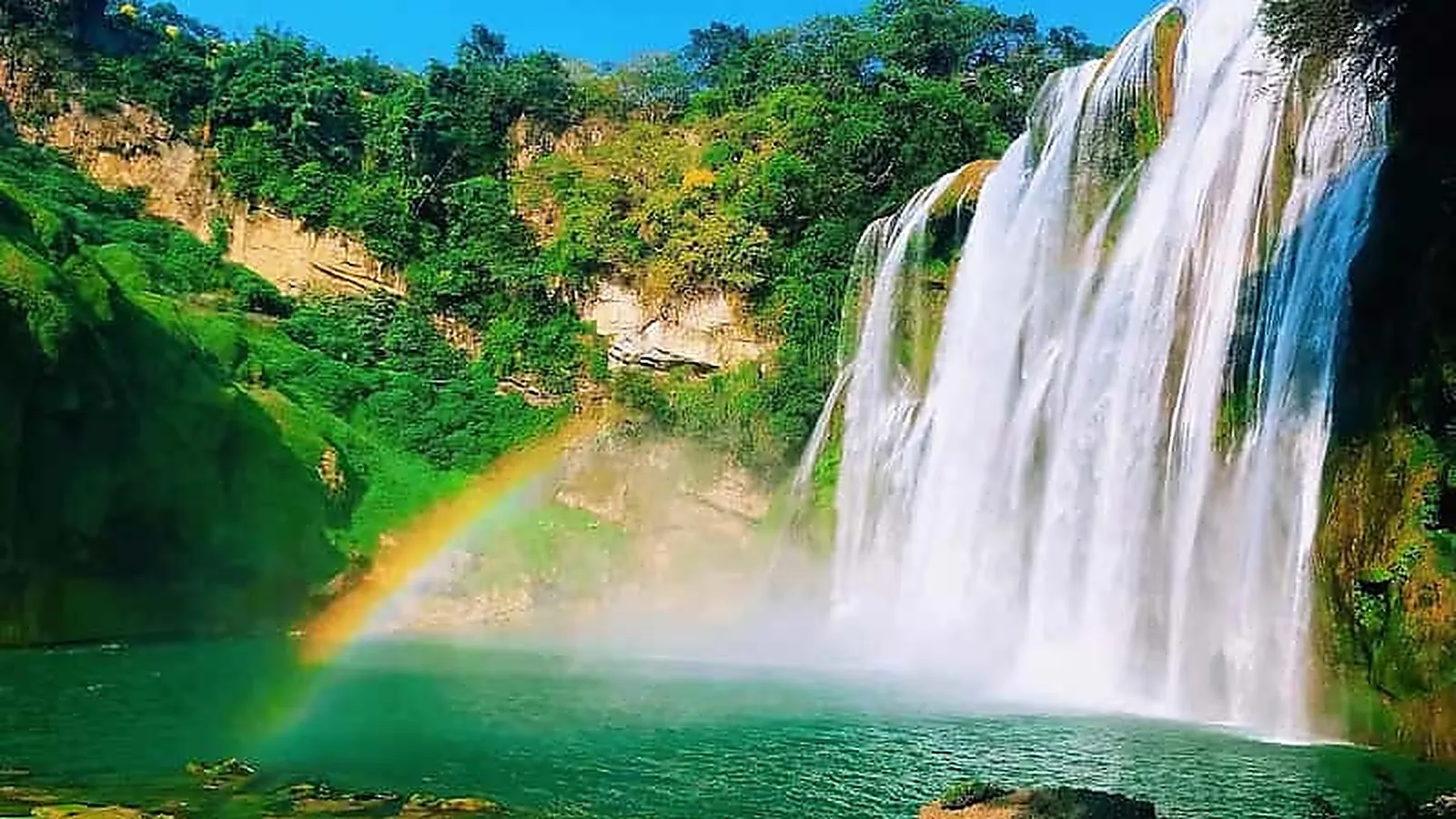
Photo: Wikimedia Commons / CC BY-SA. Source

What to bring
- Light rain jacket - the mist from the plunge pool soaks visitors at the lower viewpoint, and the Water Curtain Cave walk is wet. A packable rain jacket is essential.
- Non-slip shoes - the cave path and the Tianxing Bridge sections are wet and slippery. Hiking shoes with good tread are essential; running shoes are not adequate.
- Camera with lens cloth - the mist gets on the lens. A microfiber cloth in your pocket is essential.
- Cash (¥200-400) - small vendors and some park restaurants prefer cash. Guiyang accepts Alipay and most cards.
- Power bank - the park has no outlets. A 20,000 mAh pack is enough for 2 phone charges.
- Layered clothing - Guizhou weather is variable; 5C to 30C range through the year. A fleece and a light rain jacket are essential.
- Offline maps - Amap or Apple Maps. Cell signal is good in the park, weak on the Tianxing Bridge loop.
- Water bottle and snacks - the park has a few small vendors but prices are 2-3x normal. Stock up at the gate.
- Insect repellent - the karst forest at Tianxing Bridge has mosquitoes, especially in summer.
Hike difficulty cheat sheet
Huangguoshu is waterfall-terrain walking — short paved paths with steps, lots of bridges, and one big optional loop (Tianxingqiao) that includes the Water Curtain Cave. Total elevation change is under 200m. No technical hiking required.
| Trail | Distance | Time | Elevation | Difficulty |
|---|---|---|---|---|
| Main Waterfall view (黄果树大瀑布) | 2 km linear | 1 h | -50 m (down steps) | Easy — paved path, multiple viewpoints, behind-falls path |
| Tianxingqiao (天星桥) lower section | 4 km loop | 2-3 h | +150 m / -150 m | Moderate — bridges, stone paths, Water Curtain Cave (get wet) |
| Tianxingqiao upper section (银链坠潭瀑布) | 3 km linear | 1.5-2 h | -100 m (downhill) | Easy — end at the silver-chain waterfall pool |
| Doupotang Waterfall (陡坡塘) | 1 km loop | 30 min | flat | Easy — wide, gentle waterfall, classic film location |
| Baling River Bridge (坝陵河大桥) | 1 km linear | 30 min | flat | Easy — modern bungee-jump bridge, 370m above river |
Best for backpackers: do the 3 main waterfalls in one day (Doupotang → Main Waterfall → Tianxingqiao). The Tianxingqiao full loop (7 km total, 3-4 h) is the most scenic — it includes the Water Curtain Cave where you walk behind a waterfall (expect to get wet, bring a rain poncho ¥10 at the gate). Total day: 8-10 km, 5-6 hours, manageable for any fitness level. Avoid weekends (Doupotang is overrun with tour groups by 10 AM). Best months: May-October (high water season; November-April the main falls can be a trickle).
The 5 photo spots that matter
- Main Falls lower viewpoint. The closest spot to the plunge pool. The horseshoe shape of the falls and the rising mist are most dramatic from this angle. Best in summer peak flow. Bring a rain jacket and a lens cloth. The viewing platform holds 100+ people at peak times; arrive at 8:00 AM for empty platforms.
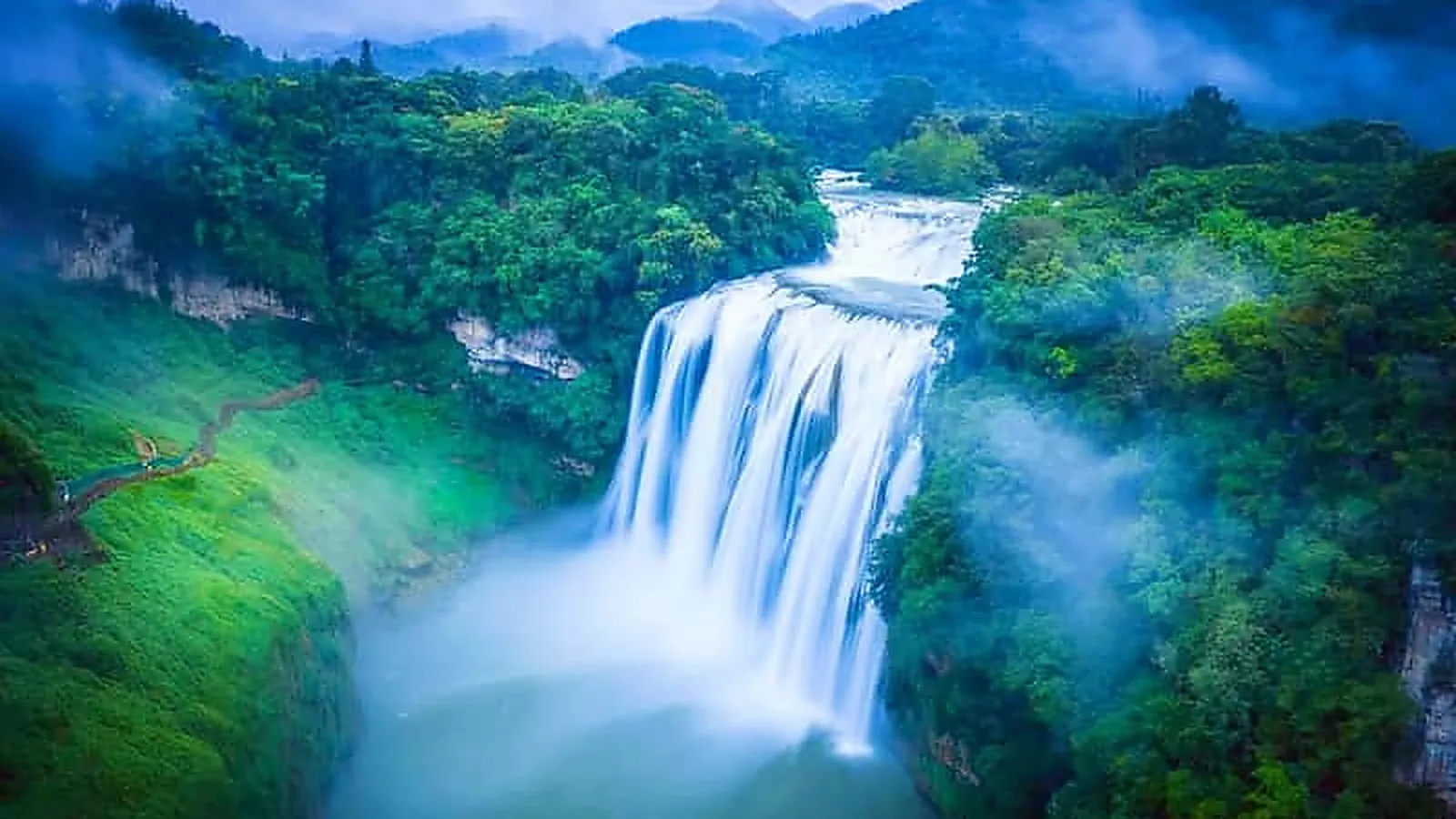
Photo: Wikimedia Commons / CC BY-SA. Source 2. Main Falls middle viewpoint (with the Water Curtain Cave). The full view of the falls from the side, with the cave entrance visible. Best 10:00 AM when the sun is on the falls. Walk up to the cave entrance for the dramatic through-the-water shot from inside. 3. Water Curtain Cave interior. Walk through the cave and shoot from the viewing windows. The water is right in front of you. Best 10:00 AM to noon. Bring a wide-angle lens (16-35mm equivalent). A polarizing filter helps cut the spray on the lens. 4. Doupotang Waterfall from the upstream side. The 105m wide cascade viewed from the river, with the surrounding forest. Best in summer peak flow. The viewing area is a 1 km flat walk. The most-photographed spot in the park. 5. Tianxing Bridge Silver Chain Waterfall. The narrow cascade that drops into a deep pool. Best 2-3 PM when the sun is on the waterfall. The 3 km loop walk passes several smaller waterfalls; the Silver Chain is the most photogenic.

Common mistakes to avoid
- Arriving at the gate at 10:00 AM. The tour buses from Guiyang arrive 9:30-10:30 AM. By 10:00 AM the Main Falls lower viewpoint is packed. Aim for 8:00 AM arrival to be ahead of the crowds.
- Skipping the Water Curtain Cave. The cave is the unique experience of Huangguoshu; most visitors regret not allocating more time. The walk takes 30 minutes and is the highlight of the day.
- Wearing white shoes. The mist soaks the lower viewpoint, the cave path is wet, and the Tianxing Bridge is slippery. Dark shoes with good tread are the practical choice.
- Skipping Tianxing Bridge. Many tour groups only do Main Falls and Doupotang; Tianxing Bridge is the most-photographed and most varied of the three sites. The Silver Chain Waterfall alone is worth the walk.
- Visiting in March-April (low flow). The waterfall is thin and unremarkable. Plan for June-October for the dramatic flow.
- Trusting Google Maps. Google services are blocked in China. Use Amap (高德地图) for navigation. Save key Chinese names: 黄果树瀑布, 水帘洞, 陡坡塘瀑布, 天星桥, 北盘江大桥, 万峰林.
- Forgetting the rain jacket. The mist from the plunge pool soaks visitors at the lower viewpoint. A light rain jacket is essential; the park sells disposable ponchos for ¥10 but quality is poor.
- Trying to do Huangguoshu and Xingyi Wanfenglin in one day. They are 4 hours drive apart. Plan at least 2 days for both.
Where to stay
- Guiyang (the gateway city) - downtown has the most options. Budget: Hanting, Home Inn, 7 Days (¥180-280/night). Mid-range: Sofitel Guiyang, Kempinski, Novotel (¥400-900/night). All have Western-style toilets and reliable hot water.
- Huangguoshu town (closest to the park) - small town 1 km from the gate. Limited options. Huangguoshu Hotel, Yuquan Hotel (¥200-500/night). Book 1 week ahead in July-August. Most include a basic Chinese breakfast.
- Anshun city (the closer airport gateway) - 45 km from the park, 1 hour drive. Anshun Hotel, Anshun International (¥250-450/night). The downtown has good Guizhou restaurants.
- Xingyi (for the Wanfenglin side trip) - 4 hours drive from Huangguoshu. Xingyi Hotel, Wanfenglin Boutique Inn (¥200-450/night). Stay 1-2 nights for the Wanfenglin karst forest.
Local food and culture
Guizhou cuisine is one of China’s most distinctive regional cuisines, famous for sour, spicy, and fermented flavors. Must-try dishes:
- Guizhou rice noodles (贵州米粉) - the regional staple, ¥15-25 per bowl. Served in a sour-spicy broth with beef, lamb, or pork. Available at any park restaurant and in every Guiyang noodle shop.
- Sour soup fish (酸汤鱼) - the Guizhou signature, a sour tomato-and-fermented-chili soup with freshwater fish, ¥80-120 per pot. Found at most Anshun and Guiyang restaurants.
- Si Wa Wa (丝娃娃) - a Guiyang specialty, thin rice wrappers filled with shredded vegetables, ¥20-30 per portion. Eat by dipping in sour-spicy sauce.
- Chang Wang Noodles (肠旺面) - Guiyang-style noodles with pork intestines and blood sausage, ¥20-30 per bowl.
- Sour bamboo shoot beef (酸笋牛肉) - the Guizhou-style stir-fry, ¥50-70 per dish. Spicy and tangy.
- Maotai (茅台酒) - the famous Guizhou baijiu liquor from Maotai town, 200 km north of Guiyang. ¥200-2,000 per bottle depending on age. Most restaurants serve Maotai by the glass (¥50-100 per 30ml).
Buyi and Miao ethnic cultures dominate the area. The Buyi (布依族) are the main ethnic group in Anshun Prefecture and have lived in the karst valleys for 1,000+ years. The Miao (苗族) are concentrated in the eastern parts of Guizhou. Both groups have distinctive silver jewelry, embroidery, and festivals. The Huangguoshu area has a Buyi cultural village near the park entrance with traditional stilt houses, batik fabric workshops, and folk performances. Most park staff are Buyi and speak Mandarin with a local accent.
Plan your trip - verified tools
These free tools are built on real, monthly-verified data and help you skip the trial-and-error phase of China trip planning:
- China 240-Hour Visa-Free Transit Checker - 57 countries, 24 provinces, 65 ports. See if you qualify for 10-day visa-free transit, which cities you can visit, and the 5-step process.
- China 6-City 5-Day Budget Calculator - Real 2026 prices for 5 days in Beijing, Shanghai, Guangzhou, Chengdu, Xi’an, or Hangzhou. Budget / mid-range / comfort tiers, broken down line by line.
Verified August 2026 by TravelHubChina Editorial. We re-check prices and policy details monthly so the data doesn’t drift.
Step by step
-
Fly to Guiyang Longdongbao Airport (KWE) or Anshun (AVA)
Guiyang is the larger gateway. Direct flights from Beijing (3h, 5-6 daily), Shanghai (2h 30m, 6-7 daily), Guangzhou (1h 45m, 5-6 daily), Shenzhen (1h 45m, 4-5 daily), and 50+ other Chinese cities. Round trip from Beijing is ¥1,500-2,800. Anshun (AVA) has direct flights from Beijing, Shanghai, and Guangzhou, 1-2 daily. The park is 2 hours from Guiyang, 1 hour from Anshun.
-
Stay 1 night in Guiyang or near the park
If you arrive late, stay 1 night in Guiyang (Sofitel Guiyang, Kempinski, ¥400-900/night) or near the park in Huangguoshu town (Huangguoshu Hotel, Yuquan Hotel, ¥200-500/night). The park town has limited options but is closest to the gate. Most visitors stay in Guiyang and drive in early morning. Book 1 week ahead in July-August peak season.
-
Drive to Huangguoshu main gate (130 km from Guiyang, 2 hours)
From Guiyang, drive west on the G60 highway, 2 hours, all paved. The park entrance is well-signed. Parking is ¥20 per day. Arrive by 8:00 AM to be ahead of the tour bus crowds (most arrive 9:30-10:30 AM). Buy the ¥160 entry and ¥50 shuttle at the gate. The shuttle is mandatory and runs between the three core sites every 15-20 minutes.
-
Start at Main Falls (Huangguoshu Waterfall)
Take the shuttle to the Main Falls stop. The waterfall is 77.8m tall and 101m wide, China's largest. The viewing area has three levels: lower (closest to the plunge pool, mist guaranteed), middle (side view, full horseshoe shape), and upper (downstream, more distant). Plan 2 hours including the Water Curtain Cave walk behind the falls. The path is well-paved; the cave section has 200+ steps.
-
Walk through the Water Curtain Cave (水帘洞)
From the middle viewing level, take the path up the right side of the falls. The cave is 134m long with 6 viewing windows onto the falls. Walking through takes 20-30 minutes. The path is wet from spray; a light rain jacket and non-slip shoes are essential. The cave is the highlight of the Main Falls visit; the view from inside looking out through the falling water is unique. Closed during heavy rain.
-
Continue to Doupotang Waterfall (陡坡塘瀑布)
Take the shuttle to Doupotang, 8 km from Main Falls. This is the widest waterfall in the park, 105m wide, and famous as the filming location for the opening scene of the 1986 TV series Journey to the West. The viewing area is a 1 km flat walk. The fall is most dramatic in summer peak flow. Plan 1.5 hours. The on-site restaurant serves Guizhou hot pot and rice noodles.
-
End at Tianxing Bridge (天星桥)
Take the shuttle to Tianxing Bridge, 7 km from Doupotang. This is a natural karst bridge over the river with a 3 km loop walk through the limestone formations, caves, and secondary waterfalls. The most-photographed section is the Silver Chain Waterfall, a narrow cascade that drops into a deep pool. Plan 3 hours including the loop. The path has some steep and slippery sections; hiking shoes are essential.
-
Return to Guiyang or continue to Xingyi Wanfenglin
From the park, drive 2 hours back to Guiyang for the evening. Alternatively, continue 4 hours west to Xingyi Wanfenglin ('10,000 Peaks' karst forest) for a 2-3 day side trip. The Wanfenglin is a 2,000 sq km karst forest with 20,000+ cone-shaped limestone peaks, a UNESCO-listed geomorphology site. The combination of waterfall + karst forest is the most-photographed 4-5 day loop in Guizhou.
FAQ
-
How many days do you need at Huangguoshu?
1 full day is the minimum to see the three core sites (Main Falls, Doupotang, Tianxing Bridge) using the park shuttle. 2 days allows a buffer day for the Balinghe Bridge viewpoint and a relaxed return to Guiyang. 3 days adds a side trip to Xingyi Wanfenglin (4 hours drive, '10,000 peaks' karst forest). Less than 1 day means skipping Tianxing Bridge or Doupotang. -
What is the best time of year to visit Huangguoshu?
June to October is peak flow, when the waterfall is at its most dramatic. The rainy season (June-August) is the absolute peak; expect 50-100m of mist from the plunge pool. Winter (November-February) is much lower water but the falls are clearer and the surrounding forest is green; the Water Curtain Cave is more walkable. Avoid the dry spring (March-April) when the falls are at their lowest. Sunrise is 6:00-6:30 AM in summer, 7:00-7:30 AM in winter. -
Can foreigners visit the Water Curtain Cave behind the waterfall?
Yes, the Water Curtain Cave (水帘洞) is open to all visitors. The cave is 134m long, on the cliff face behind the Main Falls, with 6 viewing windows. Walking through takes 20-30 minutes. The path can be wet from spray; bring a light rain jacket. The cave is open 7:30 AM to 5:30 PM but closes during heavy rain for safety. The entry ticket (¥160) includes the cave. -
Is Huangguoshu suitable for seniors or children?
Partially. The Main Falls viewpoint has a paved path from the entrance to the lower viewing area, suitable for wheelchairs and strollers. The Water Curtain Cave has 200+ steps, not suitable for wheelchairs but OK for fit seniors. Doupotang Waterfall is a 1 km flat walk. Tianxing Bridge has some steep steps and slippery sections. Most visitors with moderate mobility can handle the main sites. Avoid the Balinghe Bridge viewpoint (1,200m climb) for seniors. -
How do I get to Huangguoshu from Guiyang?
Option 1: Drive from Guiyang on the G60 highway, 130 km, 2 hours, all paved. Option 2: Fly to Anshun (AVA) from Beijing (3h), Shanghai (3h), or Guangzhou (2h), 1-2 daily, ¥600-1,500 one-way. Anshun is 45 km from the park, 1 hour drive. Option 3: Tourist bus from Guiyang Tourism Bus Station, 2.5 hours, ¥80-100, runs 4-5 times daily. Most independent travelers self-drive or hire a driver from Guiyang for the day. -
How do foreigners buy Huangguoshu tickets?
Buy at the main gate in cash or via Trip.com (English, accepts Visa/Mastercard, 5% service fee). The ¥160 entry + ¥50 shuttle covers all three core sites. No foreigner surcharge. Anshun-Guiyang transport can be arranged at any hotel. The park shuttle is mandatory and runs every 15-20 minutes from 7:30 AM to 5:30 PM between the three sites. Photography permits are not required; tripods are allowed everywhere.
Related guides
- Scenic & Nature
Guilin & Li River Scenic Guide: Cruises, Karst, Yangshuo, Longji (2026)
Guilin and the Li River in Guangxi is a karst landscape of limestone peaks, bamboo-lined rivers, and ancient villages. This guide covers the Li River cruise vs Yangshuo cycling decision, the Longji Rice Terraces, Reed Flute Cave, and how to plan 3-5 days.
12min read
- Scenic & Nature
Big Wild Goose Pagoda Guide: Xi'an's 1,300-Year Tang Pagoda
Big Wild Goose Pagoda (Dayan Ta) in Xi'an: 64m Tang-dynasty brick pagoda from 652 AD, UNESCO since 2014 as part of the Silk Roads network. Tickets (¥50), climb times, and the free North Square musical fountain (9 PM nightly).
8min read
- Scenic & Nature
China's Top 3 Scenic Wonders Compared: Zhangjiajie vs Huangshan vs Jiuzhaigou (2026)
Zhangjiajie (sandstone pillars), Huangshan (sea of clouds + granite peaks), Jiuzhaigou (turquoise lakes + waterfalls). Decision guide covering which fits your time, budget, fitness level, photography goals, and travel style. Prices, distances from Shanghai/Beijing, best seasons compared.
12min read
- Scenic & Nature
Daocheng Yading Scenic Guide: Three Sacred Mountains & Alpine Lakes
Daocheng Yading in Sichuan is a 4,000-6,032m reserve with three sacred peaks and Milk Lake. Covers ¥146-266 tickets, Chengdu flights, hiking, altitude prep.
12min read
- Scenic & Nature
Ejina Populus Forest Guide: 21 Days of Golden China
Ejina Populus Forest in Inner Mongolia has 39,000 hectares of Populus euphratica, gold October 1-21. Covers tickets, transport, Erdaoqiao Bridge, 4-day plan.
12min read
- Scenic & Nature
Forbidden City Guide: Beijing Imperial Palace, Tickets & Plan
The Forbidden City in Beijing: 72 hectares, 980 buildings, 1.4 million artifacts, Ming and Qing dynasties, UNESCO since 1987. Tickets (¥60), WeChat booking.
12min read