
Chengdu Night Markets: Where to Eat After Dark (2026 Local's Guide)
Complete guide to Chengdu's best night markets and evening food streets: 玉林 Yulin, 建设路 Jianshe Road, 奎星楼街 Kuixinglou, 锦里 Jinli, 宽窄巷子 Kuanzhai Alley, and the in-park night markets. Includes what to eat at each, opening hours, how to avoid tourist traps, average prices, and the 12 specific dishes to try.
Chengdu’s night markets are the city’s secret social infrastructure. While the world talks about Chengdu’s hotpot and panda base, locals actually spend their evenings at night markets — the 玉林 (Yulin) area in the university district, 建设路 (Jianshe Road) for grilled skewers, 奎星楼街 (Kuixinglou Street) for trendy food court dining, and the famous 锦里 (Jinli) tourist street (which is busy but worth one visit for the spectacle). These markets run from 6 PM to 1-2 AM, and on a typical weekend night, hundreds of thousands of locals are out eating, drinking, and socializing in these districts. To understand the broader Sichuan food culture beyond what you’ll taste at the night-market stalls, start with the foundational mapo tofu guide first.
The food at Chengdu night markets is distinctly different from hotpot or sit-down restaurants. You’ll find dishes that exist only in the night market context: 烤脑花 (grilled pig brain), 兔头 (rabbit head — a Chengdu signature), 钵钵鸡 (cold skewers in chili oil), 糖油果子 (sweet glutinous rice balls), and dozens of grilled-skewer varieties you won’t see on any restaurant menu. The prices are also substantially cheaper than sit-down dining — a full night market crawl can feed you for ¥50-80 per person.
This guide covers the 6 distinct night food scenes in Chengdu, what to eat at each, opening hours, prices, and how to identify the authentic local spots versus the tourist traps. The strategy for a great night is to pick 2-3 spots and spend 1.5-2 hours total — don’t try to hit all 6 in one night.
The 6 main night food districts
1. 玉林 (Yulin) — the authentic local university area. Located in the south of the city near Sichuan University, Yulin has been Chengdu’s late-night food district since the 1990s. The vibe is genuinely local — university students, young professionals, families, all eating at cheap outdoor tables. The food is the most authentic of any night market. Best for: budget travelers, people who want the “real Chengdu” experience, anyone under 35.
2. 建设路 (Jianshe Road) — grilled skewers + craft beer. A 1-km stretch of road that transforms into an outdoor food court every evening. Specializes in 烧烤 (grilled skewers) — lamb, beef, chicken wings, vegetables, tofu, all grilled on open flames. The crowd skews young and trendy; many craft beer bars have outdoor seating adjacent to the food stalls. Best for: couples, groups, anyone who likes grilled food and beer.
3. 奎星楼街 (Kuixinglou Street) — trendy food court dining. A 200-meter street packed with sit-down restaurants and small food court stalls. More upscale than Yulin or Jianshe Road, but still casual. The food is a mix of traditional Sichuan and modern fusion. The crowd is 25-40 year old professionals. Best for: a sit-down dinner with drinks, dates, special occasions.
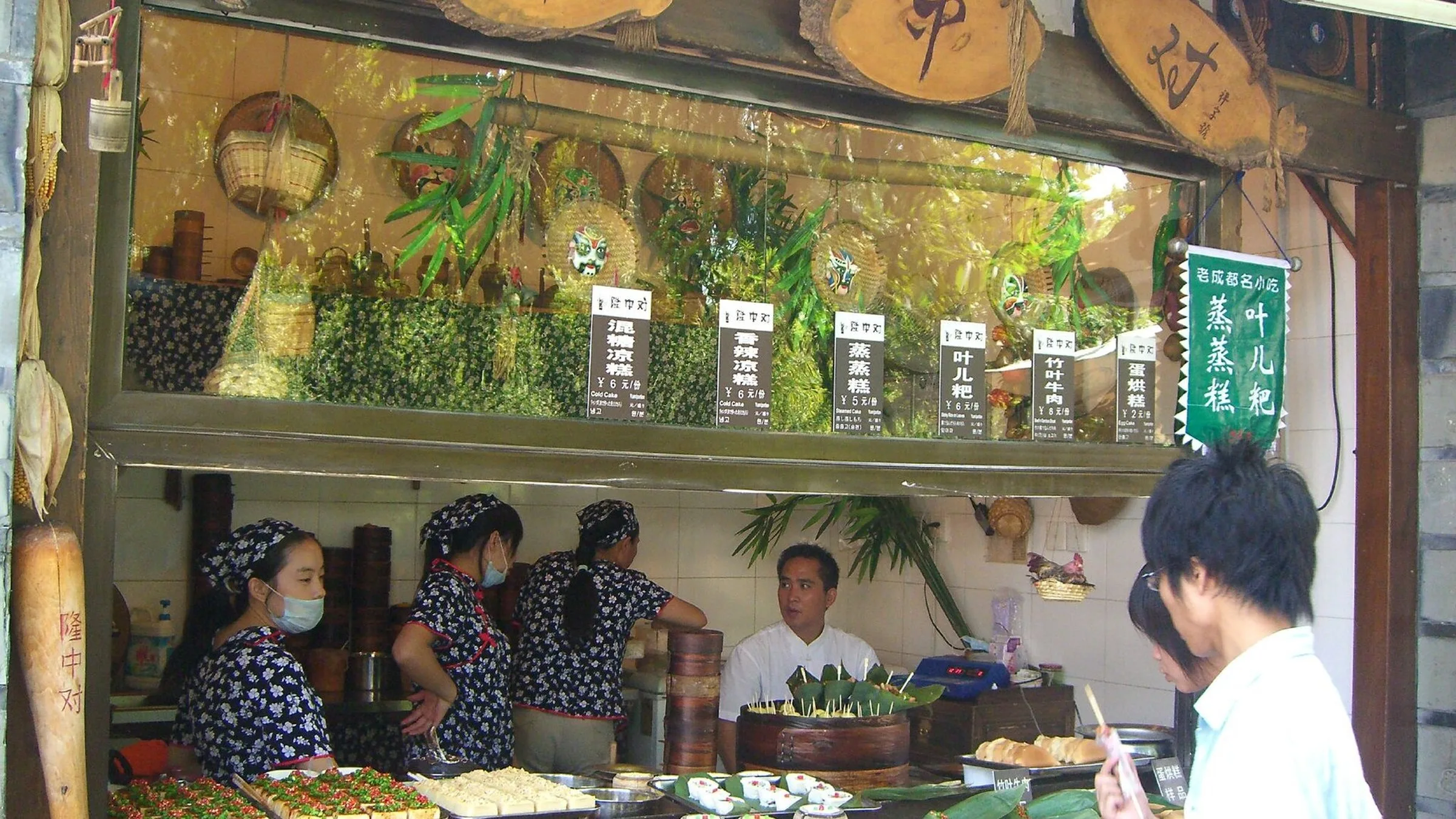
4. 锦里 (Jinli) — the famous tourist street. A reconstructed ancient-style street next to the Wuhou Ci temple, packed with traditional Sichuan snack vendors, souvenir shops, and street performers. Very crowded on weekends (sometimes shoulder-to-shoulder), but the food is genuinely good and the atmosphere is fun. Best for: first-time visitors, anyone interested in the “ancient Sichuan” aesthetic, a 90-minute evening stroll.
5. 宽窄巷子 (Kuanzhai Alley) — the polished tourist version. Two parallel restored Qing-dynasty alleys with boutique restaurants, tea houses, and snack vendors. More polished and pricier than Jinli. The crowd is mostly Chinese tourists and well-heeled visitors. Best for: a relaxed dinner in a beautiful setting, people who don’t want the chaos of Jinli.
6. 武侯祠 (Wuhou Ci) in-park night market — the cultural setting. During certain evenings (especially weekends in summer), the area around Wuhou Ci temple has temporary food stalls and snack vendors. The atmosphere is unique — eating street food while walking through an ancient temple complex. Best for: a combined culture + food evening.
The 12 specific dishes to try at Chengdu night markets
1. 钵钵鸡 (bō bō jī) — cold skewers in chili oil. A signature Chengdu cold dish. Pre-cooked chicken (or vegetarian options) on bamboo skewers, served cold in a fragrant red chili oil with Sichuan peppercorn, sesame seeds, and crushed peanuts. ¥3-5 per skewer. Mildly spicy, very aromatic. The cold + oil combination is unique to Chengdu.
2. 烤脑花 (kǎo nǎo huā) — grilled pig brain. Don’t knock it till you’ve tried it. The brain is marinated in chili oil, garlic, and Sichuan peppercorn, then grilled in its own skull. The texture is like a soft, custard-y tofu. Highly spiced, very umami. ¥20-35 per serving. Beginner tip: Order one to share with friends.
3. 兔头 (tù tóu) — rabbit head. The most “Chengdu” snack of all — the city consumes more rabbit than anywhere else in China (Sichuan is the largest rabbit-raising province). The head is split in half, marinated in chili oil and Sichuan spices, and eaten by sucking the meat off the skull. The texture is fatty and intensely flavored. ¥8-15 per head. Beginner tip: Watch a local eat one first to learn the technique.
4. 烤面筋 (kǎo miàn jīn) — grilled wheat gluten. Skewered wheat gluten seasoned with cumin, chili powder, and salt, then grilled. Crispy outside, chewy inside. ¥3-5 per skewer. Cheap, delicious, vegetarian.
5. 烤羊肉串 (kǎo yáng ròu chuàn) — cumin lamb skewers. The Xinjiang classic, ubiquitous in Chengdu. Cubes of lamb on bamboo skewers, grilled over charcoal, dusted with cumin, chili powder, and salt. ¥5-10 per skewer. The defining late-night snack of northwestern China.
6. 糖油果子 (táng yóu guǒ zi) — sweet glutinous rice balls. A Chengdu signature dessert. Small glutinous rice balls deep-fried and then coated in a caramelized brown sugar syrup, often with sesame seeds. Crispy outside, chewy inside, sweet. ¥5-8 for 3-4 pieces.
7. 三大炮 (sān dà pào) — the “three cannons” dessert. A traditional Chengdu dessert where the vendor throws three glutinous rice balls against a metal drum (making a “pao pao pao” sound) before coating them in soybean flour and brown sugar syrup. The spectacle is the main draw. ¥5-10 for 3 balls.
8. 钟水饺 (zhōng shuǐ jiǎo) — Zhong dumplings. The same as the daytime specialty — see our separate guide. Available at most night markets. ¥12-20 for 8 dumplings.
9. 龙抄手 (lóng chāo shǒu) — Long chao shou. The same as the daytime specialty. Available at most night markets. ¥10-18 for 8 wontons.
10. 凉粉 (liáng fěn) — cold jelly noodles. Mung bean or pea starch noodles, served cold with chili oil, garlic, vinegar, and soy. Refreshing, slightly spicy, perfect for a hot summer night. ¥8-12 per serving.
11. 串串香 (chuàn chuàn xiāng) — skewer hotpot. Mini skewers (¥1-3 each) cooked in hotpot-style broth at your table. You pick raw skewers from a display, they cook in the broth, you eat with dipping sauce. A fun, interactive way to eat hotpot for less money. ¥30-60 per person for a full meal.
12. 冰粉 (bīngfěn) — cold jelly dessert. The mandatory after-meal dessert at any Chengdu night market. Brown sugar syrup, peanuts, raisins, sometimes hawthorn bits. ¥5-10 per bowl. The perfect ending to any spicy meal.
The ideal 2-hour night market crawl
7:00 PM — Start at 玉林 (Yulin). Arrive before peak to get a table. Order 钵钵鸡 (5 skewers, ¥20) + 凉粉 (¥10) + 唯怡豆奶 (¥5). Eat at a plastic-table outdoor spot. ¥35
7:45 PM — Walk 10 minutes to a 建设路 (Jianshe Road) skewer spot. Order 10 lamb skewers (¥50-80) + 烤面筋 (4 skewers, ¥15) + 烤茄子 (grilled eggplant, ¥20) + a cold beer (¥10). ¥100-125
9:00 PM — End at 冰粉/糖油果子 dessert stall. Order 冰粉 (¥8) + 糖油果子 (3 pieces, ¥8). ¥16
Total: ¥150-180 per person, including a full meal and dessert. Time: 2 hours.
For a more upscale night: replace Yulin and Jianshe Road with a 奎星楼街 sit-down dinner (¥150-200 per person for a proper restaurant meal), then walk to a night market for dessert.
How to identify the good stalls
Green flags (eat here):
- A line of locals queuing (always the best sign)
- The vendor is actively cooking — flames, smoke, sizzling sounds
- The stall looks clean, especially the cutting boards and serving utensils
- Raw ingredients are displayed fresh (not pre-cooked and sitting out)
- The vendor is friendly to locals (ask for a recommendation)
Red flags (walk past):
- Empty stall at peak hours (locals are avoiding it for a reason)
- Food sitting out at room temperature (chilis, oils, vegetables, etc.)
- The vendor is on their phone or chatting, not actively cooking
- Unusually cheap prices (real Sichuan food has a market rate; if it’s half-price, ask why)
- Open trash or flies
- Raw meat next to cooked meat
The 4 food safety rules to follow
Same as for street food anywhere in China:
- Eat where locals queue — turnover = freshness
- Watch the food being cooked — boiling broth, sizzling grills, fresh frying = good
- Avoid raw vegetables, unpeeled fruit, and tap water — stick to cooked vegetables, fruit you peel yourself, bottled/boiled water
- Carry oral rehydration salts (ORS) and loperamide — available at any pharmacy for ¥10-20. If you do get a 24-hour stomach bug, you’ll recover fast.
Practical tips for the night market experience
Best time to go: 7-9 PM is peak; 9-11 PM is the most authentic (after the early-dinner crowd, before the late-night crowd); 11 PM-1 AM is for the serious night owls.
What to wear: Casual clothes, comfortable shoes (you’ll be standing or walking for 2+ hours). Nights are cool in spring/fall but warm in summer.
What to bring: Small backpack or crossbody bag (avoid big backpacks — hard to navigate in crowds). Wet wipes (essential — your hands will get messy). Tissues.
How to pay: Alipay or WeChat Pay (set up before the trip). Small amounts of cash (¥50-100) for the smallest stalls. Foreign credit cards rarely work.
Getting home: Use Didi (China’s Uber) — never hail a random taxi. Set up Didi with Alipay before your trip. From most night markets, a Didi to central Chengdu is ¥15-25.
Where to NOT go: 锦里 on Friday or Saturday evenings (so packed you can barely move). Any “night market” recommended by your hotel that turns out to be one street with 5 stalls.
What makes Chengdu night markets different
The defining feature of Chengdu’s night markets is the sitting culture. Unlike Beijing or Shanghai, where night markets are mostly take-away stalls, Chengdu’s markets have plastic tables and chairs set up everywhere, and locals linger for hours over multiple small dishes. The pace is slow, the conversation is loud, and the social aspect is as important as the food. Plan to spend time sitting, talking, and people-watching — don’t rush through.
The other distinctive feature is the variety of cold dishes. While other Chinese cities’ night markets emphasize hot grilled food, Chengdu has a strong tradition of cold appetizers (凉菜, liángcài) — 钵钵鸡, 凉粉, 凉拌鸡 (cold chicken), 蒜泥白肉 (garlic pork slices). These are perfect for the hot Chengdu summer nights.
Bottom line: Chengdu’s night markets are not a tourist attraction — they’re the social heart of the city. Visit at least one during your trip, ideally with a local guide (Trip.com’s Chengdu food tours include a local food expert) for the most authentic experience.
Book your Chengdu night-out
Chengdu hotel (Chunxi Road base)
Trip.com's Chengdu hotel listing with 2,000+ foreigner-friendly properties. Stay near Chunxi Road for the easiest night-out access (Jinli, Kuanzhai Alley, and Taikoo Li all within 2 km).
Hotels from $60/night
Set up Alipay (the night-market currency)
Set up Alipay Tour Pass before you fly. The night market vendors, hotpot restaurants, and convenience stores all use QR-code payment. Linking your Visa takes 5 minutes, and you'll need it everywhere in Chengdu after 9 PM.
Free to set up
Affiliate disclosure: We earn a small commission at no extra cost to you. See full disclosure.
Plan your trip — verified tools
These free tools are built on real, monthly-verified data and help you skip the trial-and-error phase of China trip planning:
- China 6-City 5-Day Budget Calculator — Real 2026 prices for 5 days in Beijing, Shanghai, Guangzhou, Chengdu, Xi’an, or Hangzhou. Budget / mid-range / comfort tiers, broken down line by line.
- China OTA Comparison 2026 — Trip.com vs Booking.com vs Agoda vs Klook across 5 booking types. Inventory, pricing, foreign card support, English service, per-OTA verdict.
Verified August 2026 by TravelHubChina Editorial. We re-check prices and policy details monthly so the data doesn’t drift.
Step by step
-
Pick 2-3 night markets based on your vibe
玉林 (Yulin) for authentic local + cheap snacks, 建设路 (Jianshe Road) for grilled skewers + craft beer, 奎星楼街 (Kuixinglou) for sit-down trendy dining. Skip 锦里 on weekends (too packed) but visit on weekday evenings.
-
Set up Alipay with a foreign card before you go
Most stalls take Alipay QR, almost none take foreign cards or cash reliably. Bind your Visa/Mastercard in the Alipay app (5 min) and bring ¥50-100 in cash as backup for tiny vendors.
-
Arrive at 7:30 PM when stalls are fully active
Stalls start setting up at 6 PM but hit full swing at 7:30-8 PM. Peak is 8-10 PM. Plan to eat from 7:30-10:30 PM and end with a DiDi ride back.
-
Try 4-6 signature Chengdu night-market dishes
Don't-miss: 钵钵鸡 (cold skewers, ¥3-5 each), 烤脑花 (grilled brain, ¥20-35), 兔头 (rabbit head, ¥8-15), 糖油果子 (sweet rice balls, ¥5), 烤串 (grilled skewers, ¥3-8 each). Order one of each to share.
-
Take a DiDi back to the hotel after the crawl
Markets wind down by midnight-1 AM. DiDi is reliable and safe. Avoid unmarked taxis at the market exits — use the app. Total crawl cost: ¥80-150/person including drinks.
FAQ
-
What time do Chengdu night markets open?
Most Chengdu night markets start setting up around 6 PM and are fully active by 7:30 PM. Peak hours are 8-10 PM. The most local-feeling markets (玉林, 建设路) are most authentic after 9 PM when the after-dinner crowd arrives. Most close by 1-2 AM. -
Is Chengdu street food safe for foreigners?
Yes, with the standard 4 safety rules: eat where locals queue, watch food being cooked to order, avoid raw vegetables and unpeeled fruit, carry oral rehydration salts. Chengdu tap water is not potable — drink bottled or boiled water. Most night market stalls are very clean by international standards. -
Do I need to speak Chinese?
Helpful but not required. Most stalls have picture menus, vendors can point at what's available, and pointing at what other people are eating is the universal language. The 锦里 and 宽窄巷子 areas have more English-speaking vendors. At 玉林 and 建设路, basic Chinese helps significantly. -
How much should I budget for a night of eating?
¥50-100 per person covers a substantial night market crawl. A single snack is ¥3-15, a full meal at a stall is ¥20-40, drinks ¥5-20. If you go to 奎星楼街 for sit-down dinner, expect ¥80-150 per person for a full meal with drinks. -
Are there vegetarian options at night markets?
Yes, plenty. Look for 素 (sù, vegetarian) signs, and stick to 烤蔬菜 (grilled vegetables), 凉粉 (cold jelly noodles), 土豆片 (potato chips), 藕片 (lotus root), and 臭豆腐 (stinky tofu — actually vegan). Many stalls have a separate vegetarian section. -
Can I pay by card or do I need cash?
Alipay and WeChat Pay work at almost all stalls and restaurants. Foreign cards (Visa/Mastercard) rarely work directly — set up Alipay with your foreign card first (see our Alipay guide). Carry ¥50-100 in cash as backup for tiny street stalls. -
Are night markets safe at night?
Yes, very safe. Chengdu's night markets are well-lit, crowded with locals, and patrolled by police. Petty theft is rare. The main safety concerns are stomach issues (follow the food safety rules) and getting a fake taxi (use Didi instead — see our Didi guide). -
What's the best night market for first-time visitors?
建设路 if you want grilled skewers + craft beer + lively atmosphere, or 玉林 if you want authentic local university area with cheap snacks. Avoid 锦里 on weekends (packed with tourists) but visit on weekday evenings for a more relaxed experience.
Related guides
- Food & Dietary
Chengdu's Three Famous Snacks: Dan Dan Noodles, Zhong Dumplings, Long Chao Shou (2026)
Complete guide to Chengdu's iconic snack trio: 担担面 (dan dan noodles), 钟水饺 (Zhong dumplings), and 龙抄手 (Long chao shou). Includes each dish's history, where to find the original restaurants, how to order, what they taste like, average prices, and how these local dishes differ from their national imitations.
7min read
- Food & Dietary
Chengdu Hotpot: The Local's Guide to Sichuan's Fiery Feast (2026)
Complete Chengdu hotpot guide for foreigners: how to order at a local restaurant, the 9-grid pot explained, the 3 essential dipping sauces, ingredient order, spice levels for beginners, the difference between Chengdu and Chongqing styles, and the 7 best hotpot restaurants locals recommend.
9min read
- Food & Dietary
Mapo Tofu: The Authentic Sichuan Dish (Recipe Origins + 5 Best Places in Chengdu)
Complete guide to authentic mapo tofu: the 1862 origin story, what makes a real mapo tofu vs. a Western imitation, the 7 essential ingredients (doubanjiang, Sichuan peppercorn, etc.), where to find the original Chen's Mapo Tofu in Chengdu, and 4 other historic restaurants that locals still visit for this iconic dish.
7min read
- Food & Dietary
Street Food in China: 20 Safe Dishes for First-Timers
20 iconic Chinese street foods with pinyin, English names, what they taste like, regional origin, average price in USD, and which ones are safe for first-time visitors. Plus food-safety rules.
10min read
- Food & Dietary
How to Eat Well in China for Under ¥50 a Day (2026)
Verified 2026 budget food playbook: 苍蝇馆子, 沙县小吃, university canteens, and the ¥30-50/day 3-meal plan across 7 cities.
9min read
- Food & Dietary
Beijing Hutong Food Tour: The 8 Best Stops for a 3-Hour Walk
A curated 3-hour Beijing hutong food walk covering 8 specific stops: from 豆汁儿 (the legendary fermented mung bean drink) to 卤煮 (old Beijing's working-class stew) to 炒肝 (stir-fried liver) to 北京烤鸭 (Peking duck) hutong-style. Includes the exact addresses, what to order at each, how to find the authentic (non-touristy) places, and a printable walking map.
8min read