
China Food by City: 8 Cities, 24 Iconic Dishes
A guide to Chinese regional food by city — the 8 most foodie-worthy cities for foreign visitors, the 3 iconic dishes in each, and where to find them. Beijing, Shanghai, Chengdu, Guangzhou, Hong Kong, Xi'an, Hangzhou, Chongqing.
China is a food continent, not a country
China’s culinary diversity is comparable to Europe’s — each region has its own distinct cuisine, signature ingredients, and centuries of refinement. The 8 great culinary traditions (八大菜系) are officially recognized, and within each tradition there are hundreds of local specialties. The cuisine varies dramatically by geography: the wheat-eating north (Beijing, Xi’an) with noodles, dumplings, and lamb; the rice-eating south (Shanghai, Guangzhou, Hangzhou) with seafood and refined broths; the spicy interior (Sichuan, Hunan, Chongqing) with chilies and peppercorns; the tropical south (Yunnan, Guangxi) with mushrooms and fresh herbs.
For foreign visitors, understanding the regional cuisines is the single biggest upgrade to a China trip. The most foodie-worthy cities for first-timers are the 8 listed below, each with their own character and signature dishes. For an in-depth look at street-food safety and the 20 safest first-timer dishes, see our China street food guide; for the 20 Mandarin phrases to actually order these dishes, see our food-ordering phrase guide.
The 8 most foodie-worthy cities
1. Beijing (北京) — Imperial cuisine
Beijing cuisine is the most internationally famous regional Chinese food. The cuisine emphasizes grand, ceremonial dishes, the signature ingredient is the Beijing white duck, and the local palate leans toward savory and slightly sweet.
The 3 iconic dishes:
Peking duck (北京烤鸭 Běijīng kǎoyā) — The single most famous Chinese dish. A whole duck roasted until the skin is crispy and golden, served with thin pancakes, scallions, cucumber, and hoisin sauce. The duck is carved table-side by a trained chef. Where to try: Quanjude (全聚德), Da Dong (大董), Duck de Chine. Price: ¥200-500 for a whole duck. For a deeper look at the hutong streets where Beijing’s small-plate snacks and jianbing stalls thrive, see our Beijing hutong food tour. For the full guide — which restaurant, how to order, and how to eat it like a local — see our Peking duck guide.
Jianbing (煎饼 jiānbing) — The most popular street breakfast in northern China. A thin crepe made from mung-bean-and-wheat batter, with an egg cracked on top, hoisin and chili sauce, a crispy wonton cracker, scallions, cilantro, and pickles rolled inside. Where to try: Virtually every Beijing subway exit has a jianbing stall in the morning. Price: ¥8-15 per crepe.
Zhajiangmian (炸酱面 zhájiàngmiàn) — Wheat noodles with fermented soybean paste (zhajiang) and ground pork, with cucumber, radish, and bean sprouts. The classic Beijing lunch. Where to try: Any neighborhood noodle shop. The most famous is Hai Wang Jiao (海碗居). Price: ¥25-40 per bowl.
Bonus: Beijing’s breakfast scene also includes douzhi (豆汁儿, fermented mung-bean milk — an acquired taste), jiaoquan (焦圈, crispy fried dough), and baodu (爆肚, flash-boiled lamb tripe).
2. Shanghai (上海) — Huaiyang cuisine
Shanghai cuisine is the most refined of the regional traditions, with emphasis on fresh ingredients, slightly sweet flavors, and delicate preparation. The cuisine is a mix of the Huaiyang tradition (from the lower Yangtze region) and Shanghai’s international heritage.
The 3 iconic dishes:
Xiaolongbao (小笼包 xiǎolóngbāo) — Soup dumplings. The crown jewel of Shanghai street food. A delicate pork dumpling filled with gelatinized broth that melts into soup when steamed. The trick: bite a small hole, sip the soup first, then eat the dumpling. Where to try: Jia Jia Tang Bao (佳家汤包, the famous local favorite), Din Tai Fung (鼎泰丰, the international chain), Yang’s Fry Dumpling (小杨生煎). Price: ¥20-50 for a basket of 8.
Shengjian bao (生煎包 shēngjiān bāo) — Pan-fried pork buns. The Shanghai cousin of xiaolongbao, but pan-fried instead of steamed. Crispy bottom, soft top, juicy pork filling. Where to try: Xiao Shao Xing (小绍兴), Da Hu Chun (大壶春), Yang’s Fry Dumpling. Price: ¥8-15 for 4 buns.
Hairy crab (大闸蟹 dàzháxiè) — Shanghai’s seasonal delicacy. Small freshwater crabs from Yangcheng Lake, eaten steamed with ginger and vinegar. The peak season is October-December, when the roe and milt are at their richest. Where to try: Any reputable Shanghai restaurant in the fall. Famous institution: Wang Bao He (王宝和). Price: ¥80-200 per crab.
Bonus: Shanghai’s breakfast scene also includes ci fan tuan (粢饭团, sticky rice rolls), cong you ban mian (葱油拌面, scallion-oil noodles), and da zhong huo guo (大闸蟹火锅, hairy crab hotpot).
3. Chengdu (成都) — Sichuan cuisine
Chengdu is the culinary capital of Sichuan cuisine, the most internationally famous of the Chinese regional cuisines. The cuisine is defined by the málà (麻辣) ‘spicy-numbing’ sensation from the combination of dried chilies and Sichuan peppercorns. Chengdu is the only Chinese city designated by UNESCO as a ‘City of Gastronomy’. For the broader picture — ingredient list, flavor profile, and a city-by-city breakdown — see our Sichuan cuisine guide.
The 3 iconic dishes:
Mapo tofu (麻婆豆腐 mápódòufu) — Soft tofu cubes in a spicy sauce of ground pork, fermented black beans, doubanjiang (fermented broad bean paste), and Sichuan peppercorns. Named after a pockmarked old woman who invented the dish in Chengdu in 1862. Where to try: Chen Mapo Tofu (陈麻婆豆腐) — the original 1862 restaurant. Price: ¥30-50. See our mapo tofu guide for the dish’s full history and the 5 best Chengdu spots.
Kung pao chicken (宫保鸡丁 gōngbǎo jīdīng) — Diced chicken stir-fried with peanuts, dried red chilies, and Sichuan peppercorns. Named after Ding Baozhen, a 19th-century governor of Sichuan. The international Chinese-restaurant favorite has its origins here. Where to try: Shuyi Cheshen (蜀忆陈升), also a Sichuan classic. Price: ¥40-60.
Dan dan noodles (担担面 dàndànmiàn) — Cold or hot wheat noodles served in a sauce of ground pork, chili oil, Sichuan peppercorns, and preserved vegetables. Named after the carrying pole (担子) used by street vendors. Where to try: Any street food stall or small noodle shop. Price: ¥15-25 per bowl.
Bonus: Chengdu’s street food also includes long caoshou (龙抄手, wontons in chili oil), chuan’r (串儿, cumin-lamb skewers), san wan (三碗, three-bowl combination), and the various mala snacks sold at the Jinli Ancient Street.
4. Guangzhou (广州) — Cantonese cuisine
Guangzhou is the birthplace of Cantonese cuisine, the most internationally accessible of the Chinese regional cuisines. The cuisine is characterized by fresh ingredients, light seasoning, minimal use of chilies, and an emphasis on the natural flavor of the food. Cantonese cuisine is the most prevalent international Chinese cuisine (especially in the US, UK, and Southeast Asia).
The 3 iconic dishes:
Dim sum (点心 dǐngxīn / dim sám) — The Cantonese brunch tradition of small bite-sized dishes. See our Cantonese dim sum guide for the 12 essential dishes and tea etiquette. The 5 essential dim sum dishes: har gow (shrimp dumplings), siu mai (pork dumplings), cheung fun (rice noodle rolls), char siu bao (BBQ pork buns), and egg tarts. Where to try: Tao Tao Ju (陶陶居), Dian Du De (點都德). Price: ¥80-200 per person.
White cut chicken (白切鸡 báiqiējī) — The Cantonese approach to chicken. A whole chicken is poached in seasoned water, then plunged into ice water to seal the skin. Served with a ginger-scallion sauce. The skin is gelatinous and the meat is tender. Where to try: Any Cantonese restaurant, especially the local institutions in the residential neighborhoods. Price: ¥80-150 for a whole chicken.
Wonton noodles (云吞面 yúntūnmiàn) — The Cantonese take on wonton noodles. Small shrimp wontons in a clear, flavorful broth with thin egg noodles. The broth is the key — it is made from dried flounder, pork bones, and shrimp shells, simmered for hours. Where to try: Mak’s Noodle (麦奀云吞面世家, the most famous), Zhen Dao Bing (甄道秉). Price: ¥40-80 per bowl.
Bonus: Guangzhou’s morning tea (饮茶) culture is the heart of the city’s food life. Visit any restaurant on a weekend morning from 8 AM to noon for the full experience.
5. Hong Kong (香港) — International Cantonese
Hong Kong cuisine is a refined version of Cantonese cuisine, influenced by the international heritage of the city. The food is more polished than Guangzhou’s, with emphasis on technique and presentation.
The 3 iconic dishes:
Roast goose (烧鹅 shāo’é) — Hong Kong’s signature dish. A whole goose marinated in a spiced solution, hung to dry, and roasted at high heat until the skin is lacquered and crispy. Served with plum sauce. Where to try: Yat Lok (一乐烧鹅, the most famous), Kam’s Roast (甘牌烧鹅). Price: ¥300-500 for a whole goose.
Egg waffles (鸡蛋仔 jīdànzǎi) — Hong Kong’s most iconic street snack. A batter of eggs, sugar, flour, and evaporated milk cooked in a special griddle with half-spherical molds. The result is a honeycomb-shaped waffle, crispy on the outside and soft inside. Where to try: Any street vendor in Mong Kok or Sham Shui Po. Price: ¥15-30 per portion.
Milk pudding (双皮奶 shuāngpínǎi) — A classic Cantonese dessert. A creamy custard made from milk, sugar, and egg whites, served warm or cold. The ‘two skins’ refer to the two layers of skin that form on top of the pudding as it cools. Where to try: Yee Shun Milk Company (义顺牛奶公司), Honeymoon Dessert. Price: ¥30-50 per bowl.
Bonus: Hong Kong is the most international food city in China — beyond the local Cantonese cuisine, you can find excellent Japanese, Korean, Indian, Thai, French, and Italian food. The Michelin-starred dim sum at Tim Ho Wan is the most affordable Michelin experience in the world. The same logic of “eat at night markets where locals queue” applies in every Chinese city — see our China street food guide for the night-market playbook.
6. Xi’an (西安) — Shaanxi cuisine
Xi’an is the capital of Shaanxi province, the historical heart of China, and the dumpling and noodle capital. The cuisine is hearty, with emphasis on wheat-based foods (noodles, dumplings, flatbreads), lamb, and the signature ‘biangbiang’ noodle. Xi’an is one of the most underrated food cities in China.
The 3 iconic dishes:
Rou jia mo (肉夹馍 ròujiāmó) — The Chinese ‘hamburger’. A dense, flat bun (mo) stuffed with braised pork that’s been stewed for hours with star anise, ginger, and rock sugar. Xi’an’s most famous street food — historians trace it back to the Qin dynasty. Where to try: The Muslim Quarter (回民街) has 30+ stalls. The most famous: Fan Jia (樊家). Price: ¥10-18 per bun.
Biangbiang noodles (biángbiáng面) — The longest-named noodle in China (the character ‘biang’ is one of the most complex Chinese characters, with 58 strokes). Wide, flat, hand-pulled noodles served with a hot chili oil sauce, ground pork, and vegetables. The noodles are pulled and slapped against the counter to create the characteristic shape. Where to try: Any noodle shop in the Muslim Quarter or the Beiyuanmen area. Price: ¥15-25 per bowl.
Liangpi (凉皮 liángpí) — Cold wheat noodles (or rice noodles) served cold with a sauce of chili oil, vinegar, garlic, cucumber, and bean sprouts. The classic Xi’an summer dish. Where to try: The Muslim Quarter has the most famous stalls. Price: ¥10-20 per bowl.
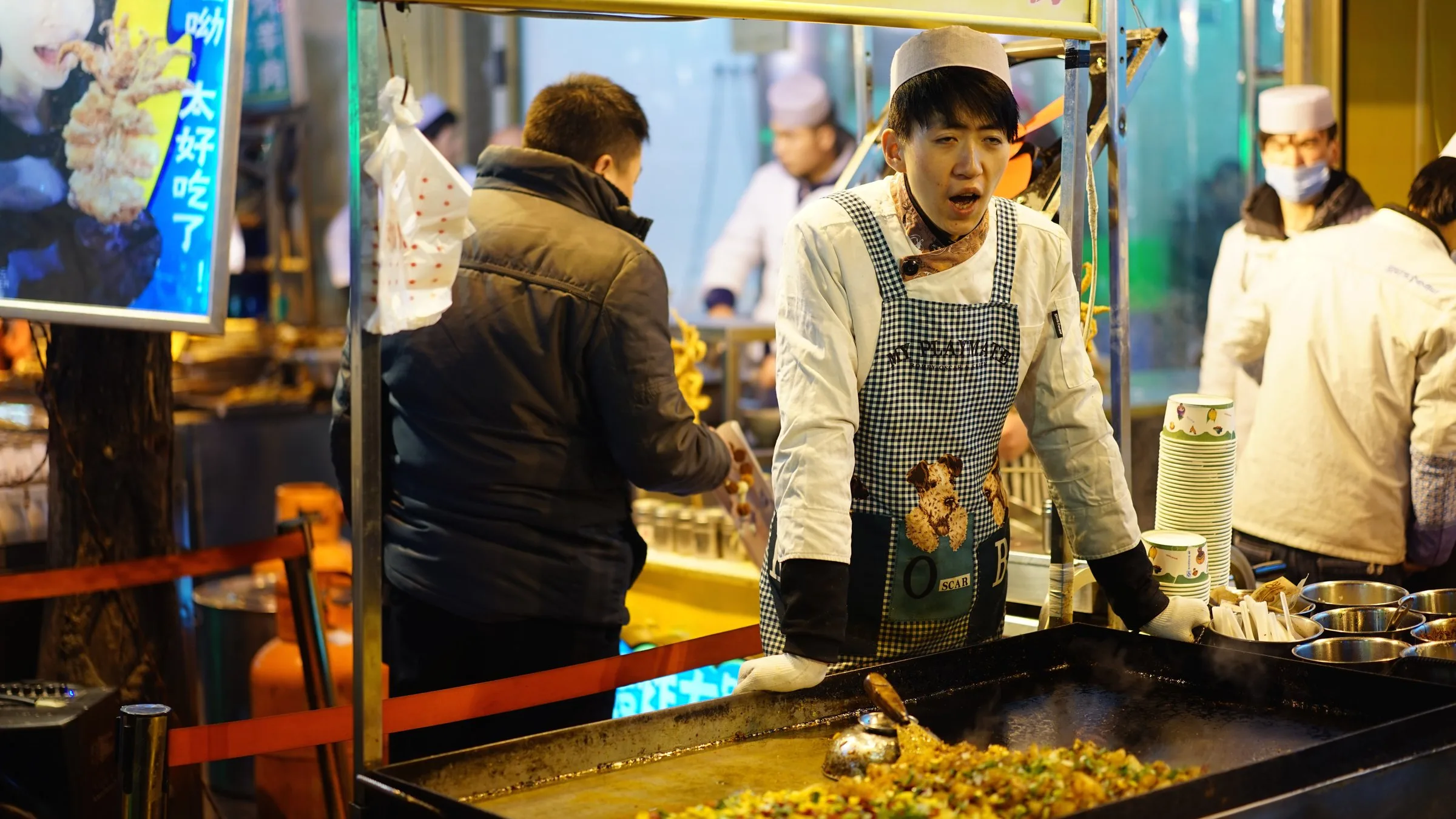
Bonus: Xi’an’s Muslim Quarter (回民街) is a food destination in itself. The street is lined with stalls selling Shaanxi specialties, and the atmosphere is unlike anywhere else in China. Visit in the evening for the most authentic experience.
7. Hangzhou (杭州) — Zhejiang cuisine
Hangzhou cuisine is one of the most refined of the regional Chinese cuisines, with emphasis on fresh seafood, slightly sweet flavors, and elegant presentation. Hangzhou was the capital of the Southern Song dynasty (1127-1279), and the cuisine reflects the imperial refinement of that era. The cuisine is also the home of the famous Longjing (Dragon Well) green tea. For the spicy interior (Chongqing + Sichuan mala flavor), see our hotpot guide — the most famous single dish of that region.
The 3 iconic dishes:
West Lake vinegar fish (西湖醋鱼 xīhú cùyú) — The most famous Hangzhou dish. A live grass carp is killed and immediately cooked in a sauce of vinegar, sugar, soy sauce, and ginger. The fish is served whole, with the sauce drizzled over the top. Where to try: Louwailou Restaurant (楼外楼) — the most famous traditional institution, founded in 1848. Price: ¥150-300 for a whole fish.
Dongpo pork (东坡肉 dōngpōròu) — A signature Hangzhou dish named after the Song dynasty poet Su Dongpo (Su Shi), who was the governor of Hangzhou in the 11th century. A thick cut of pork belly braised in soy sauce, sugar, and rice wine for 3+ hours, until the fat is translucent and the meat is meltingly tender. Where to try: Louwailou or Zhi Wei Guan (知味观). Price: ¥80-150 for a portion.
Longjing shrimp (龙井虾仁 lóngjǐng xiārén) — The most elegant Hangzhou dish. Fresh river shrimp stir-fried with Longjing (Dragon Well) tea leaves. The shrimp are tender and slightly sweet, with the floral aroma of the tea. Where to try: Louwailou or the tea houses in the Longjing village. Price: ¥100-200 per portion. For the tea itself — grades, pricing, and how to buy at the source village without getting faked — see our Longjing tea buying guide.
Bonus: Hangzhou’s tea culture is a key part of the food experience. Visit the Longjing village in the hills west of West Lake to see the tea plantations and attend a tea ceremony. The famous West Lake is also a scenic destination in its own right.
8. Chongqing (重庆) — Sichuan-style hotpot and street food
Chongqing is a separate municipality (since 1997) and the most rustic culinary capital. The cuisine is generally spicier than Chengdu’s, with a greater focus on hotpot and street food. The mountainous geography and humid climate have made the cuisine particularly bold.
The 3 iconic dishes:
Chongqing hotpot (重庆火锅 Chóngqìng huǒguō) — The original, most authentic mala hotpot. The broth is intensely spicy and numbing, with a heavy load of dried chilies, Sichuan peppercorns, and beef tallow. The pot is typically divided into nine sections (九宫格) to separate the different ingredients. Where to try: Shuzhong Yuan (蜀中源), Xiaolongkan (小龙坎), Peijie (佩姐). Price: ¥80-150 per person.
Chongqing small noodles (重庆小面 Chóngqìng xiǎomiàn) — A breakfast staple in Chongqing. Wheat noodles served in a spicy broth with ground pork, pickled vegetables, peanuts, and chili oil. The local claim is that the city’s character can be measured by the quality of its xiao mian. Where to try: Any small noodle shop in the residential neighborhoods. The most famous: Zhuang Yuan Bei (庄元北). Price: ¥10-20 per bowl.
Sour-spicy glass noodles (酸辣粉 suānlàfěn) — A classic Chongqing street food. Sweet potato or mung bean glass noodles served in a hot, sour, spicy broth with peanuts, sesame, and pickled vegetables. Where to try: The Jiefangbei Pedestrian Street is lined with stalls. Price: ¥10-15 per bowl.
Bonus: Chongqing’s street food scene is intense. The city is famous for its 24-hour food culture — you can find hotpot, noodles, and street food at any time of day or night. The most authentic experience is at the small restaurants in the residential neighborhoods, not the tourist-oriented ones near the Jiefangbei.
How to plan a food-focused China trip
For the most foodie experience, plan a multi-city trip with one city per cuisine. The most practical combination for a 2-week trip:
- Day 1-3: Shanghai (Huaiyang cuisine, soup dumplings, hairy crab)
- Day 4-6: Hangzhou (Zhejiang cuisine, West Lake vinegar fish, Longjing tea)
- Day 7-9: Chengdu (Sichuan cuisine, mapo tofu, dan dan noodles)
- Day 10-12: Xi’an (Shaanxi cuisine, rou jia mo, biangbiang noodles)
- Day 13-14: Beijing (Peking duck, jianbing, the imperial cuisine)
The cost for a 2-week food trip is typically ¥2,000-4,000 per person (excluding flights) — significantly cheaper than a comparable food trip in Europe or the US.
When to come
Each city has its own food calendar:
- Spring (April-May): Fresh bamboo shoots in the south, fresh fish in the Yangtze region
- Summer (June-August): Fresh-water fish, watermelon, refreshing cold dishes
- Autumn (September-November): Hairy crab season in Shanghai, fresh mushrooms, the best food weather
- Winter (December-March): Warming dishes (hotpot, lamb), Chinese New Year specialties (dumplings in the north, rice cakes in the south)
Final tip
China is a food continent, not a country. The regional cuisines are dramatically different, and the most rewarding China trip is one that explores multiple cities and tastes. The most foodie-worthy cities are the 8 listed above, each with its own character and signature dishes. Don’t try to eat ‘Chinese food’ — try the local cuisine of each city you visit. The most authentic experiences are at the small, family-run restaurants in the residential neighborhoods, not the tourist-oriented ones near major attractions. Plan to spend 2-3 hours per meal — Chinese food culture rewards the slow, social experience.
Plan your trip — verified tools
These free tools are built on real, monthly-verified data and help you skip the trial-and-error phase of China trip planning:
- China 6-City 5-Day Budget Calculator — Real 2026 prices for 5 days in Beijing, Shanghai, Guangzhou, Chengdu, Xi’an, or Hangzhou. Budget / mid-range / comfort tiers, broken down line by line.
- China OTA Comparison 2026 — Trip.com vs Booking.com vs Agoda vs Klook across 5 booking types. Inventory, pricing, foreign card support, English service, per-OTA verdict.
Verified August 2026 by TravelHubChina Editorial. We re-check prices and policy details monthly so the data doesn’t drift.
Step by step
-
Pick 2-3 cities to focus on based on your regional cuisine preference
China has 8 great culinary traditions. Pick the cities matching your palate: Chengdu / Chongqing for spicy-numbing Sichuan; Guangzhou / Hong Kong for light Cantonese; Shanghai for sweet-savory Huaiyang; Beijing for imperial cuisine (Peking duck, jianbing, zhajiangmian); Xi'an for hand-pulled noodles and rou jia mo; Hangzhou for fresh Zhejiang seafood; or any combination. Each city has 3 iconic dishes listed in this article.
-
Set a food budget of ¥100-200 per day (~$15-30 USD)
Per-dish prices: street food ¥5-20, casual restaurant ¥30-80 per person, mid-range ¥80-200, upscale ¥200-500+. Plan ¥100-200/day for casual eating or ¥300-500 for nicer meals. A 5-day food-only budget is ¥500-1000 (~$70-140 USD) casual, ¥1,500-2,500 (~$210-350 USD) mid-range. Shanghai, Beijing, and Hong Kong are the most expensive cities for food.
-
Search Meituan or Dianping for the iconic dish at each city
Download Meituan (美团) or Dianping (大众点评) to find the highest-rated local restaurants for each signature dish. Look for restaurants with 4.5+ star ratings and at least 500 reviews. For each city, identify the 3 must-try dishes: Beijing (Peking duck, jianbing, zhajiangmian), Shanghai (xiaolongbao, shengjian bao, hairy crab), Chengdu (mapo tofu, kung pao chicken, dan dan noodles), and so on.
-
Reserve signature restaurants 3-7 days ahead for peak dinner hours
Famous institutions like Quanjude (Quanjude Roast Duck Beijing), Da Dong (modern Peking duck), Jia Jia Tang Bao (Shanghai xiaolongbao), Chen Mapo Tofu (Chengdu), Yang's Fry Dumpling, Louwailou (Hangzhou), and Mak's Noodle (Guangzhou wonton noodles) book out 3-7 days ahead for dinner. Reserve via Trip.com or call the restaurant directly. Lunch is usually walk-in friendly.
-
Save the dish names in pinyin for ordering + 5 essential food phrases
Learn the pinyin of the 3 signature dishes for each city you'll visit. Use 我要这个 (wǒ yào zhège, I want this one) while pointing at a photo. For dietary restrictions: 不要辣 (bù yào là, not spicy), 我吃素 (wǒ chī sù, I eat vegetarian), 我不吃猪肉 (wǒ bù chī zhūròu, I don't eat pork). Always say 好吃 (hǎochī, delicious) after eating — it's the highest compliment to a local restaurant.
FAQ
-
Which Chinese city has the best food?
There is no single answer — each of the major Chinese cities has its own distinct cuisine and signature dishes. The most foodie-worthy cities for foreign visitors are: Chengdu (Sichuan cuisine, spicy-numbing), Guangzhou (Cantonese cuisine, refined seafood), Shanghai (Huaiyang cuisine, sweet-savory), Beijing (imperial cuisine, Peking duck), Xi'an (Shanxi cuisine, noodles and dumplings), Hong Kong (international Cantonese, dim sum), Hangzhou (Zhejiang cuisine, fresh seafood), and Chongqing (mala hotpot, street food). Each is worth a visit for the food alone — but Chengdu, Guangzhou, and Shanghai are typically considered the top three. -
What is the difference between Chinese regional cuisines?
China has 8 great culinary traditions (八大菜系) that are officially recognized: Cantonese (粤菜, the most internationally accessible, mild and sweet), Sichuan (川菜, spicy-numbing, the most complex), Huaiyang (淮扬菜, refined, fresh, slightly sweet), Shandong (鲁菜, northern, savory, hearty), Fujian (闽菜, light, seafood-focused, slightly sour), Anhui (徽菜, mountain ingredients, fermented), Zhejiang (浙菜, fresh seafood, slightly sweet), and Hunan (湘菜, pure spicy, no numbing). Each region has signature ingredients, cooking methods, and flavor profiles based on local agriculture and climate. -
What is the most underrated food city in China?
Among foreign visitors, the most underrated food cities are: (1) Xi'an (Shaanxi cuisine) — the dumpling and noodle capital of China, with dishes that have been made for 2000+ years; (2) Hangzhou (Zhejiang cuisine) — the home of Dongpo Pork and Longjing Shrimp, a sophisticated imperial cuisine; (3) Changsha (Hunan cuisine) — the spicy, bright cuisine of Chairman Mao's home province, less well-known internationally but beloved in China; (4) Shunde (Cantonese cuisine) — the unofficial 'food capital' of Guangdong, birthplace of many Cantonese dishes. Each is worth a special culinary trip. -
How much does food cost in China for foreign tourists?
Food in China is significantly cheaper than in Europe or the US. Typical prices in 2026: street food ¥5-20 per item, casual restaurant ¥30-80 per person, mid-range restaurant ¥80-200 per person, upscale restaurant ¥200-500+ per person. A day's food budget is ¥100-200 for casual eating or ¥300-500 for nicer meals. The most expensive cities are Shanghai, Beijing, Hong Kong (similar to NYC or London). The most affordable are Xi'an, Chengdu, Chongqing. Most cities have excellent street food options for under ¥50 per day. -
What is the best time of year for food in China?
The best times for specific regional foods: (1) October-December for hairy crab season in Shanghai (the famous Yangcheng Lake hairy crab); (2) June-August for the fresh-water fish in Hangzhou (West Lake vinegar fish); (3) September-November for the wild mushrooms in Yunnan (jīnzhēnggū, matsutake); (4) November-January for the winter warming foods (hotpot, lamb dishes) in northern China; (5) April-May for the fresh bamboo shoots in southern China. The Chinese New Year (late January or February) has special dishes like dumplings (in the north) and rice cakes (in the south). -
What is the most common food mistake foreign tourists make in China?
Five common mistakes: (1) Only eating at tourist-oriented restaurants near major attractions. The best food is often in the residential neighborhoods (苍蝇馆子 'cāngyíng guǎnzi' or 'fly restaurants' — small, family-run, no-frills). (2) Assuming all Chinese food is the same. The regional cuisines are very different — try the local specialty in each city. (3) Not trying the breakfast. Chinese breakfast is a distinct meal with its own specialties (jianbing in Beijing, rice rolls in Shanghai, dim sum in Guangzhou). (4) Skipping the night markets. The night market is where the local food culture is most accessible and authentic. (5) Not learning the local dish names. Knowing the name of the dish you want saves time and ensures you get the right thing. -
Is food in China safe for tourists?
Yes, with reasonable precautions. The food-safety rules: (1) eat where locals queue — high turnover = fresh food; (2) eat food cooked to order in front of you — boiling broth, sizzling grills, fresh frying = good; (3) avoid raw vegetables, unpeeled fruit, and tap water — stick to cooked vegetables, fruit you peel yourself (bananas, mandarins), and bottled water; (4) carry oral rehydration salts (ORS) and loperamide — available at any Chinese pharmacy (药店) for ¥10-20. The 'Delhi belly' is less common in China than in South Asia because the food is typically cooked at very high heat. -
Can I find vegetarian food in China?
Yes. Vegetarianism is supported by Buddhist traditions and there is a long history of vegetarian restaurants in China. Most cities have at least one vegetarian restaurant, often near Buddhist temples. The Buddhist vegetarian restaurants serve elaborate mock-meat dishes made from tofu, mushrooms, and gluten — often indistinguishable from the real thing. The cuisine is called 素食 (sùshí) or 斋菜 (zhāicài). For example, in Shanghai, the Ci Yun Temple vegetarian restaurant is famous. Vegetarian travelers should learn the phrase '我吃素' (wǒ chī sù, 'I eat vegetarian') to communicate the dietary restriction.
Related guides
- Food & Dietary
Sichuan Cuisine Guide: 15 Essential Dishes for Foreigners
A practical guide to Sichuan (川菜) cuisine for foreign visitors — the 15 essential dishes, what makes Sichuan food spicy-numbing (麻辣), where to eat in Chengdu, and how to order without speaking Chinese.
12min read
- Food & Dietary
Cantonese Dim Sum Guide: 12 Essential Dishes + Tea Etiquette
A practical guide to Cantonese dim sum (点心) for foreign visitors — the 12 essential dishes, how to order from the cart, tea etiquette, where to eat in Guangzhou and Hong Kong, and the famous 饮茶 (yum cha) tradition.
11min read
- Food & Dietary
Peking Duck Guide: How to Eat It, Best Restaurants, History
A practical guide to Peking duck (北京烤鸭) for foreign visitors — the history, how to eat it the traditional way, the 7 best restaurants in Beijing, prices, and how to spot a quality duck.
9min read
- Food & Dietary
Beijing Hutong Food Tour: The 8 Best Stops for a 3-Hour Walk
A curated 3-hour Beijing hutong food walk covering 8 specific stops: from 豆汁儿 (the legendary fermented mung bean drink) to 卤煮 (old Beijing's working-class stew) to 炒肝 (stir-fried liver) to 北京烤鸭 (Peking duck) hutong-style. Includes the exact addresses, what to order at each, how to find the authentic (non-touristy) places, and a printable walking map.
8min read
- Food & Dietary
Chengdu's Three Famous Snacks: Dan Dan Noodles, Zhong Dumplings, Long Chao Shou (2026)
Complete guide to Chengdu's iconic snack trio: 担担面 (dan dan noodles), 钟水饺 (Zhong dumplings), and 龙抄手 (Long chao shou). Includes each dish's history, where to find the original restaurants, how to order, what they taste like, average prices, and how these local dishes differ from their national imitations.
7min read
- Food & Dietary
Chengdu Hotpot: The Local's Guide to Sichuan's Fiery Feast (2026)
Complete Chengdu hotpot guide for foreigners: how to order at a local restaurant, the 9-grid pot explained, the 3 essential dipping sauces, ingredient order, spice levels for beginners, the difference between Chengdu and Chongqing styles, and the 7 best hotpot restaurants locals recommend.
9min read