
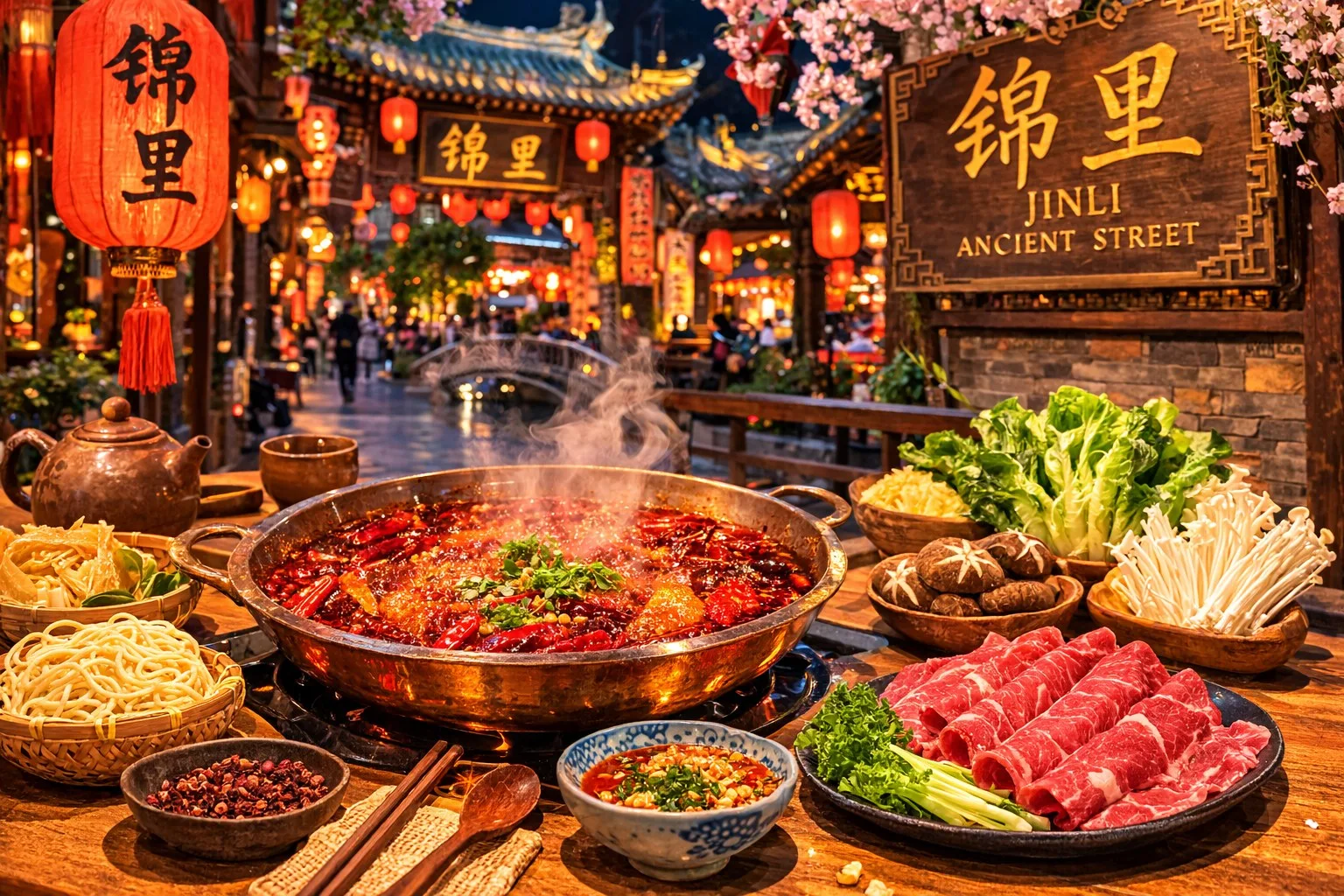
Chinese Hotpot Guide: 4 Styles + How to Eat It
A practical guide to Chinese hotpot (火锅) for foreign visitors — the 4 main styles (Sichuan, Chongqing, Beijing, Cantonese), how to eat it, the 20 essential ingredients, and where to try it in each city.
The 1000-year-old communal dinner
Chinese hotpot (火锅 huǒguō) is a communal dining experience where diners cook thin-sliced ingredients in a pot of boiling broth at the table. The dish has origins in the Mongolian horsemen of the Jin dynasty (1115-1234), who cooked thin slices of meat in their helmets over a fire. Over the last 800 years, the tradition has evolved into one of China’s most beloved communal meals, with distinct regional variations in Sichuan, Chongqing, Beijing, and Cantonese (Hong Kong/Guangdong) cuisines.
For foreign visitors, hotpot is the most social and interactive of Chinese dining experiences. The cooking is done at the table, the conversation flows freely, and the meal is endlessly customizable. No visit to China is complete without a proper hotpot meal.
For a deeper dive into the most popular regional style, see our Chengdu hotpot local’s guide — the aromatic rapeseed-oil + 30+ spice version, with the 9-grid pot and the 3 essential dipping sauces. To plan a broader Sichuan-focused food trip, see our Sichuan cuisine guide and the China food by city overview. If you’re heading to Beijing, the Peking duck guide is the city’s other must-eat classic.
The 4 main styles
1. Sichuan hotpot (四川火锅)
The most internationally famous style. A pot of spicy red broth loaded with dried chilies, Sichuan peppercorns, beef tallow, and 10+ spices (including star anise, cloves, cassia bark, and dried ginger). The broth is intensely spicy and numbing. The yuanyang (鸳鸯) option — half spicy, half clear mushroom — is the most popular for mixed groups.
Where to try: Chengdu, Sichuan province. The local chains (Shu Da Xia, Shujing Sichuan) are excellent. For upscale: Shuzhong Yuan (蜀中源).
2. Chongqing hotpot (重庆火锅)
The original, more rustic version. The broth is even more intensely spicy and peppercorn-heavy, with a thicker layer of beef tallow floating on top. The spices typically number 20+ in the Chongqing version, and the broth is allowed to cook down over the meal, becoming more concentrated and flavorful. The traditional Chongqing experience is at a small, no-frills restaurant in the residential neighborhoods.
Where to try: Chongqing, the separate municipality. Famous chains include Shuzhong Yuan (蜀中源) and Xiaolongkan (小龙坎), both of which have branches in other cities.
3. Beijing copper pot hotpot (老北京涮羊肉)
A completely different style. A copper pot with a tall chimney in the center, with a clear broth (typically just water with ginger, scallions, goji berries, and sometimes Chinese dates or mushrooms). The broth is not spicy. The focus is on thinly-sliced lamb or mutton (the local specialty), cooked for just 2-3 seconds in the boiling broth. The dipping sauce is sesame paste (芝麻酱 zhīmajiàng), a key difference from Sichuan.
Where to try: Beijing. Famous institutions include Donglaishun (东来顺, founded 1903) and Qingfeng Steamboat (青涮).
4. Cantonese hotpot (港式火锅 / 打边炉)
A light, refined style. The broth is typically a clear herbal broth (with wolfberry, red dates, and goji berries) or a rich seafood broth (with dried scallops, conpoy, and shrimp shells). The focus is on fresh seafood (shrimp, scallops, fish slices) and high-quality beef. The dipping sauce is typically soy sauce with raw egg. The Cantonese version is the most refined and least spicy.
Where to try: Hong Kong, Guangzhou, or any upscale Cantonese restaurant. Famous chains include Hai Di Lao (海底捞, international chain founded in Sichuan but with a strong Cantonese presence), which has become the most internationally accessible hotpot brand.
The 20 essential ingredients
Meat and seafood (order 2-3 portions per person)
1. Fatty beef (肥牛 fèiniú) — Thinly sliced beef with marbled fat. The most popular hotpot meat. 2. Lamb (羊肉 yángròu) — Thinly sliced lamb. The Beijing copper pot specialty. 3. Lean beef (嫩牛肉 nèniúròu) — Thinly sliced lean beef. 4. Beef tripe (毛肚 máodǔ) — Tripe with the honeycomb texture. A Sichuan hotpot essential; cook for 7-8 seconds only. 5. Fresh shrimp (鲜虾 xiānxiā) — Whole shrimp, deveined. 6. Shrimp paste (虾滑 xiāhuá) — Hand-minced shrimp paste that you spoon into the broth; it cooks into delicate shrimp balls. 7. Fish slices (鱼片 yúpiàn) — Thin slices of boneless fish (typically grass carp or basa). 8. Fish balls (鱼丸 yúwán) — Bouncy fish balls, often with added roe. 9. Squid (鱿鱼 yóuyú) — Squid rings or pieces. 10. Crab sticks (蟹棒 xièbàng) — Imitation crab sticks, popular for kids and non-seafood lovers.
Vegetables and tofu (order 2-3 portions per person)
11. Napa cabbage (大白菜 dàbáicài) — The most common hotpot vegetable. 12. Lotus root (莲藕 lián’ǒu) — Sliced thin with the characteristic hole pattern; stays crispy. 13. Potato slices (土豆片 tǔdòupiàn) — Very thin potato slices. 14. Tofu (豆腐 dòufu) — Either firm tofu (老豆腐) or soft tofu (嫩豆腐). 15. Tofu skin (腐竹 fǔzhú) — Sticks that puff up dramatically when cooked. 16. Tofu puffs (油豆腐 yóudòufu) — Fried tofu puffs that absorb broth. 17. Mushrooms (蘑菇 mógu) — Enoki, shiitake, king oyster, or wood ear.
Starches and noodles (order 1-2 per table)
18. Glass noodles (粉丝 fěnsī) — Translucent sweet potato or mung bean noodles. 19. Instant noodles (方便面 fāngbiànmiàn) — Packaged instant noodles added at the end. 20. Rice (米饭 mǐfàn) — Plain rice as a side, or added to the broth at the end.
The dipping sauce
The dipping sauce is as important as the broth. Each region has its own tradition:
Beijing (sesame paste 芝麻酱):
- Sesame paste (the base)
- Soy sauce
- Chili oil (optional)
- Minced garlic
- Chopped scallions
- Sugar
- A spoonful of the hot pot broth (to thin)
Mix all ingredients in a small bowl. The sesame paste is the defining flavor — it provides richness and a counterpoint to the lean lamb.
Sichuan/Chongqing (oil dish 油碟):
- Sesame oil (the base — protects the mouth from the heat)
- Minced garlic
- Chopped cilantro (optional)
- Black vinegar (optional)
- Soy sauce (optional)
The oil dish is simple but functional — the oil coats the mouth and prevents the spicy broth from overwhelming the taste buds. Follow the locals’ lead.
Cantonese (soy sauce with raw egg):
- Soy sauce
- Raw egg (beaten into the soy sauce)
- Chopped scallions
- Chopped cilantro
- Sesame oil (optional)
The raw egg is the traditional Cantonese touch — the heat from the cooked ingredients partially cooks the egg in the sauce.
How to eat hotpot
Step 1: Order the pot and ingredients. The server will ask if you want the yuanyang (鸳鸯, half-and-half) or the all-spicy/all-mild. The yuanyang is the most popular. Order 2-3 portions of meat, 2-3 vegetables, 1-2 starch, and a dipping sauce per person.
Step 2: Wait for the broth to boil. The server will bring the broth, light the burner (gas or induction), and bring your order on a tray. The broth takes 5-10 minutes to come to a full boil.
Step 3: Cook and eat in waves. The classic pattern:
- First wave: meat and seafood (2-3 minutes in the broth)
- Second wave: harder vegetables (potato, lotus root, broccoli) — 3-5 minutes
- Third wave: leafy vegetables and tofu (30-60 seconds)
- Fourth wave: noodles or glass noodles (3-5 minutes)
Step 4: Don’t overcook. The ingredients cook fast in hot broth. Meat and seafood are typically ready in 30 seconds to 2 minutes. Vegetables in 1-3 minutes. Overcooking makes the meat tough and the vegetables mushy.
Step 5: Dip and eat. Take the cooked ingredient with chopsticks, dip in the sauce, and eat immediately.
Step 6: Pace yourself. Hotpot is a marathon, not a sprint. Plan for 1.5-2 hours of cooking, eating, and chatting.
Where to eat
In Chengdu/Sichuan
- Shu Da Xia (蜀大侠) — A modern Sichuan hotpot chain with theatrical decor and excellent food. Price: ¥100-200 per person.
- Shujing Sichuan (蜀经香) — A more traditional institution. Price: ¥80-150 per person.
- Xiaolongkan (小龙坎) — A Chengdu chain that has expanded internationally. Price: ¥80-150 per person.
In Chongqing
- Shuzhong Yuan (蜀中源) — A classic Chongqing hotpot institution. Price: ¥80-150 per person.
- Peijie Hotpot (佩姐老火锅) — A local favorite with intense mala. Price: ¥80-130 per person.
- Local small restaurants in the Jiefangbei area — The most authentic experience. Price: ¥50-100 per person.
In Beijing
- Donglaishun (东来顺) — Founded in 1903, the most famous Beijing copper pot hotpot. Price: ¥150-300 per person.
- Qingfeng Steamboat (青涮) — A more modern alternative. Price: ¥120-250 per person.
- Haidilao (海底捞) — International chain, now with locations in 10+ countries. Excellent service. Price: ¥120-200 per person.
In Hong Kong/Guangzhou
- Haidilao (海底捞) — The international chain has strong Hong Kong and Guangzhou presence.
- The Drunken Pot (酒锅) — Upscale Cantonese hotpot in Hong Kong. Price: ¥300-500 per person.
- Local ‘打边炉’ (dǎbiānlú) restaurants — The traditional Cantonese hotpot experience. Price: ¥150-300 per person.
When to come
Hotpot is excellent year-round, but the best times:
- October-March — The cold weather makes the hotpot feel especially warming
- Chinese New Year (late January or February) — Family hotpot is a Lunar New Year tradition
- Summer evenings — Air-conditioned hotpot restaurants are popular for the contrast with the hot weather
- Avoid the May 1-3 and October 1-7 national holidays — Restaurants are crowded, prices inflated
Final tip
Hotpot rewards the social, relaxed experience. The point is not to eat as much as possible but to spend time with friends and family over a boiling pot. Order 2-3 portions of meat, 2-3 vegetables, and 1-2 starches per person. The yuanyang (half spicy, half mild) is the most popular option for mixed groups. The most authentic experience is at a local restaurant in Chengdu, Chongqing, or Beijing, where the carts are wheeled to your table and the broth has been simmering for hours. Once you have tried real Chinese hotpot, you will never look at Chinese food the same way.
Plan your trip — verified tools
These free tools are built on real, monthly-verified data and help you skip the trial-and-error phase of China trip planning:
- China 6-City 5-Day Budget Calculator — Real 2026 prices for 5 days in Beijing, Shanghai, Guangzhou, Chengdu, Xi’an, or Hangzhou. Budget / mid-range / comfort tiers, broken down line by line.
- China OTA Comparison 2026 — Trip.com vs Booking.com vs Agoda vs Klook across 5 booking types. Inventory, pricing, foreign card support, English service, per-OTA verdict.
Verified August 2026 by TravelHubChina Editorial. We re-check prices and policy details monthly so the data doesn’t drift.
Step by step
-
Pick the right style for your spice tolerance
Choose Sichuan or Chongqing for mala (numbing-spicy) experience, Beijing copper pot for clear broth + lamb, or Cantonese for light herbal seafood broth. First-timers should order 'yuanyang' (鸳鸯) — half spicy red broth + half mild clear broth in one pot, so spice-lovers and non-spice-eaters can share.
-
Order a classic ingredient set for 2-3 people
Order 2-3 portions each of thinly sliced lamb or beef (肥牛 fèiniú, fatty beef), fish balls, firm tofu, lotus root, napa cabbage, and potato slices. Add enoki or shiitake mushrooms, tofu skin (腐竹 fǔzhú), and glass noodles (粉丝 fěnsī). Budget ¥200-400 per person for a balanced meal at a mid-range restaurant.
-
Make the right dipping sauce for your style
Beijing style: 芝麻酱 (zhīmajiàng, sesame paste) thinned with hot broth + chili oil + minced garlic. Sichuan/Chongqing style: 油碟 (yóudié) — a small bowl of sesame oil + minced garlic, the oil protects the mouth from the heat. Cantonese style: soy sauce + raw egg + scallions + cilantro. Most restaurants have a self-serve sauce bar.
-
Cook each ingredient for the right time
Thin meat slices: 10-15 seconds (just until color changes). Fish balls: 2-3 minutes. Tofu and leafy vegetables: 1-2 minutes. Lotus root and potato slices: 2-3 minutes. Use the slotted spoon or chopsticks to retrieve. Do not eat the floating dried chilies from the spicy broth — they carry the most heat.
-
Pair with the right drink and pace the meal
Drink cold beer, sour plum juice (酸梅汤 suān méi tāng), or hot tea to balance the spice. Pace yourself: 20-30 min to order and wait for the broth to boil, then 60-90 min to cook and eat. The mala numbing from Sichuan peppercorns is harmless and fades within 30-60 minutes. Have ORS (oral rehydration salts) on hand if you are spice-sensitive.
FAQ
-
What is Chinese hotpot?
Chinese hotpot (火锅 huǒguō) is a communal dining experience where diners cook thin-sliced ingredients in a pot of boiling broth at the table. The broth is typically divided into two halves — one spicy (red, loaded with chilies and Sichuan peppercorns) and one mild (clear mushroom, herbal, or tomato) — called a 'yuanyang' (鸳鸯) hotpot. Diners pick ingredients from a refrigerated display or menu, cook them in the broth for 30 seconds to 5 minutes depending on the ingredient, and eat with a dipping sauce. The tradition dates to 1000+ years ago among Mongolian horsemen who cooked thin slices of meat in their helmets over a fire. -
What is the difference between Sichuan and Chongqing hotpot?
Sichuan hotpot (四川火锅) and Chongqing hotpot (重庆火锅) are closely related but distinct. Both are spicy red-broth hotpots, but Chongqing hotpot is generally more intense — using more beef tallow (牛油), heavier Sichuan peppercorns, and a longer list of spices (often 20+ spices vs. 10-15 for Sichuan). The Chongqing version is more rustic and street-food oriented, while the Sichuan version is more refined and served in nicer restaurants. Famous Chongqing institutions: Shuzhong Yuan, Xiaolongkan. Famous Sichuan (Chengdu) institutions: Shujing Sichuan, Shu Da Xia. -
How spicy is hotpot?
The spicy side of a hotpot is very spicy — loaded with dried chilies, Sichuan peppercorns, and beef tallow. The 'málà' (麻辣) sensation is the same as in Sichuan cuisine, but more concentrated. First-timers should: (1) start with the mild side of the yuanyang, (2) avoid eating the dried chilies that float in the broth, (3) drink plenty of water or beer, (4) have oral rehydration salts (ORS) on hand. The peppercorn numbing sensation is harmless and subsides within 30-60 minutes. The broth itself becomes less spicy as you cook — the ingredients absorb some of the heat. -
How much does hotpot cost for foreigners in 2026?
Budget: ¥50-100 per person at a local Sichuan or Chongqing institution. Mid-range: ¥100-200 per person at a famous restaurant. Upscale: ¥200-500+ per person for the most refined institutions or for the most expensive ingredients (wagyu beef, lobster, etc.). The cost depends on the ingredients you choose — meat is typically ¥30-80 per portion, vegetables ¥10-30, seafood ¥40-100. A typical meal for 2 people is ¥200-400. The most affordable is the all-you-can-eat option (自助火锅), typically ¥100-150 per person. -
What is the dipping sauce for hotpot?
The dipping sauce varies by region. In Beijing hotpot: the traditional sauce is 芝麻酱 (zhīmajiàng, sesame paste), sometimes thinned with hot pot broth and mixed with chili oil, garlic, scallions, and sugar. In Sichuan/Chongqing hotpot: the traditional sauce is 油碟 (yóudié, oil dish) — a small bowl of sesame oil mixed with minced garlic, sometimes with black vinegar, soy sauce, or chopped cilantro. The oil protects the mouth from the heat. In Cantonese hotpot: soy sauce with raw egg, scallions, and cilantro. Each region has its own preferred sauce — follow the locals' lead. -
What ingredients should I order for hotpot?
For first-timers, the classic order is: thinly sliced lamb or beef (肥牛 fèiniú, fatty beef, or 羊肉 yángròu, lamb), fresh shrimp (cleaned, deveined), fish balls or fish paste (鱼丸 yúwán), firm tofu (老豆腐 lǎodòufu), tofu skin (腐竹 fǔzhú, sticks that puff up when cooked), napa cabbage (大白菜 dàbáicài), lotus root (莲藕 lián'ǒu, sliced thin), mushrooms (enoki, shiitake, king oyster), potato slices, and glass noodles (粉丝 fěnsī). Order 2-3 portions of meat, 2-3 vegetables, and 1-2 starch/noodle for a balanced meal. Avoid the fish mint herb (折耳根 zhé'ěrgēn) unless you're adventurous. -
Can I eat hotpot if I don't eat spicy food?
Yes — order the 'yuanyang' (鸳鸯) hotpot, which has the spicy broth on one side and a clear, mild broth on the other (typically mushroom, herbal, or tomato). Most of the ingredients are not inherently spicy, so you can cook them in the mild side. The dipping sauce can also be made non-spicy. Most hotpot restaurants offer a 'fully mild' option (清汤 qīngtāng) for groups that want no spice at all. The '鸳鸯' option is the most popular compromise — it lets spice-lovers and non-spice-lovers share the same pot. -
How long does a hotpot meal take?
A hotpot meal typically takes 1.5-2 hours, sometimes longer. The first 20-30 minutes are spent ordering and waiting for the broth to boil. The next 60-90 minutes are spent cooking and eating. The pace is social — diners chat, drink, and cook in waves, with meat and vegetables added and removed from the pot continuously. The meal ends when everyone is full or the broth has cooked down. The broth is sometimes ordered as a soup course at the end of the meal (especially in the Beijing tradition).
Related guides
- Food & Dietary
Peking Duck Guide: How to Eat It, Best Restaurants, History
A practical guide to Peking duck (北京烤鸭) for foreign visitors — the history, how to eat it the traditional way, the 7 best restaurants in Beijing, prices, and how to spot a quality duck.
9min read
- Food & Dietary
Cantonese Dim Sum Guide: 12 Essential Dishes + Tea Etiquette
A practical guide to Cantonese dim sum (点心) for foreign visitors — the 12 essential dishes, how to order from the cart, tea etiquette, where to eat in Guangzhou and Hong Kong, and the famous 饮茶 (yum cha) tradition.
11min read
- Food & Dietary
Chengdu Hotpot: The Local's Guide to Sichuan's Fiery Feast (2026)
Complete Chengdu hotpot guide for foreigners: how to order at a local restaurant, the 9-grid pot explained, the 3 essential dipping sauces, ingredient order, spice levels for beginners, the difference between Chengdu and Chongqing styles, and the 7 best hotpot restaurants locals recommend.
9min read
- Food & Dietary
China Food by City: 8 Cities, 24 Iconic Dishes
A guide to Chinese regional food by city — the 8 most foodie-worthy cities for foreign visitors, the 3 iconic dishes in each, and where to find them. Beijing, Shanghai, Chengdu, Guangzhou, Hong Kong, Xi'an, Hangzhou, Chongqing.
14min read
- Food & Dietary
Street Food in China: 20 Safe Dishes for First-Timers
20 iconic Chinese street foods with pinyin, English names, what they taste like, regional origin, average price in USD, and which ones are safe for first-time visitors. Plus food-safety rules.
10min read
- Food & Dietary
20 Chinese Phrases to Order Food (Pinyin + Audio)
The 20 must-know Mandarin phrases for ordering food in China, with pinyin, English translation, audio tips, and a printable phrase card. Includes restaurant, street food, and dietary phrases.
8min read