
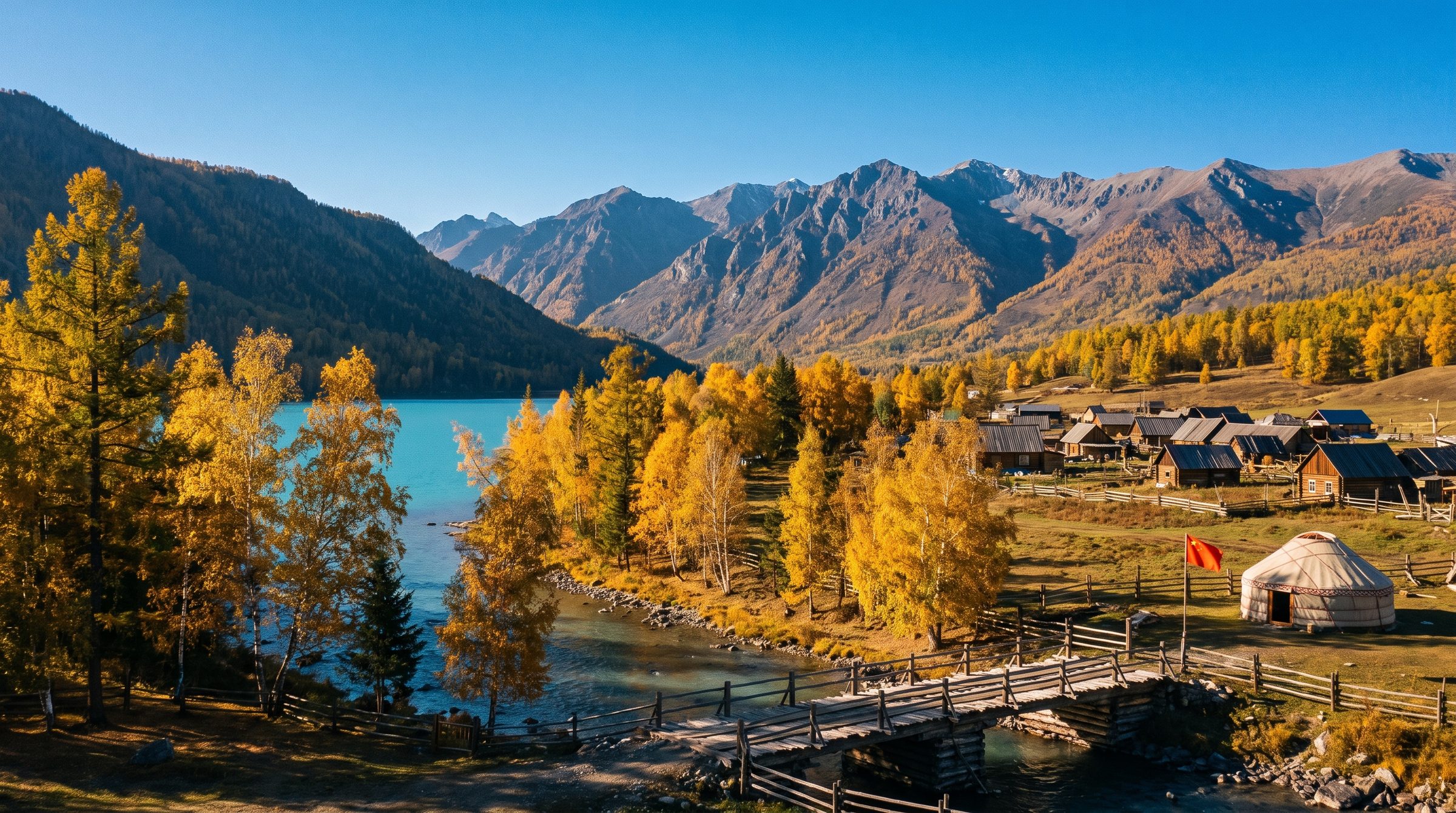
Xinjiang Northern Loop 7-Day Itinerary 2026: Urumqi to Altay via Kanas
7-day Xinjiang Northern Loop itinerary for adventurous travelers: Urumqi → Burqin → Kanas Lake → Hemu Village → Altay → Tianshan Tianchi → back to Urumqi. Includes transport between cities, costs, and best season (Sep-Oct).
Xinjiang Northern Loop 7-Day Itinerary 2026: Urumqi to Altay via Kanas
The Northern Loop is the most popular week-long Xinjiang itinerary for foreign travelers. It packs four of the province’s top experiences into 7 days: the modern Uyghur capital Urumqi, the turquoise Kanas Lake in the Altay Mountains, the wooden-yurt village of Hemu, and the alpine Tianshan Tianchi. The loop runs Urumqi to Burqin by air (no high-speed rail), then 4WD through the mountains, then back to Urumqi for the day-trip to Tianchi.
The single biggest decision is timing. This article is built around the September 15 to October 10 autumn window, when the birch forests around Kanas and Hemu turn gold and the first snow dusts the 4,374-m Friendship Peak above the lake. If you can shift dates into that 25-day window, you will see the version of the loop that fills the postcards. For a broader 10-day version that crosses the Taklamakan and reaches the Silk Road cities, see our Xinjiang Southern Loop 10-day itinerary.
For a general overview of all four western regions and how Xinjiang compares to Tibet, Qinghai, and Yunnan, see our China Western Region Comparison.
Quick answer — at a glance
| Day | Where | Transport | Overnight |
|---|---|---|---|
| 1 | Urumqi arrival, Xinjiang Museum | Airport taxi ¥80 | Urumqi 4-star |
| 2 | Fly to Burqin, drive to Kanas | Flight 1h + 3h drive | Kanas gate hotel |
| 3 | Full day Kanas Lake | Park bus ¥70 | Kanas gate hotel |
| 4 | Sunrise Kanas, drive to Hemu | 2h drive | Hemu wooden yurt |
| 5 | Sunrise Hemu, fly back via Burqin | Drive 3h + flight 1h | Urumqi 4-star |
| 6 | Tianshan Tianchi day trip | 2h drive each way | Urumqi 4-star |
| 7 | Urumqi Grand Bazaar, fly out | — | — |
Total budget per person (mid-range): $1,500-2,000 Best season: Sep 15 – Oct 10 Permits needed: China L-visa or 240-hour visa-free transit Fitness level: Easy to moderate — Kanas boardwalk is the only real walking
Why the Northern Loop (and not just fly to Kanas directly)
Kanas itself is 1,500 km from Beijing and 4,000 km from Shanghai. A standalone Kanas trip means 2 days of flying each way (via Urumqi) and you still need a driver to reach Hemu. The Northern Loop solves this by chaining four distinct experiences in one week: Uyghur urban culture in Urumqi, alpine taiga forest and turquoise water at Kanas, Tuvan wooden yurts and horseback culture at Hemu, and the high-altitude Tianchi (“Heavenly Lake”) in the Tianshan range on the way back.
The four stops are all within a 600-km radius of Urumqi, which is why internal flights plus a 3-day mountain driver is enough to do the whole thing. A pure overland version (no internal flights) takes 10-12 days and is more popular with Chinese overlanders than with foreign visitors. For budget breakdowns and visa details, see our China Budget 2026 guide.
When to go — the 25-day autumn window
The Altay Mountains have four distinct seasons, and only one of them is right for the Northern Loop:
- September 15 – October 10 (autumn, ★★★★★): Golden birch, snow on Friendship Peak, stable weather, 5-20°C. This is the peak. The exact peak colors vary year to year by 5-10 days, but the first week of October (Chinese National Day holiday) is the worst — 80,000+ daily visitors, hotels triple, roads jammed.
- Late June – August (summer, ★★★): 25-30°C in Burqin, green birch, longer days. Crowded with Chinese families on summer holiday. Kanas sunrise is at 06:00.
- December – February (winter, ★★): -20 to -30°C, snow photography, fewer tourists, some yurts closed. Altay city has the General Mountain ski resort, one of the best in China.
- March – May (spring, ★): Mud season, birch still bare, unpredictable weather. Avoid.
If you can only come in July or August, it is still a great trip — just don’t expect postcard colors. The water at Kanas stays turquoise year-round.
Day 1 — Urumqi arrival and Xinjiang Regional Museum
Most international arrivals land at Urumqi Diwopu International Airport (URC), 16 km northwest of the city. The airport has a 240-hour visa-free transit counter if you qualify — see the 240-hour visa-free guide for the country list and the 5-step process.
From the airport: Taxi to the city center ¥80-100, or the airport express metro line 1 (¥7) if your bags are light. Note that the Urumqi metro requires a Chinese phone number for ticket purchase at the vending machines — use the ticket counter instead.
Afternoon — Xinjiang Uyghur Autonomous Region Museum (新疆维吾尔自治区博物馆): This is the single best orientation stop in the city, and it’s free (passport required at the entrance). Highlights include the Loulan Beauty mummy (3,800 years old, still has eyelashes), the Khotan carpet gallery, the Silk Road artifacts, and the Uyghur costume exhibition. Allow 2-3 hours. The museum is closed Mondays.
Evening — Urumqi night market: The Shanxi Grand Mosque area (二道桥) has the best Uyghur food. Try the lamb skewers (¥5 each), samsa (¥8), and dogh (a yogurt drink, ¥10). For a more upscale option, the International Grand Bazaar is a giant shopping complex with restaurants — it’s touristy but the building is interesting.
Where to stay in Urumqi: Mid-range options ¥300-500/night include the Hanting Express (Urumqi Railway Station branch), Jin Jiang Inn, and the Urumqi Mingyuan Hotel. For a 5-star option, the Universal Hotel Urumqi (¥800-1,200) has good English reception.
Day 2 — Fly to Burqin, drive to Kanas
Morning flight: Urumqi to Burqin Kanas Airport (KJI) is 1 hour. The early morning flight (China Southern CZ6843, 08:30) is the most reliable — afternoon flights get bumped by weather in autumn. The 4-day mountain driver should meet you at the Burqin airport; the driver will hold a sign with your name and have the 4WD ready.
The drive to Kanas: Burqin to Kanas is 150 km on a divided highway, taking 3 hours. The road crosses the Irtysh River valley and enters the Altay Mountains. The last 30 km into the park gate climbs sharply, and the elevation rises from 500 m to 1,340 m at the lake. The driver will stop at the Bu’erjin town (布尔津) turnoff for a bathroom break and a snack.
Arrival at the Kanas gate: You cannot drive your own car into the Kanas scenic area — all visitors transfer to the park’s sightseeing bus (¥70 round-trip). The bus runs every 10-15 minutes from the gate to the lake area (45 minutes) and then around the lake between the main viewpoints (Three Bays, Fish-Watching Platform, Hemu transfer point). Buy tickets at the gate counter with passport.
Where to stay near Kanas: The two practical options are Jiadeli Hotel (¥600-900, the best mid-range) and the entry-level chain hotels (¥200-400) clustered near the gate. Book early for September and October — the area has limited capacity.
Day 3 — Full day Kanas Lake
Kanas is 45 km long, 1-2 km wide, and 188 m deep. The water is glacial-fed, passing through travertine deposits that give it the turquoise color. The lake is famous for the Kanas Lake Monster legend (similar to Loch Ness) and for the surrounding taiga forest of Siberian larch, Siberian pine, and birch.
Morning — Three Bays (三湾): Take the 8:00 bus from the gate. The Three Bays are three small lakes connected by walking paths on the western shore: Wolong Bay (卧龙湾), Moon Bay (月亮湾), and Shenxian Bay (神仙湾). The 4-km boardwalk from Moon Bay to Shenxian Bay is the most-photographed section — early morning mist over the water is the classic shot. Allow 3 hours round-trip.
Midday — Fish-Watching Platform (观鱼台): A 1,068-step climb (or a cable car for ¥80) to the 2,030-m summit overlooking the entire lake. On clear days you can see across to the Russia-Mongolia border ridge. Allow 1.5 hours.
Afternoon — Lake cruise: The boat tour (¥120) runs from the dock to the lake’s far end. It’s pretty but not essential — the views from the bus route are better. The return bus runs until 19:00 in peak season.
Sunset: The Fish-Watching Platform is the best sunset spot. Bring a down jacket — even in September the temperature drops 10°C from the daytime high.
Day 4 — Sunrise at Kanas, drive to Hemu Village
Sunrise (06:30-07:00 in late Sep): The classic shot is from the Fish-Watching Platform or from the western boardwalk. Get the first bus up at 06:00. After sunrise, breakfast at the hotel and check out by 09:00.
Drive to Hemu: Kanas to Hemu is 100 km / 2 hours on a mountain road through the Altay ridge. The road passes the Baihaba village viewpoint (where Russia, Mongolia, and China meet — note: you cannot cross into Russia from here, just look). Hemu village is at 1,500 m elevation, ringed by birch forest and the Friendship Peak ridge.
Hemu Village (禾木村): A Tuvan ethnic minority village of 1,500 residents, mostly wooden cabins and wooden yurts. The Tuvan people are culturally related to the Kyrgyz and Mongolian groups; the village is famous for its autumn colors, its log-cabin architecture, and the wooden-yurt homestays that host tourists.
Afternoon — Hemu overlook (禾木观景台): A 30-minute walk uphill from the village center to a platform overlooking the entire village and the valley. The late-afternoon light is the best photography window.
Wooden yurt accommodation: The yurts in Hemu are not the traditional felt kind — they are wood-and-canvas structures with a kang bed-stove (炕) and an en-suite squat toilet. The kang bed is heated by burning wood or coal under the platform, which keeps the yurt surprisingly warm. Cost: ¥200-400/night including breakfast and dinner. The best operators have English-speaking hosts and can arrange horseback riding, hiking, and Tuva cultural performances.
The stars: Hemu has zero light pollution. On a clear night, the Milky Way is brighter than anything you’ve seen in the city.
Day 5 — Sunrise at Hemu, drive back to Burqin, fly to Urumqi
Sunrise at Hemu (06:30-07:00): Walk back up to the overlook in the dark — bring a headlamp. The morning mist rising from the village chimneys is the classic shot.
Morning at leisure: Horseback ride to the Auweiqia meadow (¥100-200/hour), visit a local Tuvan family, or just wander the village.
Drive back to Burqin: 3 hours, including a lunch stop in Bu’erjin town. Try the Irtysh River grilled fish — a local specialty (cold-water fish, served with pilaf and naan).
Flight back to Urumqi: Burqin to Urumqi is 1 hour, 2-3 flights daily. The 18:00 flight gives you enough buffer; the earlier 14:00 flight is risky if the mountain road is slow.
Evening in Urumqi: Celebrate the return with a proper Uyghur feast at one of the city’s top restaurants: the Altun Bazaar (a hidden gem for lamb dishes), the Miran Uyghur Restaurant (in the Grand Bazaar), or the Alafhan Street food stalls.
Day 6 — Tianshan Tianchi day trip
Tianchi (“Heavenly Lake”, 天池) is a 4-km-long alpine lake in the Tianshan range, 110 km east of Urumqi. The lake sits at 1,910 m elevation, ringed by spruce forest, snow peaks (the highest, Bogda Peak, is 5,445 m), and Kazakh yurts. The day trip is long (4-5 hours of driving round-trip) but rewarding.
How to get there: Three options.
- Private car: ¥600-800 for the day including driver, fuel, and tolls. Most flexible.
- Shared tour from Urumqi: ¥300-500/person including lunch. Departs 08:00, returns 19:00. Book via Trip.com or your hotel.
- Public bus: Bus from Urumqi South Bus Station to Fukang city (¥40), then local minibus to the park gate (¥30). 3.5 hours each way, not recommended for first-timers.
The park experience: Mandatory park shuttle bus (¥60) from the gate to the lake (40 minutes). At the lake, a Kazakhstan yurt village offers horseback riding, eagle demonstrations, and traditional food. Boat cruise on the lake ¥80. A 5-km lakeshore boardwalk connects the main viewpoints. The whole visit takes 3-4 hours.
Why the day trip is worth it: Tianchi is the classic “China mountain lake” — the deep blue water, the snow-capped peak behind, the Kazakh culture. It’s not Kanas, but it’s a different landscape (Tianshan vs Altay, spruce vs taiga) and worth the long day for most first-timers.
Day 7 — Urumqi Grand Bazaar and depart
Morning — Urumqi International Grand Bazaar (国际大巴扎): The largest bazaar in the world by area, mixing Silk Road architecture with modern retail. Worth a 1-hour walk for the building, the carpets, the dried fruits, and the Uyghur craft shops. Skip the jade — most of it is fake, and the prices are inflated for tourists.
Final meal: For your last Uyghur meal in Xinjiang, try the Yizhou Maimaiti restaurant (the famous one, often packed) or the smaller, cheaper places in the Erdaoqiao (二道桥) neighborhood. Order: big plate chicken (大盘鸡), hand-pulled noodles (拉条子), and a yogurt drink (酸奶).
Departure: Urumqi Diwopu International Airport (URC) is 16 km from the city center. Allow 2.5 hours for international check-in. The airport has free WiFi (you need a Chinese phone number for SMS verification — bring your eSIM’s data plan) and decent Uyghur-themed restaurants in the departure area.
Practical logistics
Flights
- Urumqi to Burqin (KJI): China Southern CZ6843 (08:30), Joy Air JR1535 (10:30), Tianjin Airlines GS7558 (15:30). 1 hour. $150-200 one-way. Book 1-2 months ahead for September and October.
- Burqin to Urumqi: Same airlines, return flights at 13:00, 16:00, 18:00. 1 hour.
- International arrivals: Urumqi has direct flights from Almaty (Kazakhstan), Bishkek (Kyrgyzstan), Dushanbe (Tajikistan), Tashkent (Uzbekistan), Islamabad (Pakistan), Moscow (Russia), and a handful of Central Asian cities. Otherwise, fly in via Beijing, Shanghai, or Guangzhou.
Visa
Most travelers qualify for the 240-hour visa-free transit — see the 240-hour visa-free guide for the country list (55 countries including most of Europe, Australia, NZ, South Korea, Japan, Malaysia, UAE). For non-qualifying nationalities, a China L-visa is required (apply 5-7 working days in advance at a Chinese consulate).
The 240-hour transit also covers Urumqi as a transit port — you can enter Beijing, fly to Urumqi, do the loop, and fly back to Beijing for the exit. This is the most popular route.
Money and connectivity
- Cash: Bring 2,000-3,000 RMB cash for the Kanas-Hemu-Burqin leg. Most yurts and small restaurants are cash-only or accept WeChat/Alipay from Chinese accounts only.
- Cards: Visa and Mastercard work in Urumqi hotels and chain restaurants; useless in the Altay Mountains.
- Alipay for foreigners: See our Alipay for Foreigners 2026 guide. The app works with foreign Visa/Mastercard but has a 1-2% markup on the wholesale rate.
- eSIM: Get a China eSIM before arrival. Airalo, Holafly, Nomad, and China Unicom HK all work. See Best eSIM for China 2026.
- VPN: Required for Google, Instagram, WhatsApp, Gmail, and most Western apps. Hotel WiFi blocks them; Chinese 4G/5G does not. Install and test a VPN before arrival.
- Maps: Download offline maps of Urumqi, Burqin, Kanas, and Hemu in Maps.me or Google Maps (cached before arrival).
Driver and ground transport
The 3-day mountain driver is the single most important booking. Three options:
- Hotel-arranged driver: Most Urumqi 4-star hotels have a partner driver. ¥1,000-1,500/day. Safest, easiest.
- Trip.com transfer booking: Book a “Kanas + Hemu 3-day private tour” — these are pre-built packages with a 4WD and driver. ¥3,500-5,000 total for 3 days per vehicle.
- Self-arranged through the yurt: Hemu yurt operators often have a partner driver. ¥800-1,200/day. Direct contact, more flexible, but you need to negotiate in Chinese or use a translation app.
For Tianchi, the day-trip option (private car or shared tour) is much easier than public transport. See our China airport transfer guide for general ground-transport tips.
Where to stay — by stop
| Stop | Budget (¥) | Mid-range (¥) | Top-end (¥) | Notes |
|---|---|---|---|---|
| Urumqi | 200-400 (Jin Jiang Inn) | 400-800 (Hanting, Mingyuan) | 800-1,500 (Universal, Sheraton) | Stay near the railway station for metro access |
| Kanas gate | 200-400 (chain) | 600-900 (Jiadeli) | 1,200-1,800 (Park resort) | Book 2-3 months ahead for Sep/Oct |
| Hemu | 200-400 (wooden yurt) | 400-700 (upgraded yurt with private bath) | 800-1,500 (luxury cabin) | All include breakfast and dinner |
| Burqin | 200-400 (chain) | 400-700 (mid-range hotel) | 700-1,200 (best in town) | Only relevant if you stay the night of Day 5 |
For booking strategy and which apps work for foreigners, see our China hotel booking guide.
Food — what to eat in Xinjiang
Xinjiang is Muslim-majority. Pork is rare, lamb and beef dominate, and the regional cuisine is one of the eight great traditions of Chinese food (the others being Sichuan, Cantonese, Shanghainese, Hunan, Anhui, Fujian, and Zhejiang).
Must-try dishes:
- Big plate chicken (大盘鸡): A Urumqi invention — bone-in chicken, potatoes, peppers, and hand-pulled noodles in a savory-spicy sauce. The dish originated in 1995 at a roadside restaurant in Urumqi and spread nationwide.
- Lamb skewers (羊肉串): ¥5-10 per skewer, cumin and chili rubbed, charcoal grilled. The best places are street stalls, not restaurants.
- Hand-pulled noodles (拉条子): The signature Uyghur noodle — dough is pulled by hand into long thick strands, served with stir-fried vegetables and meat.
- Polo (手抓饭): Rice pilaf with carrots, lamb, and onions, served with yogurt. The Uyghur version is the original, not the Indian.
- Samsa (烤包子): Baked pastry filled with lamb and onion. Best from a tandoor oven.
- Dogh (酸奶): Yogurt drink, slightly sour, often served with honey. The summer version is the best.
- Kawap (烤肉): Cumin-rubbed grilled lamb ribs, Uyghur-style. Often the best single dish in Xinjiang.
Vegetarian options: Limited but improving. Most restaurants do a mushroom-and-pepper stir-fry (素炒蘑菇), egg-and-tomato (番茄炒蛋), and Uyghur-style naan. The Urumqi Han Chinese neighborhoods have more vegetarian options than the Uyghur districts.
For dietary restrictions, see our China Muslim Travel Halal Guide — note that Xinjiang is naturally halal-friendly, but the Lhasa and Yunnan sections are worth reading too.
What to pack
Clothes (autumn, late Sep to early Oct):
- Down jacket (essential for Kanas and Hemu sunrises — 0 to 5°C at 1,500-2,000 m)
- Windproof outer shell
- Fleece mid-layer
- Merino or synthetic base layers (no cotton)
- Quick-dry pants
- Warm hat and gloves
- Wool socks
- Waterproof hiking shoes (the boardwalks and mountain paths are wet in the morning)
Gear:
- Power bank (20,000 mAh — Hemu yurts have unreliable electricity)
- Headlamp (for Hemu sunrise walks in the dark)
- Sunscreen (UV 8+ at altitude)
- Sunglasses
- Brimmed sun hat
- 2-3L water bottle
- Daypack
- Thermos
Documents:
- Passport (required for park entry, hotel check-in, and bank exchange)
- Printed copies of all bookings (hotels, flights, transfers, park tickets)
- Travel insurance docs
- 200 USD cash for emergencies
- VPN app installed and tested
- Offline maps downloaded
Toiletries:
- Wet wipes (some public restrooms have no paper)
- Hand sanitizer
- Sunscreen
- Lip balm (the dry mountain air cracks lips fast)
When NOT to go — the worst weeks
- October 1-7 (Chinese National Day): All of Xinjiang is at maximum capacity. Hotel prices triple. Kanas daily visitors exceed 30,000. Roads jammed. If your dates are flexible, this is the week to avoid.
- March-April: Mud season. The mountain roads into Hemu and Kanas can be closed due to snowmelt. Cold, no autumn colors, no flowers yet.
- Late December to early February: Beautiful but very cold (-20 to -30°C). Some Hemu yurts close. Only recommended for serious winter photographers and skiers.
- Friday-Sunday in peak season: Kanas and Hemu are much quieter Monday-Thursday. If you can flex, mid-week visits are vastly more pleasant.
Costs in detail
For two travelers sharing a 4WD and mid-range hotels:
| Category | Cost per person |
|---|---|
| International flights to Urumqi | $500-1,200 (varies by origin) |
| Urumqi-Burqin flights round-trip | $300-400 |
| 4WD with driver, 3 days | $600-900 |
| Park tickets and shuttles (Kanas, Tianchi) | $80-100 |
| Hotels 6 nights | $400-700 |
| Food 7 days | $200-300 |
| Visa (if not visa-free) | $140-200 |
| eSIM | $20-50 |
| Miscellaneous | $100-200 |
| Total per person | $1,500-2,500 |
Budget version (shared tours, bunk dorms, public transport where possible): $900-1,200 per person. Luxury version (5-star hotels, private everything): $3,000-4,000 per person. For a full breakdown of China travel costs, see our China Budget 2026 guide.
Safety and cultural notes
General safety: Xinjiang is safe for tourists. The 2010s security situation has been replaced by a heavy security presence that is reassuring for most visitors. The Altay mountain region is among the safest in the province.
Cultural etiquette:
- Dress modestly near mosques.
- Ask before photographing people.
- Remove shoes when entering a yurt or home.
- Don’t point the soles of your feet at people.
- Don’t eat pork in Uyghur areas.
- Bring a small gift (fruit, sweets) if invited to a home.
- Avoid discussing politics, religion, and the 2010s incidents with strangers.
Altitude: Urumqi is 800 m, Kanas 1,340 m, Hemu 1,500 m, Tianchi 1,910 m. None of these are high enough to cause altitude sickness for most visitors. If you have heart or lung conditions, check with your doctor before going above 1,500 m.
Weather: The September-October window is generally clear, but mountain weather can change fast. The driver will know the forecast; trust their judgment on whether to push on to a viewpoint.
Travel insurance: Recommended. The Kanas-Hemu mountain roads are the most accident-prone part of the trip. Make sure your insurance covers off-road 4WD and helicopter evacuation. World Nomads and SafetyWing both work for China.
For more on cultural etiquette across China, see our China Cultural Etiquette guide.
Common questions and answers
Is it safe for solo female travelers? Yes. The Kanas-Hemu leg is a popular family destination for Chinese tourists, and the drivers and yurt operators are used to foreign visitors. Standard precautions apply — share your itinerary, check in daily, avoid isolated spots at night.
Can I see the lake monster? No reliable sightings since the 1980s. The “monster” is now part of the local folklore and is a great conversation starter, not an actual wildlife target.
Do I need to speak Chinese? No, but it helps. The drivers, yurt operators, and Tianchi guides all speak basic English. Urumqi hotels and the Grand Bazaar have English reception. Pleco or Google Translate covers the rest.
Can I extend the trip to include Sayram Lake? Yes. Sayram Lake is 4 hours west of Urumqi on the Kazakhstan border; it adds 2 days to the loop. Most visitors skip it for time reasons — Kanas is the better lake. For 10+ day versions, see our Xinjiang Southern Loop.
Can I do this in winter? Yes — the “Altay Snow Tour” with skiing at General Mountain (可可托海/阿尔泰山) is a growing niche. Temperatures -20 to -30°C, but the powder is among the best in Asia. The 4WD and driver are still required, and many yurts close — book carefully.
Can I bring children? Yes. The Kanas boardwalk and Tianchi cruise are stroller-friendly. The Hemu yurt experience is magical for kids. The main concern is the long drives and the temperature swings at sunrise.
Booking strategy
| Lead time | What to book |
|---|---|
| 3-4 months ahead | Hemu wooden yurt, Urumqi 4-star for first and last nights |
| 1-2 months ahead | Urumqi-Burqin flights, 4WD with driver |
| 2-3 weeks ahead | Tianchi day trip, Kanas tickets |
| 1 week ahead | Last-minute Urumqi restaurants, Uyghur cultural shows |
| 1-2 days ahead | Burqin hotel (if needed), flight check-in |
For general booking strategy and the apps that work best for foreigners, see our China hotel booking guide and China domestic flights guide.
Plan your trip — verified tools
These free tools are built on real, monthly-verified data and help you skip the trial-and-error phase of China trip planning:
- China 240-Hour Visa-Free Transit Checker — 55 countries, 24 provinces, 65 ports. See if you qualify for 10-day visa-free transit.
- China 6-City 5-Day Budget Calculator — Real 2026 prices for 5 days in Beijing, Shanghai, Guangzhou, Chengdu, Xi’an, or Hangzhou.
Verified August 2026 by TravelHubChina Editorial. We re-check prices and policy details monthly so the data doesn’t drift.
Step by step
-
Step 1: Book the Urumqi-Burqin flights and Hemu yurt 2-3 months ahead
Urumqi to Burqin (KJI) is the only practical way to start the loop — the 670-km drive is 8-10 hours. There are 2-3 direct flights daily (1h, $150-200 one-way) on China Southern, Tianjin Airlines, and Joy Air. Burqin Airport is 50 km from Kanas and 80 km from Hemu, both reached by pre-booked transfer (¥200-300/trip). Hemu yurts (the wooden cabin kind, not the felt kind) book out 2-3 months ahead for September and October weekends — book via Trip.com, Ctrip, or directly with the yurt operator on WeChat.
-
Step 2: Plan the day-by-day route with overnight stops
The 7-day plan: Day 1 Urumqi arrival, rest, Xinjiang Regional Museum. Day 2 fly Urumqi to Burqin, drive to Kanas, overnight near the park gate. Day 3 full day Kanas Lake (sightseeing bus + western boardwalk + Three Bays). Day 4 morning Kanas sunrise, drive to Hemu Village (2h), afternoon at Hemu overlook, overnight in wooden yurt. Day 5 morning Hemu sunrise, drive back to Burqin, fly to Urumqi. Day 6 Tianchi day trip (2h drive each way). Day 7 Urumqi International Grand Bazaar, fly out. The internal flight on Day 5 is the loop's pivot — without it, you spend 8 hours driving back.
-
Step 3: Arrange the private 4WD driver for the Kanas-Hemu-Burqin leg
For 3 days covering the gravel mountain roads into Kanas and Hemu, a 4WD with driver is essentially mandatory — public buses exist but run twice daily and don't reach the yurt clusters. Cost: ¥1,000-1,500/day for a Toyota Land Cruiser or similar, including driver, fuel, and tolls. Negotiate the rate before the trip and confirm whether the driver's accommodation and meals are included (typically yes). The driver also handles the park shuttle bus tickets (¥70) and knows the best sunrise/sunset viewpoints.
-
Step 4: Sort out the visa, cash, and connectivity in Urumqi
Most travelers qualify for the 240-hour visa-free transit — see our [China 240-hour visa-free guide](/articles/china-240-hour-visa-free/) for the 55-country list. Carry 2,000-3,000 RMB cash for the Kanas-Hemu-Burqin leg; many yurts and small restaurants do not accept Alipay or WeChat Pay from foreign cards. Get a China eSIM before arrival (Airalo, Holafly, or Nomad) — Chinese internet is blocked behind the Great Firewall, so Google, Instagram, WhatsApp, and Gmail do not work without a VPN. For the yurt nights, download offline maps of Kanas, Hemu, and Burqin in advance.
-
Step 5: Pack the right clothes for the Altay temperature swings
Urumqi daytime in September hits 25-28°C; Altay (Kanas, Hemu) at the same date ranges 0-15°C with -3 to 5°C at sunrise. Pack: a down jacket, a windproof outer shell, a fleece mid-layer, a long-sleeve merino base layer, quick-dry pants, waterproof hiking shoes, a sun hat, sunglasses, sunscreen, and a small daypack. The wooden yurts have kang bed-stove heating but the main hall is cold in the morning; bring thermal underwear for Hemu nights. Laundry is not available in Hemu — pack for 4-5 days between washes.
-
Step 6: Plan the food, language, and cultural etiquette basics
Xinjiang is Muslim-majority — pork is rare, lamb and beef dominate, and most meals feature naan, hand-pulled noodles (laghman), and polo (rice with carrots and lamb). Urumqi has the best Uyghur food in China; try the Grand Bazaar's roasted lamb skewers, samsa, and dogh fruit juice. For language, almost no English is spoken outside Urumqi's main hotels. Use Pleco or Google Translate (with Chinese downloaded) for menu translation. Respect local customs — ask before photographing people, dress modestly near mosques, and remove shoes when entering a yurt.
FAQ
-
What is the best time of year to do the Xinjiang Northern Loop?
The best window is September 15 to October 10 for the autumn colors — golden birch forests around Kanas Lake and Hemu Village, with the first snow on the Altay peaks creating postcard contrast. July and August are popular but hot (30-35°C in Burqin), crowded with Chinese domestic tourists, and the birch leaves are still green. December to February is a separate winter season for snow photography and skiing at Altay, but temperatures drop to -20 to -30°C and some Hemu yurts close. March to May is mud season (snowmelt + spring thaw) and the birch has not turned color yet. -
Do I need a tour or can I self-drive the Northern Loop?
Self-driving is technically possible and very popular with Chinese tourists, but the distances are massive (Urumqi to Burqin is 670 km) and the speed limit on Xinjiang highways is 80-100 km/h with frequent speed cameras. For first-time visitors, a private driver or a small-group tour is the practical option — ¥800-1,200/day for a 4WD with driver covers a Toyota Land Cruiser or similar that can handle the gravel roads into Kanas and Hemu. Independent self-drive requires an International Driving Permit (not always honored in China) and Chinese GPS; many gas stations between cities still require a Chinese ID card for prepayment. -
How much does a 7-day Northern Xinjiang trip cost per person?
Expect $1,500-2,000 per person for a mid-range trip, excluding international flights. Breakdown: internal flights Urumqi-Burqin-Urumqi $300-400, hotels 6 nights $400-700 (mix of city hotels and Hemu yurts), park tickets and shuttle buses $150-200, private driver 5 days $600-900, food $200-300, miscellaneous $50-100. Budget travelers using shared tours and bunk dorms can drop to $900-1,200. A 5-star version with Altay resort hotels pushes to $3,000-4,000. -
Is Kanas Lake worth the long detour from Urumqi?
Yes for most visitors. Kanas is the most photogenic lake in northwest China — a 45-km-long crescent of turquoise water ringed by snow peaks, with old-growth taiga forest and the famous Kanas Lake Monster legend (a rumored large creature in the deep water). The lake is accessible by a mandatory sightseeing bus (¥70) that runs between the main viewpoints; you can also hike the 4-km wooden boardwalk on the western shore. The 3,000-year-old Tuva ethnic minority culture in nearby Hemu Village is the other main draw. -
What should I pack for the Northern Loop in autumn?
Even in September, Altay nights drop to 0-5°C and Urumqi daytime can still hit 25°C — pack layers. Essentials: a windproof mid-layer fleece, a down jacket for sunrise at Kanas, sturdy waterproof hiking shoes (the boardwalks can be wet and icy in early morning), sunscreen (UV index 8+ at altitude), sunglasses, a brimmed hat, a thermos, and a 2-3L water bottle. Bring a power bank — Hemu yurts have unreliable electricity at night. Avoid cotton base layers; merino or synthetic is much better for the temperature swings.
Related guides
-
Beijing 2-Day Layover: Max China, Min Time
A tested 2-day Beijing itinerary for a long layover: Forbidden City highlights, Mutianyu Great Wall, Peking duck, and a Hutong night walk. With PVG/PEK airport transfer times and 240h visa-free rules.
-
3 Days in Beijing: Forbidden City + Great Wall
The best 3-day Beijing itinerary for first-time visitors: Forbidden City, Mutianyu Great Wall, Temple of Heaven, Summer Palace, and hutong food tour. With prices, transit times, and ticket tips.
-
2 Weeks in China: The Classic Beijing-Xi'an-Chengdu-Shanghai Route (2026)
A complete 14-day China itinerary for first-time visitors: 3 days Beijing, 2 days Xi'an, 2 days Chengdu, 4 days Shanghai, with day-by-day timing, costs, transit between cities (high-speed rail vs flight), hotel recommendations, and which days to skip if you have less time. Budget: ¥15,000-22,000 per person excluding international flights.