
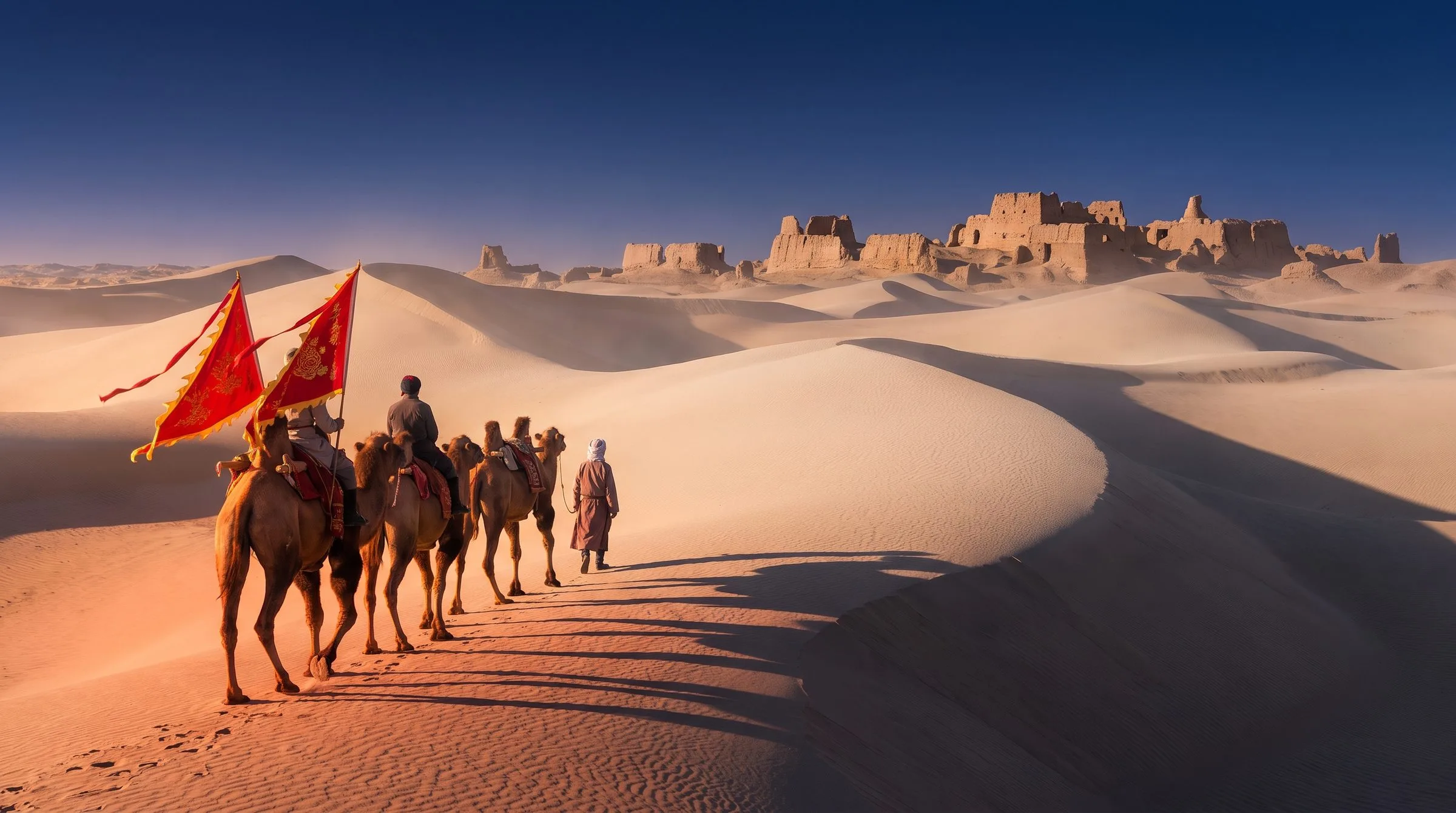
Xinjiang Southern Loop 10-Day Itinerary 2026: Kashgar to Hotan via Taklamakan
10-day Xinjiang Southern Silk Road itinerary: Kashgar → Karakul Lake → Tashkurgan → Khotan → Hotan → drive back to Urumqi. Covers Uyghur culture, the Taklamakan Desert edge, ancient Silk Road fortresses, and the Pamir Highway.
The Southern Loop is the Silk Road heart of Xinjiang. It links the three great oasis cities — Kashgar, Khotan, and Hotan — with the Pamir Mountains to the west and the Taklamakan Desert to the east. The route follows caravan tracks that have been in continuous use for 2,000 years; the cities, the food, and the faces you meet along the way are recognizably Central Asian rather than Han Chinese.
If the Northern Loop is about mountains and lakes, the Southern Loop is about culture and history. The trade-off is fewer dramatic landscapes and more long drives through the desert edge. Most first-time visitors to Xinjiang who have already done the standard China classics (Beijing, Shanghai, Xi’an) pick the Southern Loop for the cultural depth.
For a side-by-side comparison of all four western regions — Xinjiang, Tibet, Qinghai, Yunnan — see our China Western Region Comparison.
Quick answer — at a glance
| Day | Where | Transport | Overnight |
|---|---|---|---|
| 1 | Kashgar arrival, Old Town | Airport taxi ¥50 | Kashgar old-town hotel |
| 2 | Id Kah Mosque, Sunday Bazaar | Walking + taxi | Kashgar |
| 3 | Animal market, Abakh Hoja Tomb | Taxi + walking | Kashgar |
| 4 | Drive to Karakul Lake | 4WD 4h | Karakul yurt camp |
| 5 | Drive Karakul to Tashkurgan | Pamir Highway 3h | Tashkurgan hotel |
| 6 | Stone Fort, Khunjerab viewpoint | 4WD 4-6h round-trip | Tashkurgan |
| 7 | Long drive to Khotan via Yarkand | 4WD 8-10h | Khotan |
| 8 | Jade market, silk workshops | Walking + taxi | Khotan |
| 9 | Hotan silk museum, fly to Urumqi | Drive 2h + flight 1.5h | Urumqi |
| 10 | Urumqi, fly out | — | — |
Total budget per person (mid-range): $1,800-2,500 Best season: April to mid-October (May and September best) Permits needed: China L-visa or 240-hour visa-free transit + Border Area Permit for the Pamir section Fitness level: Easy — the main challenge is the altitude on Days 4-6
Why the Southern Loop is worth the logistics
Kashgar, Khotan, and Hotan were the three most important oasis cities on the southern branch of the Silk Road. Travelers from Persia, Sogdia, India, and Rome came here to trade silk, jade, spices, and horses; the Uyghur culture that dominates Xinjiang today is the descendant of those Silk Road exchanges. The architecture, the food, the music, and the bazaars in these three cities still feel recognizably Central Asian — closer to Samarkand or Isfahan than to Beijing.
The Pamir Mountains to the west, the Taklamakan Desert to the east, and the Kunlun Mountains to the south create a dramatic geographic frame. The roads are good (the Taklamakan Highway, the Pamir Highway, and the Hotan-Urumqi desert expressway are all paved), but the distances are large — 1,500-2,000 km of driving in 10 days.
This is not a trip for travelers who want to move fast and see the highlights. The 10-day plan includes several full days in cities, plus an overnight yurt at Karakul Lake. The payoff is a real feel for the Silk Road in a way that 3-day Kashgar-and-out trips don’t deliver.
When to go — the practical window
The southern Silk Road has four seasons, and only two of them are great for visitors:
- May and September (★★★★★): Warm days (20-28°C), cool nights, no sandstorms, no extreme heat. The Pamir Mountains are clear and the Taklamakan is stable. This is the peak window.
- April, June, October (★★★★): Cool or hot but workable. April has occasional sandstorms; June and October are shoulder season with fewer tourists.
- July and August (★★★): Hot — 35-40°C in Khotan and Hotan. The Pamir section stays cool, so the trip works if you spend the heat hours indoors. Long days (sunset 21:30) help.
- November to March (★★): Cold. -15 to -25°C in Kashgar, -20°C in Khotan, snow closes the Pamir passes December-February. Avoid unless you are a serious winter traveler.
The first week of October (Chinese National Day) is the worst — all of Xinjiang is at maximum capacity, hotels triple, the Pamir Highway is jammed with tour buses.
Day 1 — Kashgar arrival and the Old Town
Most international arrivals fly into Urumqi, then connect to Kashgar (KHG) on a 2-hour domestic flight. A handful of international routes connect Kashgar directly to Almaty, Bishkek, Dushanbe, and Islamabad — useful for travelers using the 240-hour visa-free transit.
From the airport: Kashgar airport is 10 km from the old town. Taxi ¥50-60, 20 minutes. The airport has a 240-hour visa-free transit counter if you qualify (see the 240-hour visa-free guide for the country list).
Kashgar Old Town (喀什噶尔老城): A 4.5-sq-km maze of adobe houses, narrow alleys, and craft workshops. The old town has been partially modernized (some sections are now touristy with souvenir shops) but the eastern and western edges are still genuine residential Uyghur neighborhoods. Allow 2-3 hours to wander. Key spots:
- Century-old teahouse (吾斯塘博依) — A 200-year-old teahouse that locals still use. Order a pot of brick tea (¥20) and watch the neighborhood.
- Aitigar Mosque neighborhood — Smaller than Id Kah, more authentic.
- Handicraft Street — Woodcarvers, coppersmiths, and traditional instrument makers.
- Id Kah Bazaar — Small bazaar in the old town, more authentic than the Sunday market.
Where to stay in Kashgar: The best mid-range is the Kashgar Old Town Hostel (¥150-300, dorm and private rooms) — the rooftop has the best old town views. The more upscale option is the Radisson Blu Kashgar (¥600-900). For an authentic Uyghur courtyard stay, the Yusuf Ali Guesthouse (¥200-400) is a 19th-century merchant house converted to a small inn.
Evening: Try the dinner at the Yumulak Restaurant (¥60-100/person) — Uyghur banquet with big plate chicken, polo, and roasted lamb. Or the street stalls near the Aitigar Mosque for ¥10-20 Uyghur-style skewers and samsa.
Day 2 — Id Kah Mosque, Sunday Bazaar, and the Handicraft Street
Id Kah Mosque (艾提尕尔清真寺): The largest mosque in China, with a 16,800-person capacity, founded in 1442. The current building is a 19th-century reconstruction. Open 8:00-20:00, free entry, but the prayer hall is closed to non-Muslims during the five daily prayers. The courtyard, the gate, and the views of the surrounding old town are the main attractions. Dress modestly — women should bring a headscarf.
Sunday Bazaar (周日巴扎): If you are in Kashgar on a Sunday, the livestock bazaar is unmissable. Every Sunday morning, thousands of farmers, traders, and herders gather in the suburbs to trade sheep, goats, cattle, donkeys, and horses. The bargaining is theatrical, the animals are inspected head-to-tail, and the atmosphere is unlike anything else in China. Allow 3 hours. The bazaar is 5 km from the old town — taxi ¥20-30.
The daily bazaar (open every day except Sunday) is the more general market — textiles, carpets, knives, dried fruits, spices. The dried fruits section is the best — Xinjiang produces half of China’s raisins, apricots, and walnuts.
Afternoon — Kashgar Handicraft Street: Wooden looms, copper pots, embroidered hats (doppa), Atlas silk, and traditional Uyghur musical instruments. Most workshops welcome visitors. Prices are 20-40% lower than in Urumqi or Beijing, and you can ship home via the shop’s partner courier.
Evening — Kashgar cultural show: The 12 Muqam restaurant has a nightly Uyghur music and dance performance (¥150-250 including dinner) — a good introduction to the region’s musical tradition.
Day 3 — Animal Market, Abakh Hoja Tomb, and the Old City Walls
Animal market (牲畜巴扎): If you missed the Sunday livestock bazaar, the Tuesday animal market in the eastern suburbs is smaller but still active. The sheep, goat, and cattle trading happens 7:00-13:00. Allow 2 hours.
Abakh Hoja Mausoleum (香妃园): The tomb of a 17th-century Uyghur ruler and (according to legend) his descendant Fragrant Imperial Concubine (the one Yang Guifei of the Qing dynasty). The complex includes a mosque, a teaching hall, a cemetery, and a museum. Beautiful tilework and the most-photographed dome in Kashgar. Entry ¥30, allow 2 hours.
Old City Walls: The eastern section of the old town still has remnants of the 14th-century city wall. Less impressive than Xi’an’s but a nice walk.
Evening — Food tour: Kashgar has the best Uyghur food in Xinjiang. Try:
- Tashpolo (烤包子, tandoor-baked pastry with lamb) — any street stall, ¥5 each.
- Gosht-nan (烤馕, baked naan stuffed with lamb and onion) — the iconic Kashgar bread.
- Dogh fruit juice (石榴汁) — pomegranate juice, fresh-pressed, ¥15-20 per glass.
- Yogurt with honey (酸奶) — sold in clay jars at the old-town stalls.
For a broader understanding of Uyghur food culture, see our China Muslim Travel Halal Guide.
Day 4 — Drive to Karakul Lake (4 hours)
The drive: Kashgar to Karakul Lake is 290 km, 4 hours on the Pamir Highway. The road climbs from Kashgar (1,290m) over the Subash Pass (3,600m) and down to Karakul (3,600m) on the Kyrgyzstan border. The views of Kongur Tagh (7,649m) and Muztagh Ata (7,509m) are the payoff.
Border permit checkpoint: The driver will stop at the permit checkpoint 100 km from Kashgar. Carry your passport and the printed permit letter from the tour agency.
Karakul Lake (卡拉库里湖): A 4.6-sq-km alpine lake at 3,600m, ringed by the 7,000m+ Kongur Tagh and Muztagh Ata peaks. The water is dark blue-green, and the Kirghiz yurt camps on the shore host travelers in summer. The lake is sacred to the local Kirghiz and was a key waypoint on the ancient Silk Road.
Altitude adjustment: 3,600m is high. Take it easy on Day 4 — no running, no alcohol, drink 4-5L of water. Diamox (acetazolamide) is recommended for altitude-sensitive travelers; consult your doctor. The yurts have oxygen bottles on request.
Yurt accommodation: The Karakul yurt camps have basic Kirghiz-style felt yurts with a wood stove and shared toilets. Cost ¥200-400/night including dinner and breakfast. The yurt operators arrange horseback riding (¥100/hour), eagle demonstrations (¥50), and short hikes to the lake’s western shore.
Sunset: The sunset over Kongur Tagh and Muztagh Ata is one of the great mountain views in Central Asia. Bring a down jacket — even in May and September, the temperature drops to -5 to 5°C at sunset.
Day 5 — Drive Karakul to Tashkurgan (3 hours on the Pamir Highway)
The drive: Karakul to Tashkurgan is 200 km, 3 hours. The Pamir Highway (中巴友谊公路) was built in the 1960s-70s and is one of the world’s highest paved international roads, climbing to 4,693m at the Khunjerab Pass.
The landscape: The road hugs the western edge of the Taklamakan, crosses the Taghdumbash Pamir, and enters the Tashkurgan River valley. The mountains on the Pakistan side are visible from the road; the China-Pakistan border is just 130 km further at Khunjerab Pass (currently open to commercial traffic only, not tourists).
Tashkurgan (塔什库尔干, “Stone Tower”): A small town of 10,000 people at 3,100m, the capital of the Tajik Autonomous County. The local population is Tajik (Pamiri), a Persian-speaking Sunni Muslim group culturally related to the people of Tajikistan and Afghanistan. The Tajik language, music, and embroidery are the cultural highlights.
Stone Fort (石头城): The ruins of a 2,000-year-old fortress that was the last Chinese outpost on the western Silk Road. The fort sits on a rocky outcrop above the town, with views of the Tashkurgan River valley. Entry ¥50.
Where to stay: The Tashkurgan Crown Inn (¥400-600) is the best mid-range. The Pamir Hotel is the older 3-star option (¥200-300). Both have basic English and oxygen on request.
Tajik dinner: Try the Pamiri plov (rice with carrots and mutton), the tandir bread (baked in a clay oven), and the salty yak yogurt drink. The K2 Restaurant is the most reliable for foreigners.
Day 6 — Stone Fort, Khunjerab Pass viewpoint, and Tajik culture
Morning — Stone Fort revisit: Go early to catch the morning light. The fort is the most atmospheric in Xinjiang.
Drive to Khunjerab Pass viewpoint: Tashkurgan to the actual border is 130 km, 3 hours each way. Most travelers go partway (60 km, 2 hours) to the high-pass viewpoint where you can see across to the Pakistan side. The pass itself is at 4,693m — Diamox strongly recommended for this leg. Note: the border is closed to tourists crossing into Pakistan; you can only reach the viewpoint.
Tajik home visit: Arrange through the hotel or your driver. A Tajik home visit includes the Pamiri plov dinner, traditional music on the rubab and tar, and embroidery demonstrations. Cost ¥200-400/person. The Tajiks are Sunni Muslims and very hospitable; bringing a small gift (fruit, sweets) is appreciated.
Sunset at Tashkurgan: The sunset over the Pamir peaks from the Stone Fort is the second of the trip’s big mountain views.
Day 7 — Long drive Tashkurgan to Khotan (8-10 hours via Yarkand)
The drive: This is the longest day of the loop. Tashkurgan to Yarkand is 350 km / 6 hours; Yarkand to Khotan is 200 km / 2.5 hours. Total 8-10 hours including stops. Start at 07:00 to arrive in Khotan by 17:00-18:00.
The route: The road descends from the Pamirs through the Kunlun foothills, crosses the Yarkand River, and enters the Tarim Basin oasis strip. The landscape changes from mountain to desert-edge.
Yarkand (莎车): Stop for lunch. Yarkand was the second-largest oasis city on the southern Silk Road. The 15th-century Yarkand Friday Mosque is one of the oldest in Xinjiang. Allow 1 hour.
Niya ruins (optional detour): 150 km east of Yarkand, the Niya ruins are a 2,000-year-old Silk Road settlement preserved in the desert. The site requires a separate permit (arrange in advance) and is 1.5 hours from the main road. Worth it for serious Silk Road history fans, skippable for most.
Khotan arrival: Khotan (和田) is the jade capital of China, the easternmost oasis city on the southern Silk Road. The city is large (300,000+ people) and more Han Chinese than Kashgar. Hotel check-in, dinner, and rest.
Day 8 — Khotan jade market, silk workshops, and the Sunday Bazaar
Khotan jade market (和田玉龙喀什河): Khotan has been the source of nephrite jade (和田玉) for 4,000 years. The Sunday jade market (8:00-13:00) is the place to see raw jade boulders, polished jade, and the dealers who travel from Beijing, Hong Kong, and Taiwan to buy. If you don’t know jade, treat this as a cultural visit rather than a shopping trip — the market is full of fakes and the price-to-quality ratio is unforgiving for outsiders.
Silk Road workshops: Khotan was the source of Atlas silk for the entire Silk Road. Visit a workshop to see the mulberry trees, the silkworms, the thread-spinning, and the loom weaving. The Khotan Silk Museum (¥30) is a good introduction.
Khotan Sunday Bazaar (周日巴扎): The Sunday bazaar is smaller than Kashgar’s but has a great crafts section — Atlas silk scarves, doppa hats, copper pots, and dried fruits. Allow 2 hours.
Where to stay: The Khotan Hotel (¥300-500) is the most reliable mid-range. The newer Huazhu Hotel (¥300-400) is clean and modern.
Evening — Uyghur dinner: The Hotan area Uyghur food is slightly different from Kashgar’s — more lamb, more rice, more pumpkin. Try the lamb-and-pumpkin stew (南瓜炖羊肉) and the Uyghur-style roast whole lamb (烤全羊, order 1 day in advance).
Day 9 — Hotan silk museum, drive back via desert highway or fly to Urumqi
Hotan (于田) — 2 hours east of Khotan: Hotan was the original source of mulberry trees, silkworms, and silk production for the entire Silk Road. The Hotan Silk Museum (¥20) is a small but excellent museum with a working silkworm room and a Silk Road history exhibit.
Two options to leave:
Option A: Desert highway drive back to Urumqi — The Taklamakan Desert Highway (塔里木沙漠公路) is one of the most spectacular drives in Asia — 550 km of straight, paved road crossing the heart of the Taklamakan. The drive is 8-9 hours, with two gas station rest stops and a few desert viewpoints. The highway runs north to Luntai (轮台), then east to Urumqi via Turpan. Some travelers do this as a 2-day detour (overnight in Luntai or Korla). It is genuinely one of the great road trips in the world, but exhausting after a 10-day loop.
Option B: Fly Hotan or Khotan to Urumqi — Hotan airport (HTN) has 2-3 daily flights to Urumqi (1.5h, $80-150). The flight is the practical choice for most travelers; the desert highway is for road trip enthusiasts.
For the 240-hour visa-free transit, the exit port from Urumqi must match your original entry port — see the 240-hour visa-free guide for the rules.
Day 10 — Urumqi departure
Morning in Urumqi: If you have a late flight, the Xinjiang Regional Museum (free, closed Mondays) is worth a 2-hour revisit. The Loulan Beauty mummy, the Khotan jade exhibit, and the Uyghur costume gallery are the highlights.
Or, if you skipped the desert highway drive: Spend the night in Turpan on Day 9 (oasis city famous for grapes, the Jiaohe ruins, and the Flaming Mountains). Turpan to Urumqi is 2.5 hours by HSR (¥100) or 3 hours by car.
Departure: Urumqi Diwopu International Airport (URC) is 16 km from the city center. Allow 2.5 hours for international check-in. See the China airport transfer guide for ground transport options.
Practical logistics
Visa and permits
- 240-hour visa-free transit: Most travelers qualify — see the 240-hour visa-free guide for the country list.
- China L-visa: For non-qualifying nationalities, apply 5-7 working days in advance.
- Border Area Permit: Mandatory for the Pamir Highway and Tashkurgan. Arrange through a registered Kashgar tour agency, 3-4 weeks ahead, ¥200-500 per person.
Flights
- Urumqi to Kashgar (KHG): China Southern, Hainan Airlines, China Eastern. 2 hours, $80-150 one-way, 6+ daily.
- Khotan or Hotan to Urumqi: 1.5 hours, $80-150, 2-3 daily.
- International arrivals to Kashgar: Almaty, Bishkek, Dushanbe, Islamabad, and a handful of other Central Asian cities.
- International arrivals to Urumqi: Moscow, Almaty, Bishkek, Dushanbe, Tashkent, Islamabad, plus Beijing, Shanghai, Guangzhou, Xi’an.
Money and connectivity
- Cash: 3,000-4,000 RMB for the full loop. Khotan and Hotan are less card-friendly than Kashgar.
- Cards: Visa/Mastercard work in Kashgar hotels and chain restaurants; Urumqi is fully card-friendly; Khotan and Hotan are mixed.
- Alipay for foreigners: See our Alipay for Foreigners 2026 guide. Works with foreign Visa/Mastercard, 1-2% markup.
- eSIM: China Unicom, Airalo, Holafly, Nomad. See Best eSIM for China 2026.
- VPN: Required for Google, Instagram, WhatsApp, Gmail. Test before arrival.
- Maps: Download offline maps of Kashgar, Karakul, Tashkurgan, Khotan, Hotan, Urumqi before arrival.
Driver and ground transport
The 4WD driver is the single most important booking. The driver:
- Has the 4WD for the Pamir and Taklamakan Highways
- Handles the border permit checkpoints
- Knows the viewpoints, restaurants, and accommodation
- Translates Mandarin to Uyghur or Tajik when needed
- Often doubles as a cultural guide
Cost: ¥1,000-1,500/day including fuel, driver accommodation, and meals. The driver typically stays in the same hotels and yurts as the travelers.
Where to stay — by stop
| Stop | Budget (¥) | Mid-range (¥) | Top-end (¥) | Notes |
|---|---|---|---|---|
| Kashgar | 150-300 (hostel) | 300-500 (Yusuf Ali) | 600-900 (Radisson) | Stay in the old town for atmosphere |
| Karakul | 200-400 (yurt camp) | 400-600 (upgraded yurt) | — | All have shared toilets; oxygen on request |
| Tashkurgan | 200-300 (Pamir Hotel) | 400-600 (Crown Inn) | 600-800 (best in town) | Both have oxygen on request |
| Khotan | 200-300 (chain) | 300-500 (Khotan Hotel) | 500-800 (Huazhu) | Book ahead for Sundays (bazaar weekend) |
| Hotan | 200-300 (chain) | 300-500 (local 3-star) | 500-800 (best in town) | Only needed if overnighting on the desert highway |
| Urumqi | 200-400 (Jin Jiang) | 400-800 (Hanting) | 800-1,500 (Universal, Sheraton) | Stay near the railway station |
For booking strategy and apps that work for foreigners, see our China hotel booking guide.
Food — what to eat in the Southern Loop
The Southern Loop is the best place in China to eat Uyghur food. The cities are Muslim-majority, the food is halal by default, and the regional dishes are more refined than in Urumqi (which has more Han Chinese influence).
Signature dishes:
- Big plate chicken (大盘鸡): Invented in Urumqi but perfected in Kashgar. Larger portion, more potatoes, more spice.
- Kashgar polo (喀什手抓饭): Yellow rice with carrots, mutton, and onion. The Kashgar version is the original — saffron instead of turmeric, more mutton fat, more almonds.
- Tandoor samsa (烤包子): Baked in a clay oven, not a metal one. Crispier and more aromatic.
- Lamb skewers (羊肉串): Cumin-rubbed, charcoal-grilled. The best in Xinjiang. The Sunday Bazaar in Kashgar is the top street-food destination.
- Yogurt (酸奶): The sour kind, served in clay jars. The Khotan version is the best.
- Tandır nan (馕): The Kashgar naan is the best in Xinjiang — larger, more decorative, more variety. The Sunday naan markets are worth a visit just to see the breads.
- Dogh fruit juice (石榴汁, pomegranate): Pomegranate season is September-October. The fresh-pressed juice in the old town is the best.
- Hand-pulled noodles (拉条子): The Uyghur version, served with stir-fried meat and vegetables. The Khotan and Hotan versions are slightly different from Kashgar.
For dietary considerations and the broader halal travel context, see our China Muslim Travel Halal Guide.
What to pack
Clothes:
- Layers for the Pamir altitude (3,100-3,600m)
- Down jacket for Karakul and Tashkurgan nights (0 to 5°C even in May)
- Windproof outer shell (the Pamir wind is brutal)
- Sun hat and sunglasses (UV 11+ at altitude)
- Cotton or linen for Khotan and Hotan (35-40°C in summer)
- Headscarf for women at mosques
- Modest clothing for cultural sites
Gear:
- Power bank (20,000 mAh — Pamir yurts have limited electricity)
- Sunscreen (UV 11+ at altitude)
- Sunglasses
- 3-4L water bottle (refillable; bottled water widely available)
- Headlamp (for Karakul and Tashkurgan at night)
- Daypack
- Hiking shoes for short Pamir walks
Documents:
- Passport (required for park entry, hotels, and permit checkpoints)
- Printed Border Area Permit letter
- Printed copies of all bookings
- Travel insurance docs
- 200 USD cash for emergencies
- VPN app installed and tested
- Offline maps downloaded
Toiletries:
- Wet wipes (public restrooms are basic)
- Hand sanitizer
- Sunscreen
- Lip balm (the dry Pamir air cracks lips fast)
- Diamox or similar altitude medication (consult your doctor)
When NOT to go
- October 1-7 (Chinese National Day): All of Xinjiang at maximum capacity. Hotels triple. Avoid.
- March-April: Sandstorm season. The Taklamakan produces dust storms that close highways and ruin the views. Avoid.
- December-February: Brutally cold, Pamir passes closed by snow. Only for serious winter travelers.
- Friday-Sunday in peak season: Crowds at the bazaars and on the Pamir Highway. Monday-Thursday is much more pleasant.
Costs in detail
For two travelers sharing a 4WD and mid-range hotels:
| Category | Cost per person |
|---|---|
| International flights to Urumqi | $500-1,200 |
| Urumqi-Kashgar round-trip flight | $200-300 |
| Urumqi-Khotan or Hotan flight | $150-200 |
| 4WD with driver, 7 days | $1,000-1,500 |
| Border Area Permit | $50-80 |
| Hotels 9 nights | $400-800 |
| Park tickets and entry fees | $50-100 |
| Food 10 days | $200-300 |
| Visa (if not visa-free) | $140-200 |
| eSIM | $20-50 |
| Miscellaneous | $100-200 |
| Total per person | $1,800-2,500 |
Budget version (hostels, shared meals, skipping the Pamir): $1,200-1,500. Luxury version (5-star hotels, private everything, all meals): $4,000-6,000. For a full breakdown of China travel costs, see our China Budget 2026 guide.
Safety and cultural notes
General safety: The 10-day Silk Road loop follows the most-traveled tourist route in southern Xinjiang. Security is heavy but reassuring for most visitors. The current UK FCDO, US State Department, and Australia Smartraveller advisories should be checked before booking — they update frequently.
Cultural etiquette:
- Dress modestly near mosques.
- Women should bring a headscarf for mosque entry.
- Ask before photographing people.
- Remove shoes when entering a home or yurt.
- Don’t point the soles of your feet at people.
- Avoid discussing politics, religion, and security matters with strangers.
- Don’t eat pork in Muslim-majority areas.
- Bring a small gift (fruit, sweets) if invited to a home.
Altitude: Karakul (3,600m) and Tashkurgan (3,100m) are high enough to cause altitude sickness for some travelers. Diamox is recommended; consult your doctor before the trip. Symptoms: headache, nausea, fatigue. Treatment: rest, water, oxygen, descent.
Heat: Khotan and Hotan in the Tarim Basin hit 35-40°C in July-August. Carry 3-4L of water, a sun hat, sunscreen, and plan outdoor activities for morning and evening.
Travel insurance: Recommended. The Pamir Highway is the most accident-prone part of the trip. Make sure your insurance covers off-road 4WD and helicopter evacuation. World Nomads and SafetyWing both work for China.
For more on cultural etiquette across China, see our China Cultural Etiquette guide.
Common questions and answers
Is it safe for solo female travelers? Generally yes. The Kashgar-Khotan-Hotan leg is heavily trafficked with Chinese tour groups, and the drivers and hotel staff are used to foreign visitors. Standard precautions apply.
Can I do the Pamir section without the Border Area Permit? No. The permit checkpoint 100 km from Kashgar is checked, and the driver cannot get you through without it. Independent travel is not possible in the Pamir.
What is the best season for the Pamir Mountains? Late May and September-October. The skies are clear, the temperatures are workable, and the snow line is at a photogenic elevation. Mid-summer has more clouds.
Can I extend the trip to include Turpan and the Flaming Mountains? Yes. Add 2-3 days at the end. Turpan is 2.5 hours from Urumqi by HSR, with the Jiaohe ancient city ruins, the Flaming Mountains, and the grape valleys. See our 2 Weeks China Classic Route for a 2-week itinerary that includes the desert side.
Can I do the Southern Loop and the Northern Loop in one trip? Yes, in 18-21 days. Fly Urumqi to Kashgar, do the Southern Loop (10 days), fly back to Urumqi, then start the Northern Loop (7 days). It’s a lot of ground to cover but doable for travelers with the time. See our Xinjiang Northern Loop 7-Day Itinerary for the second half.
Can I bring children? Yes. The cultural exposure is fantastic for kids. The Pamir altitude is the main concern — under 8s should consult a pediatrician before going to Karakul (3,600m). The Kashgar and Khotan sections are stroller-friendly.
Do I need to speak Chinese? No, but it helps. Drivers and tour guides have basic English. The Pamir and Tarim regions have less English than the Northern Loop; a translation app is essential.
Booking strategy
| Lead time | What to book |
|---|---|
| 4-6 weeks ahead | Border Area Permit (peak season) |
| 2-3 months ahead | Border Area Permit (shoulder season), Kashgar old-town hotels for October |
| 1-2 months ahead | Urumqi-Kashgar flights, 4WD with driver |
| 2-3 weeks ahead | Karakul and Tashkurgan accommodation, Khotan hotel |
| 1 week ahead | Last-minute Urumqi hotels, restaurants |
| 1-2 days ahead | Flight check-in, cash exchange |
For general booking strategy and the apps that work best for foreigners, see our China hotel booking guide and China domestic flights guide.
Plan your trip — verified tools
These free tools are built on real, monthly-verified data and help you skip the trial-and-error phase of China trip planning:
- China 240-Hour Visa-Free Transit Checker — 57 countries, 24 provinces, 65 ports. See if you qualify for 10-day visa-free transit.
- China 6-City 5-Day Budget Calculator — Real 2026 prices for 5 days in Beijing, Shanghai, Guangzhou, Chengdu, Xi’an, or Hangzhou.
Verified August 2026 by TravelHubChina Editorial. We re-check prices and policy details monthly so the data doesn’t drift.
Step by step
-
Step 1: Apply for the Border Area Permit 3-4 weeks ahead if doing the Pamir section
The Tashkurgan-Pamir Highway leg requires a Border Area Permit, and foreigners cannot apply independently. Book a registered Kashgar tour agency (China Discovery, Silk Road Tours, or Wild China) at least 3-4 weeks before your trip — peak season (September-October) needs 6-8 weeks. The agency will need your passport scan, visa scan, and the dates of your trip. Cost ¥200-500 per person. The same agency books your 4WD with driver for the entire loop, typically ¥1,000-1,500/day including fuel and driver accommodation.
-
Step 2: Fly into Kashgar via Urumqi or direct from Central Asia
Kashgar (KHG) has direct flights from Urumqi (2h, $80-150, 6+ daily), Beijing (6h, $300-500, 1-2 daily), Shanghai (7h, $400-600, 1 daily), and Xi'an (5h, $250-400, 1 daily). It also has international flights from Almaty, Bishkek, Islamabad, and Dushanbe — useful for travelers coming in from Central Asia on the 240-hour visa-free transit. Book the Urumqi-Kashgar flight 1-2 months ahead for September-October. The airport is 10 km from the old town — taxi ¥40-60.
-
Step 3: Sort out the visa, cash, and connectivity before arrival
Most travelers qualify for the 240-hour visa-free transit — see our China 240-hour visa-free guide for the 57-country list. The transit works at Kashgar as a transit port (you can enter via Beijing or Urumqi, do the loop, and exit from Urumqi). Carry 3,000-4,000 RMB cash — many smaller restaurants and Silk Road market stalls in Khotan and Hotan are cash-only. Get a China eSIM (Airalo, Holafly, Nomad) and install a VPN before arrival; hotel WiFi in Kashgar works for Western apps but most rural WiFi does not.
-
Step 4: Plan the day-by-day route with overnight stops
The 10-day plan: Days 1-3 Kashgar (Old Town, Id Kah Mosque, Sunday Bazaar, animal market). Day 4 drive Kashgar to Karakul Lake (4h, 3,600m altitude). Day 5 drive Karakul to Tashkurgan (3h on the Pamir Highway, 3,100m). Day 6 Tashkurgan Stone Fort, drive toward Khunjerab Pass viewpoint. Day 7 long drive Tashkurgan to Yarkand to Khotan (8-10h, can break at Niya ruins). Day 8 Khotan jade market and Silk Road workshops. Day 9 Hotan silk museum, drive back to Kashgar via desert highway (or fly Hotan-Urumqi). Day 10 Kashgar morning, fly out.
-
Step 5: Book the 4WD driver through a Kashgar tour agency for the entire loop
Do not try to book separate drivers for each leg. A single driver for 6-7 days is cheaper, more reliable, and the driver handles the border permit checkpoints on the Pamir Highway. Cost ¥1,000-1,500/day for a Land Cruiser or similar, including fuel, driver accommodation, and meals. The driver is also your cultural translator, fix-it person, and Pamir Highway expert — tip ¥100-200/day at the end if the service is good. Confirm whether the driver speaks basic English; many do, but a translation app is still useful.
-
Step 6: Pack for the altitude, sun, and cultural sensitivity
The Pamir section (Karakul Lake, Tashkurgan) is 3,100-3,600m — bring layers even in May, sunscreen (UV 11+ at altitude), sunglasses, and a brimmed hat. Khotan and Hotan in the Tarim Basin are 1,300m and very hot in summer (40°C) — bring light cotton, a sun hat, and 3-4L of water per day. For mosques (Id Kah in Kashgar, Juma in Yarkand, silk mosque in Hotan), women should bring a headscarf and a long-sleeve layer; men should not wear shorts. For general China packing, see our China Cultural Etiquette guide.
FAQ
-
Do I need a special permit for the Pamir Highway and Tashkurgan?
Yes. The Tashkurgan area is in a China-Pakistan border zone that requires a Border Area Permit (边境通行证), and foreigners must apply through a registered tour agency — you cannot get it independently. The same tour agency that books your 4WD driver will arrange the permit, which usually takes 5-10 working days and costs ¥200-500. Apply at least 2-3 weeks before your trip; peak season (September-October) needs 4-6 weeks. The permit covers the Pamir Highway, Karakul Lake, Tashkurgan town, and the Khunjerab Pass viewpoint at the Pakistan border. -
Is the Southern Loop safe to do in 2026?
Generally yes for foreign tourists. The 10-day loop follows the most-traveled Silk Road route (Kashgar-Khotan-Hotan-Urumqi) and the standard Pamir Highway extension. The security situation in southern Xinjiang has stabilized significantly since 2017, with a heavy security presence that is reassuring for most visitors. The current UK FCDO, US State Department, and Australia Smartraveller advisories should be checked before booking — they update frequently. Avoid any side trips to the Kyrgyzstan border, the Wakhan Corridor, or rural areas off the main highway. -
What is the best time of year for the Southern Loop?
April to mid-October is the practical window. May and September are best — warm days (20-28°C), cool nights, no sandstorms, no extreme heat. June-August is hot (35-40°C in Khotan and Hotan, which are in the Tarim Basin) but the Pamir Mountains stay cool. March-April has frequent sandstorms from the Taklamakan. December-February is brutally cold (-15 to -25°C in Kashgar, -20°C in Khotan) and the high-altitude Pamir sections (Karakul at 3,600m, Tashkurgan at 3,100m) are often closed by snow. -
Can I do the Southern Loop without a 4WD driver?
No, not practically. Public transport between Kashgar, Karakul, Tashkurgan, Yarkand, Khotan, and Hotan is unreliable for tourists — buses exist but run 1-2 times per day, do not stop at viewpoints, and cannot reach Karakul or Tashkurgan. The Pamir Highway is a paved road but the side trips to Karakul and the Khunjerab Pass viewpoint require a 4WD. A 4WD with driver costs ¥1,000-1,500/day including fuel, driver accommodation, and meals; book through your Kashgar hotel or via a tour agency. Independent self-drive is technically possible but requires an International Driving Permit (not always honored in China) and Chinese GPS. -
How does the Southern Loop compare to the Northern Loop?
Different focus. The Northern Loop is mountain scenery (Kanas, Hemu, Altay peaks) with limited cultural depth — the Uyghur culture is mostly in Urumqi. The Southern Loop is Silk Road culture and Uyghur life (Kashgar, Khotan, Hotan) with the Taklamakan Desert edge and the Pamir Mountains as the scenery. First-time visitors to Xinjiang who want the cultural depth should pick the Southern Loop; those who want the alpine scenery should pick the Northern Loop. Doing both in a single 18-21 day trip is possible but exhausting — most people do one or the other.
Related guides
- Itineraries
Xinjiang Northern Loop 7-Day Itinerary 2026: Urumqi to Altay via Kanas
7-day Xinjiang Northern Loop itinerary for adventurous travelers: Urumqi → Burqin → Kanas Lake → Hemu Village → Altay → Tianshan Tianchi → back to Urumqi. Includes transport between cities, costs, and best season (Sep-Oct).
- Itineraries
China Group Tours in 2026: Complete Guide (Worth It? Best Operators, Costs, and How to Avoid the Traps)
Comprehensive 2026 guide to China group tours: top 6 tour operators (Intrepid, G Adventures, EF, China Highlights, Wild China, Backroads) with prices, group sizes, and reviews. Plus: pros and cons vs independent travel, top 5 sample itineraries (14-day Grand Tour, photography, food, family, adventure), how to avoid shopping trap stops, and whether Tibet, Xinjiang, and Silk Road tours are worth the premium.
10min read
- Itineraries
Tibet-Nepal Overland Drive 2026: Lhasa to Kathmandu via Gyirong Border
Tibet to Nepal overland driving guide 2026: the Lhasa → Gyantse → Shigatse → Everest Base Camp → Gyirong border route into Nepal, plus paperwork (Tibet Travel Permit, Group Visa, Nepal visa on arrival), and 4WD requirements.
- Itineraries
China Vacation Packages 2026: Complete Guide to All-Inclusive Tours, Costs, and Best Operators
Compare the best China vacation packages for 2026 by tour type, budget, and traveler profile. Includes pricing for 6 budget tiers, top 8 operators (Trip.com, Intrepid, G Adventures, EF Tours, China Highlights, Wild China, Backroads, Audley), what's included vs excluded, and the 5-step booking process. Plus: how to avoid shopping trap stops, 14-day vs 7-day vs 21-day packages, and whether a guided package is worth it for first-time China visitors.
11min read
- Itineraries
China Cool 2026: 8 Best Summer Escapes from the Heat (Foreigners' Guide)
China Cool is the 2026 trending travel movement — escaping the summer heat to China's mountain and forest retreats averaging 18-26°C. 8 hand-picked destinations with transport, stay, and food tips for foreign visitors.
11min read
- Itineraries
China's 15 Hidden Gem Cities: The 2026 Reverse Tourism Guide for Foreigners
Skip Beijing and Shanghai. China's 15 hidden gem cities for 2026 — verified lesser-known destinations (Wuyuan, Fenghuang, Songpan, Dali, Wuyi, Tengchong, Jianshui, etc.) with how to get there, what to do, where to stay, and food. Reverse tourism trend up 187% YoY in 2026.
14min read