
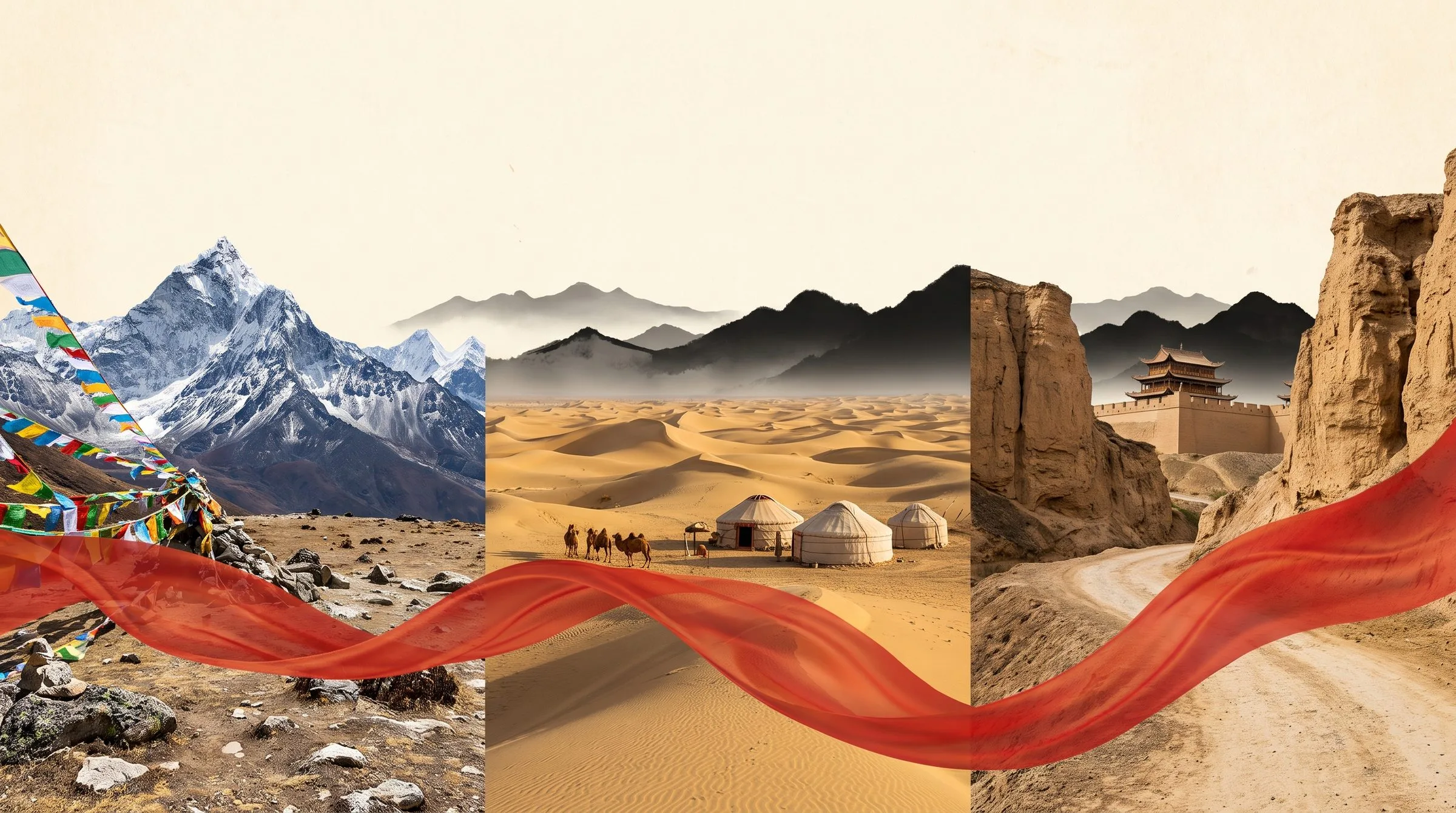
China Western Regions 2026: Tibet vs Xinjiang vs Qinghai vs Yunnan Compared
China's 4 western regions compared for first-time travelers: Tibet (altitude monasteries, hard permits), Xinjiang (Silk Road Uyghur culture, easier access), Qinghai (high-altitude lakes, train to Lhasa), Yunnan (mild climate, ethnic minorities). Best for first-timers, costs, time required, safety.
China’s four western regions — Tibet (西藏), Xinjiang (新疆), Qinghai (青海), and Yunnan (云南) — are the most diverse and least understood parts of the country. They cover 50% of China’s land area but hold only 8% of the population. The landscapes, cultures, languages, religions, and cuisines are recognizably Central Asian, Tibetan, Mongol, and Southeast Asian rather than the Han Chinese majority. For most foreign travelers, the four regions are the highlight of a China trip.
This article compares the four regions for first-time western-China travelers: what to expect, the practical logistics, the costs, the altitude risks, the cultural depth, the ease of access, and the recommended traveler type. The goal is to help you pick the right region (or combination) for your time, budget, fitness, and interests.
For a side-by-side of two of the regions (Xinjiang Northern vs Southern Loop), see our Xinjiang Northern Loop 7-Day Itinerary and Xinjiang Southern Loop 10-Day Itinerary. For a deep-dive on Tibet, see our Lhasa Tibet Travel Guide and Tibet-Nepal Overland Drive. For the broader 2-week China classic route, see our 2 Weeks China Classic Route.
Quick answer — at a glance
| Region | Capital altitude | Best season | First-trip cost | Time required | Permit needed | Easiest access |
|---|---|---|---|---|---|---|
| Tibet | Lhasa 3,650m | Apr-Jun, Sep-Oct | $500-1,000 | 5-8 days | TTB permit + Group Visa | Hardest (tour mandatory) |
| Xinjiang | Urumqi 800m | Apr-Oct (varies by area) | $400-700 | 7-10 days | None (or Border Area Permit for Pamir) | Medium (flights essential) |
| Qinghai | Xining 2,275m | Jun-mid Oct | $300-500 | 3-5 days | None | Easiest (train to Lhasa) |
| Yunnan | Kunming 1,800m | Year-round | $400-700 | 5-10 days | None | Easiest (Kunming hub) |
My recommended first-time priority order: Yunnan → Qinghai → Xinjiang → Tibet. Yunnan is the easiest and most well-trodden for first-timers; Tibet is the most demanding and the most rewarding for repeat China travelers.
The four regions in detail
Tibet — the most demanding and the most rewarding
Tibet is the highest region on Earth, with an average elevation above 4,000m. The capital Lhasa sits at 3,650m, the Everest Base Camp north side at 5,200m, and most of the population lives between 3,500m and 4,500m. The altitude is the #1 challenge; the Tibetan Buddhist culture, the Potala Palace, the Mount Everest views, and the pilgrimage atmosphere are the rewards.
Key facts:
- Capital: Lhasa (population 700,000, altitude 3,650m)
- Major sites: Potala Palace, Jokhang Temple, Drepung Monastery, Sera Monastery, Tashilhunpo Monastery (Shigatse), Rongbuk Monastery and Everest Base Camp, Mount Kailash, Namtso Lake
- Cultural identity: Tibetan Buddhist, with the Gelug (Yellow Hat) school dominant. The Dalai Lama (now in exile in India) is the spiritual leader; the Panchen Lama is recognized by the Chinese government. The Tibetan language, script, and Buddhist art are distinct from Han Chinese.
- Climate: Cold semi-arid. Summer highs 15-22°C, winter lows -15 to -25°C. Low humidity. Strong UV at altitude.
- Visa/permits: China L-visa (or 240h transit at Lhasa) + TTB permit + Group Visa for overland exit to Nepal
- Cost: $500-1,000 for 5 days Lhasa-only, $1,500-2,500 for 8-10 days including EBC
- Time required: 5 days minimum for Lhasa-only, 8-10 days for Lhasa + Shigatse + EBC, 12-14 days for the full loop
- Best season: April-June and September-October
- Easiest access: Fly to Lhasa Gonggar Airport (LXA) via Chengdu, Chongqing, Beijing, or Xi’an
- Food: Tibetan (yak momo, tsampa, thenthuk, butter tea); Sichuan and Nepali influence in Lhasa
- Languages: Tibetan (primary), Mandarin (secondary), limited English
- Tourist density: Moderate — most of the year. Heaviest in October, July-August, and Chinese New Year
- Safety: Generally safe in tourist areas. Altitude sickness is the main risk.
Why pick Tibet:
- The most-photographed Buddhist monasteries in the world (Potala, Jokhang, Tashilhunpo)
- The Everest Base Camp on the north side
- The Tibetan Buddhist culture, the most distinct of China’s 56 ethnic groups
- The pilgrimage atmosphere of Barkhor Circuit and the kora around monasteries
- The Mount Kailash trek (one of the most sacred treks in the world)
- The Namtso Lake and the high-altitude lakes of the Changtang plateau
- The train to Lhasa on the Qinghai-Tibet Railway, one of the great train journeys of the world
Why skip Tibet (for now):
- The mandatory tour (TTB permit + agency) is the most regulated in China
- The altitude is a real risk for heart, lung, and anemia conditions
- The food is limited for vegetarians and non-Buddhist dietary needs
- The 240-hour visa-free transit is too short for most Tibet trips
- The English signage and tourist infrastructure are weaker than Yunnan or Xinjiang
For the full Tibet plan, see our Lhasa Tibet Travel Guide, 3-day Lhasa itinerary, and Tibet-Nepal Overland Drive.
Xinjiang — Silk Road culture and Uyghur food
Xinjiang is China’s largest province (1.66 million sq km, 17% of China’s land area), bordering 8 countries including Mongolia, Russia, Kazakhstan, Kyrgyzstan, Tajikistan, Afghanistan, Pakistan, and India. The province is split by the Tianshan Mountains into the Northern and Southern halves, with the Taklamakan Desert in the southern Tarim Basin. The Silk Road history, the Uyghur (and Kazakh, Kyrgyz, Tajik) ethnic cultures, and the dramatic landscapes (Altay Mountains, Pamir Mountains, Taklamakan) are the main draws.
Key facts:
- Capital: Urumqi (population 4 million, altitude 800m)
- Major sites: Northern Loop (Kanas Lake, Hemu Village, Altay, Tianshan Tianchi); Southern Loop (Kashgar, Karakul Lake, Tashkurgan, Khotan, Hotan); Turpan (Jiaohe ruins, Flaming Mountains)
- Cultural identity: Uyghur (predominant), Han, Kazakh, Kyrgyz, Tajik, Hui, Mongol. The Uyghur are Sunni Muslim, Turkic-language, Central Asian culture, distinct from Han Chinese.
- Climate: Continental, extreme. Urumqi averages -15°C in January, 25°C in July. Kashgar averages -5°C in January, 25°C in July. Khotan and Hotan in the Tarim Basin hit 40°C in summer. The Altay Mountains in the north hit -30°C in winter.
- Visa/permits: China L-visa (or 240h transit at Urumqi or Kashgar). Border Area Permit (¥200-500) for the Pamir Highway and Tashkurgan.
- Cost: $1,500-2,000 for the 7-day Northern Loop, $1,800-2,500 for the 10-day Southern Loop
- Time required: 7 days for the Northern Loop, 10 days for the Southern Loop, 14-18 days for both
- Best season: Northern Loop: September 15 to October 10. Southern Loop: April to mid-October.
- Easiest access: Fly to Urumqi (URC) or Kashgar (KHG). International flights from Almaty, Bishkek, Dushanbe, Tashkent, Islamabad.
- Food: Uyghur (laghman noodles, polo, samsa, lamb skewers, big plate chicken), Kazakh, Hui, Han
- Languages: Mandarin (in Urumqi and Han-majority areas), Uyghur (in Kashgar, Khotan, Hotan), Kazakh (in Altay)
- Tourist density: Moderate — most of the year. Heaviest in October, July-August, and Chinese New Year.
- Safety: Generally safe in standard tourist areas. See the safety section below.
Why pick Xinjiang:
- The Silk Road history (Kashgar, Khotan, Hotan were the southern Silk Road’s three great oasis cities)
- The Uyghur food (the best in China, with lamb skewers, polo, and dumplings)
- The Kashgar Sunday Bazaar (the largest in Central Asia)
- The Kanas Lake and Hemu Village in the Altay Mountains
- The Pamir Highway and Karakul Lake on the Tajikistan border
- The Turpan oasis and the Flaming Mountains
- The easier access (Urumqi and Kashgar are 240h transit ports; no permit needed for most of the province)
Why skip Xinjiang (for now):
- The current UK FCDO, US State Department, and Australia Smartraveller advisories may flag the region
- The food is heavily meat-based (limited vegetarian options outside the Han-majority cities)
- The distances are massive (Kanas is 1,500 km from Beijing; the province is the size of Western Europe)
- The English signage and tourist infrastructure are weaker than Yunnan
- The altitude swings (Urumqi 800m, Kanas 1,340m, Karakul 3,600m, Tashkurgan 3,100m) can be challenging
For the full Xinjiang plan, see our Xinjiang Northern Loop 7-Day Itinerary and Xinjiang Southern Loop 10-Day Itinerary.
Qinghai — the high-altitude lakes and the gateway to Tibet
Qinghai is a sparsely populated province on the northeastern edge of the Tibetan Plateau, with Xining (2,275m) as the capital. The province is home to Qinghai Lake (the largest lake in China), the Kumbum Monastery (one of the most important Tibetan Buddhist monasteries outside Tibet), the Kanbula National Park, and the gateway to the Qinghai-Tibet Railway. The province is a transition zone between the Han Chinese and the Tibetan plateau — culturally, linguistically, and ecologically.
Key facts:
- Capital: Xining (population 2 million, altitude 2,275m)
- Major sites: Qinghai Lake, Kumbum Monastery (Ta’er Si), Kanbula National Park, Chaka Salt Lake, Menyuan Rapeseed Fields, the Qinghai-Tibet Railway (to Lhasa)
- Cultural identity: Tibetan (in the south), Hui (in the east), Han (in Xining and the east), Mongol (in the northwest). The province has the highest concentration of Tibetan Buddhist monasteries outside Tibet.
- Climate: Cold semi-arid. Xining averages -8°C in January, 17°C in July. Qinghai Lake (3,200m) is 5-10°C colder. The province is windy year-round.
- Visa/permits: China L-visa (or 240h transit at Xining). No additional permits.
- Cost: $300-500 for a 3-5 day trip
- Time required: 3 days minimum, 5 days for the full Xining-Qinghai Lake-Kanbula-Kumbum loop
- Best season: June to mid-October (summer is peak for the canola flowers and the grasslands). Winter (December-February) is brutally cold (-20 to -30°C at Qinghai Lake).
- Easiest access: Fly to Xining Caojiabu Airport (XNN) via Beijing, Shanghai, Chengdu, or Xi’an
- Food: Hui Muslim (lamb skewers, niurou mian, ganbei mian), Tibetan (momo, thenthuk, yak butter tea), Han (Sichuan, northwestern Chinese)
- Languages: Mandarin (primary), Tibetan (in rural areas), Hui dialect
- Tourist density: Moderate — most of the year. Heaviest in July-August (canola flower season) and Chinese New Year.
- Safety: Very safe. One of the safest provinces in China.
Why pick Qinghai:
- The most underrated province in China — fewer tourists than Tibet or Xinjiang, similar landscapes and culture
- Qinghai Lake is the largest lake in China, with the famous July-August canola flower bloom
- The Kumbum Monastery is one of the most important Tibetan Buddhist sites outside Tibet
- The Chaka Salt Lake is a mirror-like salt lake, a photographer’s paradise
- The Menyuan Rapeseed Fields in July are the most-photographed canola in China
- The Qinghai-Tibet Railway to Lhasa is one of the great train journeys of the world (Xining to Lhasa, 21 hours, 1,956 km, highest railway in the world)
- The cheapest of the four regions for foreign tourists
- Very low tourist density for most of the year
Why skip Qinghai (for now):
- The province is less well-known internationally than Tibet or Yunnan
- The infrastructure is less foreigner-friendly than Yunnan
- The food is heavily meat-based (limited vegetarian options outside Xining)
- The English signage is weaker than Yunnan
- The winter is too cold for most travelers
For the full Qinghai plan, see our Qinghai Lake Scenic Guide (separate article).
Yunnan — the most diverse and the most foreigner-friendly
Yunnan is China’s most ethnically diverse province, with 25 of China’s 56 ethnic groups represented, including the Yi, Bai, Hani, Dai, Naxi, Tibetan, Lisu, Lahu, and Jingpo minorities. The province ranges from the tropical Xishuangbanna in the south to the snow-capped Meili Snow Mountains in the northwest, with Kunming (the capital, 1,800m) at a near-perfect year-round temperature. Kunming is also the most foreigner-friendly city in western China, with the best infrastructure, the most established backpacker routes, and the easiest internal flights.
Key facts:
- Capital: Kunming (population 7 million, altitude 1,800m)
- Major sites: Kunming (Stone Forest, Yuantong Temple), Dali (Dali Old Town, Cangshan Mountain, Erhai Lake), Lijiang (Lijiang Old Town, Jade Dragon Snow Mountain, Tiger Leaping Gorge), Shangri-La (Songzanlin Monastery, Meili Snow Mountains), Yuanyang Rice Terraces, Xishuangbanna (tropical forests, Dai minority villages)
- Cultural identity: 25 ethnic minorities, each with distinct language, costume, food, and architecture. The Han Chinese are a minority in some areas. The province is also a major Buddhist center (Dali and Lijiang are historically Buddhist, Shangri-La is Tibetan Buddhist).
- Climate: Tropical in the south, alpine in the northwest, mild in Kunming and Dali. Kunming averages 8-20°C in winter, 17-25°C in summer. Lijiang averages 4-18°C in winter. Xishuangbanna averages 15-30°C year-round.
- Visa/permits: China L-visa (or 240h transit at Kunming). No additional permits.
- Cost: $400-700 for 5-7 days, $600-1,000 for 10-14 days
- Time required: 5 days minimum for Kunming-Dali-Lijiang, 7-10 days to add Shangri-La, 14 days to add Xishuangbanna or the Yuanyang Rice Terraces
- Best season: Year-round. Spring (March-May) for the flower festivals, autumn (September-November) for the Yuanyang Rice Terraces harvest, winter (December-February) for the mild Kunming weather and the Siberian red-beak gulls at Dianchi Lake.
- Easiest access: Fly to Kunming Changshui International Airport (KMG) — one of China’s 10 largest airports, with 300+ daily flights to all major Chinese and Asian cities
- Food: Yunnan’s cuisine is one of China’s eight regional traditions. Overlapping rice noodles (过桥米线), steam pot chicken (汽锅鸡), wild mushroom hotpot, Dai-style pineapple rice, Bai-style cured ham, yak meat in Shangri-La.
- Languages: Mandarin (primary in Kunming), Yunnanese (in central Yunnan), Bai, Yi, Naxi, Tibetan, Dai, and other minority languages
- Tourist density: Moderate to high — most of the year. Heaviest in summer (July-August) and Chinese New Year.
- Safety: Very safe. One of the safest provinces in China.
Why pick Yunnan:
- The most diverse ethnic cultures in China, with 25 minorities represented
- The mild year-round climate (Kunming is the “Spring City,” 1,800m, 17°C average annual temperature)
- The easiest access of the four regions (Kunming is a major hub, no permit required)
- The most established backpacker route in China (Kunming-Dali-Lijiang-Shangri-La)
- The most foreigner-friendly infrastructure (English signage, international hotels, well-trodden tourist routes)
- The lowest altitude risk (Kunming 1,800m, Dali 1,900m, Lijiang 2,400m)
- The best food of the four regions (Yunnan cuisine is one of China’s eight great traditions)
- The best winter destination of the four regions (Kunming is 8-20°C in December-February, warmer than the other three)
Why skip Yunnan (for now):
- The Dali and Lijiang Old Towns are heavily commercialized (the “backpacker trail” feel has faded since the 2010s)
- The Yuanyang Rice Terraces and the Meili Snow Mountains are far from Kunming (6-8 hours drive)
- The province is huge (394,000 sq km, the same size as Germany) — seeing it all takes 14+ days
- The summer rain (June-August) can disrupt the Yuanyang Terraces photography
For the full Yunnan plan, see our Dali Honeymoon, Lijiang Honeymoon, and Yuanyang Terraces Scenic Guide.
Side-by-side comparison
| Factor | Tibet | Xinjiang | Qinghai | Yunnan |
|---|---|---|---|---|
| Capital altitude | 3,650m (Lhasa) | 800m (Urumqi) | 2,275m (Xining) | 1,800m (Kunming) |
| Highest major point | 5,200m (EBC) | 3,600m (Karakul) | 4,800m (Amnye Machen) | 5,596m (Kawakarpo) |
| Climate | Cold semi-arid, extreme | Continental, extreme | Cold semi-arid, windy | Mild to tropical |
| Best season | Apr-Jun, Sep-Oct | Apr-Oct (varies) | Jun-mid Oct | Year-round |
| Cultural identity | Tibetan Buddhist | Uyghur/Central Asian Muslim | Tibetan, Hui, Mongol | 25 ethnic minorities |
| Language(s) | Tibetan, Mandarin | Mandarin, Uyghur, Kazakh | Mandarin, Tibetan | Mandarin + 25 minority languages |
| Permits needed | TTB + Group Visa | Border Area Permit (Pamir) | None | None |
| Ease of access | Hardest (tour mandatory) | Medium (flights essential) | Easy (Kunming-train to Lhasa) | Easiest (Kunming hub) |
| English signage | Limited | Limited | Limited | Moderate to good |
| Food diversity | Limited (Tibetan, Sichuan) | High (Uyghur, Han) | Limited (Hui, Tibetan) | Highest (8 great traditions) |
| Vegetarian options | Limited | Limited | Limited | Good |
| Halal-friendly | Limited (some Lhasa restaurants) | Yes (naturally halal) | Yes (Hui Muslim dominant) | Yes (Dali, Kunming) |
| Cost (per day, mid-range) | $80-150 | $80-150 | $60-100 | $60-100 |
| Cost (5-7 day trip) | $500-1,000 (Lhasa only) | $1,500-2,500 (loops) | $300-500 | $400-700 |
| Tourist density | Moderate | Moderate | Low | High |
| Best for | Adventure, culture, photography | Food, history, mountains | Lakes, train to Lhasa, low density | Family, first-timers, mild climate |
| Worst for | First-timers, kids under 8, mobility | Independent travelers, vegetarians | Independent travelers, foodies | Experienced travelers seeking remoteness |
The 2-week grand loop — all four regions in one trip
For travelers with 18-21 days, the most efficient loop covers all four regions with one domestic flight per leg:
Day 1-3: Kunming, Yunnan — Stone Forest, Yuantong Temple, Old Street. Fly to Dali.
Day 4-6: Dali, Yunnan — Dali Old Town, Cangshan, Erhai Lake, Xizhou village. Drive to Lijiang.
Day 7-9: Lijiang, Yunnan — Lijiang Old Town, Jade Dragon Snow Mountain, Black Dragon Pool. Optional day trip to Tiger Leaping Gorge.
Day 10: Fly Lijiang to Xining (via Kunming) — Xining Caojiabu Airport (XNN).
Day 11-12: Xining and Qinghai Lake — Kumbum Monastery, Qinghai Lake drive, Chaka Salt Lake.
Day 13: Fly Xining to Lhasa — Lhasa Gonggar Airport (LXA), 2.5 hours.
Day 14-16: Lhasa, Tibet — Potala Palace, Jokhang Temple, Drepung and Sera monasteries.
Day 17: Fly Lhasa to Urumqi (or Kashgar) — Lhasa to Urumqi is 4 hours, $200-300. Lhasa to Kashgar is 4 hours, $250-400.
Day 18-21: Xinjiang — For the Northern Loop, fly to Burqin for Kanas Lake and Hemu Village. For the Southern Loop, fly to Kashgar and start the Silk Road loop. Budget the rest of the days for one loop.
Total cost: $3,000-5,000 per person excluding international flights.
Pros: All four regions in one trip. Maximizes diversity.
Cons: Exhausting. 4 internal flights in 21 days. Doesn’t allow for weather delays, altitude issues, or visa problems. Most travelers do 1-2 regions per trip and save the others for future visits.
Who should pick which region
Pick Yunnan if:
- This is your first trip to western China
- You have 5-7 days and want a comfortable introduction
- You want a mild climate year-round
- You want the most foreigner-friendly infrastructure
- You are traveling with family (kids 4+ or seniors 60+)
- You want the most diverse ethnic cultures
- You want the best food of the four regions
- You want the lowest altitude risk
Recommended itinerary: Kunming 2 days → Dali 2 days → Lijiang 2 days → Shangri-La 1 day → fly out from Kunming (7-10 days)
Pick Qinghai if:
- You want a low-tourist-density region with similar landscapes to Tibet
- You want to combine with the Qinghai-Tibet Railway to Lhasa
- You want the cheapest western China trip
- You have 3-5 days and want a focused experience
- You want the canola flower bloom at Qinghai Lake (July-August)
- You are a photographer seeking less-crowded locations
Recommended itinerary: Xining 1 day → Kumbum Monastery 1 day → Qinghai Lake drive 1-2 days → fly out from Xining (3-5 days). Or: Xining → Qinghai-Tibet Railway to Lhasa (1 day on the train, then Lhasa for Tibet).
Pick Xinjiang if:
- You want the Silk Road history and Uyghur culture
- You want the best food in China (lamb skewers, polo, dumplings)
- You want dramatic mountain scenery (Kanas, Karakul, Pamir)
- You have 7-10 days and want a focused experience
- You are not put off by the distance from Beijing/Shanghai
- You can handle the long drives within the province
- You want an easier-access alternative to Tibet
Recommended itinerary: Northern Loop (Urumqi → Kanas → Hemu → Tianchi → Urumqi, 7 days) OR Southern Loop (Kashgar → Karakul → Tashkurgan → Khotan → Hotan → fly to Urumqi, 10 days). For both, allow 14-18 days.
Pick Tibet if:
- This is your second or third China trip (you’ve seen Beijing, Shanghai, Xi’an)
- You have 7-10 days and can acclimatize properly
- You want the most-photographed Buddhist monasteries in the world
- You want to see Everest Base Camp on the north side
- You are willing to use a tour agency (mandatory for foreigners)
- You are in good cardiovascular health (altitude risk)
- You can handle the cold, the limited food, and the regulatory paperwork
Recommended itinerary: Lhasa 3-4 days → Shigatse 1 day → Old Tingri 1 night → EBC 1 day → Gyirong border to Nepal 1 day (8-10 days overland). Or: fly into Lhasa, 3-4 days Lhasa, fly out (5-6 days round-trip).
Safety and cultural notes for the four regions
Tibet: Heavy security presence. Avoid discussing politics, the Dalai Lama, and the Cultural Revolution with strangers. Always walk clockwise around monasteries, stupas, and prayer wheels. Don’t touch Tibetan heads. Don’t take photos inside monastery halls without permission. See our China Cultural Etiquette guide.
Xinjiang: Heavy security presence. Avoid discussing politics, religion, and the 2010s security incidents with strangers. The current UK FCDO, US State Department, and Australia Smartraveller advisories should be checked before booking. Dress modestly near mosques; women should bring a headscarf. Don’t eat pork in Muslim-majority areas.
Qinghai: Safe and welcoming. The Hui and Tibetan communities are the most relevant. Standard Chinese etiquette applies. The Kumbum Monastery and the Tibetan Buddhist sites have the same etiquette as Tibet.
Yunnan: Safe and welcoming. The 25 ethnic minorities each have their own etiquette, but the broad rules are: dress modestly at religious sites, ask before photographing people, remove shoes when entering homes, and don’t touch anyone’s head (especially children). The Dai, Hani, and Yi minorities have animist traditions; respect the local religious sites.
Altitude risks (Tibet and Qinghai): Diamox is recommended for all travelers above 3,000m. Severe symptoms (confusion, vomiting, loss of coordination) require immediate descent. Lhasa People’s Hospital and the Xining People’s Hospital have altitude medicine clinics. Travel insurance must cover high-altitude trekking and helicopter evacuation. World Nomads, SafetyWing, and Global Rescue all work.
Common questions and answers
Which is cheapest? Qinghai is the cheapest. $300-500 for a 3-5 day trip. Xinjiang and Yunnan are similar ($400-700 for 5-7 days). Tibet is the most expensive ($500-1,000 for Lhasa-only, due to the tour agency and permit fees).
Which has the best food? Yunnan has the best food of the four regions (one of China’s eight great traditions). Xinjiang has the best meat dishes (lamb skewers, polo, big plate chicken). Tibet has the most distinctive but limited food. Qinghai has the best Hui Muslim food outside Ningxia.
Which has the best photography? All four are world-class. Tibet has the most iconic Buddhist monasteries and mountain views. Xinjiang has the most diverse landscapes (Altay, Pamir, Taklamakan). Qinghai has the canola flowers and the salt lakes. Yunnan has the rice terraces, the snow mountains, and the Old Towns.
Which is best for seniors? Yunnan. Kunming (1,800m) and Dali (1,900m) have minimal altitude risk, well-developed tourist infrastructure, and gentle walking. Tibet, Qinghai, and the higher parts of Xinjiang are too demanding for most seniors.
Which is best for kids? Yunnan. The Old Towns, the Stone Forest, and the ethnic minority villages are engaging for kids 4+. The Lijiang show and the Yuanyang Terraces are family-friendly. Tibet is too high for kids under 8; Xinjiang’s long drives are too demanding for kids under 6; Qinghai is too cold for kids in winter.
Which is best for solo female travelers? Yunnan and Qinghai are the safest. Tibet and Xinjiang are also safe for solo female travelers with the standard precautions, but the mandatory tour group in Tibet means you are not alone on the road.
Can I do all four in 14 days? Technically yes, but it is rushed and exhausting. 18-21 days is the minimum for a comfortable grand loop. Most travelers do 1-2 regions per trip and save the others for future visits.
Can I use the 240-hour visa-free transit? Yes, for all four regions if you fly in and out of the right airports. Lhasa (LXA), Urumqi (URC), Kashgar (KHG), Xining (XNN), and Kunming (KMG) are all 240-hour transit ports. The 240-hour window is too short for Tibet (you need 5-8 days minimum) but works for short Yunnan, Qinghai, or Xinjiang trips if you plan the airports carefully. See our China 240-hour visa-free guide for the rules.
Do I need a Chinese visa for any of them? Standard China L-visa is required for non-qualifying nationalities, or the 240-hour visa-free transit for qualifying ones. Tibet additionally requires the TTB permit and Group Visa, arranged through a tour agency. Xinjiang additionally requires the Border Area Permit for the Pamir Highway and Tashkurgan.
Plan your trip — verified tools
These free tools are built on real, monthly-verified data and help you skip the trial-and-error phase of China trip planning:
- China 240-Hour Visa-Free Transit Checker — 57 countries, 24 provinces, 65 ports. See if you qualify for 10-day visa-free transit.
- China 6-City 5-Day Budget Calculator — Real 2026 prices for 5 days in Beijing, Shanghai, Guangzhou, Chengdu, Xi’an, or Hangzhou.
For the specific Tibet, Xinjiang, or Yunnan plan that fits your dates, see our related guides:
- Lhasa Tibet Travel Guide
- Tibet-Nepal Overland Drive
- Xinjiang Northern Loop 7-Day Itinerary
- Xinjiang Southern Loop 10-Day Itinerary
- Yuanyang Rice Terraces Scenic Guide
- Qinghai Lake Scenic Guide
Verified August 2026 by TravelHubChina Editorial. We re-check prices and policy details monthly so the data doesn’t drift.
Step by step
-
Step 1: Decide which region (or combination) based on your travel style
Active adventure + cultural depth → Tibet. Silk Road history + Uyghur food + mountain scenery → Xinjiang. Alpine lakes + Tibetan Buddhism + train to Lhasa → Qinghai. Mild climate + ethnic minorities + backpacker routes → Yunnan. First-timers should pick one region. Second-timers can combine two (Yunnan + Tibet is the most popular pairing, or Yunnan + Sichuan for pandas). Experienced China travelers doing a 3-week western sweep can do all four. For the cultural-deck comparison, see the table below and the per-region section that follows.
-
Step 2: Check the visa and permit requirements before booking flights
Yunnan, Qinghai, and Xinjiang have standard China visa or 240-hour visa-free transit. Tibet has additional TTB permit + Group Visa requirements arranged through a tour agency. Most travelers qualify for the 240-hour visa-free transit — see our China 240-hour visa-free guide for the 57-country list. Lhasa, Urumqi, Xining, and Kunming airports are all 240-hour transit ports. For Tibet, apply for the China L-visa 5-7 working days before the TTB application, then arrange the TTB through an agency 20+ days before the trip.
-
Step 3: Plan the season carefully — each region has a different sweet spot
Yunnan: year-round, with spring and autumn best. Qinghai: June to mid-October (summer is peak). Tibet: April-June and September-October (avoid monsoon and winter). Xinjiang Northern Loop: September 15 to October 10 for the autumn colors at Kanas. Xinjiang Southern Loop: April to mid-October. The first week of October (Chinese National Day) is the worst week in all four regions — hotels triple, attractions are at maximum capacity, mountain roads are jammed. If your dates are flexible, the week before or after National Day is much more pleasant.
-
Step 4: Book the internal flights, hotels, and tours 1-3 months ahead
Internal flights between Lhasa, Urumqi, Xining, and Kunming are competitive but book 1-2 months ahead for peak season. Hotels in Lhasa, Urumqi, and the Kanas-Hemu area book out 2-3 months ahead for October. Tibet tours must be arranged through an agency 4-6 weeks ahead. Xinjiang 4WD with driver for the Northern or Southern Loop should be booked 1-2 months ahead. Yabuli and Snow Town (in northeast China, not the western regions) book 1-2 months ahead for Christmas and Chinese New Year. Use Trip.com for English booking or work with a Chinese travel agent for Tibet.
-
Step 5: Pack for the altitude, weather, and cultural sensitivity
Altitude is the #1 risk in Tibet, Qinghai, and parts of Xinjiang (Karakul Lake, Tashkurgan). Yunnan is low-altitude and has minimal risk. Pack: a down jacket (essential for Tibet and Qinghai even in summer), layers for the temperature swings, sunscreen (UV 11+ at altitude), sunglasses, sturdy hiking shoes, a power bank, a thermos, and 2-3L of water refillable. For Tibet and Xinjiang mosques, women should bring a headscarf and a long-sleeve layer. For ethnic minority villages in Yunnan, dress modestly and ask before photographing people. For cultural context, see our China Cultural Etiquette guide.
-
Step 6: Sort out the cash, connectivity, and VPN before arrival
Carry 2,000-4,000 RMB cash for the smaller cities and rural areas. Get a China eSIM before arrival (Airalo, Holafly, Nomad) and install a VPN — Google, Instagram, WhatsApp, and Gmail are blocked behind the Great Firewall. For payments, see our Alipay for Foreigners 2026 guide. For the specific apps that work for foreigners (Trip.com, WeChat, Maps.me, Pleco, Dianping), see our essential apps for China guide. For language basics, see our China essential phrases 20 guide.
FAQ
-
Which of the four western regions is best for first-time China travelers?
Yunnan. The province has the mildest climate (Kunming averages 15-25°C year-round), the easiest access (Kunming Changshui Airport is one of China's largest, with 300+ daily flights), the most foreigner-friendly infrastructure (English signage, international hotels, established backpacker routes), and the lowest altitude (Kunming 1,800m, Dali 1,900m, Lijiang 2,400m — minimal altitude risk). The 5-7 day Kunming-Dali-Lijiang-Shangri-La route is the most well-trodden western China path for first-timers. Tibet and Xinjiang are second-trips for most foreign travelers. -
How difficult is it to get a Tibet Travel Permit (TTB) for foreigners?
Difficult. The TTB requires going through a registered Tibet tour agency, which provides a licensed guide, a 4WD with driver (for overland routes), and the hotel bookings. The permit must be applied 20+ days in advance and cannot be modified. Cost: ¥150-300 for the permit, plus the agency fee (typically $200-500 for a 5-8 day trip). The Group Visa (a single visa for the entire tour group, used for the China exit) is arranged by the same agency. Independent travel in Tibet — including self-driving, cycling, or unguided travel — is illegal for foreigners and results in detention at the first checkpoint. -
Is Xinjiang safe for foreign tourists in 2026?
Generally yes for the standard tourist routes. The 2010s security situation has stabilized significantly, with a heavy security presence that is reassuring for most visitors. The main tourist routes — Urumqi to Kanas, Kashgar to Karakul to Tashkurgan, Kashgar to Khotan to Hotan — are heavily trafficked with Chinese tour groups. The current UK FCDO, US State Department, and Australia Smartraveller advisories should be checked before booking — they update frequently. Avoid any side trips to the Kyrgyzstan border, the Wakhan Corridor, or rural areas off the main highway. The Northern and Southern Xinjiang loops in this article are safe for most visitors. -
Can I see all four regions in one 2-3 week trip?
Yes, in 18-21 days. The route is: Kunming 2 days → Dali-Lijiang 3 days → fly to Xining 1 day → Qinghai Lake 2 days → fly to Lhasa 4-5 days → fly to Urumqi 1 day → drive to Kanas 3-4 days → fly out from Urumqi. This is a lot of ground to cover but is the most efficient way to see all four regions. The alternative — 2-3 days per region with internal flights — is also workable but you spend more time in airports. The downside: rushed, exhausting, and you don't get the full depth of any one region. Most travelers do 1-2 regions per trip. -
What is the best time of year to visit the four western regions?
Different regions peak at different times. Yunnan is good year-round (Kunming averages 15-25°C, Dali and Lijiang slightly cooler); spring (March-May) for the flower festivals, autumn (September-November) for the rice terraces. Qinghai peaks in summer (June-August) when the grasslands are green and the canola flowers bloom around Qinghai Lake; winter is brutally cold. Tibet peaks in April-June and September-October; July-August is monsoon, December-February is too cold. Xinjiang has two peaks: the Northern Loop peaks in late September to early October for the autumn colors at Kanas, the Southern Loop peaks in May and September. Avoid Chinese National Day (October 1-7) in all four regions — the crowds are intense.
Related guides
- Culture & Practical
Solo Female Travel in China 2026: The Honest Safety Guide Foreigners Don't Get
China is statistically one of the safer large countries for solo female travelers, but the safety profile is different from Western countries. What works in Tokyo or Paris may not work in Beijing. The 2026 honest guide: 8 specific safety scenarios (DiDi at night, hostel vs hotel, walking alone, foreigner-targeted scams, hostel harassment, menstruation access, dating safety, embassy backup), ranked by frequency and risk. Includes the 5 phrases every solo female traveler should learn, and the 2 scenarios where you should NOT go alone.
5min read
- Culture & Practical
Is It Safe to Travel to China in 2026? The Complete Foreigner's Safety Guide
Comprehensive 2026 safety guide for China travel: crime statistics, region-specific risks, scams targeting foreigners, US State Department advisory, LGBTQ+ safety, female solo travel, health and medical care, embassy registration, and 5-step arrival safety checklist. Plus: is it safe to travel to China right now in 2026 (yes, with normal precautions).
12min read
- Culture & Practical
Chinamaxxing 2026: 12 Chinese Lifestyle Experiences Every Foreigner Should Try
Chinamaxxing is the 2026 trend of foreign visitors going deep into Chinese daily life — hot water, ba duan jin qigong, hanfu, mahjong, tea ceremony, foot baths, and more. 12 hands-on experiences with where to try each one, what to expect, and how to book.
9min read
- Culture & Practical
Beijing Hutongs: A Complete Guide to the City's Ancient Alleyways (History, Map, How to Visit)
Complete guide to Beijing's hutongs: the 700-year history from Yuan dynasty to today, why hutongs are disappearing, the 6 best hutong areas to visit as a foreigner, how to navigate them on foot or by rickshaw, the etiquette rules, and how to experience the real local hutong life (not the tourist-trap version).
8min read
- Culture & Practical
Beijing Hutong Rickshaw Tour: The Complete Guide (2026)
Everything you need to know about Beijing's hutong rickshaw tours: the history of the rickshaw, the 3 main rickshaw stands, how to negotiate a fair price (¥150-300/hour), the 4 most popular routes, what the rickshaw driver typically explains, how to avoid the commission-shop scams, and whether to do a self-walk or rickshaw tour.
7min read
- Culture & Practical
10 Best Beijing Hutongs to Visit (Beyond the Tourist Traps)
Beyond the crowded Nanluoguxiang: 10 specific hutongs worth visiting, from the most authentic residential alleys to the most photogenic, with what makes each one unique, exact addresses, how to get there, and when to visit. Includes a printable walking map.
9min read