Tibet-Nepal Overland Drive 2026: Lhasa to Kathmandu via Gyirong Border
Tibet to Nepal overland driving guide 2026: the Lhasa → Gyantse → Shigatse → Everest Base Camp → Gyirong border route into Nepal, plus paperwork (Tibet Travel Permit, Group Visa, Nepal visa on arrival), and 4WD requirements.
The Lhasa-to-Kathmandu overland drive is the most dramatic road trip in Asia. You start in the Tibetan capital at 3,650m, climb to the 5,200m Everest Base Camp on the north side, descend through the Tibetan plateau to the 1,800m Gyirong border, and end in Kathmandu after crossing the Himalayan foothills. The route takes 8-10 days, requires a 4WD and an obligatory tour agency, and produces some of the most-photographed mountain views on Earth.
The single biggest constraint is regulatory: foreigners cannot self-drive, self-tour, or independent-travel in Tibet. The Tibet Travel Permit (TTB) is tied to a registered tour agency that provides a licensed guide, a 4WD with driver, and the hotel bookings. This guide assumes you accept that constraint and want the full overland experience.
For a 3-4 day Lhasa-only option (fly in, tour, fly out), see our 3-day Lhasa itinerary (separate article). For a broader view of the four western regions of China, see our China Western Region Comparison.
Quick answer — at a glance
| Day | Where | Transport | Overnight |
|---|---|---|---|
| 1 | Lhasa arrival, rest | Airport pickup | Lhasa 4-star |
| 2 | Potala Palace, Jokhang Temple, Barkhor | Walking + guide | Lhasa |
| 3 | Drepung Monastery, Sera Monastery, acclimatize | Guide + car | Lhasa |
| 4 | Drive Lhasa → Gyantse (Pelkor Chode) → Shigatse | 4WD 6-8h | Shigatse |
| 5 | Tashilhunpo Monastery, drive to Old Tingri | 4WD 4-5h | Tingri or guesthouse |
| 6 | Everest Base Camp (Rongbuk Monastery) day trip | 4WD 2h each way | Tingri |
| 7 | Drive Old Tingri → Gyirong border | 4WD 6h | Guesthouse near border |
| 8 | Cross border, drive Gyirong → Kathmandu | 4WD 8-9h | Kathmandu |
Total budget per person (mid-range): $2,000-3,000 Best season: April-June, September-October Permits needed: China L-visa + TTB permit + Group Visa + Nepal visa on arrival Fitness level: Moderate to demanding — altitude is the main risk
Why the overland drive is worth the logistics
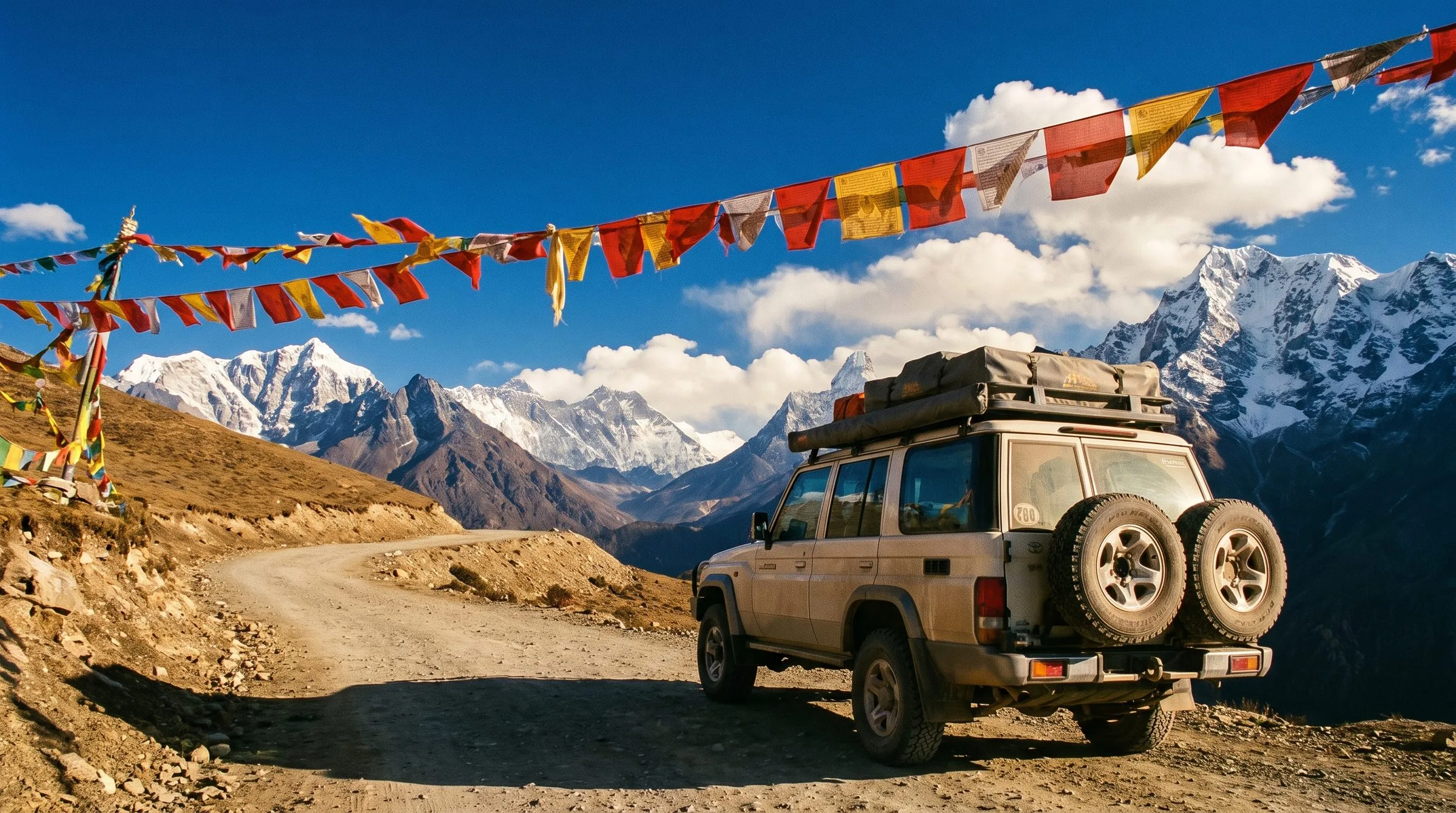
The 1,000-km drive from Lhasa to the Gyirong border crosses three distinct geographic zones: the Yarlung Tsangpo River valley (the Tibet highway from Lhasa to Shigatse), the high-altitude Tibetan plateau (Shigatse to Tingri to EBC at 4,000-5,200m), and the Himalayan descent (Tingri to Gyirong, dropping from 4,300m to 1,800m). The road is paved the entire way; the 4WD is needed for the side trips to EBC and the 100+ km of unpaved mountain road in the last section before the border.
For most travelers, the highlight is the day at Everest Base Camp on the north (Tibetan) side. The view of the north face from Rongbuk Monastery is the classic shot — golden prayer flags, the Rongbuk glacier in the foreground, and the 8,848m summit in the background. The actual EBC viewpoint (the tourist base camp 4 km past the monastery) is at 5,200m and requires a separate 4WD trip; the monastery viewpoint is 5,000m and reachable by regular 4WD.
The second highlight is the descent from Old Tingri to the Gyirong border. The road drops 2,500m in 6 hours through the Himalayan foothills, with switchback after switchback and views back up to the snow-capped peaks. The landscape changes from desert plateau to alpine forest to subtropical vegetation in the space of one afternoon.
The regulatory framework — what you must do
The Tibet tourism system is among the most regulated in the world. Four documents are required:
1. China L-visa (tourist visa): $140-200, apply 5-7 working days in advance at a Chinese consulate. Single entry, 30 days. Multi-entry is possible but not required for the overland trip.
2. Tibet Travel Permit (TTB, 西藏旅游通行证): The key permit. Your tour agency submits it on your behalf, with passport scan, visa scan, and trip dates. Processing time: 20+ working days. Cost: ¥150-300. The TTB is tied to the tour dates and cannot be modified.
3. Group Visa (团体签证): A single paper visa covering the entire tour group, used for the China exit at Gyirong. The agency arranges the Group Visa in Lhasa, usually on Day 2 of the tour. You surrender your passport for 1-2 working days. The Group Visa is single-entry and single-exit.
4. Nepal visa: Obtained on arrival at the Gyirong border or at Kathmandu airport. $50 USD for 30 days (single entry), $125 USD for 90 days. Bring 2 passport photos and the completed application form. Cash USD only — no cards at the border. The Gyirong border Nepal immigration is open 9:30 to 16:30, Monday-Friday; closed Saturday-Sunday.
The agency must also provide:
- A licensed Tibetan guide (mandatory, speaks English or your language)
- A 4WD with driver (mandatory for the overland route)
- All hotel bookings in Tibet
- All transportation within Tibet
- The TTB and Group Visa processing
Independent travel is not an option. Attempting to skip the agency results in detention at the first checkpoint, fines, possible deportation, and a multi-year China entry ban. Some experienced travelers try to use a Chinese friend’s license plate or rent a motorcycle; both are illegal and not recommended.
When to go — the two practical windows
The overland route has a narrow practical season due to the altitude and the monsoon:
- April-June (★★★★★): Clear skies, mild temperatures (5-20°C in Lhasa, -5 to 10°C at EBC), rhododendrons in bloom, low humidity. The best window for Everest views and comfortable travel.
- September-October (★★★★★): Post-monsoon, the clearest mountain views of the year. Temperatures similar to April-June. October is the peak — book 2-3 months ahead.
- July-August (★★): Monsoon. Heavy rain, landslides, clouds obscuring the mountains. The Friendship Highway (G318) has occasional closures. Avoid for EBC views; still workable for the Lhasa-Shigatse section.
- November-March (★★): Winter. High passes close by snow, EBC inaccessible, temperatures -20 to -30°C at EBC. Some agencies still run the Lhasa-Shigatse-Gyirong section but not the EBC side trip.
- First week of October (Chinese National Day): Crowded, hotels triple, roads jammed. Avoid.
For the best balance of weather, crowds, and mountain views, late April to mid-May and mid-September to early October are the two sweet spots.
Day 1 — Lhasa arrival, acclimatize
Arrival: Lhasa Gonggar Airport (LXA) is 65 km from the city, 1 hour by car. The airport is at 3,570m — many travelers feel the altitude immediately on landing. Take it easy: walk slowly, drink water, skip alcohol, eat light.
Hotel rest: Most travelers spend Day 1 sleeping, drinking water, and letting the body adjust. The classic altitude symptoms (headache, fatigue, insomnia) usually appear in the first 24-48 hours. Diamox (acetazolamide) is widely available in Lhasa pharmacies without prescription.
Where to stay: The four best 4-star options in Lhasa are the Shangri-La Lhasa (¥800-1,200), the St. Regis Lhasa (¥1,200-2,000), the Brahmaputra Grand Hotel (¥500-800), and the Kyichu Hotel (¥400-600). For an authentic Tibetan-style option, the House of Shambhala (¥600-900) is a boutique Tibetan-owned hotel in the old town.
For 3-star options, the Yak Hotel and the Tibet Hotel are reliable choices (¥300-500).
Evening — light meal: Try the Lhasa Kitchen (Tibetan food, ¥80-120/person) for a yak momo (dumpling) and tsampa (roasted barley) introduction. Or the Dunya Restaurant (international food, ¥100-150/person) for European-style meals.
Day 2 — Potala Palace, Jokhang Temple, Barkhor Circuit
Potala Palace (布达拉宫): The 7th-century winter palace of the Dalai Lamas, perched on a 130-m hill in the center of Lhasa. The current structure is largely 17th century. Book tickets 1 day in advance (the agency arranges this) — daily visitor cap is 2,300. The visit takes 1.5-2 hours and involves climbing ~300 steps at 3,650m. Take it slow.
Jokhang Temple (大昭寺): The holiest temple in Tibetan Buddhism, founded in the 7th century. The Jowo Shakyamuni statue inside is the most sacred image in Tibet. Allow 1.5 hours. The temple is in the heart of the old town.
Barkhor Circuit (八廓街): The pilgrim circuit around the Jokhang, a 1-km kora route through the old town’s market and residential streets. Pilgrims prostrate every few steps; tourists walk. The kora is the best place to see Tibetan street life, pilgrim interactions, and traditional crafts.
Lunch — Tibetan tea house: The Guangming Gangqiong Sweet Tea House is the local favorite. ¥7 for a cup of sweet tea (po cha), ¥15-20 for a Tibetan-style meal. Sit, watch, repeat.
Afternoon — rest. The altitude is unforgiving. The 300-step climb at the Potala in the morning is enough for one day.
Day 3 — Drepung and Sera Monasteries, more acclimatization
Drepung Monastery (哲蚌寺): Once the largest monastery in the world (10,000 monks), now 700+ monks. 5 km from Lhasa, 30 minutes by car. The monastery is on a hillside at 4,000m. The highlight is the debate courtyard where monks practice philosophical debating with dramatic hand claps. Allow 2 hours.
Sera Monastery (色拉寺): Founded in 1419, 5 km north of Lhasa. The debating courtyard is the main attraction — the monks do a 2-hour debate session every weekday afternoon (3-5pm). Allow 2 hours.
Afternoon — Tibet Museum (西藏博物馆): Free, 2 hours. The best introduction to Tibetan history, the Dalai Lama lineage, and the modern era. Closed Mondays.
Evening — acclimatization day 3. Most travelers are well-adjusted by Day 3. If you still have headaches and fatigue, the Lhasa People’s Hospital has an altitude medicine clinic and can provide oxygen and Diamox injections.
Day 4 — Drive Lhasa to Shigatse via Gyantse (6-8 hours)
The drive: 360 km on the G318 Friendship Highway, 6-8 hours with stops. The road follows the Yarlung Tsangpo River (Brahmaputra upstream), the longest river in Tibet, and crosses the Khamba La pass (4,794m) and the Karo La pass (5,045m). The Kamba La has the first views of Yamdrok Lake (one of the three sacred lakes of Tibet).
Yamdrok Lake (羊卓雍错): 4,441m, 130 km from Lhasa. The classic viewpoint is at the Kamba La pass, with the turquoise lake 1,000m below. Allow 30-45 minutes for the photo stop.
Karola Glacier (卡若拉冰川): 5,045m, 100 km from Gyantse. A hanging glacier that comes down to within 100m of the road. The glacier has retreated significantly since the 1990s due to climate change, but it’s still impressive.
Gyantse (江孜): Small Tibetan town, 4,040m, famous for the Pelkor Chode Monastery and the Gyantse Kumbum (the largest chorten in Tibet, 9 stories, 108 chapels). Allow 1.5 hours for the monastery and kumbum.
Shigatse (日喀则): Tibet’s second-largest city, 3,840m, the traditional seat of the Panchen Lama. The drive from Gyantse is 90 km / 2 hours.
Where to stay in Shigatse: The Shigatse Hotel (¥300-500), the Manasarovar Hotel (¥400-600), or the Tashi Choten Hotel (¥500-800) — the latter is a Tibetan-owned option with cultural performances.
Day 5 — Tashilhunpo Monastery, drive to Old Tingri (4-5 hours)
Tashilhunpo Monastery (扎什伦布寺): Founded in 1447 by the 1st Dalai Lama, the seat of the Panchen Lama since the 17th century. The 26m-tall Maitreya Buddha statue in the Maitreya Hall is the highlight. The monastery survived the Cultural Revolution better than most, so the art and statues are well-preserved. Allow 2 hours.
Drive to Old Tingri (老定日): 350 km, 4-5 hours. The Friendship Highway (G318) continues west, crossing the Tso La pass (4,500m) and entering the high-altitude Tibetan plateau. The landscape becomes increasingly barren — rolling brown hills, occasional nomadic yak camps, and views of the Himalayan range to the south.
Old Tingri (4,300m): A small town with a handful of guesthouses. The accommodation is basic — shared toilets, no hot water, electric blankets for the cold nights. The food is simple Tibetan (yak meat, momo, tsampa). Cost: ¥150-300/night including breakfast and dinner.
Why Old Tingri and not New Tingri: The EBC side trip uses the Old Tingri road, which is 130 km / 3 hours to Rongbuk Monastery. New Tingri is 30 km closer to Lhasa but the road to EBC is 30 km longer from there.
Acclimatization: Sleep in Old Tingri 2 nights before going to EBC. The altitude jump from Shigatse (3,840m) to EBC (5,200m) is too much for one day. Diamox recommended.
Day 6 — Everest Base Camp (Rongbuk Monastery) day trip
Drive to Rongbuk Monastery (绒布寺): 130 km, 3 hours each way. The road climbs steadily, passing the Gawula Pass (5,250m) with views of 4 of the world’s 14 8,000m+ peaks (Everest, Lhotse, Makalu, Cho Oyu). The pass is the highest point of the entire trip.
Rongbuk Monastery (5,000m): The highest monastery in the world, founded in 1902 by a Nyingma lama. The monastery viewpoint has the classic north-face Everest shot. Allow 1-2 hours. The monastery is small but atmospheric; the prayer flags and the wind are the main impressions.
Everest Base Camp (5,200m): The tourist base camp is 4 km past the monastery, requiring a separate 4WD shuttle (¥120). The actual EBC viewpoint has a marker stone, a few souvenir tents, and the best view of the Rongbuk glacier and the north face. Altitude: 5,200m. Stay 30-45 minutes, no longer — the altitude is too high to linger.
Lunch: The Rongbuk Monastery guesthouse serves simple Tibetan food (momo, noodles, tea, ¥30-50). The food is basic but the view is the most-photographed in Tibet.
Back to Old Tingri: 3 hours. Early return is important because the Gawula Pass can have afternoon clouds and occasional snow.
Sunset at Old Tingri: The sunset over the Himalayan range from Old Tingri is one of the most underrated photo opportunities on the trip.
Day 7 — Drive Old Tingri to Gyirong border (6 hours)
The drive: 290 km, 6 hours. This is the most dramatic single day of the trip — the road drops from 4,300m to 1,800m in 6 hours, with switchback after switchback through the Himalayan foothills.
The route: The road follows the Matsang Tsangpo river, then the Gyirong Tsangpo river, descending from the Tibetan plateau to the Nepal-Tibet border. The landscape changes from brown desert plateau to alpine forest to subtropical vegetation in the space of one afternoon.
Border crossing setup: The Chinese side exit is at the Gyirong Port (吉隆口岸), about 20 km from the Tibetan town. The driver will drop you at the China immigration hall. Process:
- China exit: Group Visa checked, passport stamped, luggage scanned. 30-60 minutes.
- Walk or shuttle (¥10) across the no-man’s-land bridge to Nepal side.
- Nepal entry: Visa application form, $50 USD cash, 2 photos, biometric data. 30-90 minutes. The Nepal immigration hall has currency exchange (rupees for USD, poor rate), SIM card vendors, and a small restaurant.
Where to stay on the Nepal side: The border town of Rasuwagadhi has basic hotels (¥20-40) and the slightly larger Syabrubesi, 8 km further, has better options (¥30-60). Most travelers push on to Kathmandu the same day.
Day 8 — Drive or bus to Kathmandu (8-9 hours by 4WD, 14-16 hours by bus)
Option A: Pre-booked 4WD — Most agencies arrange a Nepal-side 4WD to meet you at the border. The drive to Kathmandu is 130 km / 8-9 hours, following the Trishuli River valley through the Himalayan foothills. The road is paved but has many switchbacks and is landslide-prone. Cost: $200-300 per vehicle.
Option B: Shared jeep or bus — From Rasuwagadhi, shared jeeps leave for Kathmandu (¥100-200, 6-8 hours, multiple departures) and tourist buses leave for Kathmandu (¥80-150, 14-16 hours, 1-2 daily). The bus is the cheapest but the slowest.
Option C: Overnight at the border, continue next morning — The Rasuwagadhi and Syabrubesi guesthouses are basic but functional. This adds 1 day to the trip but lets you acclimatize and explore the Langtang Valley entrance.
Kathmandu arrival: The Thamel neighborhood is the foreigner hub — hotels, restaurants, gear shops, tour operators, and the most English-speaking staff. The Boudhanath Stupa, Pashupatinath Temple, and Kathmandu Durbar Square are the main sights. Allow 1-2 days in Kathmandu to decompress from the Tibet altitude and explore.
Alternative return — fly Lhasa to Kathmandu
If 8-10 days is too long, or if the border is closed, fly from Lhasa Gonggar Airport (LXA) to Kathmandu Tribhuvan Airport (KTM). Multiple daily flights on Himalaya Airlines, Sichuan Airlines, and Air China, $400-600 one-way, 1.5 hours.
Why fly instead of drive:
- Save 4-5 days
- Avoid the most demanding parts of the overland
- Weather-independent
- Higher chance of seeing Everest (you fly past the south face at 10,000m)
Why drive instead of fly:
- The overland is the adventure
- The mountain views from the road are different from the flight
- The cultural stops (Gyantse, Shigatse, EBC) are the main reason to come
Practical logistics
Visa and permits
- China L-visa: $140-200, apply 5-7 working days in advance. Single entry, 30 days.
- TTB permit: Arranged by the agency, ¥150-300, 20+ days to process.
- Group Visa: Arranged by the agency in Lhasa, free, requires passport surrender for 1-2 days.
- Nepal visa on arrival: $50 USD (30 days), bring 2 photos. Available at Gyirong border or Kathmandu airport.
Money and connectivity
- China side: 2,000-3,000 RMB cash. Old Tingri guesthouses are cash-only. Tibet has fewer card readers than mainland China.
- Nepal side: 5,000-10,000 NPR (~$40-80) cash for the first day or two. ATMs are widely available in Kathmandu.
- China cash exchange: Bring USD cash and exchange at a Chinese bank (Bank of China) for the best rate. Avoid airport exchanges.
- Nepal cash exchange: The Kathmandu airport and Thamel have money changers — rates are similar to banks.
- Alipay for foreigners: See our Alipay for Foreigners 2026 guide. Works in Lhasa hotels and chain restaurants, limited in Old Tingri and the border.
- Nepal eSIM: Ncell and Nepal Telecom have tourist SIMs at Kathmandu airport ($10-20 for 30 days).
- China eSIM: Get before arrival. See Best eSIM for China 2026.
- VPN: Required for Google, Instagram, WhatsApp. Test before arrival. Note: VPNs in Tibet are monitored more strictly than in mainland China; avoid political content.
Driver and guide
The 4WD with driver and guide is the single most important booking. Cost: $150-250 per day (typically the agency fee), covering:
- 4WD vehicle (Land Cruiser, Prado, or similar)
- Driver with knowledge of the route, the permit checkpoints, and the best viewpoints
- Licensed Tibetan guide (English or your language; Japanese, German, French guides available on request)
- All fuel, tolls, and parking
- Driver and guide accommodation and meals
Tip: $10-20 per day for the guide, $5-10 per day for the driver. Total $200-400 tip for an 8-10 day trip is appropriate for good service.
Health and altitude
- Diamox (acetazolamide): Strongly recommended. Start 1 day before arriving in Lhasa, continue 3-5 days. 125 mg twice daily. Side effects: tingling fingers, frequent urination, mild nausea. Available in Lhasa pharmacies without prescription.
- Oxygen: Most Lhasa, Shigatse, and Old Tingri hotels have oxygen machines or oxygen cylinders. The 4WD typically carries a small oxygen bottle.
- Symptoms to watch: Severe headache, vomiting, confusion, loss of coordination = immediate descent. Lhasa People’s Hospital (in the city) and the Shigatse People’s Hospital (in Shigatse) have altitude medicine clinics.
- Insurance: Travel insurance that covers helicopter evacuation from high altitude. World Nomads and SafetyWing both work for China and Nepal; check the policy for altitude coverage.
Where to stay — by stop
| Stop | Budget (¥) | Mid-range (¥) | Top-end (¥) | Notes |
|---|---|---|---|---|
| Lhasa | 200-400 (Yak Hotel) | 400-800 (Brahmaputra) | 1,200-2,000 (St. Regis) | Stay near the old town |
| Shigatse | 200-300 (Shigatse Hotel) | 400-600 (Manasarovar) | 800-1,200 (Tashi Choten) | Tashi Choten has Tibetan performances |
| Old Tingri | 150-300 (guesthouse) | — | — | Basic, electric blankets, shared toilets |
| Rongbuk (EBC) | 150-300 (monastery guesthouse) | — | — | Simple Tibetan food, shared toilets |
| Gyirong border | 100-200 (Nepal side guesthouse) | — | — | Basic, simple |
| Kathmandu | $20-50 (Thamel hotel) | $50-100 (boutique hotel) | $150-300 (Dwarika’s, Yak & Yeti) | Stay in Thamel for the foreigner hub |
For booking strategy and the apps that work for foreigners, see our China hotel booking guide.
Food — what to eat on the route
Lhasa Tibetan food:
- Yak momo (牦牛饺子): Dumplings filled with yak meat and onion. The most popular Tibetan dish.
- Tsampa (糌粑): Roasted barley flour mixed with butter tea. The staple Tibetan food.
- Thenthuk (藏面): Tibetan-style noodle soup with vegetables and meat.
- Yak butter tea (酥油茶): Salted tea with yak butter. Acquired taste but high-calorie and good for the altitude.
- Sweet tea (甜茶): Tibetan-style milk tea, sweet, similar to Indian chai. The most popular drink in Lhasa.
Shigatse Tibetan food:
- Similar to Lhasa, with a stronger emphasis on noodles and mutton.
Old Tingri and EBC: Simple Tibetan food — momo, thenthuk, fried rice, tsampa. Limited variety. Bring snacks from Lhasa for variety.
Nepal side:
- Dal bhat (दाल भात): Lentils, rice, vegetables, pickle. The national dish. Cheap, filling, vegetarian-friendly.
- Momo (मोमो): Nepali-style dumplings, very similar to Tibetan momo.
- Thukpa (थुक्पा): Tibetan-influenced noodle soup, the staple of the Himalayan region.
- Newari cuisine: The Kathmandu Valley has its own cuisine — chatamari (rice crepe), bara (lentil pancake), choila (spiced grilled meat).
For dietary considerations across the broader region, see our China Muslim Travel Halal Guide — note that Tibetan and Nepali cuisines are often Muslim-unfriendly (pork and alcohol appear in many dishes, especially in Kathmandu).
What to pack
Clothes:
- Down jacket (essential for EBC and the high passes — 0 to 5°C at 4,500-5,200m)
- Windproof outer shell (the mountain wind is brutal)
- Fleece mid-layer
- Thermal underwear (merino or synthetic)
- Quick-dry pants
- Wool socks
- Warm hat and gloves
- Balaclava or buff for the wind at EBC
- Modest clothing for monasteries (no shorts, no bare shoulders)
Gear:
- Power bank (20,000 mAh — Old Tingri and EBC have unreliable electricity)
- Sunscreen (UV 11+ at altitude)
- Sunglasses (essential — snow blindness is a real risk at EBC)
- Brimmed sun hat
- 3-4L water bottle (refillable; bottled water widely available)
- Headlamp (for Old Tingri and EBC at night)
- Daypack
- Hiking shoes for short monastery walks
- Motion-sickness pills (the switchbacks on the Lhasa-Shigatse and Old Tingri-Gyirong legs are intense)
Documents:
- Passport (required for park entry, hotel check-in, and border crossings)
- Printed TTB permit
- Printed Group Visa
- 2 passport photos for the Nepal visa
- $50 USD cash for the Nepal visa
- Printed copies of all bookings (Kathmandu hotel, return flight)
- Travel insurance docs
- 200 USD cash for emergencies
- VPN app installed and tested
- Offline maps downloaded (Lhasa, Shigatse, Old Tingri, Gyirong, Kathmandu)
Toiletries:
- Wet wipes (public restrooms are basic)
- Hand sanitizer
- Sunscreen
- Lip balm (the dry mountain air cracks lips fast)
- Diamox or similar altitude medication (start 1 day before Lhasa)
- Hand warmers (for EBC sunrise)
When NOT to go
- July-August (monsoon): Heavy rain, landslides, clouds obscuring the mountains. The Friendship Highway has occasional closures. Avoid.
- December-February (winter): High passes close by snow, EBC inaccessible, temperatures -20 to -30°C at EBC. Most agencies don’t run the overland in winter.
- First week of October (Chinese National Day): Crowded, hotels triple, roads jammed.
- Saturday-Sunday at the Gyirong border: Nepal immigration is closed on weekends. Plan your border crossing for Monday-Friday.
Costs in detail
For two travelers sharing a 4WD and mid-range hotels:
| Category | Cost per person |
|---|---|
| International flights (or end in Kathmandu) | $600-1,500 |
| China L-visa | $140-200 |
| TTB permit | $30-50 |
| Group visa processing | free (included) |
| Nepal visa on arrival | $50 |
| 4WD with driver and guide, 8 days | $1,200-2,000 |
| Hotel 7 nights in Tibet | $400-800 |
| Kathmandu 1-2 nights | $50-150 |
| Park tickets (Potala, Jokhang, monasteries) | $50-100 |
| Food 8-10 days | $200-300 |
| eSIM | $20-50 |
| Miscellaneous | $100-200 |
| Total per person | $2,000-3,000 |
Budget version (shared tour, 3-star hotels, basic EBC accommodation): $1,500-1,800. Luxury version (5-star Lhasa hotels, private everything, 2 days at EBC): $4,000-6,000. For a full breakdown of China travel costs, see our China Budget 2026 guide.
Safety and cultural notes
General safety: The Lhasa-Shigatse-EBC-Gyirong route is the most-traveled tourist route in Tibet. The Tibetan guide and driver are safety-trained, the 4WD has oxygen, and the hotels in Lhasa and Shigatse have emergency altitude care. Avoid discussing politics, the Dalai Lama, and the Cultural Revolution with strangers — Tibet is heavily monitored.
Cultural etiquette in Tibet:
- Always walk clockwise around monasteries, stupas, and prayer wheels.
- Don’t point the soles of your feet at people or religious images.
- Don’t touch Tibetan heads — even children’s.
- Remove hats when entering temples and monastery halls.
- Don’t take photos inside monastery halls without permission.
- Ask before photographing monks or pilgrims.
- Bring a small gift (fruit, sweets, khatas) if invited to a home.
Cultural etiquette in Nepal:
- Greet with “Namaste” (palms together at chest).
- Remove shoes when entering temples and homes.
- Don’t touch anyone with your feet.
- Public displays of affection are frowned upon.
- Alcohol is restricted in some temples and in the Kathmandu Valley during festivals.
- Dress modestly at Hindu temples (cover shoulders and knees).
Altitude: Lhasa (3,650m), Shigatse (3,840m), Old Tingri (4,300m), EBC (5,200m). The altitude is the #1 risk. Diamox is recommended; severe symptoms require immediate descent. See the Health and Altitude section above.
Border closure risk: The Gyirong border has closed for extended periods in the past (2015 earthquake, 2019-2023 COVID). Confirm with your agency within 1 week of departure.
Travel insurance: Strongly recommended. Must cover high-altitude trekking (EBC at 5,200m), helicopter evacuation, and travel in both China and Nepal. World Nomads, SafetyWing, and Global Rescue all work.
For more on cultural etiquette across China, see our China Cultural Etiquette guide.
Common questions and answers
Is it safe for solo female travelers? Yes, with the standard precautions. The 4WD and guide system means you are not alone on the road. Solo female travelers should book a single supplement for the 4WD, which most agencies offer for a 50-100% upcharge.
Can I include Lhasa and the overland in the same trip? Yes — this is the standard 8-10 day overland route. The Lhasa section is Days 1-3, the overland is Days 4-8.
Can I do the trip in winter? Partially. The Lhasa-Shigatse section works in winter with proper cold-weather gear. The EBC side trip is not possible December-February (the Gawula Pass is closed by snow). The Gyirong border is open year-round.
Can I add a side trip to Mount Kailash? Yes, but it adds 4-5 days and is one of the most demanding treks in the world. Most travelers skip Kailash on a first Tibet trip and plan a separate visit.
Can I bring children? The altitude makes it risky for children under 8. Older children can do the trip with proper Diamox and careful acclimatization. Most agencies require a doctor’s note for children under 12.
What if I want to spend more time at EBC? Add a Day 7 overnight at the Rongbuk Monastery guesthouse (5,000m) and a Day 8 morning at EBC for sunrise, then drive to Old Tingri in the afternoon. This adds 1 day and improves the EBC experience significantly.
What if the border is closed when I arrive? Your agency should have a contingency plan — typically fly Lhasa to Kathmandu ($400-600) or take a 2-day overland via Sichuan and Yunnan (impractical, but possible). Travel insurance with trip cancellation coverage is recommended.
Booking strategy
| Lead time | What to book |
|---|---|
| 3-4 months ahead | Tour agency, TTB permit application, Lhasa Shangri-La for October |
| 1-2 months ahead | China L-visa, internal flights, Kathmandu hotel |
| 2-3 weeks ahead | Final agency confirmation, Kathmandu tours |
| 1 week ahead | Gyirong border status check, cash exchange, last-minute gear |
| 1-2 days ahead | Flight check-in, final altitude preparation |
For general booking strategy and the apps that work best for foreigners, see our China hotel booking guide and China domestic flights guide.
Plan your trip — verified tools
These free tools are built on real, monthly-verified data and help you skip the trial-and-error phase of China trip planning:
- China 240-Hour Visa-Free Transit Checker — 57 countries, 24 provinces, 65 ports. See if if you qualify for 10-day visa-free transit.
- China 6-City 5-Day Budget Calculator — Real 2026 prices for 5 days in Beijing, Shanghai, Guangzhou, Chengdu, Xi’an, or Hangzhou.
Verified August 2026 by TravelHubChina Editorial. We re-check prices and policy details monthly so the data doesn’t drift.
Step by step
-
Step 1: Book a registered Tibet tour agency 4-6 weeks in advance
Foreigners cannot arrange the Tibet Travel Permit independently — it must go through a registered Tibet tour agency. The agency provides: the TTB permit (20+ days to process, ¥150-300), the Group Visa for the China exit, a licensed Tibetan guide, a 4WD with driver, and the hotel bookings in Tibet. Top agencies: Windhorse Tour, Tibet Vista, Tibet Travel, China Tibet Train. The agency fee for the 8-10 day overland is typically $200-500 per person, plus $150-200 per day for the 4WD with driver and guide. Book 4-6 weeks ahead for April-June and September-October; 6-8 weeks for the peak October window.
-
Step 2: Get the right China visa (or confirm 240-hour transit eligibility)
Most travelers use a single-entry China L-visa (tourist visa), valid 30 days, $140-200. The 240-hour visa-free transit is theoretically usable for Tibet but impractical because the overland loop is 8-10 days, and most 240-hour transits only allow entry at specific ports (Beijing, Shanghai, Guangzhou, Chengdu, Kunming, etc.) and exit from a different one. Lhasa airport is a 240-hour transit entry port, but you would need to enter at Lhasa, do the loop, and exit at Kathmandu — which is not officially supported. Apply for the L-visa 5-7 working days in advance.
-
Step 3: Apply for the Tibet Travel Permit (TTB) and Group Visa
The TTB is the entry permit for Tibet. Your tour agency submits it on your behalf, with your passport scan, visa scan, and the trip dates. Processing time: 20+ working days (sometimes faster, never slower). Cost: ¥150-300. The TTB is tied to the tour dates and cannot be changed. The Group Visa is a single paper visa for the entire tour group, used for the China exit at Gyirong border. The agency arranges the Group Visa in Lhasa, usually on Day 2 of the tour. You must give the agency your passport for 1-2 working days to process the Group Visa.
-
Step 4: Plan the acclimatization carefully — altitude is the #1 risk
Lhasa is at 3,650m, Shigatse at 3,840m, Old Tingri at 4,300m, EBC at 5,200m. Most travelers need 2-3 days in Lhasa to acclimatize before going higher. Diamox (acetazolamide) is strongly recommended — start taking it 1 day before arriving in Lhasa, continue for 3-5 days. Symptoms of altitude sickness: headache, nausea, fatigue, insomnia. Severe symptoms (confusion, vomiting, loss of coordination) require immediate descent. Sleep at lower altitudes when possible (e.g., overnight in Shigatse, not Lhatse, before going to EBC). Drink 4-5L of water per day. Avoid alcohol for the first 3-4 days.
-
Step 5: Pack for the altitude, cold, and border crossing logistics
Even in May and September, EBC nights are -5 to 5°C, and the wind chill makes it feel colder. Pack: a down jacket, a windproof outer shell, a fleece mid-layer, thermal underwear, wool socks, a warm hat, gloves, and a balaclava or buff for the wind. For the border crossing: 2 photos for the Nepal visa, $50 USD cash, a printed copy of your hotel booking in Kathmandu, photocopies of all your documents. For the road: snacks, 3-4L of water refillable, motion-sickness pills for the mountain passes, sunscreen (UV 11+ at altitude), and sunglasses.
-
Step 6: Plan the Kathmandu arrival and onward logistics
After crossing at Gyirong, the Nepal side has a 130-km drive to Kathmandu via the Trishuli River valley. Options: (1) pre-booked private 4WD from the agency ($200-300, 8-9 hours, recommended); (2) shared jeep or bus from the border (¥100-200, 14-16 hours, multiple departures per day); (3) overnight at the border town of Rasuwagadhi ($20-30 hotels) then bus the next morning. For your Kathmandu stay, the Thamel neighborhood has the most foreigner-friendly hotels, restaurants, and tour operators. The Kathmandu airport has direct flights to most Asian hubs and some European cities. Most Tibet-Nepal travelers end in Kathmandu and fly home from there, or continue to Chitwan, Pokhara, and the Annapurna trekking region.
FAQ
-
Can foreign tourists self-drive from Lhasa to Kathmandu?
No. All foreign tourists in Tibet must travel with a registered tour agency and a Tibetan guide. Independent travel — including self-driving, motorcycle touring, and bicycle touring — is illegal for foreigners. The Tibet Travel Permit (TTB) is tied to the agency, and the agency is required to provide a guide and a 4WD with driver for overland routes. Attempting independent travel results in detention at the first checkpoint, fines, and possible deportation with a multi-year China entry ban. Some experienced overlanders use a Chinese friend's license plate, but this is illegal and not recommended. -
What documents do I need to cross from Tibet to Nepal by land?
Four documents are required. (1) China visa or 240-hour visa-free transit confirmation (most travelers use a single-entry L-visa for this trip, since 240-hour transit is too short for the 8-10 day loop). (2) Tibet Travel Permit (TTB), arranged by your tour agency, applied 20+ days in advance, ¥150-300. (3) Group Visa (also called Tibet Group Visa), a single visa covering the entire group arranged by the same agency, exit from the Gyirong or Zhangmu border. (4) Nepal visa, obtained on arrival at the Gyirong border or at Kathmandu airport, $50 USD for 30 days, plus 2 photos and a completed application form. -
How long does the Tibet-Nepal overland drive take?
The minimum is 7 days of driving, but 8-10 days is the practical plan to allow for acclimatization. Day 1 Lhasa arrival, Days 2-3 Lhasa sightseeing and acclimatization, Day 4 drive Lhasa to Gyantse to Shigatse (6-8 hours), Day 5 drive Shigatse to Old Tingri (4-5 hours), Day 6 Everest Base Camp side trip (4WD from Tingri, 2 hours each way), Day 7 drive Old Tingri to Gyirong border (6 hours), Day 8 cross border, drive or bus to Kathmandu (8-9 hours drive or 14-16 hours bus). Add 1-2 days for weather delays, especially at EBC. -
Is the Gyirong border open in 2026?
Generally yes, but it has been closed for extended periods — most recently from 2019 to 2023 due to COVID-19 and the 2015 earthquake damage. As of 2026, the Gyirong border is open for tourism year-round, with a 9:30 to 16:30 window for tourists. The Zhangmu border (the historic Friendship Highway route) has been closed for tourism since 2015. The Gyirong-Rasuwagadhi crossing is now the only legal tourist overland route between Tibet and Nepal. Confirm with your tour agency within 1 week of departure — the border can close with little notice due to landslides, weather, or political events. -
What is the best time of year to do the Tibet-Nepal overland drive?
April-June and September-October are the best windows. April-May has clear skies, mild temperatures (5-20°C in Lhasa, -5 to 10°C at EBC), and rhododendrons in bloom. September-October is post-monsoon with the clearest mountain views of the year — the best window for Everest views. Avoid the July-August monsoon (heavy rain, landslides, clouds obscuring the mountains) and the December-February winter (high passes closed by snow, EBC inaccessible, temperatures -20 to -30°C at EBC). The first week of October (Chinese National Day) is crowded — avoid if possible.
Related guides
- Itineraries
3 Days in Lhasa 2026: A First-Timer's Itinerary That Actually Works
A practical 3-day Lhasa itinerary for first-time visitors that respects altitude acclimatization: Day 1 light walking, Day 2 Potala Palace, Day 3 Jokhang + Sera debate, with Tibet Travel Permit guidance and packing list.
- Culture & Practical
Lhasa Tibet Travel Guide 2026: Permits, Altitude, Monasteries, Cost
Lhasa Tibet travel guide for foreign visitors: altitude acclimatization (3,650m), Tibet Travel Permit process, Potala Palace ticket booking, Jokhang Temple, Sera Monastery debates, 5-day Lhasa city + day trips, costs, and the Lhasa-Namtso Lake route.
- Itineraries
China Group Tours in 2026: Complete Guide (Worth It? Best Operators, Costs, and How to Avoid the Traps)
Comprehensive 2026 guide to China group tours: top 6 tour operators (Intrepid, G Adventures, EF, China Highlights, Wild China, Backroads) with prices, group sizes, and reviews. Plus: pros and cons vs independent travel, top 5 sample itineraries (14-day Grand Tour, photography, food, family, adventure), how to avoid shopping trap stops, and whether Tibet, Xinjiang, and Silk Road tours are worth the premium.
10min read
- Itineraries
3 Days in Chengdu: Pandas, Hot Pot, Leshan
The perfect 3-day Chengdu itinerary: Panda Base, Leshan Giant Buddha, Sichuan hot pot, Jinli Street, and tea culture. With prices, transit times, and ticket tips.
10min read
- Itineraries
3 Days in Beijing: Forbidden City + Great Wall
The best 3-day Beijing itinerary for first-time visitors: Forbidden City, Mutianyu Great Wall, Temple of Heaven, Summer Palace, and hutong food tour. With prices, transit times, and ticket tips.
10min read
- Itineraries
4 Days in Xi'an: Terracotta Warriors, City Wall
The best 4-day Xi'an itinerary: Terracotta Warriors, ancient City Wall, Muslim Quarter, Big Wild Goose Pagoda, Mount Hua. With prices, transit times, and ticket tips.
10min read