Lhasa Tibet Travel Guide 2026: Permits, Altitude, Monasteries, Cost
Lhasa Tibet travel guide for foreign visitors: altitude acclimatization (3,650m), Tibet Travel Permit process, Potala Palace ticket booking, Jokhang Temple, Sera Monastery debates, 5-day Lhasa city + day trips, costs, and the Lhasa-Namtso Lake route.
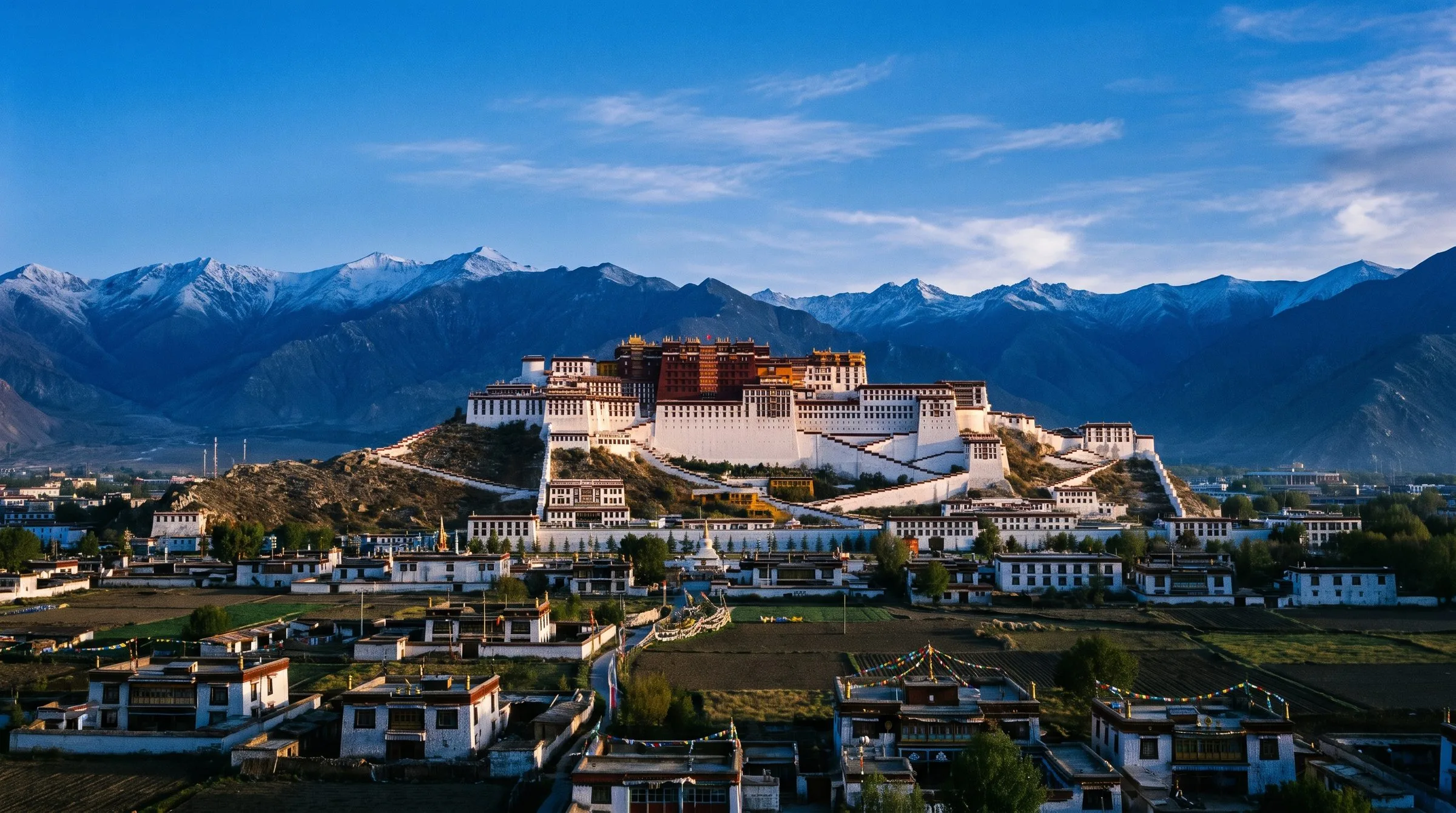
Lhasa (拉萨, Lāsà) is the spiritual capital of Tibet, set on the south bank of the Kyichu River at 3,650m elevation on the Tibetan Plateau. It is one of the highest capital cities in the world and the home of the Potala Palace, the Jokhang Temple, and three great Gelug monasteries that have shaped Tibetan Buddhism for 600 years. The city has a population of about 560,000, of whom roughly half are ethnic Tibetan. Lhasa is part of a broader route through western China that links the plateau to the rest of the country — for travelers coming from Sichuan, the same altitude logic applies to the eastern plateau at Daocheng Yading (4,000-4,700m).
This is a practical guide for foreign visitors in 2026: how the Tibet Travel Permit works, how to acclimatize, the 5-day Lhasa + day trip route, costs, hotels, restaurants, and getting around.
Quick facts
- Elevation: 3,650m above sea level (the Potala Palace sits on a hill at 3,700m)
- Population: ~560,000
- Language: Standard Tibetan (Lhasa dialect) and Mandarin Chinese; English is limited outside hotels and tour agencies
- Currency: Chinese yuan (¥, CNY). $1 = ¥7.20 roughly in 2026
- Time zone: UTC+8 (China Standard Time). Tibet does not observe a separate timezone
- Best season: May to October
- Visa: standard Chinese tourist visa (L) plus Tibet Travel Permit (TTB)
- 240-hour visa-free transit: 57 nationalities can transit through mainland China visa-free for 240 hours. The transit does NOT extend to Tibet, so the TTB is still required for all foreign visitors
The Tibet Travel Permit (TTB) — how it actually works
Independent travel in Tibet is not permitted for foreign passport holders. Every foreigner needs a Tibet Travel Permit (入藏函, TTB) issued by a registered Lhasa-based tour agency and must travel with that agency or a partner agency for the duration. This rule applies whether you fly in, take the train, drive in, or enter from Nepal.
Application process
- Pick a registered Lhasa tour agency 30+ days before travel (15-20 days is the bare minimum). Recommended: Tibet Vista, Wind Horse, Tibet Ctrip, Tibet Travel. The agency must be licensed by the Tibet Tourism Bureau.
- Submit passport copy + Chinese visa copy + travel dates + full itinerary to the agency. The agency will confirm the application in 2-3 working days.
- Pay the agency service fee: ¥500-1,500 per person (the TTB itself is free; the fee covers agency handling, guide, transport, and sometimes hotel booking).
- Receive the TTB by email 3-5 days before travel. Print 3 copies. The agency will also send the original to your hotel in Lhasa, where you will pick it up on arrival.
- Show the TTB at the airport or train station in Chengdu, Xining, or wherever you enter Tibet. The original is required.
- The agency holds the original at the hotel during your stay. The agency will hold the original at the hotel; the front desk will let you see it. Border checkpoints inside Tibet (Yamdrok Pass, Everest Base Camp, Mount Kailash) also check it.
What the TTB does and does not cover
- Covered: Lhasa city, Yamdrok Lake, Ganden Monastery, Namtso Lake, Shigatse, Gyantse
- NOT covered: Mount Everest Base Camp (Tibet side) requires an additional Everest Permit (¥200). Mount Kailash pilgrimage requires a separate Military Permit (arranged 30+ days ahead). The China-Nepal border crossing at Zhangmu requires a Border Permit (¥50).
- NOT required for day trips from Lhasa to Yamdrok, Ganden, or Namtso.
Common permit scams to avoid
- Agencies offering “visa-free Tibet” or “independent Tibet permit” - both are scams. There is no such thing.
- Agencies that ask for the full fee up front with no refund if the permit is denied (the permit is free; only the agency fee is paid).
- Agencies that will not provide a written itinerary or hotel list before you pay.
- Agencies that are not on the Tibet Tourism Bureau list. Ask to see the license.
Altitude acclimatization — the most important section
Altitude sickness is the single biggest risk for first-time visitors to Lhasa. The city is at 3,650m, and the surrounding day trips (Yamdrok 4,400m, Namtso 4,718m) are higher. Mild altitude sickness (headache, fatigue, shortness of breath, insomnia, nausea) affects 30-50% of visitors at 3,650m, and the percentage rises above 4,000m. The condition is rarely dangerous if you acclimatize properly, but it can ruin a trip if you try to do too much on Day 1.
The 24-48 hour rule
Plan to spend the first 24-48 hours in Lhasa doing nothing more than short walks. Do not climb the Potala Palace stairs. Do not take a day trip to Yamdrok or Namtso. Do not drink alcohol. If you can, fly into Lhasa in the morning and arrive at your hotel by noon — this gives you the afternoon to rest and a full Day 2 to acclimatize.
Symptoms and what to do
- Mild (headache, fatigue): drink water, rest, take ibuprofen or paracetamol, do not ascend further. Usually resolves in 24-48 hours.
- Moderate (severe headache, vomiting, dizziness, loss of appetite): descend to lower altitude if possible (Chengdu at 500m is the closest low-altitude city). Take Diamox (acetazolamide) if a doctor has prescribed it. Symptoms usually resolve within 12-24 hours of descent.
- Severe (confusion, loss of coordination, fluid in the lungs, loss of consciousness): this is a medical emergency. Descend immediately and seek medical care. Lhasa People’s Hospital and the Tibet Military Region Hospital have high-altitude emergency departments. Insurance that covers helicopter evacuation is essential.
Prevention checklist
- Start Rhodiola rosea supplements 1-2 weeks before travel (no strong clinical evidence, but widely used in Chinese tourism).
- Drink 3-4L of water daily for the first 3 days. The dry plateau air dehydrates you faster than you expect.
- Avoid alcohol for the first 48 hours and limit it for the first week. Alcohol worsens altitude symptoms and impairs acclimatization.
- Eat light meals for the first 48 hours: tsampa (roasted barley flour), yak butter tea, momos (dumplings), soups. Avoid heavy, greasy, or rich food.
- Sleep with the hotel window cracked for fresh air. Many Lhasa hotels have in-room oxygen machines — request one when booking.
- Ask your doctor about Diamox (acetazolamide) 2-4 weeks before travel if you have a history of altitude sickness, heart, or lung conditions. The typical preventive dose is 125 mg twice daily starting 24 hours before ascent and continuing for 2-3 days at altitude.
- The Qinghai-Tibet Railway from Xining is a gentler ascent than flying — the train climbs from 2,200m to 3,650m over 22 hours with oxygen-supplied sleeper cars. Book the soft sleeper for the best experience.
Getting to Lhasa
Fly into Lhasa Gonggar Airport (LXA)
Lhasa Gonggar Airport is 65 km south of the city center, about 1 hour by airport shuttle (¥30) or 1 hour by pre-booked private car (¥200). Direct domestic flights connect Lhasa to:
| City | Flight time | Daily flights | Round-trip price |
|---|---|---|---|
| Chengdu (CTU) | 2h 30m | 8+ | $200-400 |
| Xining (XNN) | 2h 15m | 3-4 | $180-350 |
| Beijing (PEK) | 4h 30m | 4 | $400-700 |
| Shanghai (PVG) | 5h 30m | 3 | $450-800 |
| Chongqing (CKG) | 3h | 4 | $300-500 |
| Xi’an (XIY) | 3h 30m | 2 | $350-600 |
| Kunming (KMG) | 3h | 2 | $300-550 |
| Kathmandu (KTM) | 1h 30m | 1-2 | $250-500 |
Chengdu is the most reliable entry point — 8+ daily flights, frequent connections from international hubs, and a low-altitude city (500m) to recover in. The altitude jump from Chengdu to Lhasa is sudden; plan a rest day on arrival.
Qinghai-Tibet Railway
The Qinghai-Tibet Railway runs from Xining (2,200m) to Lhasa (3,650m) in 22 hours, crossing the Tanggula Pass at 5,231m. The train has oxygen-supplied sleeper cars (the oxygen comes on automatically above 3,000m) and is the gentler altitude entry. Foreigners must book tickets through a tour agency — independent ticket purchase is not possible. Soft sleeper (4-bed compartment) ¥1,200; hard sleeper (6-bed) ¥600.
5-day Lhasa route
This is the standard 5-day Lhasa + day trip route used by most agencies. It assumes you arrive in the morning of Day 1, acclimatize on Day 1-2, and fly out the evening of Day 5.
Day 1: Arrive Lhasa, acclimatize
- Morning: fly into Lhasa Gonggar Airport. Pick up your Tibet Travel Permit at the hotel. Drink water, eat light.
- Afternoon: short walk around the hotel area. Optional slow walk to Barkhor Street (1.5 km circuit, no stairs) just to see the prayer wheels and pilgrims. Do not climb the Potala Palace or visit any monastery today.
- Evening: dinner at Lhasa Kitchen (Tibetan, mid-range, ¥80-150 per person) or Tashi Restaurant (Tibetan-Nepali, ¥60-120). Sleep by 9 PM.
Day 2: Potala Palace morning + Jokhang Temple afternoon
- 8:30 AM: hotel breakfast. Pre-booked agency car picks you up.
- 9:00 AM: enter the Potala Palace. Pre-booked ticket (¥200 peak / ¥100 off-peak, agency-arranged). Guided tour, 1 hour inside. Climb 200+ stairs to the White Palace entrance. Visit the assembly halls, the Dalai Lama’s living quarters, and the Red Palace with 8 golden funerary stupas. Photography is forbidden in most halls.
- 12:00 PM: light lunch at the hotel or a nearby Tibetan restaurant.
- 1:30 PM: walk 2 km downhill to the Jokhang Temple (¥85). The spiritual heart of Tibetan Buddhism, founded in the 7th century. Allow 1 hour. The main hall has the Jowo Shakyamuni statue, the most sacred statue in Tibet.
- 3:00 PM: walk the Barkhor kora (pilgrim circuit, 1.5 km around the Jokhang, 30-45 min). Buy a prayer wheel or a kata (ceremonial scarf) from the street stalls.
- Evening: dinner at a Tibetan family kitchen. Early sleep.
Day 3: Sera Monastery debate + Drepung Monastery
- 7:30 AM: breakfast. Agency car to Sera Monastery (5 km north, 20 min).
- 9:00-11:00 AM: Sera Monastery debating monks. Arrive by 8:30 AM. The debate happens in the rear courtyard, with two groups of monks — one seated, one standing, clapping hands and gesturing to test their understanding of Buddhist logic. Free entry. Photography is allowed in the courtyard but not in the temples.
- 12:00 PM: lunch near Sera (Tibetan noodle shops, ¥30-50).
- 1:30 PM: taxi or agency car to Drepung Monastery (5 km west, ¥30 by taxi or 20 min by car). The largest of the three great Gelug monasteries, founded in 1416 by Tsongkhapa’s student Jamyang Choje Tashi Pelden. ¥60 entry. Allow 2 hours for the main temples, the debating courtyard, and the panoramic view over the Lhasa valley.
- 4:00 PM: return to Lhasa. Optional stop at the Tibet Museum (free, 1 hour, near the Potala Palace) for context.
- Evening: dinner at Tashi Restaurant or Tibetan Family Kitchen. Early sleep.
Day 4: Day trip to Ganden Monastery OR Yamdrok Lake
Pick one based on weather and altitude tolerance. Both require a full day and an acclimatized driver.
Option A: Ganden Monastery (甘丹寺, 60 km east, 4,300m)
Founded by Tsongkhapa in 1409, Ganden is the most important of the three Gelug monasteries and the seat of the Gelug school. The road climbs over two 4,000m+ passes. The monastery sits on the slopes of Mount Gephel at 4,300m with views over the Lhasa valley. The kora (pilgrim circuit, 45 min) is steep but rewarding. Allow 6-7 hours round-trip. ¥50 entry. Driver ¥800-1,200 for the day.
Option B: Yamdrok Lake (羊卓雍错, 110 km south, 4,400m)
The most-photographed lake in Tibet: turquoise water set against snow-capped Himalayan peaks. The road climbs over the Kamba La Pass (4,794m) with panoramic views. The lake is at 4,400m; walk slowly and limit time at the lakeside. The round trip is 8-10 hours. ¥90 entry. Driver ¥1,000-1,500 for the day. Combine with a stop at the Pelkor Chode Monastery in Gyantse (1h detour, 250 km round trip) if you have the energy.
Day 5: Namtso Lake day trip OR Norbulingka + free day in Lhasa
Option A: Namtso Lake (纳木错, 250 km north, 4,718m)
One of the highest large lakes in the world and a sacred site in Tibetan Buddhism. The road crosses the Nagen La Pass (5,190m) with views of the Nyenchen Tanglha range. The lake is at 4,718m — altitude is severe and the wind is biting. Only attempt after 4 days of acclimatization. Round trip is 10-12 hours. ¥120 entry. Driver ¥1,500-2,500 for the day. Pack warm clothes, sunscreen, and water.
Option B: Norbulingka + Tibet Museum + free day
Norbulingka (罗布林卡, ¥60) is the Dalai Lama’s former summer residence, 2 km west of the Potala Palace. Allow 1.5 hours. The Tibet Museum (free, near the Potala Palace) is excellent for context on Tibetan history. End the day with a final walk around Barkhor Street and a farewell Tibetan dinner.
7-day extension: Shigatse, Gyantse, and Everest Base Camp
If you have 7-9 days, extend south to the historic cities and the Everest region.
- Day 6: drive to Gyantse (260 km, 5h, 4,000m) via Yamdrok Lake. Visit Pelkor Chode Monastery (¥60) and the Gyantse Kumbum stupa (¥40). Overnight in Gyantse.
- Day 7: drive to Shigatse (90 km, 2h, 3,800m). Visit Tashilhunpo Monastery (¥80), the seat of the Panchen Lama. Overnight in Shigatse.
- Day 8-9: drive to Everest Base Camp (350 km, 8-9h, 5,200m). Requires a separate Everest Permit (¥200) and a 4WD vehicle. Most agencies offer 2-3 day EBC packages. The base camp is at 5,200m; altitude sickness is a real risk. Sleep at the base camp tent hostel if you can.
- Day 10: drive back to Lhasa (450 km, 9-10h) or fly from Shigatse to Chengdu.
Where to stay in Lhasa
Lhasa has a range of hotels from budget guesthouses to international luxury. Most are in the central area near Barkhor Street or the Potala Palace.
Mid-range (¥500-1,000 / $70-140 per night)
- Yabshi Phuntsok Palace Heritage Hotel (亚宾馆): a 4-star Tibetan-style hotel 5 min walk from the Jokhang. Traditional Tibetan architecture, in-room oxygen, ¥600-900/night.
- House of Shambhala: boutique hotel in the old town, 12 rooms, Tibetan decor, oxygen-supplied. ¥700-1,200/night.
- Shangri-La Hotel Lhasa (香格里拉拉萨): international 5-star, 280 rooms, heated pool, the only Western-style luxury in Lhasa. ¥1,200-2,500/night.
Budget (¥150-350 / $20-50 per night)
- Tibet House Hotel: simple Tibetan-run guesthouse near Barkhor. ¥200-300/night.
- Khangsar Guest House: backpacker favorite, dorm beds ¥60-80, private rooms ¥150-250. Tibetan family kitchen on-site.
- Lhasa Yak Hotel: budget chain, ¥200-350/night, basic but clean.
What to look for in a Lhasa hotel
- In-room oxygen or portable oxygen concentrators — most mid-range and up hotels provide this on request. Critical for the first 2 nights.
- Heating — Lhasa hotels have heating in winter (October-April) but the quality varies. The Shangri-La and the Yabshi Phuntsok have the best heating.
- Hot water — most Lhasa hotels have hot water 24/7 but the pressure can be weak. Avoid top floors.
- English-speaking staff — only at the international hotels and the better mid-range. Budget places have limited English.
Where to eat in Lhasa
Lhasa has Tibetan, Nepali, Chinese, and a small but growing international food scene. Most restaurants are in the Barkhor Street area and the old town.
Tibetan
- Lhasa Kitchen (拉萨厨房): mid-range Tibetan restaurant popular with both tourists and locals. Try the yak meat curry, the momos, and the butter tea. ¥80-150 per person.
- Tashi Restaurant (扎西餐厅): Tibetan-Nepali fusion, slightly cheaper than Lhasa Kitchen. Good thukpa (Tibetan noodle soup) and momos. ¥60-120 per person.
- Tibetan Family Kitchen (藏家宴): small family-run restaurant near Barkhor. Authentic home-style Tibetan food. ¥50-100 per person.
Nepali and Indian
- New Mandala Restaurant: Nepali and Tibetan, popular with trekkers. Dal bhat, momos, and curries. ¥60-100 per person.
- Tibet Kitchen: another Nepali-Tibetan option, slightly cheaper. ¥50-80 per person.
Chinese
- Dong Cuo Xiang: Sichuan-Tibetan, spicy. ¥50-80 per person.
- Xueyu Restaurant: Cantonese and Sichuan. ¥60-100 per person.
Western / international
- Lhasa’s Third Eye: the only fully Western-style restaurant, near the Yak Hotel. Western breakfast, sandwiches, salads. ¥80-150 per person. Limited hours.
- Summit Cafe: coffee, sandwiches, and Tibetan-style cakes. ¥50-100 per person.
Getting around Lhasa
Lhasa is small (population 560,000, central area about 8 km across) but the layout is unique: the Potala Palace dominates the center, the old town (Barkhor) wraps around the Jokhang, and the monasteries are scattered on the outskirts.
DiDi (China’s Uber) does NOT work in Lhasa
Unlike Beijing, Shanghai, or Chengdu, DiDi does not operate in Lhasa. You cannot call a ride-hailing car with the app. All transport in Lhasa is by taxi (which must be flagged on the street or called by your hotel), private car arranged through your tour agency, or public bus.
Taxi
Taxis are cheap (¥10-30 for most trips in the central area) but drivers speak limited English. Have your hotel write the destination in Chinese characters. Most drivers do not use meters — agree on the price before getting in. The average trip from the Potala Palace to Sera Monastery is ¥30; from the Potala Palace to Drepung Monastery is ¥30; from the airport to the city is ¥200 (fixed price, set by the airport).
Private car with driver
Most tour agencies include a private car with driver for the day in their package. Rates: ¥600-1,200 per day for a sedan, ¥800-1,500 for a 7-seater. For Yamdrok or Namtso day trips, the rate is higher (¥1,000-2,500 per day) because of the distance and the wear on the vehicle.
Public bus
Lhasa has a small public bus network (15+ routes, ¥1-2 per ride) but it is rarely used by foreign visitors due to the language barrier and the altitude stress of crowded buses. Routes 1, 2, 6, and 8 cover the central area and connect to Sera, Drepung, and Norbulingka.
Budget breakdown: 5-day Lhasa
For a mid-range traveler (mid-range hotel, agency package, mid-range restaurants, 1 day trip):
| Item | Cost (per person) |
|---|---|
| Agency package (5 days, including guide, 1 vehicle, 4 nights mid-range hotel) | ¥3,000-5,000 ($420-700) |
| Tibet Travel Permit (TTB) | Free (agency fee included) |
| Potala Palace ticket | ¥200 |
| Jokhang Temple | ¥85 |
| Sera Monastery | Free |
| Drepung Monastery | ¥60 |
| Norbulingka | ¥60 |
| Day trip (Ganden OR Yamtso) | ¥800-1,500 (car + driver + entry) |
| Meals (5 days, mid-range) | ¥500-800 ($70-110) |
| Local transport (taxis, supplements) | ¥200-400 ($30-55) |
| Total ground (5 days) | ¥5,000-8,000 ($700-1,100) |
| Chengdu-Lhasa round-trip flight | ¥1,500-2,800 ($200-400) |
| International flight to Chengdu (US round-trip) | $600-1,200 |
| Total trip (7-8 days from abroad) | $1,500-2,500 per person |
Budget travelers can do it for $1,000-1,500 total. Luxury travelers (Shangri-La Lhasa, private 4WD for day trips, private guide) will spend $4,000-6,000 total.
Practical tips
Money and payment
Lhasa is increasingly cashless, but Tibet is behind mainland China on mobile payment. Alipay and WeChat Pay are accepted in most hotels, restaurants, and shops, but some smaller Tibetan-run places are cash-only. Carry ¥500-1,000 in cash for small purchases, taxis, and monastery donations. ATMs are widely available in central Lhasa (Bank of China, ICBC, Agricultural Bank of China); they accept foreign Visa and Mastercard with a daily limit of ¥2,500-5,000 per transaction.
For broader payment context across China, see the Alipay setup guide and the WeChat Pay setup guide.
Language
Mandarin Chinese is widely spoken. Tibetan (Lhasa dialect) is the local language. English is limited outside the international hotels and the tour agencies. Download Pleco (offline Chinese dictionary) and Google Translate with the Chinese offline pack before arrival. For broader phrase coverage, see the essential Chinese phrases guide.
Connectivity
VPN: access to Google, Instagram, WhatsApp, Facebook, and most Western news sites is blocked in China. Download and configure a VPN before arrival. Recommended: Astrill, ExpressVPN, NordVPN. Free VPNs are unreliable. See the China VPN guide for current recommendations.
SIM card: buy a China Unicom or China Mobile SIM at the airport or any carrier store. The 7-day tourist SIM with 30 GB of data is ¥150-200. eSIM via Airalo or Holafly also works; see the eSIM setup guide.
Cultural etiquette
Tibetan Buddhism is the dominant religion and Tibetan culture is distinct from Han Chinese culture. Show respect at monasteries and around pilgrims. For specific etiquette at Buddhist sites, see the China cultural etiquette guide and the China travel etiquette guide.
- Walk clockwise around monasteries, stupas, and prayer wheels. This is the direction of prayer.
- Ask before photographing monks in religious settings. Most will say yes, but some prefer not to be photographed during prayer.
- Do not touch anyone’s head — the head is sacred in Tibetan Buddhism.
- Do not step on monastery thresholds — step over them.
- Remove your hat when entering a temple.
- Do not point your feet at a person, an altar, or a Buddha statue. Sit with your feet tucked under you.
- Dress modestly at monasteries and the Jokhang. No shorts, no bare shoulders.
- Counterclockwise is reserved for the practice of tantric rituals — visitors should never go counterclockwise.
Photography
Photography is generally allowed in outdoor monastery courtyards, on the Barkhor kora, and at Potala Palace exteriors. Forbidden inside the Potala Palace halls, the Jokhang Temple main hall, and most monastery chapels. Signs in Tibetan, Chinese, and English mark the no-photo zones. Guards are strict. Always ask before photographing monks or pilgrims in religious practice.
Health and safety
Lhasa is safe for foreign visitors. The biggest risks are altitude sickness, traffic (Lhasa traffic is chaotic and many drivers do not respect pedestrians), and petty theft in crowded areas like Barkhor Street. Pickpockets are uncommon but possible. Keep your passport, TTB, and valuables in the hotel safe.
For medical issues, the Lhasa People’s Hospital and the Tibet Military Region Hospital are the main options. Most Lhasa hotels have a doctor on call. Travel insurance that covers high-altitude emergency evacuation is essential — World Nomads, SafetyWing, and IMG all offer Tibet-specific plans.
Best time to visit (detail)
| Month | Temperature | Conditions | Crowds |
|---|---|---|---|
| January | -2 to 8°C | Cold, dry, very quiet | Low |
| February | -1 to 10°C | Cold, possible snow | Low (Losar spikes prices) |
| March | 3 to 13°C | Cool, windy | Low |
| April | 6 to 16°C | Mild, blooming | Moderate |
| May | 10 to 20°C | Warm, clear | High (start of peak) |
| June | 14 to 23°C | Warm, occasional rain | High |
| July | 15 to 24°C | Warm, monsoon rain | High |
| August | 14 to 23°C | Warm, monsoon rain | High |
| September | 12 to 21°C | Warm, clear | High (best) |
| October | 7 to 17°C | Cool, clear | Moderate (best) |
| November | 0 to 12°C | Cold, dry | Low |
| December | -3 to 9°C | Cold, dry, very quiet | Low |
May to October is the standard travel season. September and October are the sweet spot: warm days, low rain, clear skies, fewer crowds than July-August. November to April is winter: cold but very quiet and atmospheric. Avoid Losar (Tibetan New Year) unless you specifically want the festival — flights and hotels sell out and prices spike.
Frequently asked practical questions
Do I need a Chinese visa for Lhasa? Yes, a standard Chinese tourist visa (L) is required for most nationalities. The 240-hour visa-free transit (57 nationalities) does not apply to Tibet — you still need the Tibet Travel Permit and a Chinese visa. See the China 240-hour visa-free guide for details.
Can I use Alipay in Lhasa? Yes, Alipay works in most hotels, restaurants, and shops. Set it up before arrival — see the Alipay setup guide.
Do I need a Chinese SIM card? Recommended. Buy a SIM at the airport or a carrier store. eSIM also works. See the eSIM guide and the essential apps guide.
What should I pack for Lhasa? Layers (T-shirt, fleece, down jacket for evenings), sunscreen (SPF 50+), sunglasses, lip balm, comfortable walking shoes, a hat, a refillable water bottle, and any prescription medication (Diamox if prescribed). For the same packing logic applied to other high-altitude western China destinations, see the Daocheng Yading guide.
Is Lhasa safe for solo female travelers? Yes — Lhasa is one of the safer Chinese cities for solo female travelers, with low violent crime and a strong cultural respect for visitors. The main concerns are altitude sickness and the language barrier. See the solo female travel guide for broader tips.
Can I travel from Lhasa to Kathmandu overland? Yes, but it requires a Chinese group visa, a Tibet Travel Permit, a Border Permit (¥50), and a 4WD vehicle with an agency. The road is the Friendship Highway via Zhangmu and Nyalam. Most agencies offer 3-4 day Lhasa-to-Kathmandu packages ($500-800 per person including the Chinese exit fees). Independent overland travel is not permitted for foreigners.
What about the western scenic wonder destinations comparable to Lhasa? The same Tibetan Plateau extends west into Xinjiang — see the China scenic wonders comparison for the full set.
Is Lhasa expensive? Mid-range, comparable to other Chinese second-tier cities. The agency package and the international flights are the biggest costs. See the China budget 2026 guide for cost comparisons.
Lhasa is one of the most extraordinary travel experiences in Asia — the highest capital in the world, the heart of Tibetan Buddhism, and a window onto a culture that has endured for 1,400 years. The logistics are unusual (the permit, the agency requirement, the altitude) but they are also part of what makes the trip special. Plan ahead, acclimatize properly, and let the city do the rest.
Step by step
-
Book a registered Lhasa tour agency 30 days in advance
Foreigners cannot travel Tibet independently. Contact a registered Lhasa-based tour agency 30 days before travel (15-20 days is the minimum) to arrange the Tibet Travel Permit (TTB), the itinerary, the guide, and the hotel bookings. Recommended agencies: Tibet Vista, Wind Horse, Tibet Ctrip, Tibet Travel. The agency will email you a permit application form; fill it in with passport copy, visa copy, exact entry and exit dates, and full itinerary. Agency fee ¥500-1,500 per person.
-
Fly to Chengdu or Xining, then to Lhasa Gonggar Airport
There are no direct international flights to Lhasa. The standard entry is via Chengdu (CTU) or Xining (XNN), then a domestic flight to Lhasa Gonggar Airport (LXA). Chengdu-Lhasa is 2h30m and runs 8+ flights daily ($200-400 round-trip). Xining-Lhasa is 2h15m with fewer flights but is the rail hub. The altitude jump from Chengdu (500m) to Lhasa (3,650m) is sudden - fly in the morning so you have the afternoon to rest. An alternative is the Qinghai-Tibet Railway from Xining, 22 hours but a gentler altitude gain.
-
Spend 24-48 hours acclimatizing in Lhasa before any sightseeing
Day 1: arrive Lhasa, transfer to hotel, rest, drink 3-4L of water, eat light (try tsampa, yak butter tea, momos), avoid alcohol, sleep early. Day 2 morning: a slow walk around Barkhor Street (the old town kora, 1.5 km circuit at 3,650m, no stairs), visit the Jokhang Temple (¥85, no more than 1 hour), return to hotel for lunch and afternoon rest. Do not climb the Potala Palace, the Sera Monastery stairs, or any high-elevation day trip on Day 1 or Day 2. If you experience severe headache, nausea, or shortness of breath, descend to lower altitude immediately.
-
Day 2: visit Potala Palace in the morning, Jokhang Temple in the afternoon
Pre-book the Potala Palace ticket through your agency for a specific morning time slot (¥200 peak / ¥100 off-peak). The palace is open 9:00 AM - 3:00 PM with last entry at 3:00 PM. All visitors must join a guided tour limited to 1 hour inside. Bring your passport and your Tibet Travel Permit. The palace has 1,300 rooms and 200+ stairs. Photography is forbidden in most halls. After the palace, walk 2 km downhill to the Jokhang Temple (¥85) for the afternoon. Allow 4-5 hours total for the palace + Jokhang.
-
Day 3: Sera Monastery debate (morning) and Drepung Monastery (afternoon)
The Sera Monastery debating monks (色拉寺辩经) gather 9-11 AM Monday to Friday in the rear courtyard. The session is free, dramatic, and one of the most photographed events in Tibet. Arrive by 8:30 AM. From Sera, take a taxi (¥30) to Drepung Monastery (¥60, 5 km west of Lhasa), the largest of the three great Gelug monasteries, founded in 1416. The combined day is 4-5 hours. End with a Tibetan dinner at Lhasa Kitchen (Tibetan Family Kitchen) or Tashi Restaurant.
-
Day 4: day trip to Ganden Monastery (60 km east) or Yamdrok Lake (110 km south)
Choose one day trip. Ganden Monastery (甘丹寺, 4,300m) is the most important of the three Gelug monasteries, founded by Tsongkhapa in 1409. The road climbs over 4,000m passes; allow a full day. Yamdrok Lake (羊卓雍错, 4,400m) is the most-photographed lake in Tibet, with turquoise water against snow-capped peaks; the day trip is 8-10 hours round-trip. Both require an acclimatized driver arranged by your agency ($80-150 for the day, plus ¥100-200 entry fee per site).
-
Day 5: Namtso Lake day trip OR Norbulingka and free day in Lhasa
Namtso Lake (纳木错, 4,718m) is one of the highest large lakes in the world and 250 km north of Lhasa. The day trip is 10-12 hours round-trip with a 5,200m pass. Altitude is severe - only attempt after 4 days of acclimatization and clear weather. Cost: ¥500-700 per person including car, driver, and entry. If altitude is still a concern, spend Day 5 at Norbulingka Summer Palace (¥60, the Dalai Lama's former summer residence), the Tibet Museum (free, 1 hour), and a final walk around Barkhor.
-
Fly out of Lhasa (or take the Qinghai-Tibet Railway back to Xining)
Most travelers fly out the same way they came in. For a gentler exit and a dramatic experience, take the Qinghai-Tibet Railway from Lhasa to Xining (22 hours, ¥400-1,200 depending on class). The train crosses the Tanggula Pass at 5,231m and includes oxygen-supplied sleeper cars. Book train tickets 30 days in advance through your agency (foreigners cannot buy train tickets independently for the Lhasa segment). Allow a buffer day in Xining or Chengdu on arrival and departure for altitude recovery.
FAQ
-
Can foreigners travel to Lhasa and Tibet independently?
No - all foreign passport holders must travel with a registered Lhasa-based tour agency. The agency issues the Tibet Travel Permit (入藏函 / TTB) and arranges the itinerary, transport, guide, and accommodation. Independent travel, self-driving, and even taking a public bus into Tibet are not permitted for foreigners. The agency must be licensed by the Tibet Tourism Bureau. Budget ¥500-1,500 per person for the agency service fee, on top of the trip costs. -
How do I get a Tibet Travel Permit (TTB) for Lhasa?
Apply through a registered Lhasa-based tour agency 15-20 days before your travel date. The agency needs a scanned copy of your passport and Chinese visa, the exact entry and exit dates, and your itinerary. The TTB itself is free; you pay the agency service fee. The permit is checked at the airport or train station on entry to Tibet, and the original is held by your hotel during the stay. Permits for the Mount Everest region, Mount Kailash, and the China-Nepal border require additional permits (边防证). -
How bad is altitude sickness in Lhasa and how should I prepare?
Mild altitude sickness (headache, shortness of breath, fatigue, insomnia) affects 30-50% of visitors at 3,650m. Symptoms usually appear 6-24 hours after arrival and resolve within 48-72 hours. Prevention: start Rhodiola rosea supplements 1-2 weeks before travel, drink 3-4L of water daily, avoid alcohol for the first 48 hours, eat light meals, and ascend slowly. The Qinghai-Tibet Railway from Xining is a gentler ascent than flying. Diamox (acetazolamide) is widely used but requires a doctor's prescription. -
When is the best time to visit Lhasa?
May to October for the best weather: 10-22°C, clear skies, lower rain. June to August is peak season with the highest visitor numbers and the highest prices. September and October are the sweet spot: warm days, low rain, fewer crowds. November to April is winter (cold, -2 to 10°C, possible snow) but very quiet and atmospheric. Avoid Losar (Tibetan New Year, February-March dates vary) unless you specifically want the festival - flights and hotels sell out and prices spike 50-100%. -
How much does a Lhasa trip cost in 2026?
Budget $80-120 per day per person excluding international flights. A 5-day Lhasa trip with day trips: $400-600 ground costs (4 nights mid-range hotel, agency package, Potala Palace ticket ¥200, Jokhang ¥85, meals, day trips). Add the international flight to Chengdu ($600-1,200 from the US or Europe round-trip) and the Chengdu-Lhasa flight ($200-400 round-trip). Total trip from abroad: $1,500-2,500 per person for 7-8 days. Budget travelers can do it for $1,000-1,500; mid-range for $2,000-2,500; luxury for $4,000+.
Related guides
- Itineraries
3 Days in Lhasa 2026: A First-Timer's Itinerary That Actually Works
A practical 3-day Lhasa itinerary for first-time visitors that respects altitude acclimatization: Day 1 light walking, Day 2 Potala Palace, Day 3 Jokhang + Sera debate, with Tibet Travel Permit guidance and packing list.
- Itineraries
Tibet-Nepal Overland Drive 2026: Lhasa to Kathmandu via Gyirong Border
Tibet to Nepal overland driving guide 2026: the Lhasa → Gyantse → Shigatse → Everest Base Camp → Gyirong border route into Nepal, plus paperwork (Tibet Travel Permit, Group Visa, Nepal visa on arrival), and 4WD requirements.
- Culture & Practical
Solo Female Travel in China 2026: The Honest Safety Guide Foreigners Don't Get
China is statistically one of the safer large countries for solo female travelers, but the safety profile is different from Western countries. What works in Tokyo or Paris may not work in Beijing. The 2026 honest guide: 8 specific safety scenarios (DiDi at night, hostel vs hotel, walking alone, foreigner-targeted scams, hostel harassment, menstruation access, dating safety, embassy backup), ranked by frequency and risk. Includes the 5 phrases every solo female traveler should learn, and the 2 scenarios where you should NOT go alone.
5min read
- Culture & Practical
Is It Safe to Travel to China in 2026? The Complete Foreigner's Safety Guide
Comprehensive 2026 safety guide for China travel: crime statistics, region-specific risks, scams targeting foreigners, US State Department advisory, LGBTQ+ safety, female solo travel, health and medical care, embassy registration, and 5-step arrival safety checklist. Plus: is it safe to travel to China right now in 2026 (yes, with normal precautions).
12min read
- Culture & Practical
Chinamaxxing 2026: 12 Chinese Lifestyle Experiences Every Foreigner Should Try
Chinamaxxing is the 2026 trend of foreign visitors going deep into Chinese daily life — hot water, ba duan jin qigong, hanfu, mahjong, tea ceremony, foot baths, and more. 12 hands-on experiences with where to try each one, what to expect, and how to book.
9min read
- Culture & Practical
11 Cultural Mistakes Foreigners Make in China (And How to Avoid Them)
The 2026 etiquette guide for foreigners in China: 11 cultural mistakes that cause offense, awkwardness, or worse — and exactly what to do instead. Covers tipping (don't), chopsticks (don't stick them in rice), gift-giving (red envelope etiquette), loud phone calls, queueing, gift color symbolism, and the 茶 ceremony scam. Plus regional and generational differences.
9min read