Xining Qinghai Travel Guide 2026: Gateway to Tibet, Kumbum Monastery, Qinghai Lake Loop
Xining travel guide for foreign visitors: starting point of Qinghai-Tibet Railway to Lhasa, Kumbum Monastery (¥80, birthplace of Tsongkhapa), Dongguan Mosque, Qinghai Lake 2-day loop, $60-100/day.
Xining (西宁) is the most underrated provincial capital in China, and the most strategic. It sits at 2,200 meters elevation in the eastern part of the Qinghai-Tibet Plateau, the only Chinese city that is genuinely on the plateau without being Tibet proper. It is the capital of Qinghai province, a multi-ethnic melting pot of Han, Hui, Tibetan, Tu, and Salar people; the starting point of the Qinghai-Tibet Railway to Lhasa; the gateway to Qinghai Lake (China’s largest inland lake); and home to the Kumbum Monastery, birthplace of Tsongkhapa, founder of the Gelug school of Tibetan Buddhism that has ruled Tibet since the 15th century.
The city itself is small (1.5 million population) and walkable, with a striking juxtaposition of mosques, Tibetan monasteries, and Hui restaurants in the same neighborhoods. The air is dry, the light is intense, and the temperatures are mild in summer but brutally cold in winter. The combination of altitude, culture, and proximity to some of China’s most extraordinary natural landscapes makes Xining a strong alternative to the standard China itinerary — and a logical stop on the way to Tibet.
This 2-3 day guide covers the four pillars of a Xining trip: Kumbum Monastery (the cultural highlight), the Dongguan Mosque and Hui Quarter (the Islamic culture), Qinghai Museum and Nanshan Park (the city orientation), and the Qinghai Lake loop (the natural highlight). It also covers the practical layer: flights in, the train to Lhasa, food, and where to stay.
Why Xining matters
Xining sits in a valley on the Huangshui River (湟水), 200 km west of Lanzhou, 1,000 km west of Xi’an, and 1,964 km east of Lhasa by rail. The city’s strategic position — at the eastern edge of the plateau, at the natural break between the Loess Plateau and the Qinghai-Tibet Plateau — has made it a Silk Road stop, a Tang-dynasty frontier fortress, a Mongol-period trade center, and a modern transportation hub for all of western China.
The multi-ethnic character is what most foreign visitors notice first. Of Xining’s 1.5 million residents, roughly 50% are Han, 17% are Hui (Chinese-speaking Muslim), 7% are Tibetan, and 4% are Tu (a unique ethnic group found mostly in Qinghai), with smaller numbers of Salar, Mongol, and Manchu. The Hui neighborhood around the Dongguan Mosque is a maze of halal restaurants, Islamic book stores, and head-scarved women; the Tibetan area around the Kumbum Monastery is a different world of prayer wheels, butter lamps, and monks in maroon robes. The Tu people have a unique folk culture with distinctive round hats, embroidered aprons, and a unique language that is one of the oldest in China.
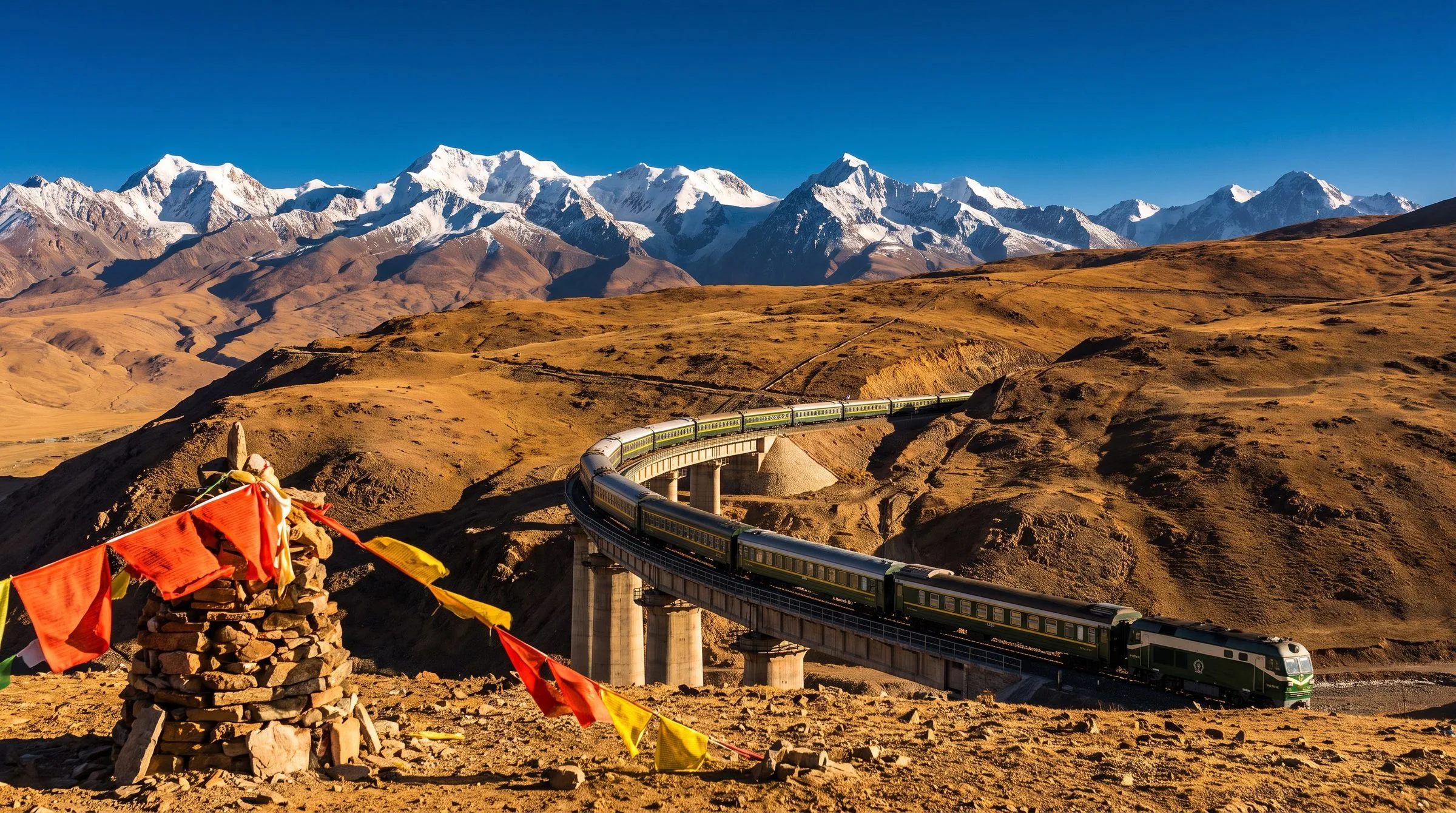
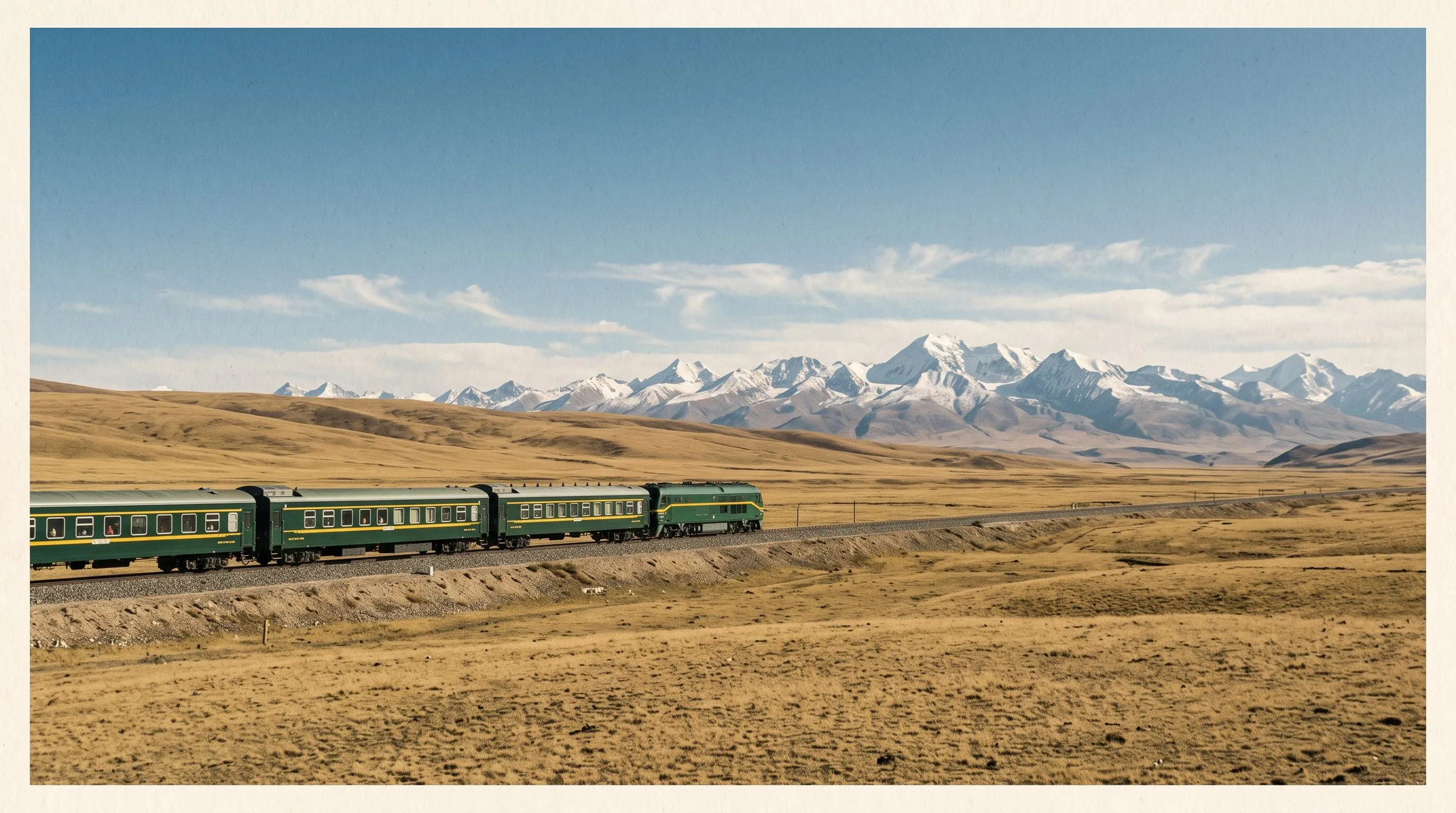
The gateway to Tibet role is what Xining is most famous for internationally. The Qinghai-Tibet Railway, completed in 2006, starts in Xining and runs 1,956 km south to Lhasa, crossing the Tanggula Pass at 5,072 m — the highest point on any railway in the world. The train has become a tourist experience in its own right: it crosses 965 km of permafrost, passes over 675 bridges, and traverses some of the most spectacular plateau scenery in the world. Most foreign travelers to Tibet fly into Lhasa, but the train from Xining is the experience.
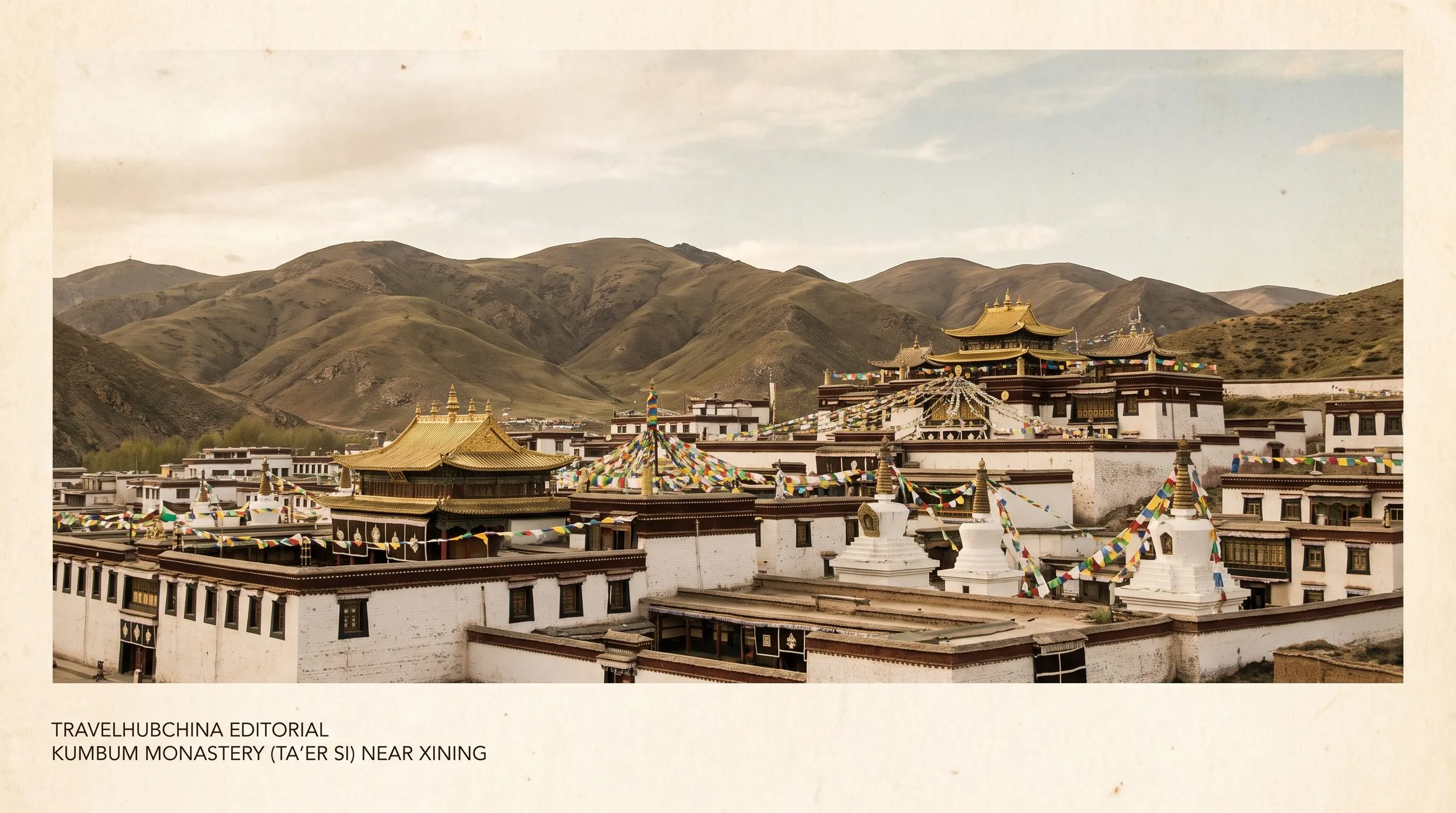
The Kumbum Monastery (塔尔寺) is the cultural highlight. Founded in 1583, it is one of the six great monasteries of the Gelug school of Tibetan Buddhism. The monastery is the birthplace of Tsongkhapa (1357-1419), the founder of the Gelug school and the man whose followers eventually became the Dalai Lamas. Kumbum is one of the most important Tibetan Buddhist sites in the world, and the most visited in Qinghai.
Xining at a glance
- Province: Qinghai
- Population: 1.5 million
- Elevation: 2,200 m (about 7,200 ft) — altitude sickness is possible for sensitive travelers
- Climate: highland continental, cold dry winters (down to -20°C), pleasant warm summers (15-25°C), strong UV year-round
- Main airport: Xining Caojiapu Airport (西宁曹家堡机场), 30 km east of the city
- Main HSR station: Xining Railway Station (西宁站), in the city center
- Closest major cities: Lanzhou (2.5h HSR), Xi’an (4h HSR), Chengdu (5h HSR)
- Best months: June to September (the rapeseed season)
- Visa: 240-hour visa-free transit available via Beijing, Shanghai, Xi’an, Chengdu, and others
Getting to Xining
By air (most common for international visitors)
Xining Caojiapu Airport has direct flights from all major Chinese cities:
- Beijing (2.5h direct, ¥700-1,500 round-trip) — multiple daily
- Shanghai (3h direct, ¥1,000-2,000 round-trip) — 2-3 daily
- Xi’an (2h direct, ¥500-1,200 round-trip) — multiple daily
- Chengdu (1.5h direct, ¥400-1,000 round-trip) — multiple daily
- Guangzhou (3.5h direct, ¥1,200-2,500 round-trip) — 1-2 daily
- Lhasa (2.5h direct, ¥800-2,000 round-trip) — multiple daily
- Lanzhou (1h direct, ¥300-800 round-trip) — frequent
From the airport to the city, take a DiDi (¥80-100, 45 min), the airport bus (¥21, 1h), or a taxi (¥150 fixed).
By train (cheaper, scenic, and direct to Lhasa)
The Qinghai-Tibet Railway runs between Xining and Lhasa, with additional services from Beijing, Shanghai, Chengdu, and Guangzhou that all pass through Xining. The Xining to Lhasa segment is 22 hours, ¥521 ($73) hard sleeper, ¥830 ($116) soft sleeper, with departures daily at multiple times.
For most foreign travelers, taking the train from Xining to Lhasa is the recommended way to get to Tibet — both for the experience and for the gradual altitude adjustment. The train crosses the Tanggula Pass at 5,072 m (the highest point) and provides supplemental oxygen through the carriage outlets.
Other train routes:
- Xining to Lanzhou (HSR 1.5h, ¥84) — the standard connection to eastern China
- Xining to Chengdu (HSR 5h, ¥350) — runs through the beautiful Gansu-Qinghai corridor
- Xining to Dunhuang (HSR 4h direct, new 2025 line, ¥250)
- Xining to Golmud (HSR 3h, ¥180) — gateway to the Qaidam Basin and the northern Tibet Highway
Where to stay
Xining’s hotel scene is concentrated in the city center (around the Qinghai Provincial Museum, the central square, and the Dongguan Mosque) and along the West Railway Station area (the HSR station, convenient for early trains to Lhasa).
City center (recommended for cultural sightseeing)
- Budget (¥150-300 / $21-42): Xining Youth Hostel (clean dorms, central), Hanting Express Xining (chain budget, near the museum)
- Mid-range (¥400-800 / $56-112): Xining Hotel (4-star, central, classic Chinese hotel), Sanwant Hotel Xining (4-star, near the mosque), Qinghai Plaza Hotel (4-star, near the night market)
- Luxury (¥1,000-2,500 / $140-350): Sofitel Xining (5-star, modern), Kempinski Hotel Xining (5-star, near the museum), Qinghai Mansion (5-star, the historic provincial guesthouse)
West Railway Station (best for early trains to Lhasa)
- Mid-range (¥300-600 / $42-84): Vienna Hotel West Station, Holiday Inn Express Xining West Station
- Luxury (¥700-1,500 / $98-210): Wyndham Grand Plaza Royale Xining (5-star, near the HSR station)
For most travelers, stay in the city center for the cultural sightseeing. The West Railway Station area is better for travelers with a tight Tibet train schedule.
Top sites in Xining and Qinghai
1. Kumbum Monastery (塔尔寺)
The single most important site in Qinghai, and the cultural reason most foreign visitors come to Xining.
History: Kumbum was founded in 1583 around the birthplace of Tsongkhapa (1357-1419), the founder of the Gelug school of Tibetan Buddhism. Tsongkhapa was born in the Tsongkha area of the Huangshui valley, near present-day Xining, and the Kumbum site (the “100,000 Image” monastery) was built to commemorate his birthplace. The monastery is one of the six great Gelug monasteries (along with Ganden, Sera, Drepung, Tashilhunpo, and Labrang), and was a major center of Tibetan Buddhist learning for 440 years.
What to see:
- The Eight Stupa Temple (八宝如意塔) — eight white stupas lining the entrance, commemorating the eight great events of Buddha’s life
- The Great Golden Tile Temple (大金瓦殿) — the main hall, with a gold-tiled roof and a 1.6-ton silver stupa said to mark Tsongkhapa’s exact birthplace
- The Sutra Hall (大经堂) — the main assembly hall, where 200+ monks gather for daily prayer
- The Butter Sculpture Hall (酥油花馆) — the museum of butter sculptures, a unique Tibetan art form where monks sculpt elaborate Buddhist figures from yak butter. The sculptures are replaced annually before Losar (Tibetan New Year, February-March)
- The Medical College (医学院) — the traditional Tibetan medical school
- The Tsongkhapa Birthplace Stupa — the main stupa inside the Great Golden Tile Temple
Practical information:
- Address: Huangzhong County, 30 km south of Xining (湟中县)
- Hours: 8:00 AM - 5:00 PM (April-October), 9:00 AM - 4:30 PM (November-March)
- Entry: ¥80 ($11)
- Photography: free outside, ¥0 inside most halls, with a few restricted halls
- How long: 2.5-3 hours
- Reaching it: DiDi (¥80-100, 45 min), bus 909 from Xining Railway Station (¥7, 1h), tour bus from the Xining tourist center (¥60 round-trip with 2-hour monastery tour)
What to bring: modest clothing (no shorts, shoulders covered), walking shoes (the monastery is on a hill), sunscreen (the high-altitude sun is intense), and water.
What to do after: lunch at the monastery vegetarian restaurant (the monastery has a famous vegetarian buffet, ¥60-80 per person, all vegetable-based Tibetan food), then return to Xining or continue to the Tibetan township of Huangzhong.
2. Dongguan Mosque (东关清真大寺)
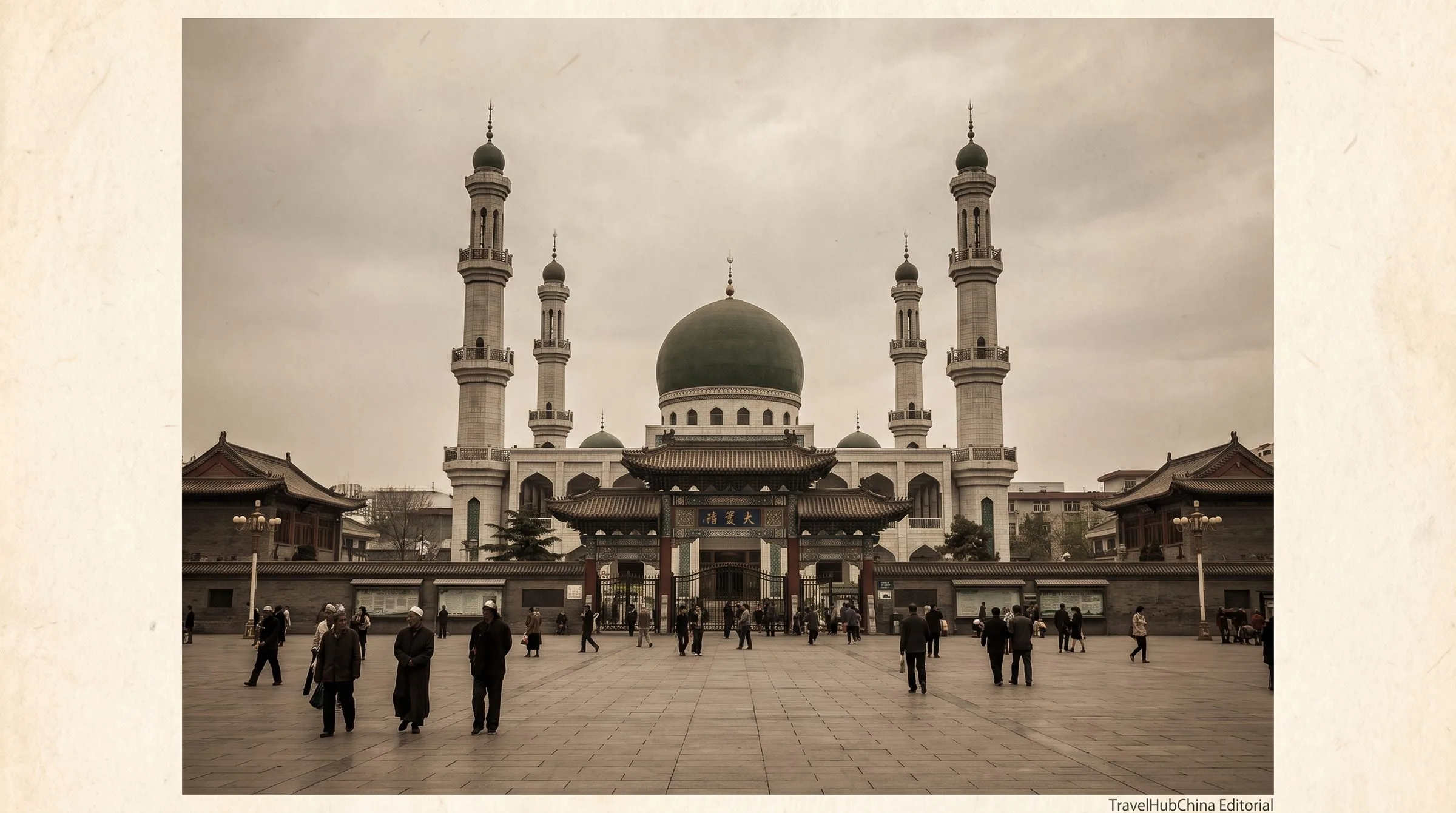
One of the four great mosques of northwest China and the largest mosque in Qinghai. Founded in 1380 during the Ming dynasty, the current complex was rebuilt in 1914 and expanded multiple times since.
The complex: the main prayer hall can hold 25,000+ worshippers, making it one of the largest mosques in the world. The architecture combines traditional Chinese temple style (curved tile roofs, central axis layout) with Islamic elements (the minarets, the Arabic calligraphy, the green dome on the central hall). The most photogenic feature is the green dome and the two 30-m minarets, visible from across the city.
Practical information:
- Address: 21 Dongguan Street (东关大街21号)
- Hours: 8:00 AM - 8:00 PM, closed during Friday noon prayer
- Entry: Free, with a ¥0-30 donation expected
- How long: 1-1.5 hours
- Reaching it: walk from most central hotels (10-15 min), or DiDi (¥10-15)
Rules for non-Muslim visitors:
- Modest dress: no shorts, no short skirts, no sleeveless tops
- Women should cover their hair inside the prayer hall (scarves are provided at the entrance if you don’t have one)
- No alcohol or pork products on the premises
- The main prayer hall is closed to non-Muslims during the five daily prayers, especially the Friday noon prayer
- Photography is allowed outside, restricted inside the prayer hall
Best time to visit: between prayers, when the mosque is quiet and photogenic. The call to prayer (adhan) is one of the most evocative sounds in Xining, audible from across the city center.
3. Qinghai Provincial Museum (青海省博物馆)
A free provincial museum in the city center, well-curated and an essential orientation before visiting the Kumbum Monastery and Qinghai Lake. The collection covers the natural history of the Qinghai-Tibet Plateau, the Silk Road history of Qinghai, the Tibetan and Hui ethnic cultures, and the development of the Qinghai-Tibet Railway.
Practical information:
- Address: 58 West Street (西大街58号)
- Hours: 9:00 AM - 5:00 PM, closed Mondays
- Entry: Free, ID/passport required
- How long: 2-2.5 hours
- Reaching it: walk from most central hotels (10-15 min), or DiDi (¥10-15)
Highlights:
- The Qinghai-Tibet Plateau wildlife diorama — snow leopards, Tibetan antelope, wild yaks
- The Silk Road trade goods exhibition — Tang-dynasty silk, gold, and silver
- The Tibetan Buddhist art exhibition — thangkas, butter sculptures, prayer wheels
- The Hui minority culture exhibition — Islamic art, calligraphy, traditional clothing
- The Qinghai-Tibet Railway exhibition — photos and artifacts from the railway construction
Audio guide in English ¥20.
4. Nanshan Park (南山公园)
A free city park on the south side of Xining, on a hill overlooking the city. The park has a panoramic viewpoint at the top, several Tibetan and Hui religious sites, and a good walk.
Practical information:
- Address: Nanshan Road (南山路)
- Hours: 6:00 AM - 9:00 PM
- Entry: Free
- How long: 1.5-2 hours
- Reaching it: DiDi to the bottom of the hill (¥20, 20 min from the city center), then walk up (30 min) or take the cable car (¥30 round-trip)
What to see:
- The Nanshan Temple (南山寺) — a Tibetan Buddhist temple complex
- The panoramic view of Xining from the top, especially at sunset
- The Qiyan Pagoda (七雁塔) — a small pagoda on the hill
- The wildlife — many of Xining’s free-roaming Tibetan mastiffs and the occasional yak
Best time: late afternoon, for the sunset view.
5. Qinghai Lake (青海湖)
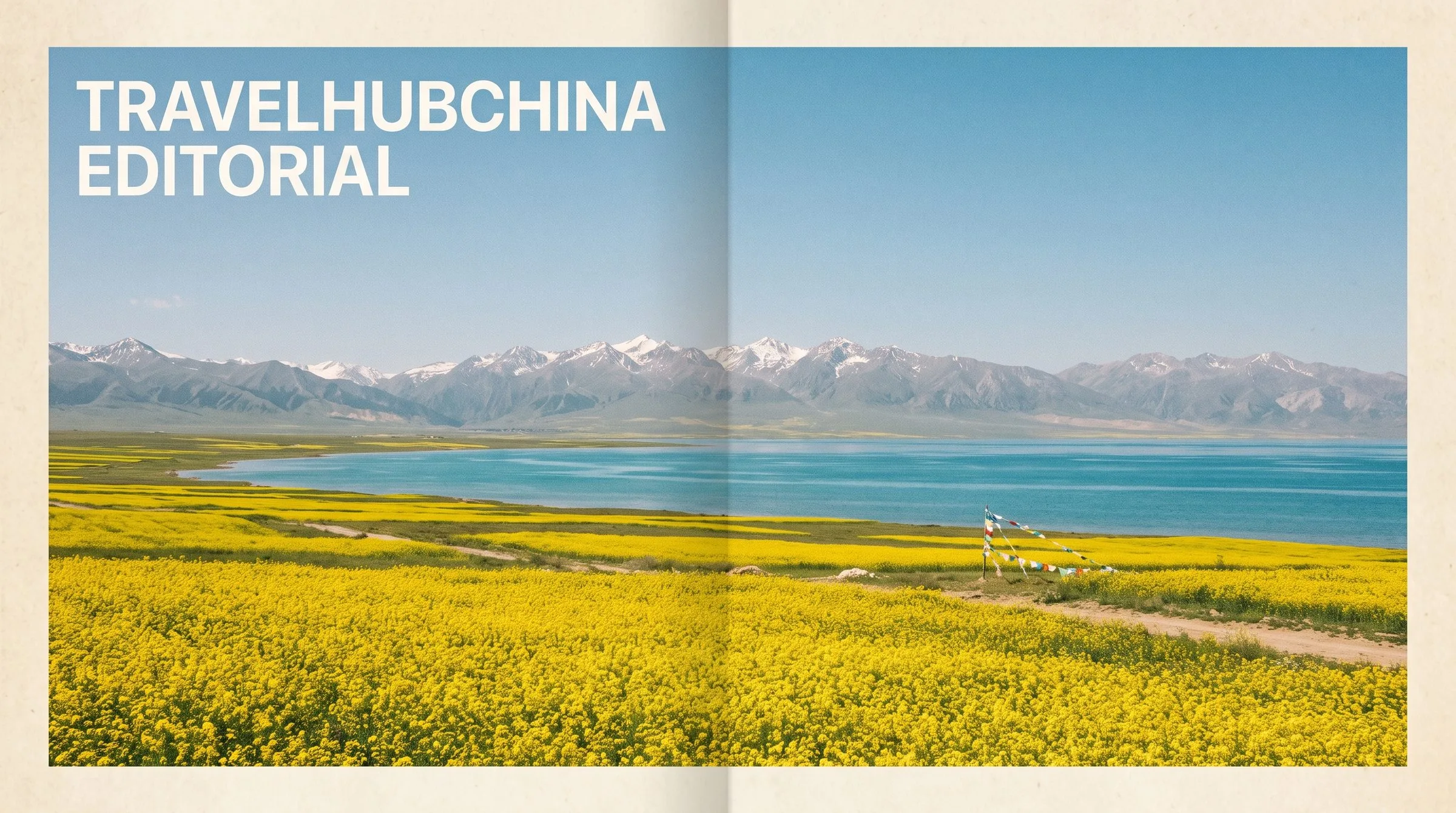
China’s largest inland lake and one of the most popular natural sites in the northwest. The lake is 4,500 km² (about the size of Connecticut), 150 km west of Xining, at 3,200 m elevation. The lake is saline (the water is drinkable but not tasty), surrounded by grasslands, mountains, and the small Nanshan mountain range.
The Qinghai Lake loop is one of China’s most popular self-drive or cycle trips. The loop is about 360 km, taking 2-3 days, passing through Tibetan villages, rapeseed fields, and the lake shore.
What to see at the lake:
- The lake itself — the deep blue water against the yellow rapeseed fields (in July) is one of the iconic images of western China
- The Nanshan Peninsula — the closest point of the lake to the road, the most photogenic
- The Sand Island (沙岛) — a small sandy peninsula on the north side
- The Bird Island (鸟岛) — a small island in the northwest, famous for the migratory birds that visit in May-June
- The rapeseed fields (油菜花) — July, when the entire west side of the lake is covered in yellow flowers
- The Tibetan villages — small Tibetan townships around the lake, with prayer flags, yurts, and the occasional yak herd
Practical information:
- Hours: 24 hours
- Entry: ¥100 ($14) per person at the main entry points (April-October), ¥50 ($7) in winter
- How long: 1 day for a quick visit, 2-3 days for the full loop
- Best time: July (rapeseed blooming), August (Naadam Festival in the surrounding grasslands), September (autumn colors, fewer crowds)
- Reaching it: DiDi round trip from Xining (¥500-700, 5-6h, 1 day only), tour bus (¥200-300 round-trip with 1-2h lake visit), or hire a car for the day (¥700-1,000)
Cycling the lake: experienced cyclists do the full 360-km loop in 3-4 days, sleeping in Tibetan tents or small guesthouses. Bike rental is available at the main entry points, ¥60-100/day.
Overnight at the lake: there are Tibetan tent camps (藏族帐篷) on the south and east sides of the lake, with simple beds, a central fire pit, and home-cooked Tibetan food. Cost: ¥300-600 per person per night, including dinner and breakfast. The most popular is the Heimahe (黑马河) tent area, on the west side, famous for the sunrise over the lake. Book in advance for July-August.
6. Other sites in and around Xining
- Tibetan Medical Museum (藏医药博物馆, in the Kumbum Monastery complex, ¥0 with monastery ticket) — an interesting small museum of Tibetan traditional medicine
- Huangshui River Bridge (湟水河大桥) — a popular evening walking area, with local Tibetan and Hui residents
- Xining Nanshan Forest Park (free) — for a half-day hike
- The Hui Quarter Walking Tour (free) — walk the streets around the Dongguan Mosque, browse the halal food shops, visit a Hui restaurant for lunch
- Menyuan Rapeseed Fields (门源油菜花, 2h west of Xining) — the most spectacular rapeseed fields in Qinghai, July only
Food in Xining
Xining’s food culture is a mix of Tibetan, Hui, and northwest Chinese cuisine. The most distinctive dishes are:
Hui (halal) food
- Hand-pulled noodles (拉面) — ¥15-25 for a bowl, the Hui specialty. The most famous shop is Ma Zhonghua Beef Noodle (马忠华牛肉面), near the Dongguan Mosque
- Lamb skewers (羊肉串) — ¥3-5 per skewer, grilled over charcoal
- Liangpi (凉皮) — cold noodles, ¥10
- Mutton soup with bread (羊肉泡馍) — the Hui version of the Xi’an dish, ¥40-60
- Gao mian (糕面) — sticky rice dessert
- Maoyan noodles (毛眼面) — the Xining specialty, hand-pulled small noodles with chili
- Beef and tofu skin (牛肉豆腐皮) — a local favorite, ¥30-50
Tibetan food
- Tsampa (糌粑) — roasted barley flour, the Tibetan staple. Often eaten with butter tea, ¥10-20
- Butter tea (酥油茶) — the iconic Tibetan drink, ¥10-15 per cup
- Yak hotpot (牦牛火锅) — ¥150-300 per person, the most popular Tibetan dinner
- Momo (藏包子) — Tibetan dumplings, ¥20-30 for 10
- Tibetan yogurt (牦牛酸奶) — thick, sour, the local dessert, ¥10-15
- Yak jerky (牦牛肉干) — for snacking, ¥50-100 per bag
Northwest Chinese
- Sweet pea milk tea (甜醅) — the Xining specialty, a sweet fermented barley drink, ¥8-12
- Lamb hotpot (羊肉火锅) — a local favorite, ¥100-200 per person
- Nang bread (馕) — the Xinjiang-style flatbread, ¥5-10
- Roasted whole lamb (烤全羊) — ¥300-800 for a group, must be ordered 1 day in advance
Where to eat:
- Ma Zhonghua Beef Noodle (马忠华牛肉面) — for the most authentic Xining noodles
- Yak Hotpot Restaurants near the Dongguan Mosque — for Tibetan hotpot
- Mojia Street Night Market (莫家街) — for street food and snacks
- Shui Jing Xiang (水晶巷) — the most famous food street, mostly Hui restaurants
- Huijia Restaurant (汇家餐厅) — for upscale Hui food
- Qinghai Hotel Restaurant — for a quiet sit-down meal with Tibetan and Hui dishes
For halal travelers, the entire Hui neighborhood around the Dongguan Mosque is halal by default. Most restaurants are halal even if not labeled. For vegetarian travelers, the Kumbum Monastery vegetarian restaurant is excellent.
Practical details
Altitude
Xining is at 2,200 m, Qinghai Lake at 3,200 m, and the Qinghai-Tibet Railway crosses 5,072 m at the Tanggula Pass. Most travelers do not experience severe altitude sickness at Xining, but sensitive travelers may feel:
- Mild headache, fatigue, shortness of breath for the first 1-2 days
- The recommended preparation: drink extra water, avoid alcohol the first 24-48 hours, take it easy on day 1, consider Rhodiola (红景天) supplements before arrival
For travelers going higher (Qinghai Lake or Tibet), the gradual altitude gain on the Xining-Lhasa train is the safest way to acclimatize. Most travelers find the train easier than flying directly to Lhasa.
Payment
Xining accepts Alipay and WeChat Pay almost universally, including the monastery ticket hall, the airport, the HSR station, and most restaurants. The smaller Hui street food shops sometimes prefer cash, but Alipay with the Tour Card works for almost all of them. Set up Alipay before your trip — see our Alipay setup guide.
Data and connectivity
Xining has good 4G/5G coverage. The Kumbum Monastery has good coverage. Qinghai Lake has spotty coverage (improving but still unreliable in many areas). The Qinghai-Tibet Railway has good coverage (with some gaps at the Tanggula Pass). Get a China eSIM before your trip — see our eSIM guide.
Language
Mandarin is the official language. The Xining accent is heavy Qinghai dialect, with many unique words and pronunciations. The Hui and Tibetan populations also speak their own languages. Get a translation app before your trip.
Getting around Xining
- DiDi works in the city
- Buses are cheap (¥1-2) but slow and not well-marked
- Taxis are cheap (¥10-20 within the city)
- Car and driver for Qinghai Lake: hire through your hotel, ¥500-700 for the day, ¥1,200-1,800 for 2 days
When to visit
- June to September: the best months — warm, dry, the rapeseed flowers bloom in July
- July-August: the high season for Qinghai Lake, the Naadam Festival, and the Tibetan tent camps. Crowded and expensive, but the best weather
- October: clear skies, autumn colors, fewer crowds, good photography
- November-February: cold (down to -20°C at night) and dry, some roads close, but the light is dramatic and the monasteries are quiet
- March-May: short spring, the rapeseed has not bloomed yet, dust storms possible
The best month is mid-July for the rapeseed and the Naadam Festival, or September for the autumn colors and smaller crowds.
Day-by-day plans
2-day plan (Xining essentials)
Day 1: Kumbum Monastery (full morning, including the butter sculpture hall); lunch at the monastery vegetarian restaurant; afternoon return to Xining; late afternoon Dongguan Mosque (1.5h); evening Hui Quarter food walk; dinner at a Hui restaurant.
Day 2: Qinghai Provincial Museum (morning, 2h); lunch; afternoon Nanshan Park (1.5h) or Mojia Street for shopping; evening Tibetan hotpot dinner; depart.
3-day plan (Xining + Qinghai Lake)
Day 1: as above. Day 2: hire a car for Qinghai Lake (full day, ¥700-1,000 with driver). 8-hour round trip from Xining, with stops at the lake shore, the Nanshan Peninsula, the rapeseed fields (July), and a Tibetan tent camp. Return to Xining by 7 PM, or overnight at the lake.
Day 3: Qinghai Museum + Nanshan Park in the morning; afternoon board the Qinghai-Tibet Railway to Lhasa (22h) or fly to Lhasa (2.5h).
4-day plan (Xining + Qinghai Lake + Lhasa)
Day 1: Kumbum + Dongguan Mosque (as above). Day 2: Qinghai Museum + Nanshan Park + city walking. Day 3: Qinghai Lake day trip (or overnight at the lake). Day 4: board the Qinghai-Tibet Railway to Lhasa.
For the Tibet extension, see our Lhasa Tibet travel guide and Lhasa 3-day itinerary.
Connection to Lhasa
The Qinghai-Tibet Railway is the most famous train route in China. From Xining to Lhasa, the train takes 22 hours, passes through the most spectacular plateau scenery in China, and crosses the Tanggula Pass at 5,072 m — the highest point on any railway in the world.
The train experience:
- Distance: 1,956 km
- Duration: 22 hours
- Price: ¥521 ($73) hard sleeper, ¥830 ($116) soft sleeper
- Departures: 1-2 daily from Xining Railway Station
- Oxygen: the train provides supplemental oxygen through the carriage outlets at altitudes above 3,000 m. Each seat has an oxygen tube. There is also a medical attendant on board.
- Views: the most spectacular stretch is between Golmud and Amdo, where the train crosses the Kunlun Mountains and the Tanggula Pass. The views are most photogenic from the carriage windows in the morning.
- Food: dining car (limited and expensive, ¥50-100 per meal) or bring your own food from Xining
The view from the train:
- Xining to Golmud (6h, 900m to 2,800m): the urban sprawl of Xining gives way to the grasslands of the Qaidam Basin
- Golmud to the Kunlun Mountains (3h, 2,800m to 4,600m): the train climbs the northern edge of the plateau, with views of the snow-capped Kunlun range
- The Tanggula Pass (3,000m to 5,072m to 4,500m, 2h): the highest point, brief, with views of the snow-capped mountains on both sides
- Amdo to Lhasa (8h, 4,500m to 3,650m): the train descends gradually through the Tibetan grasslands and the Yangtze and Yarlung Tsangpo river valleys
Tibet travel permit (入藏函): required for foreign travelers going to Tibet. Apply through a tour operator in advance (15-20 days minimum). The permit is checked at the Lhasa station on arrival.
For most travelers, taking the train from Xining to Lhasa is the recommended way to get to Tibet, both for the experience and for the gradual altitude adjustment.
Combining Xining with other cities
The most common Xining combinations:
- Lanzhou + Xining (4-5 days): 2 days Lanzhou (Yellow River, Gansu Museum), 3 days Xining
- Xining + Lhasa (7-10 days): 3 days Xining, 4-5 days Lhasa, train in between
- Chengdu + Xining + Lhasa (8-10 days): 2-3 days Chengdu, 3 days Xining, 4 days Lhasa
- Beijing + Xining + Dunhuang (8-10 days): the Silk Road + Tibet combination
- Gansu + Qinghai loop (8-10 days): Lanzhou → Xining → Qinghai Lake → Tongren (Regong art) → Xiahe (Labrang Monastery) → Linxia → Lanzhou
For the broader Tibetan plateau context, see our Lhasa Tibet travel guide and Lhasa 3-day itinerary. For the broader northwest comparison, see our China western region comparison. For the Lake-side context, see our Qinghai Lake scenic guide.
Booking essentials before you go
- 240-hour visa-free transit: Xining is one of the inland cities on the visa-free list — see our 240-hour visa-free guide
- Tibet permit: required for Lhasa onward, apply 15-20 days in advance through a tour operator
- Alipay/WeChat Pay: see our Alipay setup guide — essential for monastery tickets and Hui restaurants
- eSIM: see our eSIM guide — Qinghai Lake and the plateau have spotty coverage
- Altitude preparation: consider Rhodiola supplements before arrival, drink extra water, avoid alcohol the first 24-48 hours
- Cultural etiquette: see our China cultural etiquette guide for temple and mosque behavior
- Halal food: see our China halal travel guide — Xining is one of the most halal-friendly cities in China
For a multi-city China trip that includes Xining and the Tibetan plateau, see our 7-day classic China route. For budget planning, see our China budget 2026 guide.
Book this Xining trip
From Kumbum Monastery tours to Qinghai Lake 2-day trips to Qinghai-Tibet Railway tickets — these three platforms cover everything in this itinerary.
Xining hotels + Kumbum tours
Book Sofitel or Kempinski Xining, plus Kumbum Monastery guided tours, Qinghai Lake day trips, and Qinghai-Tibet Railway sleeper tickets to Lhasa. English interface, accepts foreign cards.
Hotels from $40/night · Tours from $25
Plan your trip — verified tools
These free tools are built on real, monthly-verified data and help you skip the trial-and-error phase of China trip planning:
- China 240-Hour Visa-Free Transit Checker — 57 countries, 24 provinces, 65 ports. See if you qualify for 10-day visa-free transit, which cities you can visit, and the 5-step process.
- China 6-City 5-Day Budget Calculator — Real 2026 prices for 5 days in Beijing, Shanghai, Guangzhou, Chengdu, Xi’an, or Hangzhou. Budget / mid-range / comfort tiers, broken down line by line.
Verified August 2026 by TravelHubChina Editorial. We re-check prices and policy details monthly so the data doesn’t drift.
Step by step
-
Fly into Xining Caojiapu Airport
Fly direct from Beijing (2.5h, ¥700-1,500), Shanghai (3h, ¥1,000-2,000), Xi'an (2h, ¥500-1,200), Chengdu (1.5h, ¥400-1,000), or Guangzhou (3.5h, ¥1,200-2,500). The airport is 30 km east of the city, DiDi ¥80-100 to the city center.
-
Day 1: Kumbum Monastery (half day south)
Take a DiDi to Kumbum Monastery (¥80, 45 min). Enter at the main gate (¥80 ticket). Walk the monastery complex: Eight Stupa Temple, Great Golden Tile Temple, Sutra Hall, butter sculpture hall. Allow 2.5-3h. Lunch at the monastery vegetarian restaurant. Return to Xining by 4 PM.
-
Day 1 evening: Dongguan Mosque + Hui Quarter
Dress modestly (no shorts, women should cover hair). Walk the Dongguan Mosque (¥0-30 donation, 1.5h). Walk the surrounding Hui neighborhood for street food: hand-pulled noodles, lamb skewers, sweet pea milk tea. Dinner at a Hui restaurant.
-
Day 2: Qinghai Museum + Nanshan Park
Morning: Qinghai Museum (free, 2h, well-curated Tibetan and Hui exhibits). Afternoon: climb Nanshan Park (free, 1h) for panoramic view of the city. Evening: walk the night market on Mojia Street for Hui snacks and Tibetan crafts.
-
Day 3: Qinghai Lake 2-day loop (or board the train to Lhasa)
Option A (1 day): hire a car for the day (¥500-700, 8h round trip) to see the lake and rapeseed fields. Option B (2 days): overnight at the lake in a Tibetan tent camp (¥300-600 per person including dinner and breakfast, sunrise and sunset). Option C: board the Qinghai-Tibet Railway to Lhasa (22h, ¥521 hard sleeper).
-
Depart Xining
Fly out from Xining Caojiapu Airport, or take the Qinghai-Tibet Railway to Lhasa. For the Tibet extension, see our Lhasa Tibet travel guide.
FAQ
-
How do I get from Xining to Lhasa?
Two main options. The Qinghai-Tibet Railway is the classic: 22 hours from Xining to Lhasa, with Z-trains daily, ¥521 ($73) hard sleeper, ¥830 ($116) soft sleeper. The train crosses the Tanggula Pass at 5,072m, the highest railway in the world, and is famous for the views. Flying is faster: Xining to Lhasa Gonggar Airport 2.5h direct, ¥800-2,000 ($112-280) round-trip, on China Southern, Tibet Airlines, and Chengdu Airlines. Both options are popular; the train is the experience. -
How much does the Kumbum Monastery ticket cost and how do I get there?
The Kumbum Monastery ticket is ¥80 ($11) for foreign visitors, free for under-18 and 60+ with passport. Photography is ¥0 inside most halls. The monastery is 30 km south of Xining, in Huangzhong County. Reach it by DiDi (¥80-100, 45 min), bus 909 from Xining Railway Station (¥7, 1h), or tour bus from the Xining tourist center (¥60 round-trip with 2-hour monastery tour). Allow 2-3 hours at the site. -
What is the best time to visit Xining and Qinghai Lake?
June to September is the best period: the lake is accessible, the rapeseed flowers bloom in July, the weather is warm (15-25°C) and dry. The Naadam Festival in July-August is in full swing. October has clear skies and good photography. November-February is cold (down to -20°C at night) and snow closes some roads. April-May is short and the rapeseed hasn't bloomed yet. Avoid May Day (May 1-3) and National Day (Oct 1-7) — both extreme crowds and high prices. -
Is Xining worth a 2-3 day stay or can I transit through?
Stay 2-3 days. Xining itself needs at least 1 full day for Kumbum Monastery (a half day south of the city), Dongguan Mosque, and the Qinghai Museum. Add 1-2 more days if you want to do the Qinghai Lake loop. Many travelers use Xining as a 1-night stop before boarding the Qinghai-Tibet Railway to Lhasa, but staying longer is rewarding — the Hui, Tibetan, and Tu cultures of Xining are unique in China. -
Can I visit the Dongguan Mosque as a non-Muslim?
Yes, the Dongguan Mosque welcomes visitors, but with rules: no shorts or short skirts (modest dress required), no alcohol or pork products on the premises, and the main prayer hall is closed to non-Muslims during the five daily prayers (especially Friday noon prayer). Women should cover their hair inside the prayer hall. The mosque is most photogenic and quiet between prayers. Allow 1-1.5 hours.
Related guides
- Culture & Practical
Solo Female Travel in China 2026: The Honest Safety Guide Foreigners Don't Get
China is statistically one of the safer large countries for solo female travelers, but the safety profile is different from Western countries. What works in Tokyo or Paris may not work in Beijing. The 2026 honest guide: 8 specific safety scenarios (DiDi at night, hostel vs hotel, walking alone, foreigner-targeted scams, hostel harassment, menstruation access, dating safety, embassy backup), ranked by frequency and risk. Includes the 5 phrases every solo female traveler should learn, and the 2 scenarios where you should NOT go alone.
5min read
- Culture & Practical
Is It Safe to Travel to China in 2026? The Complete Foreigner's Safety Guide
Comprehensive 2026 safety guide for China travel: crime statistics, region-specific risks, scams targeting foreigners, US State Department advisory, LGBTQ+ safety, female solo travel, health and medical care, embassy registration, and 5-step arrival safety checklist. Plus: is it safe to travel to China right now in 2026 (yes, with normal precautions).
12min read
- Culture & Practical
Chinamaxxing 2026: 12 Chinese Lifestyle Experiences Every Foreigner Should Try
Chinamaxxing is the 2026 trend of foreign visitors going deep into Chinese daily life — hot water, ba duan jin qigong, hanfu, mahjong, tea ceremony, foot baths, and more. 12 hands-on experiences with where to try each one, what to expect, and how to book.
9min read
- Culture & Practical
China Western Regions 2026: Tibet vs Xinjiang vs Qinghai vs Yunnan Compared
China's 4 western regions compared for first-time travelers: Tibet (altitude monasteries, hard permits), Xinjiang (Silk Road Uyghur culture, easier access), Qinghai (high-altitude lakes, train to Lhasa), Yunnan (mild climate, ethnic minorities). Best for first-timers, costs, time required, safety.
- Culture & Practical
LGBTQ+ Travel in China 2026: Safety, Apps, Cities & Practical Guide
Practical LGBTQ+ travel guide for China in 2026 — legal status (homosexuality is legal, no same-sex marriage), social attitudes by city, dating apps (Blued, Tantan, Aloha), the 3 most LGBTQ+-friendly cities (Shanghai, Beijing, Chengdu), nightlife, healthcare, family considerations, and 5 ready-made LGBTQ+-friendly city profiles. Updated 2026-08-21 with current legal status and city-by-city social attitudes.
- Culture & Practical
Beijing Hutongs: A Complete Guide to the City's Ancient Alleyways (History, Map, How to Visit)
Complete guide to Beijing's hutongs: the 700-year history from Yuan dynasty to today, why hutongs are disappearing, the 6 best hutong areas to visit as a foreigner, how to navigate them on foot or by rickshaw, the etiquette rules, and how to experience the real local hutong life (not the tourist-trap version).
8min read