
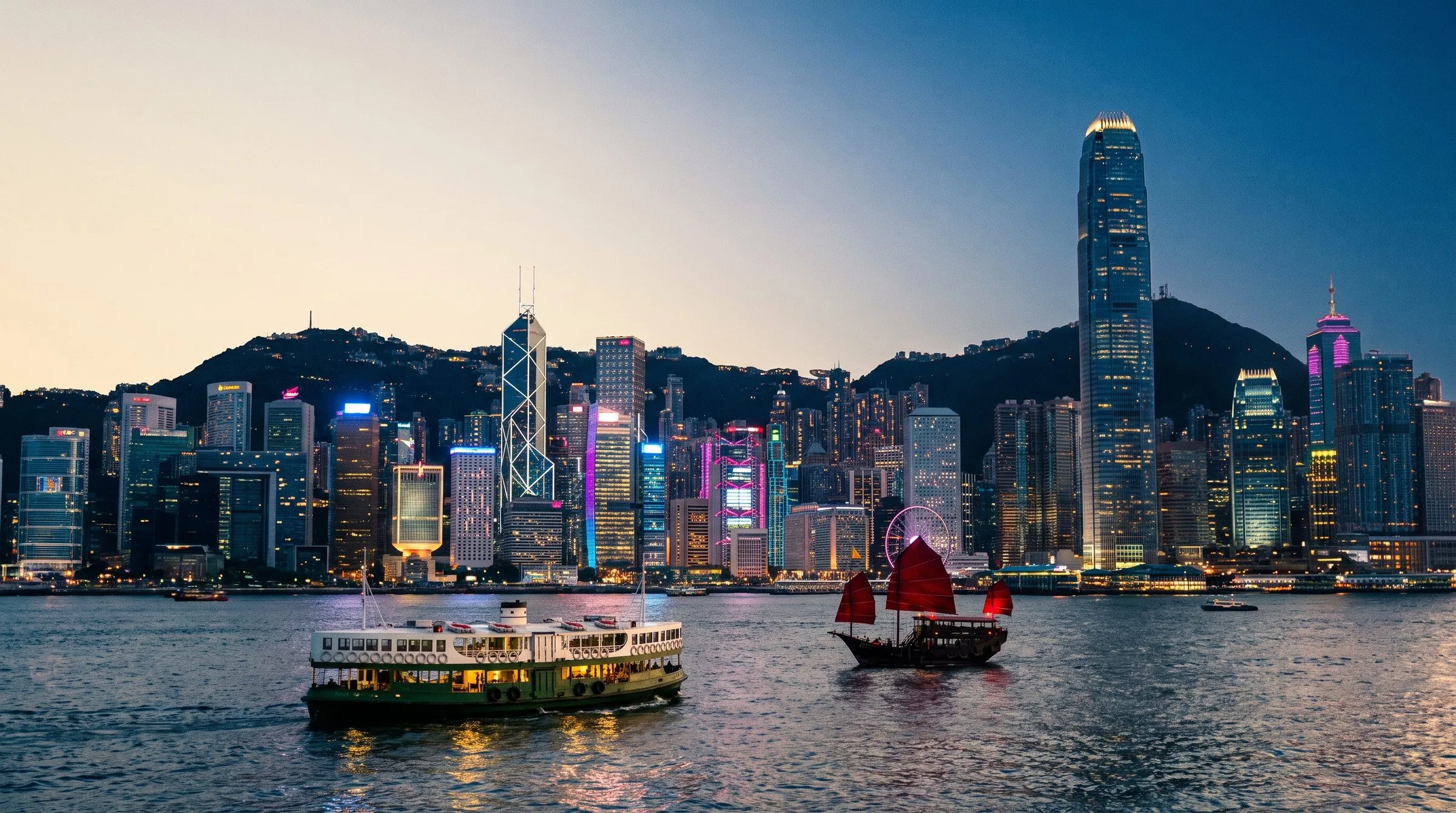
Hong Kong 5-Day Itinerary 2026: Peak Tram, Star Ferry, Disneyland, Lantau Island
5-day Hong Kong itinerary for first-time visitors: Day 1 Victoria Peak + Star Ferry, Day 2 Tsim Sha Tsui + Avenue of Stars, Day 3 Disneyland or Ocean Park, Day 4 Lantau Island + Tian Tan Buddha, Day 5 local neighborhoods (Sheung Wan, Sham Shui Po, Wong Tai Sin Temple).
Hong Kong rewards 5 full days. The famous harbour and skyline can be ticked off in 1-2, but to actually feel the city —its layered food scene, its hiking trails on Hong Kong Island, its outlying fishing villages, its chaotic Kowloon neighborhoods —you need slow time. This 5-day plan is designed for first-time visitors who want the highlights without feeling rushed, and it includes one full day at a theme park plus one full day on Lantau Island. If you only have 3 days, see our 3-day budget Hong Kong plan. If you have 6-7 days, add a Macau weekend (1-hour ferry from HK Macau Ferry Terminal in Sheung Wan).
The plan follows a natural intensity curve: a moderate walking Day 1 (Central + Peak), an easy harbour-front Day 2 (TST), a high-energy theme park Day 3, a long but beautiful Day 4 (Lantau, full day out), and a deep-immersion Day 5 (local neighborhoods). If you swap the theme park, you can do Disneyland or Ocean Park on either Day 3 or Day 4 (Lantau is a true full day so we keep it separate).
Day 1: Central, Victoria Peak, Star Ferry to Tsim Sha Tsui
Theme: The Peak, the skyscrapers, the harbour. Total walking: 8-10 km, mostly downhill.
Morning: Victoria Peak via Peak Tram (10 AM — 1 PM)
Start at Central Pier (the Star Ferry pier). Walk 5 minutes to Garden Road Peak Tram Lower Terminus. The Peak Tram has run since 1888 and is the steepest funicular railway in the world (you will feel the angle — your body literally tilts backward).
- Tram ticket: HK$65 one-way, HK$99 round-trip (buy at the lower terminus or online at Klook for HK$5-10 off, skip-the-line).
- Time tip: Arrive at 9:30 AM (the tram opens 10 AM). By 11 AM the line at the upper terminus is 45-90 min. Go early, return mid-afternoon.
- Duration: The tram itself takes 7-8 minutes (yes, really — but the view is spectacular). The total experience with queuing is 1-1.5 hours.
At the top, you have three options. Option A (skip the line, free): skip the Sky Terrace 428 and walk the Lugard Road circular — a flat 1-hour paved walk around the Peak with viewing platforms that are usually 70% empty even when Sky Terrace has 200 people in line. Option B (pay, easy): Sky Terrace 428 at the top of Peak Tower, HK$45, 360° indoor viewing deck, 428m elevation, busy but worth it on a clear day. Option C (free, off-the-beaten-path): walk 10 minutes downhill east to Victoria Peak Garden — a quiet hilltop park with benches and almost no tourists.
Lunch recommendation: The Peak Lookout (HK$200-300 per person, 19th-century colonial building at the upper Peak Tram terminus) or grab dim sum at one of the Peak Tower restaurants for HK$150-200. Budget option: take the tram back down and eat in Central — choices and prices are 50% better.
Afternoon: Central District Walking (2 PM — 5 PM)
Take the tram back down. From the lower terminus, walk through Central — Hong Kong’s financial heart and a study in vertical density. Key stops:
- HSBC Main Building (1 Queen’s Road Central) — Norman Foster design, 1985, was the world’s most expensive building when built (US$668M). The atrium is open to the public and free.
- Bank of China Tower (1 Garden Road) — I.M. Pei design, 1990, geometric triangular prisms. Often called Hong Kong’s most photographed building.
- Statue Square — bronze statues of colonial-era governors, a small green park in the middle of skyscrapers.
- Cheung Kong Center — Li Ka-shing’s headquarters, more understated but worth a photo from the public plaza.
- IFC Mall + IFC Two — the airport express terminates here, and the IFC Mall rooftop has the Four Seasons Hotel and the Palace IFC cinema (English movies with original soundtrack).
Optional add-on (1 hour, free): Tai Kwun (10 Hollywood Road) — the former Central Police Station compound, beautifully restored 2018, now a contemporary art museum + performance space + heritage site. Run by the Hong Kong Jockey Club. Worth it for the architecture alone.
Evening: Star Ferry to Tsim Sha Tsui (5:30 PM — 8:30 PM)
Walk to Central Pier 7 (Star Ferry Pier). The Star Ferry has run since 1880 and is consistently rated one of the world’s best value urban transit experiences. Crossing from Central to Tsim Sha Tsui takes 10 minutes and costs HK$4 (upper deck) or HK$3.5 (lower deck). At sunset, the upper deck on the right side gives the best view of the Kowloon skyline.
After the ferry, walk the Tsim Sha Tsui Promenade east. Stop at the Avenue of Stars — Hong Kong’s version of the Hollywood Walk of Fame, but along the waterfront, with statues of Bruce Lee, Jackie Chan, and a 4.5m-tall Bruce Lee bronze. Free, open 24/7.
At 8 PM, the Symphony of Lights show begins — 40+ buildings on both sides of the harbour synchronized with music and lasers. The best vantage point is the TST Promenade between the Star Ferry Pier and the Hong Kong Cultural Centre. The show runs nightly, lasts 10 minutes, and is free.
Dinner recommendations for Day 1:
- Spring Deer (2/F, 42 Mody Road, TST) — Peking duck institution since 1966, HK$300-400 per person, book 2-3 days ahead.
- Tim Ho Wan (various branches, TST at 9-11 Fuk Chuen Street) — the world’s cheapest Michelin-starred dim sum, HK$60-100 per person, expect 1-2 hour wait if you arrive after 7 PM.
- Australian Dairy Company (47 Parkes Street, Jordan) — scrambled eggs and steamed milk pudding, HK$80-100 per person, famously brisk service.
Day 2: Tsim Sha Tsui — Harbour Front + Museums
Theme: Kowloon side, history, art, night skyline. Total walking: 6-8 km, easy.
Morning: Avenue of Stars + Hong Kong Museum of History (9 AM — 12:30 PM)
Start at the Tsim Sha Tsui Promenade (already saw it on Day 1 evening, but daytime is also great). Walk east past the Hong Kong Space Museum (HK$10 entry, hands-on exhibits, great for families) and the Hong Kong Cultural Centre (free concerts on weekends).
Hong Kong Museum of History (100 Chatham Road South, Tsim Sha Tsui) — the city’s main history museum, opened 2000. Eight galleries walking through 400 million years: prehistoric fossils, the Qin/Han dynasty, Opium Wars, Japanese occupation, the 1997 handover, and post-1997 Hong Kong. HK$10 adults, free for children under 4. Allow 2-3 hours. The audio guide is included and has English.
Adjacent: Hong Kong Museum of the War of Resistance and Coastal Defence (same complex, separate entrance) — covers the 1937-1945 Japanese invasion and the wartime experience. Worth 1-1.5 hours if you have time.
Lunch recommendation: Mido Café (63 Temple Street, Yau Ma Tei) — 1950s cha chaan teng (Hong Kong diner), egg tarts and rice plates, HK$80-100 per person, a movie-set piece of Old Hong Kong. Or Australia Dairy Company again if you didn’t make it on Day 1.
Afternoon: Hong Kong Museum of Art + Kowloon Park (2 PM — 5 PM)
Hong Kong Museum of Art (10 Salisbury Road, TST) — reopened 2019 after major renovation, now has 17,000+ pieces covering Chinese antiquities, modern Hong Kong art, and contemporary installations. Free admission. The building itself (curved white facade facing the harbour) is worth a photo. Allow 1.5-2 hours.
Walk 10 minutes to Kowloon Park — 33 acres, free, a green lung in the middle of TST. Highlights: the Kowloon Mosque (a Sunni Muslim mosque, 1984, open to visitors outside prayer times), the Aviary, the Sculpture Walk, and the Peking Opera statues. Locals practice tai chi here in the early morning.
Evening: Symphony of Lights + TST Night (6 PM — 9:30 PM)
Return to the TST Promenade for sunset (the vantage point looking toward Hong Kong Island is the classic postcard). Dinner options:
- Hutong (28/F, One Peking Road, TST) — spectacular North Chinese fine dining, views over the harbour, HK$500-800 per person, book 1-2 weeks ahead for window seats.
- Din Tai Fung (various branches) — Taiwanese xiao long bao, reliable and good, HK$200-300 per person.
- Tsim Chai Kee (98 Wellington Street, Central — easier to do on Day 1 actually) — wonton noodle institution, HK$50-70 per person.
Cap the night: walk to Knutsford Terrace (1-minute off Nathan Road) — a narrow lane of 30+ bars and restaurants, the backpacker-meets-local nightlife hub. Or for a quieter drink, Sevva (25/F, Prince’s Building, Central) — rooftop bar with panoramic harbour views, dress code enforced, HK$150+ cocktails.
Day 3: Hong Kong Disneyland OR Ocean Park (1 Full Day)
Theme: Theme park day, high energy. Choose one; both deserve a full day. If you have 6+ days, do both.
Option A: Hong Kong Disneyland (1 Full Day, 10:30 AM — 8:30 PM)
Located on Lantau Island (different part from Tian Tan Buddha), 1.5 hours from Central via MTR. Route: MTR to Sunny Bay (30 min from Central) → transfer to Disneyland Resort Line (5 min, themed trains with Mickey windows) → arrive at the gates.
- Ticket: HK$759 adults (1-day), HK$639 if pre-booked on Klook. Open 10:30 AM, close 8:30 PM.
- Strategy: Arrive 30 min before opening. Most people rush to Fantasyland — instead, start with Mystic Manor (Hong Kong-exclusive, no other Disney park has this) or Iron Man Experience (the world’s first Marvel-themed Disney ride) in Tomorrowland. Hit Hyperspace Mountain (Space Mountain re-themed as Star Wars) and Big Grizzly Mountain Runaway Mine Cars in Grizzly Gulch (another Hong Kong-exclusive).
- Family note: For under-10s, the Disneyland Railroad (parlor car around the park, included free) and the Castle of Magical Dreams (re-themed 2020 with 13 Disney princesses representing different cultures) are the highlights. The new World of Frozen area opened 2023 — massive if your kids are Frozen fans.
- Food: Inside the park is overpriced (HK$100-200 per person per meal). Pre-purchase a meal voucher (HK$240) on Klook for slightly better value. Or eat at Toy Story Bazaar (cheaper quick service) before going in.
- Evening: The 8 PM Momentous nighttime show (replaces the old fireworks, projection on the castle) is worth staying for.
Option B: Ocean Park (1 Full Day, 10 AM — 7 PM)
Hong Kong Island south side, 30 min from Central via MTR to Admiralty + bus 629 or taxi. The park is split: Waterfront (low) and Headland (high), connected by the Ocean Express funicular and the Cable Car (HK$200 round trip combined ticket for non-park-guests, free for park guests).
- Ticket: HK$498 adults (cheaper than Disneyland). Open 10 AM, close 7 PM.
- Strategy: Head straight to the Headland via cable car for the Hair Raiser roller coaster (4 inversions, best ride in the park) and the Whisker’s Harbor for the giant pandas (Ying Ying, Le Le, twin cubs born 2024). After 2 PM, go back down to Waterfront for the Grand Aquarium (one of Asia’s largest, shark tunnel) and the Symbio! 360° coral exhibit.
- Family note: Better for tweens/teens than Disneyland. Animal shows run on schedule (sea lion, dolphin, panda keeper talk) — check the app on arrival.
- Food: HK$120-180 per person. The Sichuan-style restaurant in Summit area is better than average theme park food.
Note on buying tickets: Klook, KKday, and the official park websites all discount 10-20% versus walk-up. Always book 2-3 days ahead.
Day 4: Lantau Island — Big Buddha, Ngong Ping 360, Tai O
Theme: Lantau — the largest island, the iconic Buddha, a fishing village. Total time: 10-12 hours including travel.
Morning: Ngong Ping 360 Cable Car + Tian Tan Buddha (8:30 AM — 1 PM)
Take the MTR to Tung Chung Station (50 min from Central via the orange Airport Express route or the regular Tung Chung Line, HK$25-65 depending on origin). From Tung Chung, walk to the Ngong Ping 360 Cable Car Terminal.
- Cable car ticket: HK$235 round trip (standard cabin), HK$295 (crystal cabin — glass floor). Buy at Klook for HK$210 round trip. The 25-minute ride is itself an experience — panoramic views of Tung Chung Bay, the airport, the South China Sea, and finally the Buddha.
- Note on time: 8:30 AM departure is essential if you want a quiet Big Buddha. Tour buses arrive 10 AM onward and the Buddha base becomes a 30-minute queue.
Arrive at Ngong Ping Village — themed Chinese architecture, mostly tourist restaurants and shops. Walk 5 minutes to the Tian Tan Buddha (天壇大佛, “Heavenly Altar Big Buddha”). The bronze statue is 34m tall (112 ft), the largest seated bronze Buddha in the world, completed 1993.
- Entry: Free to the platform. The 268-step climb to the base is free but moderately strenuous (about 15-20 min going up, longer coming down).
- Inside the Buddha: HK$0 to enter (no, free) but you can see the inside. Actually: HK$0 entry to the platform, but a HK$0 token for the round-trip elevator inside the Buddha (free for accessibility).
- Allow: 1-1.5 hours for the Buddha, including the climb and the photo stops.
Walk 5 minutes to Po Lin Monastery (寶蓮禪寺), the Buddhist monastery that commissioned the Buddha. The main hall is ornate and incense-filled. The famous vegetarian lunch is served at the monastery’s restaurant (HK$120-150 per person, 11:30 AM-2:30 PM only). 30+ dishes, all vegetarian, some with mock meat (seitan/soy-based “chicken”, “duck”). Better than expected.
Afternoon: Tai O Fishing Village (2 PM — 5:30 PM)
From Po Lin, take Bus 21 to Tai O (45 min, HK$7). Tai O is Hong Kong’s last major stilt-house fishing village, on the western side of Lantau. The village is built over a tidal estuary on wooden stilts; many houses are 100+ years old.
- Stilt house boat tour: HK$50-100 per person, 30 minutes. Operators are at the dock. The boat weaves through the village, gives close-up views of the houses, and includes a 10-minute stop at a small mangrove area to look for the rare pink dolphin (Chinese white dolphin, 50-60% sighting rate in calm weather).
- Walking: 1-1.5 hours is enough. The village has narrow alleys, dried seafood shops (try the shrimp paste, shrimp roe, and shredded cuttlefish as souvenirs), and snack stalls. Try the tai tai (Tai O style sponge cake, a kind of brown sugar chiffon).
- Note: The village is genuinely local and older-generation Chinese — most signs are Chinese-only, few English, and almost everyone speaks Cantonese. Bring cash (HK$ small denominations, no Alipay in Tai O).
Evening: Return via Tung Chung Sunset (6 PM — 8 PM)
Take Bus 11 back to Tung Chung Town Centre (45 min, HK$10). From Tung Chung, take the MTR back to Central (50 min). The evening cable car run gives spectacular sunset views — book a 6:30 PM round trip return if you want to see the sunset from the cable car.
Dinner option in Tung Chung: Spice House (Citygate Outlets basement) — solid Cantonese, HK$150-200 per person. Or eat at Citygate Outlets mall (1 minute from station, dozens of restaurants).
Alternative: If the Lantau day is too long, replace with Cheung Chau Island (1-hour ferry from Central Pier 5, HK$15-30, half-day trip) — a car-free island with beaches and seafood.
Day 5: Local Neighborhoods — Sheung Wan, Sham Shui Po, Mong Kok, Wong Tai Sin
Theme: The real Hong Kong — markets, temples, street food, locals. Total walking: 10-12 km but spread across MTR jumps.
Morning: Sheung Wan + Man Mo Temple (9 AM — 12:30 PM)
Sheung Wan is Hong Kong’s oldest district, west of Central. Man Mo Temple (124 Hollywood Road) — built 1847, dedicated to the gods of literature (Man) and war (Mo). The ceiling is hung with giant spiral incense coils that burn for days. Free, open 8 AM-6 PM, photography allowed.
Walk 5 minutes to Cat Street (Upper Lascar Row) — antique market, jade, vintage Chinese furniture, communist-era memorabilia. Bargain 30-50% off asking price, cash preferred, fun to browse.
Walk 5 minutes to PMQ (35 Aberdeen Street) — former Police Married Quarters, now a creative hub with 100+ design studios, local fashion brands, and small galleries. Free entry, the courtyard is photo-friendly, the rooftop is a quiet rest stop.
Lunch in Sheung Wan:
- Lin Heung Tea House (160 Wellington Street) — 1927 dim sum institution, traditional trolley service, dim sum is “made in front of you” (literally), expect a 30-45 min wait and chaotic seating. HK$60-100 per person.
- Mak’s Noodles (77 Wing Lok Street) — fresh wonton noodles, one of Hong Kong’s top 3, HK$60-100 per person.
- Bao Bei (6 On Wo Lane) — modern Chinese small plates, dim sum and cocktails, HK$200-300 per person.
Afternoon: Sham Shui Po Electronics + Street Food (1:30 PM — 4:30 PM)
Take MTR to Sham Shui Po Station. This is Hong Kong’s bargain-hunter and DIY heartland.
- Apliu Street — flea market, electronics parts, vintage cameras, broken laptops being repaired. Saturdays and Sundays are busiest (the “Bird Market” — Apliu North Street — is Sunday only, with songbirds in tiny bamboo cages).
- Golden Computer Arcade (Fuk Wing Street) — 5+ buildings, hundreds of stalls selling computer parts, cables, gaming gear, anything electronic. The same ecosystem is replicated in 298 Computer Plaza across the street.
- Tung Choi Street (the southern end) — goldfish market (the aquatic kind: koi, arowanas, goldfish in plastic bags), parrot and reptile stalls. Free to walk, no need to buy.
- Cheung Sha Wan Road — fabric street, wholesale buttons and trims.
Snacks in Sham Shui Po:
- Kau Kee Beef Brisket (21 Gough Street) — 90-year-old beef brisket noodle shop, HK$50-70 per person.
- Café Seasons (Shop 18, G/F, 174 Apliu Street) — old-school Hong Kong diner, HK$60-100 per person.
- Kung Wo Soy Milk Factory (118 Pei Ho Street) — 100+ year old tofu and soy milk, watch the production, eat fresh beancurd pudding, HK$30-50 per person.
Late Afternoon: Wong Tai Sin Temple (4:30 PM — 6 PM)
MTR to Wong Tai Sin Station. Sik Sik Yuen Wong Tai Sin Temple (2 Chuk Yuen Village, Wong Tai Sin) — one of Hong Kong’s most famous Taoist temples, founded 1921, dedicated to the god of healing. The temple complex has multiple halls, beautiful ceramic figurines, and is famous for Cau Cim (fortune sticks) — visitors shake a bamboo cylinder until a stick falls out, then have the stick interpreted by a fortune teller (HK$50-100, English available). Free entry to the temple itself; free incense. Allow 1-1.5 hours.
Photography tip: The temple is most photogenic in the late afternoon when the lanterns start to glow and the incense smoke catches the light.
Evening: Mong Kok + Ladies Market (6:30 PM — 9:30 PM)
MTR to Mong Kok Station. Mong Kok is the most densely populated neighborhood on earth (130,000+ per km² in parts) and the most frenetic.
- Ladies Market (Tung Choi Street, between Argyle Street and Dundas Street) — 1 km of market stalls, mostly fashion, accessories, souvenirs, and toys. Open 12 PM-11 PM. Bargaining is expected —start at 50% of asking price, settle at 60-70%. The market is named “Ladies” because of the original cosmetics + jewelry focus, but it’s unisex now.
- Sneaker Street (Fa Yuen Street) — 50+ sportswear shops, mostly genuine but some replicas, good for athletic gear.
- Goldfish Market (Tung Choi Street north) — the part closer to Mong Kok, similar to Sham Shui Po but busier.
- Mong Kok Flower Market (Flower Market Road) — 50+ flower shops, opens until late, beautiful in the evening with the LED-lit displays.
Dinner in Mong Kok:
- Tim Ho Wan Mong Kok (2-8 Kwong Wa Street) — the original Tim Ho Wan, slightly cheaper than TST, same Michelin star.
- Mong Kok Cooked Food Centre (4/F, 118 Fa Yuen Street) — 30+ dai pai dong stalls (open-air cooked food center), HK$50-100 per person, try Hing Fat for seafood.
- Yat Lok (G/F, 34 Stanley Street, Central — easier from earlier in day) — 1-Michelin-star roast goose, HK$100-150 per person, must-try.
Cap the night: drinks at Tai O Lookout (1/F, 14-15 Stanley Street, Central) — wait, that’s Central. Try The Iron Fairies (G/F, 1 On Hing Terrace, Central) — 1,000+ hand-forged iron butterflies covering the ceiling, hidden bar vibe. Or for a quieter end, Locke in Sheung Wan (27 Hollywood Road) — small wine bar.
Practical Hong Kong Tips
Visa
- 95+ countries (US, UK, Canada, AU, NZ, EU, JP, KR, SG, MY, TH) are visa-free for 7-180 days depending on passport. Check the Hong Kong Immigration Department website.
- PRC mainland Chinese need a separate Home Return Permit to enter Hong Kong — they cannot enter on a mainland Chinese passport. (Special arrangements for some cross-border workers.)
- Taiwan passport holders: visa-free 30 days.
- The visa-free list changes yearly; always verify 1-2 months before travel.
Money
- Currency: Hong Kong Dollar (HKD, often written HK$). HK$1 = 100 HK cents. Coins: 10¢, 20¢, 50¢, $1, $2, $5, $10. Notes: $10, $20, $50, $100, $150, $500, $1000.
- Exchange rate (2026): 1 USD ≈ 7.8 HKD. ATMs are everywhere; most accept Visa, Mastercard, UnionPay, and increasingly Alipay and WeChat Pay.
- Octopus Card: HK$150 includes HK$100 stored value + HK$50 refundable deposit. Tap to ride MTR, buses, ferries, and most convenience stores. Auto-top-up via credit card available. Octopus on iPhone/Apple Watch: same functionality, no physical card.
- Tipping: Not customary in Hong Kong, but 10% appreciated at upscale restaurants, HK$10-20 for hotel housekeeping, HK$20-30 for taxi if helping with luggage.
Transport
- MTR (subway): clean, on-time, English everywhere. 11 lines + Airport Express. Single journey: HK$4-65 depending on distance. Octopus Card or contactless.
- Tram (ding ding): Hong Kong Island only, HK$3 flat fare, no Octopus Card needed (just drop coins), a great slow tour of the city.
- Bus (KMB, Citybus): covers everywhere MTR doesn’t. Octopus tap. Front seat upper deck for best views.
- Taxi: red (urban), green (New Territories), blue (Lantau). Uber is in Hong Kong but limited. Taxis are HK$29 flag fall + HK$2-3 per km. Most drivers speak limited English — write down your destination in Chinese or show a Google Maps screenshot.
- Star Ferry: HK$3.5-4 per crossing, one of the great value urban experiences in the world.
Connectivity
- VPN: Hong Kong has free internet (unlike mainland China) — Google, Gmail, WhatsApp, Instagram, Facebook all work without VPN. WiFi is fast and free at airports, MTR, malls, Starbucks, McDonald’s, and most hotels.
- SIM card: 4G LTE covers all of Hong Kong + Lantau + outlying islands. Buy at airport arrivals (CSL, 3 Hong Kong, SmarTone) for HK$80-150 with 30-day validity. eSIM via Airalo HK$10-30, but data only (no local number).
- Apps to install: MTR Mobile (real-time train times), Citymapper, OpenRice (restaurant reviews), HK Observatory (weather), Octopus on iPhone/Apple Watch.
Language
- Cantonese is the local language. Mandarin is widely understood. English is the official second language — most menus, signs, MTR announcements, and museum staff have English.
- Useful phrases in Cantonese: 唔該 (m̀hgōi, “please/thank you”), 多謝 (dōjeh, “thank you”), 唔好意思 (m̀hóuyisi, “excuse me/sorry”), 呢個 (nīgo, “this one”), 幾多錢 (géidōchín, “how much?”). The romanization is “Jyutping” — once you read it, the tones are easier to spot.
When to Visit
- Best months: October-December (autumn, 18-25°C, clear skies, post-typhoon season) and March-May (spring, 18-26°C, before humidity and rain). These are the peak season — book hotels 2-3 months ahead.
- Summer (Jun-Aug): hot (30-33°C), humid, and typhoon risk July-September. Most locals and visitors avoid.
- Christmas and Chinese New Year: Hong Kong decorates heavily, especially the harbourfront. CNY (late January or early February) — many shops close for 2-3 days but the city is festive.
- 2026 specific: avoid the first week of October if possible (National Day Golden Week brings mainland Chinese tourist surge).
Safety
Hong Kong is one of the safest cities in the world for tourists. Violent crime against visitors is very rare. Common-sense precautions:
- Watch for pickpockets in Mong Kok, Tsim Sha Tsui night markets, and on the MTR.
- Cross traffic carefully — Hong Kong drivers are aggressive, and the “look right” / “look left” painted warnings on crosswalks are not decorative.
- For political demonstrations, follow local news; the situation is calmer than 2019-2020 but check current advisories.
Combining Hong Kong with Other Destinations
- Macau: 1-hour ferry from HK Macau Ferry Terminal (Sheung Wan) or China Ferry Terminal (TST). TurboJet or Cotai Water Jet, HK$200-300 one-way. See our Macau weekend guide — perfectly doable as a day trip or 2-night.
- Shenzhen: 14-minute MTR to Lo Wu or Lok Ma Chau border crossings. Mainland Chinese visa-free for many nationalities. Day trip possible.
- Guangzhou: 1-hour HSR from West Kowloon Station, ¥215 second class. Day trip or overnight.
Budget Breakdown (Per Day, Mid-Range)
| Item | Budget (HK$) | Mid-Range (HK$) | Upscale (HK$) |
|---|---|---|---|
| Hotel (1 night) | 400-700 | 800-1,500 | 2,500+ |
| Breakfast | 30-60 | 60-100 | 150+ |
| Lunch | 60-100 | 100-200 | 250+ |
| Dinner | 100-200 | 200-400 | 600+ |
| MTR / Bus | 30-60 | 60-100 | 100+ |
| Attractions | 0-200 | 200-500 | 500+ |
| Total per day | 620-1,320 | 1,420-2,800 | 4,100+ |
5-day total estimate:
- Budget: HK$3,100-6,600 (US$400-850) —hostel or budget hotel, dai pai dong, free attractions.
- Mid-range: HK$7,100-14,000 (US$910-1,800) —3-4 star hotel, mix of local and mid-tier restaurants, 1-2 paid attractions per day.
- Upscale: HK$20,500+ (US$2,650+) —5-star hotel (Mandarin Oriental, Four Seasons, The Upper House), fine dining, all extras.
Add HK$639-759 for the theme park day (Disneyland or Ocean Park), and HK$235 for the Ngong Ping 360 cable car on Day 4.
Sample 5-Day Schedule (One Glance)
| Day | Focus | Key Sites | Cost Estimate |
|---|---|---|---|
| 1 | Central + Peak | Peak Tram, Victoria Peak, HSBC Building, Bank of China Tower, Star Ferry, TST Promenade, Symphony of Lights | HK$200-500 |
| 2 | Tsim Sha Tsui | Avenue of Stars, Hong Kong Museum of History, Museum of Art, Kowloon Park | HK$200-400 |
| 3 | Theme Park | Disneyland OR Ocean Park (full day) | HK$600-1,000 |
| 4 | Lantau | Ngong Ping 360, Tian Tan Buddha, Po Lin Monastery lunch, Tai O stilt houses | HK$350-600 |
| 5 | Local Neighborhoods | Man Mo Temple, Cat Street, Sham Shui Po, Wong Tai Sin, Ladies Market | HK$200-400 |
How to Make the Most of Each Day
- Start at 9 AM for major attractions to beat crowds. Most museums open at 10 AM. The Peak Tram queues build 11 AM onward.
- Use Octopus Card on iPhone/Apple Watch — no queuing at ticket machines.
- Carry a small umbrella even in fine weather — Hong Kong’s microclimates mean sudden showers especially May-September.
- Download offline Google Maps of Hong Kong (works without VPN). Mark key destinations as saved.
- Bring a refillable water bottle — Hong Kong tap water is safe to drink but not always tasty. Hotels and malls have filtered water dispensers.
- Pack light — Hong Kong’s MTR has lots of escalators but no elevators at some stations. Wheeled suitcases on TST’s steep streets are painful.
- Tip in cash at upscale restaurants (10% service charge is sometimes auto-added, sometimes not — check the receipt).
- Get a Hong Kong Tourist Sim at airport arrivals — CSL’s 6-day unlimited 4G for HK$88 covers your whole trip.
- Save your energy for Day 3 (theme park) and Day 4 (Lantau) — both are full days.
Hong Kong in 5 days is just enough to feel the city, not just photograph it. By the end you’ll understand why locals call it “the greatest city in Asia” — and probably already be planning your return.
Step by step
-
Book Hong Kong hotel, confirm visa, and pre-buy theme park tickets
Stay in Tsim Sha Tsui for walkability (HK$800-1,500/night mid-range), Causeway Bay for shopping, or Mong Kok for budget (HK$400-700/night). Confirm visa status — 95+ countries are visa-free 7-180 days. Pre-buy Disneyland or Ocean Park tickets on Klook (HK$639 vs HK$759 walk-up for Disneyland). Install Octopus Card on iPhone/Apple Watch for tap-to-pay MTR, buses, ferries, and most stores. Most major Asian hubs have direct flights; the Airport Express train reaches Central from HKIA in 24 min (HK$115).
-
Day 1: Central, Victoria Peak Tram, Star Ferry to TST
Take the Peak Tram up at 10 AM (HK$65, includes Peak Tower entry, arrive 30 min early to skip the line). Victoria Peak Garden and the Lugard Road circular walk are free and less crowded than Sky Terrace 428. Descend to Central, walk through HSBC Building + Bank of China Tower + Statue Square. Take the Star Ferry from Central Pier 7 to TST (HK$4, 10 min, Iconic Harbour view). End the day at the TST Promenade for 8 PM Symphony of Lights.
-
Day 2: Tsim Sha Tsui — Avenue of Stars, museums, harbour night
Walk the Avenue of Stars (free, Bruce Lee statue, handprints) along the Tsim Sha Tsui Promenade. Visit Hong Kong Museum of History (HK$10, 2-3 h, the city's story from prehistoric to handover). Afternoon: Hong Kong Museum of Art (free, modern + contemporary Chinese). 8 PM Symphony of Lights from the waterfront — 40+ buildings synchronized. Dinner at Spring Deer (Peking duck, TST institution) or Tim Ho Wan (dim sum, Michelin-starred).
-
Day 3: Hong Kong Disneyland OR Ocean Park (1 full day)
Disneyland: take MTR to Sunny Bay then transfer to Resort Line (1 h total from Central). Open 10:30 AM, close 8:30 PM. Highlights: Mystic Manor (Disneyland-exclusive), Iron Man Experience, Hyperspace Mountain, the castle nighttime show. Ocean Park: MTR to Admiralty then bus 629 or taxi. Highlights: Hair Raiser roller coaster, Grand Aquarium, panda exhibit, cable car between headlands. Both: arrive 30 min before opening, bring water + sunscreen.
-
Day 4: Lantau Island — Ngong Ping 360, Tian Tan Buddha, Tai O village
MTR to Tung Chung (50 min from Central). Ngong Ping 360 cable car (HK$235 round trip, 25 min, standard or crystal cabin). Tian Tan Buddha: 268 steps to the base of the world's largest seated bronze Buddha (free). Po Lin Monastery vegetarian lunch (HK$120-150, 11:30 AM-2:30 PM). Bus 21 to Tai O fishing village (45 min), boat tour through stilt houses (HK$50-100, 30 min). Return via Tung Chung cable car evening for sunset.
-
Day 5: Local neighborhoods — Sheung Wan, Sham Shui Po, Mong Kok, Wong Tai Sin
Sheung Wan: Man Mo Temple (free, incense-shrouded 1847 Taoist temple), Cat Street antique market, PMQ creative hub. Lunch: dim sum at Lin Heung (traditional trolleys) or fresh wonton noodles at Mak's. MTR to Sham Shui Po: Apliu Street electronics, Temple Street night market, goldfish market. Then Wong Tai Sin Temple (free, 9 AM-5 PM, Taoist temple with fortune telling). Cap the night at Ladies Market (Tung Choi Street) for souvenirs and bargaining practice.
FAQ
-
Is 5 days enough for Hong Kong?
Yes, 5 days is the sweet spot for first-time visitors. It covers the major peaks (Victoria Peak), harbours (Star Ferry), theme parks (Disneyland or Ocean Park), outlying islands (Lantau, Tai O), and at least one or two deep-dive neighborhoods (Sheung Wan, Sham Shui Po, Kowloon). 3 days is rushed — see our Hong Kong 3-day budget guide for that version. 7 days lets you add a day trip to Macau or a Lamma Island hike. -
Do I need a visa for Hong Kong?
About 95 countries are visa-free for 7-180 days including the US, UK, Canada, Australia, EU/Schengen, Japan, South Korea, Singapore, and most Commonwealth nations. PRC mainland passport holders need a separate Home Return Permit and a Taiwan permit if applicable. Always verify on the Hong Kong Immigration Department website before booking, as the list updates yearly. -
Is Hong Kong expensive compared to mainland China?
Yes, Hong Kong is roughly 1.5-2x more expensive than Tier 1 mainland cities (Shanghai, Beijing, Shenzhen). A mid-range hotel in Tsim Sha Tsui is HK$800-1,500/night (US$100-190) versus ¥400-800 in Shanghai. MTR, dim sum, and street food remain reasonable, and the city's Octopus Card system makes transit cost-controlled and easy. -
Should I do Disneyland or Ocean Park with kids?
Disneyland Hong Kong is the better pick for under-10s — it's small, walkable, and has all the classic Disney rides with English. Ocean Park is better for tweens and teens who want roller coasters, marine animals, and a more thrilling experience. Families often do 1 day Disneyland + half day Ocean Park. Either way, buy tickets online in advance (10-15% off walk-up price) and arrive at 9:30 AM opening. -
What's the best way to get from Hong Kong International Airport to Central?
The Airport Express (AEL) train is the fastest —24 minutes, HK$115 one-way or HK$205 round-trip with same-day MTR connections. Free MTR transfers at Hong Kong and Kowloon stations on presentation of the AEL ticket. Taxis run HK$300-400 to Central (45 min with traffic). Airport buses (A11 to Causeway Bay, A21 to TST) are cheapest at HK$40-50 but slower (70-90 min).
Related guides
- Itineraries
Hong Kong on a Budget: 3 Days Under HKD 3,000 (2026 Guide)
A practical 3-day Hong Kong itinerary for budget travelers: how to keep total spend under HKD 3,000 (USD 380) including accommodation, food, attractions, and transit. Includes where to stay (Kowloon vs HK Island), cheap eats (cha chaan teng, dai pai dong, dim sum), free attractions (Victoria Peak, Star Ferry, Tsim Sha Tsui Promenade), and the Octopus Card system.
8min read
- Itineraries
China Cool 2026: 8 Best Summer Escapes from the Heat (Foreigners' Guide)
China Cool is the 2026 trending travel movement — escaping the summer heat to China's mountain and forest retreats averaging 18-26°C. 8 hand-picked destinations with transport, stay, and food tips for foreign visitors.
11min read
- Itineraries
China's 15 Hidden Gem Cities: The 2026 Reverse Tourism Guide for Foreigners
Skip Beijing and Shanghai. China's 15 hidden gem cities for 2026 — verified lesser-known destinations (Wuyuan, Fenghuang, Songpan, Dali, Wuyi, Tengchong, Jianshui, etc.) with how to get there, what to do, where to stay, and food. Reverse tourism trend up 187% YoY in 2026.
14min read
- Itineraries
China Honeymoon 2026: The Ultimate Romantic Travel Guide (Itineraries, Cost, Visas)
China is the surprise 2026 honeymoon destination — cheaper than Bali/Maldives, less crowded than Paris, with hidden romantic gems. 4 ready-made itineraries (7 / 14 / 21 / 30 days) covering Yunnan, Sichuan, Jiangnan, and Tibet-Yunnan grand circuits. 2026 visa rules, costs, best seasons, and how to avoid the 5 most common honeymoon mistakes in China.
16min read
- Itineraries
2 Weeks in China: The Classic Beijing-Xi'an-Chengdu-Shanghai Route (2026)
A complete 14-day China itinerary for first-time visitors: 3 days Beijing, 2 days Xi'an, 2 days Chengdu, 4 days Shanghai, with day-by-day timing, costs, transit between cities (high-speed rail vs flight), hotel recommendations, and which days to skip if you have less time. Budget: ¥15,000-22,000 per person excluding international flights.
12min read
- Itineraries
3 Days in Chongqing: Hongya Cave Night, Hotpot, Yangtze Cable Car (2026 Itinerary)
The perfect 3-day Chongqing itinerary: Hongya Cave at night, Chongqing hotpot, Yangtze River cable car over the river, Jiefangbei, Ciqikou ancient town, and a Dazu Rock Carvings day trip. With prices, transit times, and a foreigner-friendly hotpot survival guide.
10min read