
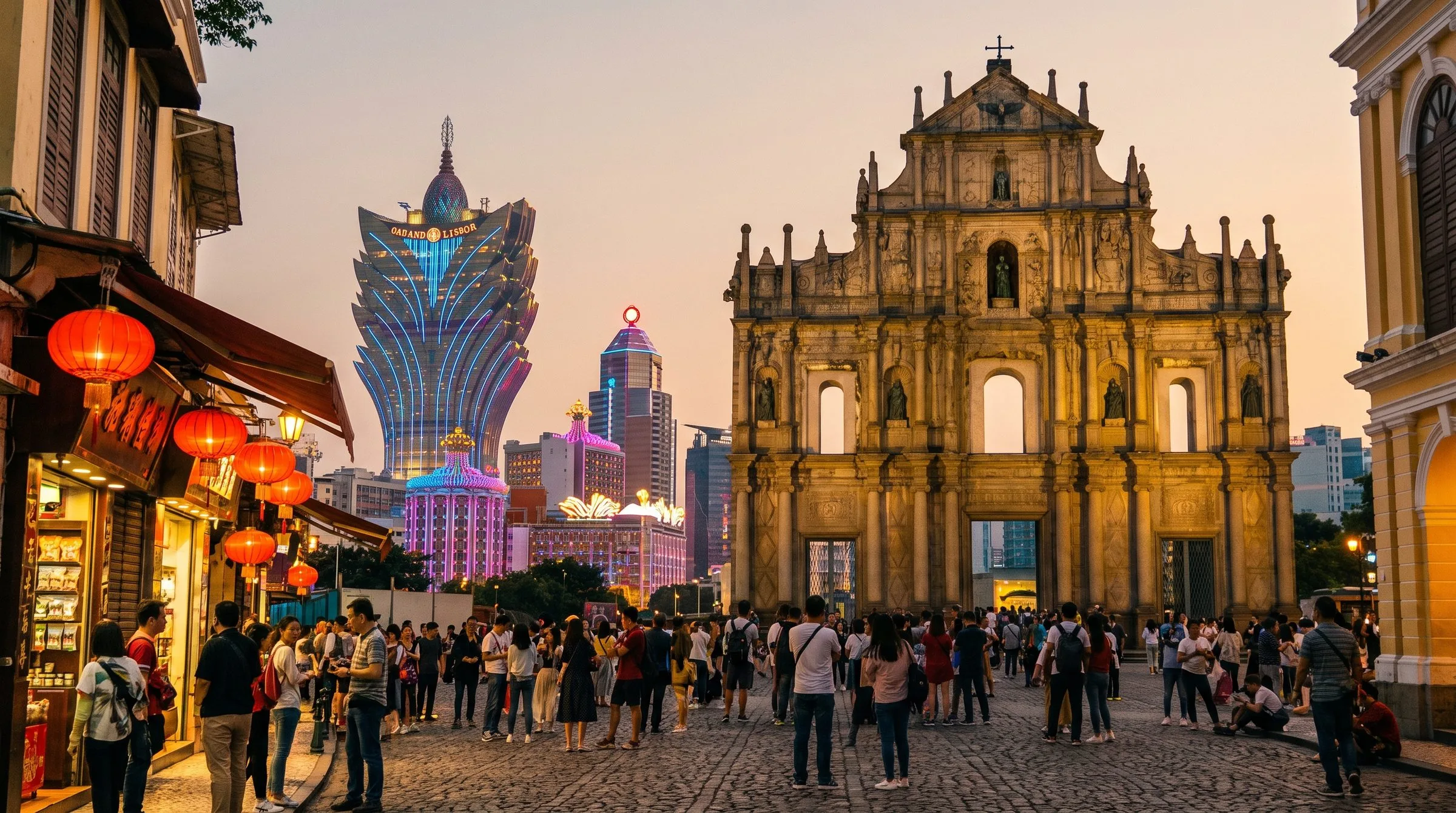
Macau Weekend Guide 2026: 2-Day Itinerary from Hong Kong (Ferry, Cotai, UNESCO Center)
Macau weekend guide for first-time visitors: 2-day itinerary from Hong Kong (1-hour ferry HK$200-300), Ruins of St Paul's, Senado Square, Cotai Strip (Venetian, Parisian), Taipa Village, UNESCO Historic Centre, and 1 day trip Zhuhai.
Macau is the most layered city in Asia. A 30-minute ferry from Hong Kong lands you in a 33 km² territory with 450+ years of Portuguese colonial history (the longest of any European presence in Asia), a 21st-century Cotai Strip of Las Vegas-scale casinos, a UNESCO World Heritage historic centre, and the most interesting food in southern China — a unique Macanese fusion of Cantonese and Portuguese. This 2-day plan is the right amount of time: 1 day for the heritage, 1 day for the modern Cotai + Taipa Village. If you only have a day from Hong Kong, see the “1-day-from-Hong Kong” section at the end.
If you have 5+ days in Hong Kong, this Macau weekend pairs naturally with our 5-day Hong Kong itinerary. Macau is also a 1-hour ferry from Shenzhen and a 30-minute walk from Zhuhai (free Border Gate crossing), making it a flexible addition to any southern China trip.
Why Macau Is Different
Macau (also spelled Macao, 澳門 / 澳门) is a Special Administrative Region of China since 1999, just like Hong Kong. It has its own currency (Macanese Pataca, MOP, but HKD is accepted at 1:1), its own immigration controls, and its own legal system (Portuguese-civil-law-based). The city has been Portuguese since 1557 — 442 years of European presence before the 1999 handover, the longest of any European colony in Asia.
That long Portuguese presence gave Macau:
- Macanese cuisine: a unique fusion of Cantonese ingredients with Portuguese cooking techniques, found nowhere else on earth. African chicken (galinha à africana, invented in Macau), pork chop bun, bacalhau (salt cod, 365+ recipes), Portuguese egg tarts (pastéis de nata, now global).
- Cobblestone streets and pastel architecture: the historic centre’s 20+ surviving squares and churches.
- UNESCO World Heritage status (2005): the “Historic Centre of Macau” was the first UNESCO site in China to include European colonial buildings alongside Chinese temples.
- A tiny but incredibly dense cultural layer: 33 km², 680,000 residents, 40+ museums, 30+ historic churches, 7 UNESCO-listed monuments.
Then in 2002, the Macau government ended the gambling monopoly, opened the market to foreign operators, and the Cotai Strip exploded into existence between 2007 and 2018. Today Macau generates more gambling revenue than Las Vegas (7x in some years), and the Cotai Strip’s resorts (Venetian, Parisian, MGM, City of Dreams, Studio City) rival any in the world.
So: a weekend in Macau is two cities. The historic centre, walking only, 1 day. The Cotai Strip, free to walk the public areas, 1 day. The contrast is the whole point.
Getting to Macau
From Hong Kong (Most Common)
Ferry is the most popular way.
| Operator | From | To | Frequency | Price | Time |
|---|---|---|---|---|---|
| TurboJET | HK Macau Ferry Terminal (Sheung Wan) | Macau Outer Harbour | Every 15-30 min, 7 AM-11 PM | HK$200-300 economy | 55-65 min |
| Cotai Water Jet | HK Macau Ferry Terminal (Sheung Wan) | Taipa Temporary Ferry Terminal (Cotai) | Every 30 min, 7 AM-10 PM | HK$200-300 economy | 60-70 min |
| TurboJET | China Ferry Terminal (Tsim Sha Tsui) | Macau Outer Harbour | Every 30-60 min | HK$200-300 economy | 60-70 min |
Book on Klook or Trip.com 1-2 weeks ahead for 10-15% off walk-up. The crossing is smooth but the border check happens at the pier (15-20 min wait typical) and again on arrival. Bring your passport — the paper form is sometimes required.
Hong Kong-Zhuhai-Macau Bridge (HZMB) Bus is a cheaper alternative if you have a Chinese visa and want to combine Zhuhai:
- Hong Kong Port → Zhuhai Port: HK$65-150 (1.5 hours)
- Hong Kong Port → Macau Port: HK$65-150 (1.5-2 hours)
- The bus crosses the world’s longest sea bridge (55 km). Dramatic but time-consuming with customs.
From Mainland China
- Guangzhou: 1-hour HSR to Zhuhai North, then 30-min taxi or bus to Macau Border Gate.
- Shenzhen: 1-hour HSR to Zhuhai North + transfer, or ferry from Shekou to Macau (1 hour, ¥150-200).
- Zhuhai: Walk across the Border Gate (Portas do Cerco) for free, 5 min, open 6 AM-1 AM. Zhuhai is on the mainland, Macau is the SAR, the border is the line between them.
- Hong Kong-Zhuhai-Macau Bridge: from any major city, you can bus via the HZMB.
Within Macau
Once in Macau, the transport is simple:
- Free casino shuttles: All major casinos (Venetian, Parisian, MGM, Wynn, Galaxy) run free shuttle buses from the ferry terminals, the airport, and Border Gate. Use them — they save MOP$50-100 per trip.
- Taxis: MOP$19 flag fall + MOP$2-3 per km. Mandarin-speaking drivers (vs Cantonese in HK).
- Public buses: MOP$6 flat, dense network, all signs in Chinese + Portuguese + English.
- Walking: The historic centre is entirely walkable (3-4 km core). Cotai to Taipa is 15-20 min on foot.
Day 1: UNESCO Historic Centre + Old Macau
Theme: 450 years of Portuguese-Macanese heritage. Total walking: 6-8 km, flat.
Morning: Senado Square + Holy House of Mercy (9 AM — 11:30 AM)
Start at Senado Square (Largo do Senado). The 4,000 m² square is the historic heart of Macau, paved in the distinctive calçada portuguesa — black and white wave-pattern cobblestone laid by Portuguese prisoners in the 1990s. Free, always open. The pastel neoclassical buildings (built 1870-1930) are the most photographed in Macau.
Walk 2 minutes to the Holy House of Mercy (Santa Casa da Misericórdia, 1 Largo de Santo Agostinho) — 1569, the oldest charitable institution in Asia, founded by a Portuguese bishop. The white neoclassical facade houses a museum (MOP$10, English signage). The chapel is free.
Walk 5 minutes to St Dominic’s Church (Largo de São Domingos) — 1587, one of the three oldest churches in Macau, the place where the first Catholic mass was celebrated in China. Free, open 10 AM-6 PM.
Lunch in the historic centre:
- Choi Heong Yuen (Calçada de São Paulo) — 1920s bakery, the famous almond cookies (MOP$30-50 per box) and pork chop bun (MOP$30-40). Tourist-friendly, MOP$80-120 per person.
- Café Ou Mun (17 Rua de São Paulo) — modern Macanese small plates, MOP$200-300 per person, try the African chicken and the duck rice.
- O Porto Interior (33 Rua de São Paulo) — Portuguese, slightly upscale, MOP$300-500 per person, the duck rice is a Macau institution.
Midday: Ruins of St Paul’s (12 PM — 1:30 PM)
Walk 5 minutes to the Ruins of St Paul’s (Ruínas de São Paulo). The stone façade is all that remains of the 1580 Jesuit cathedral of Madre de Deus, destroyed by fire in 1835 during a typhoon. The façade is 23m wide, 25.5m tall, and carved in tiers of Jesuit iconography mixed with Chinese and Japanese Christian symbols (the Jesuits were the most cosmopolitan of the missionary orders).
- Entry: Free, 24/7.
- Time: 12 PM is the worst time (peak crowds). 9 AM or after 5 PM is much quieter.
- Photography: The façade is most dramatic at sunrise and at night when lit. The view from the side of the cathedral (where you can see the carved steps) is the iconic Macau shot.
- Adjacent: The Crypt underneath the ruins (MOP$5 extra) has 16 niches with Japanese and Vietnamese Christian martyrs.
Walk 5 minutes back down to Mount Fortress (Fortaleza do Monte) — 1617, the original military defence of Macau, also destroyed in 1835, restored 1990s. Macau Museum (MOP$15, included in fortress ticket) is inside the fortress — 3 floors covering Macau’s history from prehistoric to the casino era. Allow 1-1.5 hours. The fortress ramparts give a 360° view of the historic centre and the harbour.
Afternoon: A-Ma Temple + Barra District (2 PM — 4 PM)
Walk 10 minutes down to A-Ma Temple (媽閣廟, Templo de A-Má) — the oldest temple in Macau, built 1488 (before the Portuguese even arrived), dedicated to the Chinese sea goddess Mazu. The temple is built into the hillside, multi-tiered, with incense-filled pavilions. Free, open 8 AM-6 PM.
- Historical note: The name “Macau” comes from the A-Ma Temple. Portuguese sailors heard the locals call it “A-Ma-Gau” (Bay of A-Ma) and the name stuck.
- Adjacent: Maritime Museum (MOP$15, 1 hour) — 1987, on the waterfront, good exhibits on Macau’s fishing and trade history. The view from the back deck is excellent.
Walk 5 minutes to the Barra district — quieter, older, the residential part of old Macau. The Lilian Ho Exhibition Hall (free) has Portuguese-era photographs. The Mandarin’s House (Casa do Mandarim, MOP$10) is a 19th-century Chinese official’s residence, the largest surviving traditional Chinese building in Macau.
Late Afternoon: Coloane Village + Lord Stow’s Original (Optional Half Day)
If you have time and energy, take bus 25 or 26A to Coloane Village (40 min, MOP$6) — the southernmost part of Macau, a quiet former fishing village.
- Lord Stow’s Bakery (1 Rua de Tassara) — the original Lord Stow’s Portuguese Egg Tart bakery, opened 1989 by Andrew Stow (a Brit living in Macau). The recipe is the global standard now exported to the Philippines, Japan, Korea, and elsewhere. MOP$12 per tart. Worth the trip.
- St Francis Xavier Chapel (free) — 1928, white and yellow, peaceful.
- Tam Ka Seng Temple (free) — 19th-century Taoist temple.
- Hac Sa Beach (free) — the only natural sand beach in Macau, with a heated indoor pool complex in winter (MOP$30).
Evening: Dinner in the Historic Centre (7 PM — 9 PM)
After freshening up at the hotel, return to the historic centre for dinner.
- Restaurante Espaco (9 Rua de São Paulo) — modern Macanese tasting menu, MOP$400-600 per person, often rated Macau’s best.
- O Santos (20 Rua de Santo António) — Portuguese, family-run, 1976, MOP$200-400 per person.
- Tou Heong Kuen (17 Rua do Visconde Paço de Arcos) — Cantonese and Macanese, MOP$150-250 per person, the crab congee is a Macau classic.
- Hon Kee Café (9G Rua de Cinco de Outubro) — 1960s cha chaan teng, scrambled eggs and macaroni soup, MOP$60-100 per person.
Cap the night: Photograph the Ruins of St Paul’s at night. The stone façade is dramatically lit, the steps are usually empty after 9 PM, and the surrounding streets glow with neon. Free, you can do it every night.
Day 2: Cotai Strip + Taipa Village
Theme: Modern Macau — Las Vegas of Asia. Total walking: 10-12 km, mostly indoors (good for hot/rainy days).
Morning: Cotai Strip Walk (10 AM — 1 PM)
Take the free shuttle from Macau Outer Harbour or your hotel to Cotai (the reclaimed land strip between Coloane and Taipa). The Cotai Strip is the most concentrated casino-resort area in the world — 5+ kilometres of resorts, shopping, dining, entertainment.
Start at The Venetian Macao (Estrada da Baía de Nossa Senhora da Esperança, Cotai):
- The Venetian is the largest casino in the world (550,000 m² floor area, 3,000+ slot machines, 800+ gaming tables). Entry to the public areas is free.
- The Grand Canal Shoppes is a 1-million-square-foot shopping mall with painted sky ceilings, indoor canals, and gondola rides (MOP$128 per person, 15 min). The shopping is high-end (Apple Store, Zara, Gucci, Louis Vuitton) but the architecture is the attraction.
- The Cotai Arena (separate building) hosts major concerts and shows.
Cross to The Parisian Macao (next to the Venetian):
- The Parisian is a 3,000-room hotel + casino with a half-scale Eiffel Tower replica (160m, half the height of the original). The tower viewing platform is MOP$138 (10th floor) or MOP$168 (7th + 10th floor). The view is good but the photo of the tower from the Cotai Strip lawn is the classic Cotai shot.
- The Parisian Street (free entry) is a 1km indoor boulevard with a fountain show, French-themed restaurants, and pastry shops.
- Eiffel Tower light show: nightly at 6:30 PM, 7:30 PM, 8:30 PM (free, 5 min). Best viewed from the Venetian lawn across the street.
Walk to the City of Dreams (5 min, pedestrian bridge from the Parisian):
- City of Dreams is Morpheus Hotel by Zaha Hadid (her last major work, completed 2018), the world’s first free-form high-rise exoskeleton. The lobby is free to enter and the architecture is jaw-dropping.
- Inside: The House of Dancing Water theater (shows MOP$680-1,580, see evening section), The Shops at Morpheus (luxury mall), and the casino floor.
Optional museums on Cotai:
- HoloFun (4/F, The Venetian) — interactive holographic art, MOP$120-200.
- Studio City (10 min walk from City of Dreams) — Golden Reel (the world’s highest figure-8 Ferris wheel between two towers, free to view, MOP$80 to ride).
Lunch on Cotai:
- The Golden Peacock (The Venetian) — North Indian, MOP$250-400 per person.
- Le Buffet (The Parisian) — French buffet, MOP$300-500 per person.
- Imperial Court (Studio City) — Cantonese dim sum, MOP$200-400 per person.
- Food court (The Venetian, Level 3) — Asian food court, MOP$80-150 per person.
Afternoon: Taipa Village (2:30 PM — 5:30 PM)
From Cotai, take bus 11, 22, 28A, or AP1 to Taipa Village (15-20 min, MOP$6). Taipa is a different world from Cotai — narrow streets, pastel houses, 100+ years of local Macanese life.
Walk the Taipa Heritage Trail:
- Taipa Houses (Avenida da Praia) — 5 pastel Portuguese houses from 1921, now the Taipa Houses Museum (free, English signage). Each house is a different exhibit (Macanese weddings, wedding dresses, old kitchens, photographs).
- Our Lady of Carmo Church (free) — 1885, yellow and white, the most photographed church in Taipa.
- Pak Tai Temple (free) — 19th-century Taoist temple, dedicated to the North God.
- Rua do Regedor and Rua dos Mercadores — narrow streets with local snack stalls, dried seafood, and Macanese souvenirs.
- Rua da Cunha — the food street. Eat everything.
Lord Stow’s Bakery (1 Rua de Tassara, Taipa) — yes, this is the same Lord Stow’s as Coloane, but the Taipa branch is closer to Cotai. MOP$12 per Portuguese egg tart, the queue can be 20-30 min but moves fast.
Snack on Rua da Cunha:
- Pastelaria Koi Koi — Macanese pastries, almond cookies, serradura (a kind of cream-and-biscuit dessert), MOP$30-60 per person.
- Loja de Doces Hang Heong (6 Rua do Regedor) — 1920s, Macanese sweets, the ginger milk curd is the must-try, MOP$30-50 per person.
- O Sang (14 Rua do Regedor) — 80-year-old noodle shop, wonton noodles and congee, MOP$60-100 per person.
- Taste of Taipa (Rua da Cunha) — modern Macanese small plates, the African chicken and pork chop bun, MOP$150-250 per person.
Evening: Cotai Show OR Historic Centre Night Photography (7 PM — 10 PM)
Option A: Cotai Show — Book ahead. The two best:
-
The House of Dancing Water at City of Dreams — Franco Dragone (who did Cirque du Soleil’s “O” and “Le Rêve”), 90 min show with a 3.5-million-litre pool, dives from 18m, motorcycles, and 80+ performers. MOP$680 (C-zone) to MOP$1,580 (VIP). Showtimes 5 PM and 8 PM. Easily Macau’s most spectacular show.
-
Tabù at Studio City — sensual Parisian cabaret, 90 min, MOP$480+ (or MOP$780 with dinner). 7:30 PM showtime.
-
CE LA VI at the City of Dreams (5/F Morpheus) — sky-bar with dinner + show package, MOP$800+.
Option B: Free Eiffel Tower Light Show + Dinner — Watch the 8:30 PM Eiffel Tower light show from the lawn at the Venetian (free, perfect photo of the Parisian with the lit tower). Then dinner at a Cotai buffet (¥200-500 per person) or return to a Taipa restaurant for Macanese.
Option C: Historic Centre at Night — Return to the historic centre for the lit Ruins of St Paul’s and Senado Square at night. Dinner at a Macanese restaurant. Quieter and more atmospheric than Cotai.
1-Day Hong Kong Day Trip to Macau
If you only have 1 day from Hong Kong, this is doable:
- 7 AM: TurboJET from HK Macau Ferry Terminal (Sheung Wan) to Macau Outer Harbour (1 hour, HK$200-300)
- 8:30 AM: Drop bags at Macau ferry terminal storage (MOP$30-50 per bag), or take the free shuttle to a Cotai hotel for bag drop
- 9 AM — 12 PM: Macau Outer Harbour → Senado Square (MOP$20 taxi). Walk the historic centre (Senado Square, Ruins of St Paul’s, Mount Fortress + Macau Museum, A-Ma Temple, Barra district)
- 12 PM — 1:30 PM: Lunch at Senado Square (Café Ou Mun or Choi Heong Yuen)
- 2 PM — 6 PM: Bus 11 to Cotai (MOP$6). Walk Venetian + Parisian + City of Dreams
- 6:30 PM — 8 PM: Watch Eiffel Tower light show, then Lord Stow’s Bakery in Taipa for take-out
- 8:30 PM: Bus 11 or taxi back to Outer Harbour
- 9 PM: TurboJET back to Hong Kong (last ferries 10-11 PM)
This is a long day (12-14 hours with travel) but very doable. The cost is roughly HK$600-900 (US$77-115) per person including ferry, transport in Macau, meals, and 1-2 paid attractions.
Practical Macau Tips
Visa
- 80+ countries visa-free 30 days including the US, UK, Canada, AU, NZ, EU, JP, KR, SG, MY, TH. Always check the Macao Immigration Service website for the current list.
- PRC mainland Chinese need a Gang’ao Tongxing Permit (港澳通行证, “Mainland-HK-Macau Travel Permit”) — a separate permit from the standard Chinese passport. Apply at your local Public Security Bureau.
- Hong Kong SAR passport holders can enter Macau visa-free for 1 year (and vice versa for Macau SAR holders entering HK).
- Taiwan passport: visa-free 30 days.
Money
- Macanese Pataca (MOP, MOP$): the official currency. Notes MOP$10, 20, 50, 100, 500, 1000. Coins 10, 20, 50 avos, MOP$1, 2, 5, 10.
- HKD accepted everywhere at 1:1 — keep your leftover HKD from Hong Kong, use it in Macau. The exchange rate is fixed (1 HKD = 1.03 MOP roughly), so MOP is 3% better but practically nobody cares.
- ATMs: HSBC, BOC, ICBC dispense MOP. Most have a MOP$20-50 fee for foreign cards. Wise and Revolut cards usually fee-free.
- Credit cards: Visa, Mastercard, UnionPay widely accepted. Alipay and WeChat Pay accepted at most major stores and restaurants, but not at small street vendors.
- Tipping: 10% at upscale restaurants (sometimes auto-added), MOP$10-20 for hotel housekeeping. Not customary at street food.
Transport in Macau
- Free casino shuttles: every major casino runs shuttles from Macau Outer Harbour Ferry Terminal, Taipa Ferry Terminal, Macau International Airport, and Border Gate (Portas do Cerco). Free, every 10-20 min, 6 AM-1 AM. Use them.
- Taxis: MOP$19 flag fall, MOP$2-3 per km. Most drivers speak Mandarin and Cantonese; few speak English. Write down your destination in Chinese.
- Public buses: MOP$6 flat, dense network, signs in Chinese + Portuguese + English. Buses are the cheapest way to get around.
- Light rail (LRT): Taipa-only line, opened 2019, free (currently no fare), 13 stations. Useful for moving along Taipa and Cotai.
Connectivity
- VPN: NOT needed in Macau. Google, WhatsApp, Instagram, Facebook, Gmail all work without VPN (like Hong Kong).
- SIM card: Buy at airport arrivals or any 7-Eleven. CSL, 3 Macau, China Telecom. MOP$80-150 for 7 days unlimited 4G.
- WiFi: Free WiFi at all major resorts, the ferry terminals, and most public squares. The “FreeWiFi.MO” network covers most of the historic centre.
Language
- Cantonese (95% of locals), Mandarin (also widely spoken), Portuguese (official, spoken by 1-2% but all signs are bilingual Chinese + Portuguese). English in tourist areas and the Cotai Strip but not in old neighborhoods.
- The bilingual Chinese-Portuguese signs are one of Macau’s most distinctive visual features — even small alleys have Portuguese street names (Rua de Cinco de Outubro, Calçada de São Paulo, Largo de Santo Agostinho).
When to Visit
- Best months: October-December (autumn, 18-26°C, dry, clear) and March-May (spring, similar). Book 1-2 months ahead for weekends.
- Summer (Jun-Aug): hot (30-33°C), humid, afternoon thunderstorms common. Avoid if possible.
- Chinese New Year (late Jan / early Feb): Macau decorates heavily, fireworks over the harbour, lion dance in Senado Square, beautiful atmosphere. Many shops close for 1-2 days.
- Grand Prix (mid-November): the Macau Grand Prix is one of the world’s most famous street races. The whole city fills up, prices spike 30-50%, hotels book 2-3 months ahead.
Safety
Macau is very safe. Violent crime against tourists is essentially zero. Common-sense precautions:
- Watch for pickpockets in Senado Square and on the ferries.
- Pedestrians lose to traffic — Macau drivers are aggressive, especially the taxis.
- Casino dress code: most Cotai casinos allow smart-casual. The Wynn, MGM, and Ritz-Carlton casino floors have stricter dress codes (no flip-flops, no sleeveless).
What NOT to Do in Macau
- Don’t confuse the two ferry terminals: Macau Outer Harbour is the historic-side ferry terminal (TurboJET from Sheung Wan); Taipa Temporary Ferry Terminal is the Cotai side (Cotai Water Jet from Sheung Wan). They’re 10 km apart.
- Don’t try to gamble in the historic centre — there are no casinos in the historic centre (all are in Cotai or the Outer Harbour area, none in the UNESCO zone).
- Don’t take a non-casino taxi at the airport without confirming the meter (sometimes off-duty drivers try to charge a flat rate).
- Don’t exchange money at the airport — rates are 3-5% worse than ATMs or HKD/MOP exchange counters in the city.
- Don’t bring large suitcases on the public bus — taxis are MOP$30-50 more but worth it for the comfort.
Combining Macau with Hong Kong
The 1-hour ferry makes this easy. Suggested combinations:
- 3 days in Hong Kong + 2 days in Macau: a 5-day combined trip covering both SARs.
- 5 days in Hong Kong + 2 days in Macau: adds 1 full day to each.
- Hong Kong + Macau + Zhuhai + Guangzhou: 8-10 days, includes Border Gate walk to Zhuhai, HSR to Guangzhou.
- Hong Kong + Macau + Shenzhen: 6-8 days, covers all three SARs and the Shenzhen tech / theme park scene.
See our 5-day Hong Kong itinerary and 3-day Hong Kong budget plan for the Hong Kong side.
Sample 2-Day Schedule (One Glance)
| Day | Focus | Key Sites | Cost Estimate |
|---|---|---|---|
| 1 | UNESCO Historic Centre | Senado Square, Holy House of Mercy, Ruins of St Paul’s, Mount Fortress + Macau Museum, A-Ma Temple, Barra district, dinner in historic centre | MOP$300-700 |
| 2 | Cotai + Taipa | Venetian Macao, Parisian Macao, City of Dreams (Morpheus), Taipa Houses, Lord Stow’s Bakery, Rua da Cunha, Cotai show or Eiffel Tower light show | MOP$500-1,500 |
2-day total:
- Budget: MOP$1,000-1,800 (US$125-225) —budget hotel (MOP$500/night), local restaurants (MOP$100/meal), free attractions.
- Mid-range: MOP$2,500-4,000 (US$315-500) —3-4 star hotel, mix of local and mid-tier restaurants, 1-2 paid shows/attractions per day.
- Upscale: MOP$8,000+ (US$1,000+) —5-star Cotai resort, fine dining, all extras, premium show seats.
Add MOP$680-1,580 for The House of Dancing Water show, MOP$138-168 for the Eiffel Tower viewing, and MOP$50-100 for a gondola ride at the Venetian.
How to Make the Most of Each Day
- Start at 9 AM for the historic centre. Ruins of St Paul’s crowds peak 11 AM-3 PM.
- Use the free casino shuttles — they save MOP$50-100 per trip and run frequently.
- Carry small HKD notes for taxis and small vendors. MOP is preferred for amounts under MOP$100.
- Pre-book the Cotai show on Klook (1-2 weeks ahead) for cheaper seats. The House of Dancing Water often sells out 1 month ahead for weekend shows.
- Pack light — historic centre is cobblestone, no cars, easy to walk. Cotai is indoors (air-conditioned).
- Download offline Google Maps of Macau (no VPN needed).
- Bring a refillable water bottle — Macau’s tap water is safe. Most hotels and casinos have filtered water dispensers.
- Save room for Lord Stow’s egg tarts — try at least 2 fresh (one in Taipa, one in Coloane if you can).
- Tip in cash at upscale restaurants (10% if not auto-added).
Macau in 2 days gives you the full picture: 450 years of layered history in 33 km². The Portuguese past, the Macanese present, and the Chinese future all in one walkable, walkable, walkable city.
Step by step
-
Book Hong Kong to Macau ferry, confirm visa, and reserve hotel
Book TurboJET or Cotai Water Jet from HK Macau Ferry Terminal in Sheung Wan (1 hour, HK$200-300 economy, every 15-30 min). Reserve 1-2 weeks ahead on Klook for cheaper fares. Confirm visa — 80+ countries are visa-free 30 days. Stay in Senado Square area for heritage feel (MOP$600-1,200/night mid-range) or Cotai for resort pools and convenience (MOP$800-2,000/night).
-
Take the ferry to Macau, walk to Senado Square hotel, explore on foot
Arrive at Macau Outer Harbour Ferry Terminal or Taipa Ferry Terminal (depending on operator). Free hotel shuttles from both terminals. From Outer Harbour, taxi MOP$70-100 to Senado Square. Drop bags, then walk Senado Square, the pastel Portuguese colonial buildings, the Holy House of Mercy (free), and the cobblestone Calçada do Gaio. Dinner at a Portuguese restaurant in the historic centre (MOP$200-400 per person).
-
Day 1: UNESCO Historic Centre — Ruins of St Paul's, A-Ma Temple, Mount Fortress
Start at Senado Square (free, the 14th-century patterned-wave cobblestone plaza). Walk up the 68 stone steps to the Ruins of St Paul's (free, the 17th-century stone façade of the original 1580 Jesuit cathedral, the most iconic Macau sight). Continue to Mount Fortress (MOP$15) for the 17th-century cannons and Macau Museum. Walk to A-Ma Temple (free, 15th-century, oldest in Macau, dedicated to the sea goddess Mazu). Lunch: pork chop bun at Choi Heong Yuen or Portuguese tarts at Lord Stow's.
-
Day 2 morning: Cotai Strip — Venetian Macao, Parisian Macao, City of Dreams
Take the free Cotai Jet shuttle or MOP$6 public bus to Cotai. Walk the Venetian Macao's Grand Canal Shoppes (free entry to the public areas, indoor canals with gondolas, painted sky ceiling — yes, painted). Cross to the Parisian Macao (free entry, half-scale Eiffel Tower replica, 6,500 LED lights on the exterior). Visit the City of Dreams for the giant Morpheus hotel by Zaha Hadid. For the art crowd: MGM Cotai's 28 LED carpets and the Morpheus lobby are free to enter.
-
Day 2 afternoon: Taipa Village — Lord Stow's Bakery, Taipa Houses Museum, local food
From Cotai, take bus 11, 22, or 28A to Taipa Village (15-20 min). Visit the Taipa Houses Museum (free, 5 pastel Portuguese colonial houses from 1920s). Try the original Lord Stow's Bakery for Portuguese egg tarts (MOP$12 each, the recipe created 1989 by Andrew Stow). Wander the narrow Taipa streets: Rua do Regedor, Rua dos Mercadores, Rua da Cunha. Eat at one of the local restaurants: African chicken (galinha à africana), pork chop bun, bacalhau (cod).
-
Day 2 evening: Cotai show or return to historic centre for night photo of Ruins of St Paul's
Options: (1) Book a Cotai show — The House of Dancing Water at City of Dreams (MOP$680-1,580, the most spectacular water-based show in Asia, by Franco Dragone); Tabù at Studio City (MOP$480+, sensual Parisian cabaret); or the Eiffel Tower light show at the Parisian (free, 8 PM, 6:30 PM, 7:30 PM). (2) Return to the historic centre to photograph the Ruins of St Paul's at night (the façade is dramatically lit, much less crowded after 9 PM). Dinner: dine at a Cotai hotel buffet (¥200-500 per person) or return to Senado Square for Portuguese.
FAQ
-
How do I get from Hong Kong to Macau?
Two main ferry terminals in Hong Kong: HK Macau Ferry Terminal in Sheung Wan (closest to Central, on MTR Island Line) and China Ferry Terminal in Tsim Sha Tsui. TurboJET and Cotai Water Jet run ferries every 15-30 min, 1-hour crossing, HK$200-300 economy class. Book online in advance (Klook, Trip.com) for 10-15% off walk-up. Bring your passport for the border check on board or at the terminal. The new Hong Kong-Zhuhai-Macau Bridge (HZMB) bus is a cheaper alternative from Hong Kong at HK$65-150 (1.5-2 hours with customs). -
Do I need a separate visa for Macau?
About 80 countries are visa-free for Macau, 30 days including the US, UK, Canada, Australia, EU, Japan, South Korea, Singapore. Macau visa is separate from Hong Kong visa. PRC mainland Chinese need a special permit (Gang'ao Tongxing Permit) to enter Macau. Check the Macao Immigration Service homepage for the current list — it changes yearly. -
Is Macau worth 2 days or just a day trip from Hong Kong?
Two days is ideal. The UNESCO historic centre (Senado Square, Ruins of St Paul's, A-Ma Temple) deserves a full day, and the Cotai Strip + Taipa Village deserves another full day. One day is doable as a long day trip from Hong Kong but rushed — you can hit the highlights by 8 PM. Three days lets you add the outlying islands (Coloane, Taipa) or a Zhuhai day trip. -
What's the difference between MOP and HKD in Macau?
Macau's official currency is the Macanese Pataca (MOP, MOP$1 = 100 avos). But HKD is accepted everywhere at a 1:1 fixed rate — so if you have HKD leftover from Hong Kong, use it. For small purchases (street food, taxis under MOP$100), MOP is preferred and you may get MOP change even if you pay in HKD. ATMs dispense MOP. Keep small HKD notes for taxis and buses. -
Can I visit Zhuhai from Macau?
Yes, easily. The Border Gate (Portas do Cerco) is a 5-minute walk from the historic centre, free, open 6 AM-1 AM. The same Gang'ao Tongxing Permit that mainland Chinese need for Macau also works for Zhuhai. Foreigners need a separate Chinese visa for mainland China. Zhuhai has beaches (Jintian Beach, the 30-km Lovers' Road coastline), the Chinese Overseas Museum, and Chimelong Ocean Kingdom (Asia's largest ocean theme park).
Related guides
- Itineraries
West Lake Hangzhou: The Complete Walking Guide (2026 Update)
West Lake (西湖) is a 6-sq-km UNESCO World Heritage lake in Hangzhou — a 15-km loop with 10 classical scenes, causeways, pagodas, and lotus ponds. This guide covers the best 1-day circuit, boat rides, the 10 scenes ranked, and how to avoid the crowds.
10min read
- Itineraries
Wuzhen Water Town: The Complete Day-Trip Guide from Hangzhou (2026)
Wuzhen (乌镇) is a 1,300-year-old canal town 1.5 hours from Hangzhou. This guide covers how to get there, East vs West scenic zones, the iconic boat rides at night, ticket prices, and how to avoid the tour-bus crowds.
8min read
- Itineraries
Xiamen Gulangyu Weekend Guide 2026: UNESCO Island, Fujian Food, Tulou Day Trip
Xiamen weekend guide for foreign visitors: Gulangyu UNESCO Piano Island (5-minute ferry ¥35), South Putuo Temple, Xiamen University, Zhongshan Road, and a day trip to the Hakka Tulou (round earthen buildings, UNESCO).
- Itineraries
China Group Tours in 2026: Complete Guide (Worth It? Best Operators, Costs, and How to Avoid the Traps)
Comprehensive 2026 guide to China group tours: top 6 tour operators (Intrepid, G Adventures, EF, China Highlights, Wild China, Backroads) with prices, group sizes, and reviews. Plus: pros and cons vs independent travel, top 5 sample itineraries (14-day Grand Tour, photography, food, family, adventure), how to avoid shopping trap stops, and whether Tibet, Xinjiang, and Silk Road tours are worth the premium.
10min read
- Itineraries
China Vacation Packages 2026: Complete Guide to All-Inclusive Tours, Costs, and Best Operators
Compare the best China vacation packages for 2026 by tour type, budget, and traveler profile. Includes pricing for 6 budget tiers, top 8 operators (Trip.com, Intrepid, G Adventures, EF Tours, China Highlights, Wild China, Backroads, Audley), what's included vs excluded, and the 5-step booking process. Plus: how to avoid shopping trap stops, 14-day vs 7-day vs 21-day packages, and whether a guided package is worth it for first-time China visitors.
11min read
- Itineraries
China Cool 2026: 8 Best Summer Escapes from the Heat (Foreigners' Guide)
China Cool is the 2026 trending travel movement — escaping the summer heat to China's mountain and forest retreats averaging 18-26°C. 8 hand-picked destinations with transport, stay, and food tips for foreign visitors.
11min read