
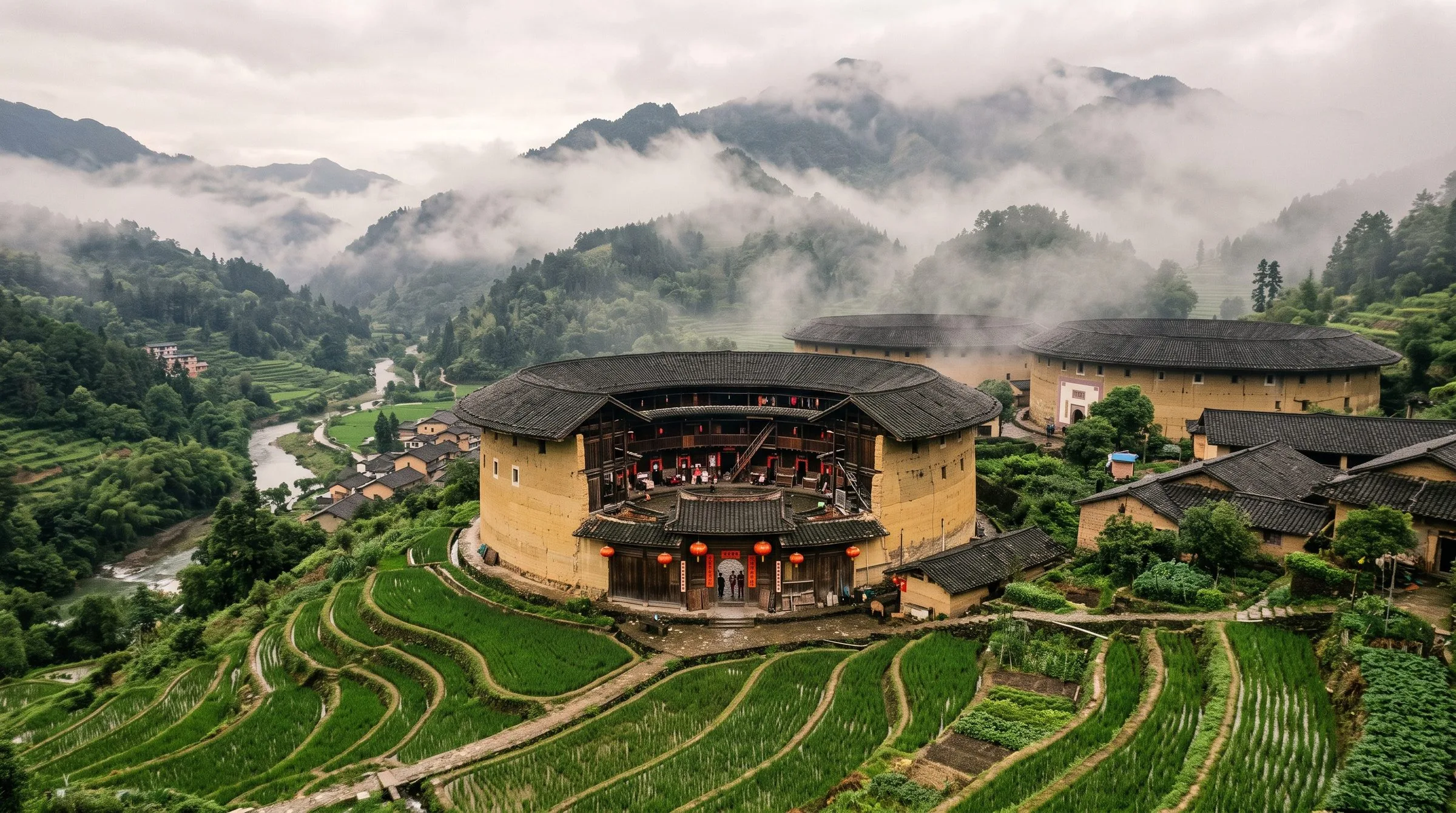
Fujian Tulou and Wuyishan Tea Trip 2026: UNESCO Hakka Round Buildings + Da Hong Pao
Fujian deep travel guide: Hakka Tulou UNESCO round earthen buildings (Yongding + Nanjing tulou clusters, ¥90-130), Wuyishan mountain tea (Da Hong Pao 大红袍 from the mother trees), 5-7 day combined itinerary from Xiamen.
Fujian is the underrated chapter of southeast China. The province shares its coastline with Guangdong and its mountains with Jiangxi, but where its neighbors drew crowds, Fujian stayed quiet. That is changing fast. In 2008 UNESCO inscribed 46 Hakka Tulou earthen buildings across four clusters as a single World Heritage Site. In 1999 UNESCO had already inscribed Mount Wuyi (Wuyishan) as a mixed cultural and natural site, with caves holding 3,800-year-old boat-coffin burials and the original mother trees of Da Hong Pao, the most expensive oolong tea on earth. A single 5-7 day Fujian trip covers both, plus the coastal Xiamen food scene, without ever leaving the province.
This guide is built around the realistic constraint that most travelers fly into Xiamen, the cleanest, easiest, and best-served coastal city in Fujian. From there you can drive 2-3.5 hours to either tulou cluster, or take a 4-hour high-speed train north to Wuyishan. We will walk through the route, costs, and timing below.
Why Fujian: Two UNESCO Sites, One Province
Fujian punches well above its weight on the UNESCO list. Two separate inscriptions, both reached within four hours of each other by road or rail, plus a third UNESCO site, Gulangyu Island off Xiamen, that gets far less attention than it deserves.
Mount Wuyi (Wuyishan) — UNESCO 1999. A compact Danxia-landscape range where sheer red cliffs fall into the jade-green Jiuqu River. UNESCO lists it as a mixed site, both natural and cultural, recognizing the ecological integrity of the lower subtropical forests and the human cultural history, particularly the tea cultivation, boat-coffin burials, and the Neo-Confucian academies founded here in the 11th-12th centuries.
Fujian Tulou — UNESCO 2008. Forty-six rammed-earth communal buildings, mostly round, scattered across four clusters in Nanjing County, Yongding District, and Hua’an County in southwest Fujian. The largest, Chengqi Lou in Yongding, holds 400 residents across four stories. UNESCO describes them as “exceptional examples of a building tradition and function, exemplifying a particular type of communal living and defensive organization in a harmonious relationship with their environment.”
Gulangyu Island — UNESCO 2017. Just off Xiamen, a 1.88-square-kilometer island with 1,800+ colonial-era villas, an organ museum, a piano museum, and Shuzhuang Garden. Worth 1-2 days of any Fujian trip.
If you have only five days and you must choose, do the Wuyishan + Yongding Tulou combination. Add a day in Xiamen for the coast. If you have a full week, you can do Wuyishan (2 days) + Nanjing Tulou (1 day) + Yongding Tulou (1 day) + Xiamen (2 days) + Fuzhou or Quanzhou (1 day). Each is reachable from the next in 2-4 hours.
Getting There: Xiamen or Fuzhou as Your Base
Xiamen Gaoqi International Airport (XMN) has direct or one-stop flights from most major Asian cities and from European / North American gateways via Beijing, Shanghai, or Hong Kong. It is also well connected by high-speed rail: 4.5 hours from Shanghai, 5.5 hours from Hangzhou, 3.5 hours from Shenzhen, 8 hours from Hong Kong.
Fuzhou Changle International Airport (FOC) is closer to Wuyishan for travelers who want to skip the coast. Fuzhou itself is the provincial capital and underrated: 220 kilometers / 2 hours HSR to Wuyishan vs 450 kilometers from Xiamen.
For a balanced 5-7 day trip starting from Xiamen:
- Xiamen to Wuyishan: 4 hours by HSR (transfer at Nanping or Shangrao). Tickets ¥150-180 second class.
- Wuyishan to Nanjing Tulou: 4.5-5 hours total (HSR back to Longyan or Nanping then 1-2 hours by road).
- Nanjing Tulou to Yongding Tulou: 2-3 hours by road across the river.
- Yongding Tulou to Xiamen: 2.5-3.5 hours by road, or HSR via Longyan (3 hours total).
- Xiamen to Fuzhou: 1.5 hours by HSR, ¥80.
If you do not drive, the easiest approach is to hire a private car for the entire 4-5 day Wuyishan + Tulou loop. A 7-seat Buick GL8 or similar runs ¥800-1,200 per day including driver, fuel, and tolls. Split three ways that is ¥250-400 per person per day, comparable to a guided tour but more flexible. Independent travelers without Mandarin ability should consider a small-group tour for the tulou days: it solves the language problem at the village guesthouses and gets you a Hakka-speaking guide who can explain the family histories.
Wuyishan Tea Country: 2 Days, 2,000 Years of Tea
The Wuyi Mountains sit on the Fujian-Jiangxi border. The northern third (in Jiangxi) is more developed for tourism; the southern Fujian side is where the tea is. Plan two full days.
Day 1: Da Hong Pao + Jiuqu River Raft
Start early. The Wuyishan Scenic Area opens at 7:00 AM and the morning light on the red Danxia cliffs is the best of the day.
Da Hong Pao Mother Tree Garden (大红袍母树). Six ancient tea bushes growing on a cliff ledge called Tiancai Yan (天彩岩) above Tianxin Yongle Temple. The original planting dates to 1691, making them 335+ years old. The 1972 Nixon visit allegedly included a gift of 200 grams of Da Hong Pao from these bushes; the story goes that Mao Zedong was so alarmed at giving away the national treasure that the bushes were placed under armed guard and never harvested again. Today the mother-tree leaves are auctioned, once every decade, for charity, and the park itself is ¥80 entry with a 30-40 minute walking loop. Open 7:30-17:00.
From the mother-tree garden, walk or take a 5-minute shuttle to the Wuyi Palace (武夷宫), the cultural heart of the area. Originally built in 1,000 AD as an imperial Taoist temple complex. Today the site has a small museum on local tea history, the Song Dynasty Liu Yong Memorial Hall, and a courtyard with giant banyans.
In the afternoon, do the Nine-Bend Stream (Jiuqu Xi 九曲溪) bamboo raft. The classic Wuyishan experience: a 2-hour downstream float on traditional bamboo rafts poled by local boatmen, passing the 36 named cliffs and 9 river bends. The boatman narrates the legends (the Five Elders of Wuyi, the Da Hong Pao origin story) in heavily accented Mandarin. Tickets are ¥180 per raft (6 people per raft) and you can split or pay for empty seats, ¥130-180 per person realistically. The raft starts at the Jiujiu Dock and ends at Wuyi Palace, where you started. The water level and weather control everything; the raft is suspended in heavy rain and the channel closes in flash flood season. Reserve 1-2 days ahead at the scenic-area window or on Trip.com.
Finish the day with a tea-house visit. Wuyishan town has dozens of small family-run tea houses where you can sit through a formal 60-90 minute gongfu cha (功夫茶) tasting of 5-8 oolong varieties: shui xian, rou gui, da hong pao grades from commercial to premium, and the rarer “beef jerky” yan cha rock teas. Prices range from ¥80 for a basic tasting to ¥500+ for the high-end single-bush teas. Most houses also sell tea, ¥80-300 for 100g. Buy at the tea farm or one of the small shops in Sangu Gu Li (三姑度假区) to avoid the marked-up tourist shops near the scenic-area gates.
Day 2: Tianyou Peak + Tea Farm Stay
Start at sunrise. The Tianyou Peak (天游峰) hike is the single most popular Wuyishan experience, 3-4 hours round-trip, 800 meters of vertical gain on stone stairs through tea fields. The summit at 408 meters is the highest point in the scenic area, with a tea-pavilion view that justifies the climb on a clear day. Entry is included in the ¥115 scenic-area ticket (valid for 3 days, so you can re-enter). Go early, by 7:30 AM, to beat the tour buses; the steps are steep and one-way on the busiest sections. Bring 1 liter of water per person.
After the hike, drive or take a taxi 30 minutes north to a tea-farm homestay. Wuyishan’s tea farms are terraced up the hillsides between 200 and 600 meters elevation. Several cooperative farms now run B&B programs where you stay in a converted farmhouse, walk the tea rows at dawn, pick leaves with the farmers (April-May harvest), and learn to roast and roll your own batch. The farms are typically ¥400-700/night for a double with full board. Two well-known options: Tianya Wuyi Tea Farm (天涯武夷) and Yilong Tea Manor (艺龙茶庄园). Book direct on WeChat mini-programs or through the Wuyishan Tourism Bureau site.
If you cannot get a tea-farm stay, spend the afternoon at the Dahongpao Scenic Area (different from the mother-tree garden; this is the larger 4A area covering Tianyou Peak, the Jiuqu River upper sections, and a 5-kilometer tea-culture walking path with explanatory panels). It also has a tea museum inside a restored Song Dynasty building, free with the scenic-area ticket.
Hakka Tulou: Two Clusters, One Day Each
The 46 UNESCO tulou are split between two practical visit areas: Nanjing County (Tianluokeng, Hekeng, Hechun, Hegui Lou, Huaiyuan Lou) and Yongding District (Chengqi Lou, Zhencheng Lou, Hongkeng, Chuxi, Nanxi). They are 2-3 hours apart. Plan one full day per cluster and don’t try to compress them.
Day 3: Nanjing Tulou Cluster
The Nanjing cluster is closer to Xiamen (3 hours vs 4 to Yongding) and the tulous are more accessible. Most first-time visitors see the four UNESCO sites in one day:
Tianluokeng Tulou Cluster (田螺坑土楼群). The iconic “Four Dishes and One Soup” formation: one square (Buyun Lou) and four round buildings (Hechanglou, Ruiyun Lou, Hechun Lou, Zhenchang Lou) arranged on a hillside like dishes around a central square. Built between 1330 and 1700 AD. Most visitors see this from the upper viewpoint (10-minute uphill walk) for the famous group photo, then descend to walk through the buildings. Entry to the cluster is ¥90; an additional ¥20 buys the right to climb the 4-story Hechun Lou’s wooden staircases and see the communal kitchen, bedrooms, and storage rooms on the upper levels. Allow 2 hours.
Yuchang Building (裕昌楼). Inside the Tianluokeng area. Built 1308-1338 AD, the “Zigzag Building” famous for its tilted internal columns, up to 15 degrees off vertical. It still houses 30+ Hakka families. No additional entry beyond the Tianluokeng ticket.
Yunshui Yao Scenic Area (云水谣). A 5-kilometer riverside walking path that connects three tulous (Hegui Lou, Huaiyuan Lou, and a 13th-century square tulou) and a 700-year-old banyan grove. Hegui Lou is the tallest square tulou in the UNESCO list, 17.08 meters high, built on marshland and still standing. Huaiyuan Lou is a “ring within a ring” round tulou with a central Confucian academy, the “Si Shi Shi” classroom. Entry ¥130 combined ticket; allow 3 hours including the riverside walk.
Taxia Village (塔下村). A Hakka village built along a 1.5-km stream with 47 tulous of various shapes, including two that bend the stream in a Tai Chi pattern. The village is free to walk through and works well as a late-afternoon stop on the way to dinner and overnight. The Zhang clan ancestral hall, built 1426 AD, is still active for clan meetings.
Hekeng Tulou Cluster (河坑土楼群). 13 tulous, 7 of which are UNESCO-listed, in a mountain setting. Less visited; the highlight is the “Big Dipper” view from the top of Lion Rock above the cluster (45-minute uphill hike). The buildings are more weathered and the residents friendlier than the showpiece Tianluokeng. Entry ¥50; allow 1.5-2 hours.
For the Nanjing day, stay overnight in one of the converted tulous at Taxia Village (Yunshui Yao area) for ¥100-300/night or in Nanjing town at a 3-star hotel for ¥250-400/night. The taxia guesthouses are more atmospheric; the town hotels are cleaner and have reliable Wi-Fi.
Day 4: Yongding Tulou Cluster
Yongding is the “Tulou Kingdom” and the home of the most famous individual buildings. The drive from Nanjing is 2-3 hours, half on a new toll expressway, half on a winding mountain road through tea and rice terraces. The scenery is half the pleasure.
Chengqi Lou (承启楼), the “King of Tulou”. In Gaobei Village, 3 km from the Yongding Tulou scenic-area entrance. Built 1709-1730, four stories high, 400+ rooms, outer wall 62 meters in diameter. It housed 400+ residents at peak occupancy; today about 80 families still live inside. The internal layout follows a Bagua feng-shui pattern with concentric rings. Chengqi Lou was featured on a 1986 Chinese national stamp and is the building most foreigners picture when they imagine a tulou. ¥50 entry; allow 1.5-2 hours including a walk around the central courtyard, the ancestral hall, and the inner wells.
Zhencheng Lou (振成楼), the “Prince of Tulou Architecture”. In Hongkeng Village, 1.5 km from Chengqi. Built 1912-1934, four stories, 57.2 meters high. The interior has elaborate woodcarvings, gold-leaf details, and Chinese-Western decorative elements, including American newspapers that the overseas Hakka sponsors pasted on the walls. Lin Shangkang, 52, lives in the building and gives free tours in Mandarin to anyone who walks in. ¥50 entry; allow 1 hour.
Hongkeng Tulou Cluster (洪坑土楼群). The village of Hongkeng has 11 major tulous of varied shapes, round, square, rectangular, half-moon, including Fuyu Lou (the “Flying Phoenix” five-phoenix-style tulou with tiered roofs like wings) and Rusheng Lou (the “Pocket Tulou,” 23 meters diameter, one of the smallest in the UNESCO list). ¥80 combined ticket; allow 2-3 hours.
Chuxi Tulou Cluster (初溪土楼群). 5 km south of Hongkeng, the most pristine and least-touristed of the major Yongding clusters. 14 tulous, the oldest from 1419 AD, the most architecturally varied, with terraced rice fields on three sides and a clear stream running through. The view from the hilltop above Chuxi is the single best tulou photograph in Fujian. ¥50 entry; allow 2 hours.
Nanxi Tulou Cluster (南溪土楼群). 100+ tulous scattered along 10 km of the Nanxi river, called the “Fujian Tulou Great Wall.” The scale is more impressive than the individual buildings. You drive through it rather than walk it. No formal entry fee; the area is open countryside.
For the Yongding day, stay in Hongkeng Village (most atmospheric, in or near a tulou guesthouse) for ¥150-300/night, or in Yongding town for ¥200-400/night at a clean 3-star. The town is unremarkable but functional; Hongkeng is genuinely beautiful in the early-morning mist.
Where to Eat: Fujian and Hakka Food
Fujian cuisine (闽菜) is one of China’s eight great culinary traditions but rarely gets attention outside the province. The two faces of Fujian food are:
Min Dong (eastern Fujian, Xiamen and Fuzhou): seafood-forward, light seasoning, sweet-savory flavors. Signature dishes include oyster omelette (蚝烙, hao luo), Xiamen shacha noodles (沙茶面, peanut-based broth with noodles and seafood), peanut soup (花生汤), fish ball soup (鱼丸汤), and the famous Fujian-style red-braised pork (红烧肉, hong shao rou).
Hakka (客家, southwest Fujian tulou regions): heartier, more preserved foods, originally from the northern migrants who settled here in the Song-Yuan era. Signature dishes: stuffed tofu (酿豆腐, niang dou fu), salt-baked chicken (盐焗鸡, yan ji ji), Hakka braised pork (梅菜扣肉, mei cai kou rou, pork belly with preserved mustard greens), pounded ginger duck (姜酒鸭), Hakka rice noodles (客家米粉), and the various rice-paste sweets you see at village festivals.
In Xiamen, the seafood markets are an experience on their own. The Eighth Seafood Market (第八海鲜市场) in central Xiamen has been the city’s seafood distribution center since the 1920s. Buy a live fish or crab in the morning, pay ¥10-30 for cooking, and have it on your table in 20 minutes. The nearby Zhongshan Road Pedestrian Street has the famous snacks: Bapopo Herbal Jelly (八婆婆烧仙草), Huang Ze He Peanut Soup (黄则和花生汤), and dozens of Fujian-Taiwanese stalls.
In Wuyishan, try the local smoked goose (岚谷熏鹅), bamboo rice (竹筒饭), and the slightly bitter Wuyi rock tea-braised chicken (武夷岩茶鸡). A dinner for two with local tea costs ¥150-300.
In the tulou villages, the Hakka farmhouse meals (农家菜) served at the guesthouses are the real draw. Six to eight dishes for ¥80-150 per person including stuffed tofu, salt-baked chicken, smoked pork, bamboo shoot stir-fry, river fish, and a soup. Ingredients are hyperlocal; the chicken is from the courtyard, the vegetables from the back garden.
When to Go: Weather and Crowds
Fujian is warm and humid year-round. Average annual temperature 18-20°C, with January the coldest month (average 9°C) and July the hottest (28-29°C). The rainy season runs March-September, with June the peak.
Best months: April-May and October-November. Comfortable temperatures (20-28°C), low rainfall, and the rice terraces at their most photogenic: water-filled mirror terraces in May, golden rice harvest in late September-October. Spring also brings the tea harvest in Wuyishan and the glow-worm nights in late May at Hekeng Tulou.
Shoulder months: March and June. Still pleasant; fewer domestic tour groups. Some risk of rainy-day disruptions to the bamboo raft.
Avoid: Chinese National Day Golden Week (October 1-7) and the Spring Festival week (mid-January to mid-February, exact dates vary). Tulou villages overflow with domestic tour groups; Wuyishan hotels triple their rates. Mid-summer (July-August) is hot and humid; the Danxia cliffs in the afternoon sun are punishing.
For a tea-focused trip, late April to mid-May is the first Da Hong Pao harvest; this is the only time you can pick and process tea yourself at a farm. For photography, the September-October rice harvest is unbeatable.
What to Budget: 5 Days from Xiamen
A realistic mid-range budget for a 5-day Wuyishan + Tulou trip from Xiamen, two people traveling together:
- Hotels (4 nights): ¥250/night average mid-range hotel or tulou guesthouse. Total ¥1,000 (~$140).
- Private car with driver for 3 days (Xiamen-Tulou-Wuyishan-Xiamen): ¥900/day split. Total ¥2,700 (~$380).
- HSR tickets (Xiamen-Wuyishan round trip): ¥360 per person. Total ¥720 for two.
- Entrance fees: Wuyishan Scenic Area ¥115 + Jiuqu raft ¥180 + Da Hong Pao garden ¥80 + Tianluokeng ¥90 + Yunshui Yao ¥130 + Chengqi Lou ¥50 + Zhencheng Lou ¥50 = ¥695 per person. Total ¥1,390 for two.
- Meals: ¥120/day per person. Total ¥1,200 (~$170).
- Tea, snacks, water, tips: ¥200 per person. Total ¥400 (~$55).
Total for two people, 5 days, mid-range: ¥6,500-7,500, approximately $900-1,000. Per person: $450-500.
For a backpacker-style trip using hostels, public buses, and the China High-Speed Rail, you can do it for $300-400 per person. For a comfort-level trip with 4-star hotels and private guides throughout, plan $1,500-1,800 per person.
Practical Tips for Foreign Visitors
Cash and payment. Most tulou village guesthouses, Wuyishan tea farms, and small local restaurants are still cash-preferred. Alipay and WeChat Pay work everywhere there is signal, but the vendors sometimes refuse them for small transactions. Get your Alipay set up and working with a foreign card before you arrive (see our Alipay for Foreigners 2026 guide). Carry ¥500-1,000 in small notes for the tulou days.
Language. English is rare in rural Fujian. In Xiamen, the tourism industry is bilingual. In Wuyishan town, hotel receptionists speak basic English. In the tulou villages, Mandarin is the only working language, and Hakka is the local dialect. Translation apps work well in text but not voice-to-voice. Plan for 30-50% slower communication than in a tier-1 city.
Connectivity. 4G works in Xiamen, Wuyishan town, and the Tulou scenic-area entrances. Speeds drop inside the buildings (the 1-meter-thick earthen walls are not 5G-friendly) and disappear entirely in the mountain hikes and Nanxi Tulou drive. Download offline maps (Maps.me or Baidu Maps) before leaving Xiamen.
Walking and stairs. The tulou staircase climbs at Tianluokeng, Chengqi Lou, and Tianyou Peak are steep. Wear shoes with real grip, not flip-flops. The interior stairs of older tulous are narrow, dark, and uneven. The villages themselves are on slopes; expect 100-200 meters of elevation change in any walking route.
Cultural respect. The UNESCO tulous are still homes. About 70-80 families live in the showpiece buildings. Photography is fine, but ask before photographing residents. Don’t enter private rooms on upper floors without an invitation. Don’t touch the wooden columns or the ancestral altars. Smoking is forbidden inside the buildings.
Drones. Allowed outside the scenic-area gates but banned inside. The Yuchang Building drone ban is the most strictly enforced.
Combining This Trip with the Rest of Fujian or Beyond
A 7-day version of this route can add:
- Fuzhou (1 day, between Wuyishan and Xiamen): the Three Lanes and Seven Alleys (Sanfang Qixiang 三坊七巷) historic district, the Fujian Provincial Museum, and Drum Mountain (Gushan). Fuzhou is the underrated Fujian capital and gives a different cultural beat than the Hakka villages.
- Quanzhou (1-2 days, on the way from Xiamen to Fuzhou): the Maritime Silk Road starting point, with the Kaiyuan Temple, the Qingjing Mosque (one of the oldest in China), and the Confucian Temple. Quanzhou is a UNESCO World Heritage site in its own right (2021) for its role as the Song-Yuan maritime trade hub.
- Xiapu Mudflats (1-2 days, if you are a photographer): the famous tidal-flat fishing scenes, 2-3 hours north of Fuzhou. Best at low tide in April-June and September-October.
For an extended 10-12 day trip that includes Fujian plus a deeper dive into southeast China, link the tulou days to Wuyi Mountain, then fly from Fuzhou or Xiamen to Wuyuan (Jiangxi’s most photogenic village cluster) and on to Huangshan (Yellow Mountain), before continuing to Hangzhou or Shanghai by HSR. The full China 2-week classic route covers this in detail.
Frequently Asked Questions (Quick)
Can I do the trip without a private car? Yes, but with significant time loss. Public buses connect Xiamen, Nanjing, Yongding, and Wuyishan town, but the schedules are infrequent and the tulou clusters themselves require local taxis once you arrive. A 5-day independent bus-and-taxi version is feasible but plan 1.5x more time for the same route.
Is Fujian safe for solo travelers? Yes, among the safest provinces in China. The tulou villages are well-policed for tourism. The main risks are the same as anywhere in China: traffic, petty theft at crowded scenic areas, and the scam of being led to a fake tea house in Wuyishan by a friendly stranger. The latter can be avoided by booking tea tastings through your hotel.
How does this compare to the Anhui Hongcun / Xidi tulou-style experience? The Anhui villages (Xidi and Hongcun, UNESCO 2000) are different: Huizhou merchant houses with white walls and black tile roofs, not round earthen communal buildings. They are arguably more refined architecturally and easier to combine with Huangshan. Fujian tulou are more dramatic, more communal, and more authentic as still-lived-in homes. See our Huangshan scenic guide for the Anhui side.
What about kids? Tulou villages are family-friendly and children are welcome everywhere. The bamboo raft is suitable for kids 4+. Tianyou Peak is too strenuous for children under 8. Wuyishan tea-farm stays work well for kids 6+. Plan for a slightly slower pace with kids; 6-7 days rather than 5.
Should I book a guided tour or go independent? Independent travel is possible but more challenging in rural Fujian than in tier-1 cities. For first-time visitors with limited Mandarin, a 3-4 day guided tour from Xiamen costs ¥2,500-4,000 per person including hotels, transport, and entrance fees, and is often the best value. Trip.com and China Discovery both offer standard 5-day packages. For experienced independent travelers, hire a private car and driver for the tulou days (¥800-1,200/day) and self-book Wuyishan.
Related Reading
For more on related routes and topics, see our guides to the Great Wall, Hangzhou West Lake, and the China Budget 2026 breakdown. For deeper China culture, our China cultural etiquette guide explains gift-giving, dining, and temple etiquette, all useful in rural Fujian where manners still follow traditional patterns.
The Wuyishan-and-Tulou combination is one of the most rewarding 5-day trips in southeast China. Two UNESCO World Heritage sites, two distinct cultural traditions (Hakka earthen communalism and northern Fujian Danxia tea culture), and the best coastal food in the country, all reachable from a single base. The window to see it before the crowds fully arrive is closing; the year after Fujian’s 2024 high-speed rail extension to Yongding, visitor numbers are up 30-40%. Go now, while the villages still have real Hakka elders to talk to.
Related articles
Step by step
-
Fly into Xiamen or Fuzhou
Xiamen Gaoqi International Airport (XMN) is the most convenient gateway, with direct flights from most Asian hubs and connections from Europe / North America via Beijing or Shanghai. Fuzhou Airport (FOC) is closer to Wuyishan for travelers skipping the coast.
-
Day 1-2 in Wuyishan Tea Country
Take a 4h high-speed train from Xiamen to Wuyishan (transfer at Nanping). Visit the Da Hong Pao mother-tree garden, raft down the Jiuqu River, hike Tianyou Peak, and stay one night in a tea-farm B&B for an early-morning walk through the terraced fields.
-
Day 3 Drive 3h to Nanjing Tulou Cluster
Return to Wuyishan East Station, take HSR back to Nanjing (or Longyan), and explore the four showpiece tulous: Tianluokeng (Four Dishes and One Soup), Yunshui Yao, Hechun, and Taxia Village. Stay one night in a converted tulou guesthouse or in Nanjing town.
-
Day 4 Drive 2-3h to Yongding Tulou Cluster
Continue to Yongding, the home of the round 'Tulou King' Chengqi Lou and the ornate Zhencheng Lou. Spend 4-6 hours walking through Hongkeng, Gaobei, and Chuxi sub-clusters. Stay in Yongding town.
-
Day 5 Back to Xiamen and the Coast
Drive 2.5-3h back to Xiamen and use the final day to explore Gulangyu Island, Nanputuo Temple, and the seafood markets. Optional: add a day in Fuzhou's Three Lanes and Seven Alleys (Sanfang Qixiang) before flying out.
-
Budget and Booking Tips
Book hotels and entry tickets on Trip.com or Booking.com 1-2 weeks ahead, especially tulou guesthouses which have few rooms. Total 5-day budget: $500-700 per person mid-range, $300-400 backpacker style, $1,200-1,800 comfort level. Best months: April-May and October-November.
FAQ
-
What is a Fujian Tulou and why is it a UNESCO site?
A Fujian Tulou is a large rammed-earth communal round or square house built by the Hakka people, dating from the 15th-20th centuries. In 2008 UNESCO inscribed 46 of them across four clusters (Nanjing, Yongding, Hua'an) as World Heritage, calling them exceptional examples of a building tradition that exemplified communal living and defensive organization in a harmonious relationship with their environment. -
How do I get from Xiamen to the Tulou clusters?
Xiamen is the standard gateway. By car or hired driver it is 2.5-3.5 hours to Nanjing Tulou Cluster and another 2-3 hours to Yongding. Direct buses run from Xiamen Wucun Bus Station to both counties in 2-3.5 hours, or you can take a 30-60 minute bullet train to Nanjing Railway Station then transfer 1 hour by road. -
How much does a 5-day Fujian Tulou + Wuyishan trip cost?
Plan $80-120 per day per person on a mid-range budget: $40-70/night hotels, $15-25 entrance fees per site, $10-20 on meals, plus private car ($80-120/day) or train tickets. A 5-day independent trip from Xiamen typically totals $500-700 excluding international flights; a small-group guided tour runs $900-1,500. -
Is Da Hong Pao tea worth the trip to Wuyishan?
Yes if you care about tea. The original six mother-tree Da Hong Pao bushes on Tiancai Rock are 360+ years old and are now a national treasure; the small park (¥80) is the pilgrimage site for oolong fans. Even if you do not drink tea, the Wuyi Mountains Danxia landscape, Jiuqu River bamboo rafts, and Tianyou Peak are among the most beautiful in southeast China. -
Can I stay overnight inside a Tulou building?
Yes, several Yongding and Nanjing tulous have been converted to small guesthouses. Zhencheng Lou and Chengqi Lou in Yongding have on-site family-run stays for ¥100-300/night; some Tulou in Tianluokeng and Yunshuiyao clusters also host visitors. Bathrooms may be shared, hot water and Wi-Fi can be limited, and you should respect residents still living in the buildings.
Related guides
- Itineraries
Xiamen Gulangyu Weekend Guide 2026: UNESCO Island, Fujian Food, Tulou Day Trip
Xiamen weekend guide for foreign visitors: Gulangyu UNESCO Piano Island (5-minute ferry ¥35), South Putuo Temple, Xiamen University, Zhongshan Road, and a day trip to the Hakka Tulou (round earthen buildings, UNESCO).
- Itineraries
China Cool 2026: 8 Best Summer Escapes from the Heat (Foreigners' Guide)
China Cool is the 2026 trending travel movement — escaping the summer heat to China's mountain and forest retreats averaging 18-26°C. 8 hand-picked destinations with transport, stay, and food tips for foreign visitors.
11min read
- Itineraries
China's 15 Hidden Gem Cities: The 2026 Reverse Tourism Guide for Foreigners
Skip Beijing and Shanghai. China's 15 hidden gem cities for 2026 — verified lesser-known destinations (Wuyuan, Fenghuang, Songpan, Dali, Wuyi, Tengchong, Jianshui, etc.) with how to get there, what to do, where to stay, and food. Reverse tourism trend up 187% YoY in 2026.
14min read
- Itineraries
China Honeymoon 2026: The Ultimate Romantic Travel Guide (Itineraries, Cost, Visas)
China is the surprise 2026 honeymoon destination — cheaper than Bali/Maldives, less crowded than Paris, with hidden romantic gems. 4 ready-made itineraries (7 / 14 / 21 / 30 days) covering Yunnan, Sichuan, Jiangnan, and Tibet-Yunnan grand circuits. 2026 visa rules, costs, best seasons, and how to avoid the 5 most common honeymoon mistakes in China.
16min read
- Itineraries
2 Weeks in China: The Classic Beijing-Xi'an-Chengdu-Shanghai Route (2026)
A complete 14-day China itinerary for first-time visitors: 3 days Beijing, 2 days Xi'an, 2 days Chengdu, 4 days Shanghai, with day-by-day timing, costs, transit between cities (high-speed rail vs flight), hotel recommendations, and which days to skip if you have less time. Budget: ¥15,000-22,000 per person excluding international flights.
12min read
- Itineraries
3 Days in Chongqing: Hongya Cave Night, Hotpot, Yangtze Cable Car (2026 Itinerary)
The perfect 3-day Chongqing itinerary: Hongya Cave at night, Chongqing hotpot, Yangtze River cable car over the river, Jiefangbei, Ciqikou ancient town, and a Dazu Rock Carvings day trip. With prices, transit times, and a foreigner-friendly hotpot survival guide.
10min read