
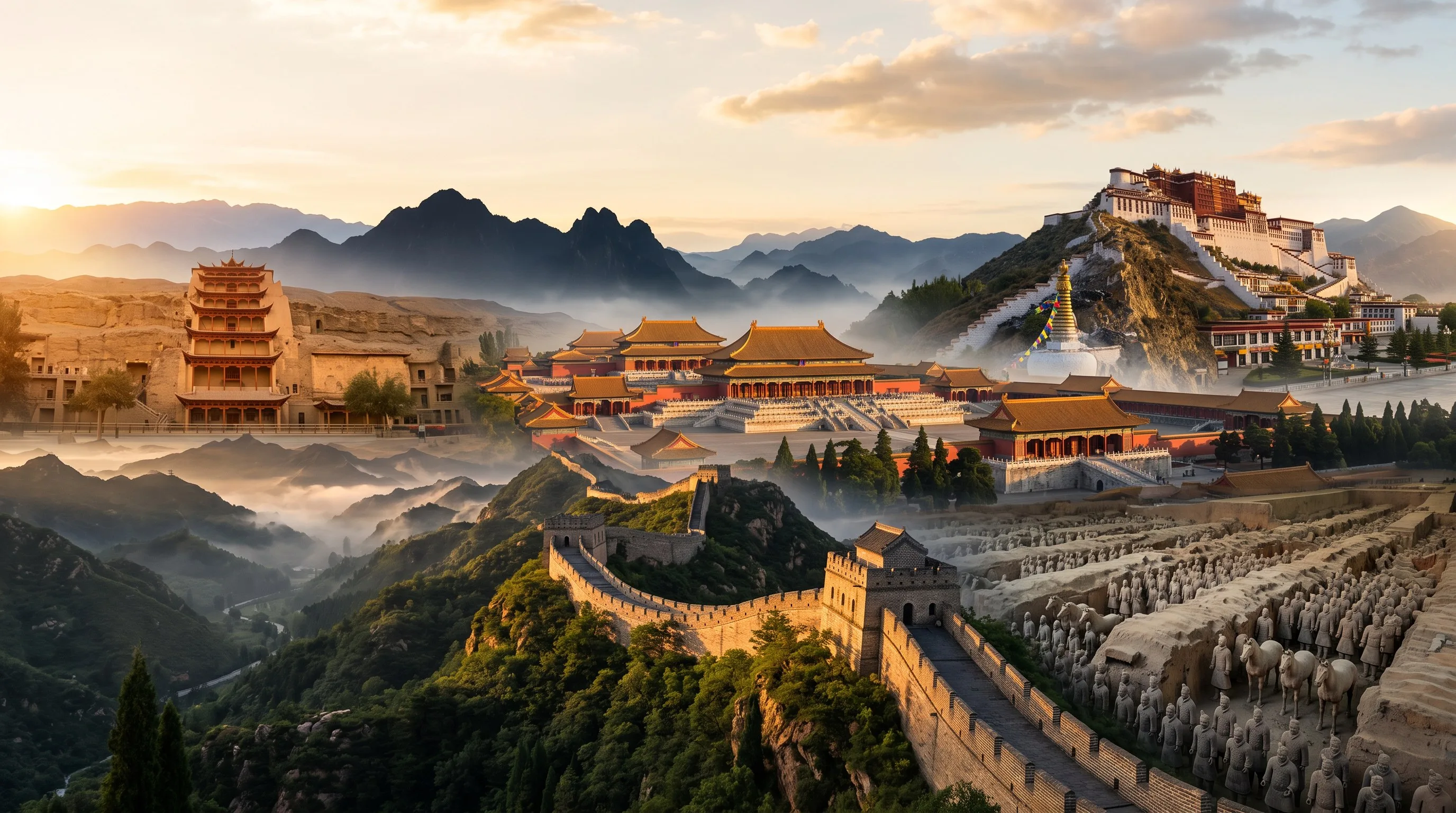
China UNESCO World Heritage Sites 2026: Complete List of 59 Sites + Travel Guide
Complete list of all 59 China UNESCO World Heritage Sites (2026 update) with travel info: which to see, which to skip, how to combine, when to visit, costs. The Great Wall, Forbidden City, Mogao Caves, Jiuzhaigou, Huangshan, and the lesser-known.
As of mid-2026, China has 59 UNESCO World Heritage Sites: 40 cultural, 15 natural, and 4 mixed. This is the largest collection of any country in Asia and the second largest in the world after Italy (which has 60+). The 2024 inscription of the Beijing Central Axis (Beijing’s 8th site) and the 2025 inscription of the Jingdezhen imperial porcelain kilns brought the total to 59; the 48th World Heritage Committee session in July 2026 considered additional Chinese nominations.
This guide is a complete, opinionated map of the 59 sites, with the practical context a first-time or repeat visitor actually needs: which sites to prioritize, which to skip, when to visit, how to combine them, and what they cost. It is structured in three sections: the top 10 must-see sites, the full categorized list, and the practical combination routes.
The Top 10 Must-See Chinese UNESCO Sites
These 10 sites represent the diversity of Chinese civilization across 1,500 years and 6,000 km of geography. They are reachable on a 2-3 week grand tour, and any first-time visitor who sees at least 5 of them has a strong foundation in Chinese history and natural beauty.
1. The Great Wall at Mutianyu (UNESCO 1987)
What it is. The best-preserved and most scenic section of the 21,196 km Great Wall, 1.5-2 hours north of central Beijing. The Ming-dynasty wall dates to the 14th-17th centuries; the Wall as a continuous defensive system was built and rebuilt from the 7th century BC to the 17th century AD.
Why Mutianyu specifically. Badaling (closer to Beijing) is over-restored and over-crowded (40,000+ visitors per day); Jinshanling (further) requires serious hiking. Mutianyu is the sweet spot: 22 restored watchtowers, restored wall walk of 2.5 km, less than 10,000 visitors on a typical day, and the option of a toboggan slide down from Tower 6. ¥45 entry, ¥120 round-trip cable car, ¥100 toboggan.
Time needed. 4-5 hours including transit from Beijing.
Internal link: See our Great Wall scenic guide.
2. The Forbidden City, Beijing (UNESCO 1987)
What it is. The imperial palace from 1420 to 1912, 24 emperors, 980 surviving buildings across 74 hectares, the largest wooden building complex in the world. The Ming and Qing emperors governed China from here for 491 years.
Why it matters. Every Chinese dynasty’s political decisions from 1420 to 1912 were made within these walls. The layout follows Confucian cosmological principles (the front half is for the emperor’s public life, the back half for his private life; the central axis is the imperial power line). The art collection is the largest in any museum in the world, much of it in the Palace Museum in Taipei since 1949 but still substantial in Beijing.
Visit tips. ¥60 entry (advance booking required via the official WeChat mini-program or Trip.com 1-2 weeks ahead). The 80,000 visitors-per-day cap means morning tickets sell out by 10 AM in peak season. Allow 4 hours minimum. Enter from the south at the Meridian Gate (Wumen), exit through the north at the Gate of Divine Prowess (Shenwu), and add a side climb up Jingshan Park (¥10) for the iconic overhead view.
Time needed. 4-5 hours.
Internal link: See our Forbidden City scenic guide.
3. The Terracotta Army, Xi’an (UNESCO 1987)
What it is. The funerary army of China’s first emperor, Qin Shi Huang (reigned 221-210 BC). Approximately 8,000 life-sized soldiers, 130 chariots with 520 horses, and 150 cavalry horses, all individually carved and originally painted in vivid colors. The site is 40 km east of Xi’an, discovered by farmers in 1974.
Why it matters. It is the most significant archaeological find of the 20th century, the only surviving large-scale figural sculpture from the Qin dynasty, and the only material evidence of the Qin’s vision for his afterlife empire. UNESCO inscribed it the same year as the Great Wall and the Forbidden City (1987), the first batch of Chinese sites.
Visit tips. ¥120 entry, ¥30 for the optional shuttle from the visitor center to Pit 1. The site has three main pits (Pit 1 the largest with 6,000+ figures, Pit 2 the most varied with the original kneeling archers, Pit 3 the smallest with the command post). Best at opening (8:30 AM) to beat the tour buses. The figures were originally painted; the paint oxidizes within minutes of exposure to air, so what you see today is the bare clay surface. Pair with the Han Yangling Museum (30 km north, ¥90) for a comparison of Han-dynasty tomb art.
Time needed. 3-4 hours.
Internal link: See our Terracotta Army scenic guide.
4. The Mogao Caves, Dunhuang (UNESCO 1987)
What it is. A 1.6 km cliff face along the Dachuan River, carved with 735 caves containing 2,100 painted Buddhist murals and 2,400 painted clay sculptures, ranging from 4th to 14th century AD. The caves were active Buddhist monasteries and pilgrimage sites along the Silk Road for 1,000 years.
Why it matters. The Mogao Caves contain the largest and most comprehensive collection of Buddhist art in the world, with continuous patronage across the Northern Wei, Western Wei, Sui, Tang, Song, and Western Xia dynasties. The Library Cave (Cave 17, discovered 1900) yielded 50,000+ manuscripts in 16 languages, the single most important Silk Road-era document find.
Visit tips. ¥238 entry, which includes the Mogao Caves Digital Exhibition Center (a required 30-minute intro film before entering the actual caves). 6,000 visitors per day cap. Tickets sell out 1 month in advance in peak season (May-October); book via the official Dunhuang Academy WeChat mini-program. Only 10-12 caves are open to the public on any given day, and the specific caves change daily to limit wear. Photography is forbidden inside the caves. The Dunhuang site is in Gansu province, 2,000 km west of Beijing; the easiest access is a 3-hour flight from Beijing or Xi’an, or a longer HSR via Lanzhou.
Time needed. 3-4 hours at the caves, plus 1-2 days in Dunhuang to see the Singing Sand Dunes (Mingsha Shan, ¥110), Crescent Lake (Yueyaquan), and the Yumen Pass and Yangguan Pass Silk Road frontier sites.
Internal link: See our Mogao Caves scenic guide.
5. Jiuzhaigou Valley, Sichuan (UNESCO 1992)
What it is. A 720-square-kilometer nature reserve in the Min Mountains of northern Sichuan, containing 108 interconnected high-altitude lakes (tian chi, “heavenly lakes”) and a series of spectacular waterfalls, including the Nuorilang Waterfall (the widest travertine waterfall in China at 320 m wide). Elevation 2,000-3,100 m.
Why it matters. Jiuzhaigou is the most photogenic natural site in China. The turquoise and emerald lakes, fed by travertine-filtered glacial water, are unlike any other landscape on earth. The site is also home to the giant panda and the Sichuan golden monkey.
Visit tips. ¥190 entry, ¥90 mandatory eco-bus ticket. Open April-November only (closed in winter for snow and ice safety). Best in late September to late October for autumn color, when the leaves turn red and gold against the turquoise water. Allow a full day; the park is too large to do in less than 6 hours. The 2017 earthquake temporarily closed Jiuzhaigou, but it has been fully reopened since 2019. Reach via a 1.5-hour flight to Jiuzhai Huanglong Airport from Chengdu, or a longer 8-hour drive from Chengdu.
Time needed. Full day.
6. Huangshan (Yellow Mountain), Anhui (UNESCO 1990)
What it is. A 1,200-square-kilometer mountain range in southern Anhui, with 77 named peaks, the highest at 1,864 m. The mountains are famous for four scenic features: the strangely-shaped pines growing out of granite cliffs, the seas of cloud below the summit, the hot springs at the base, and the winter snow scenes. The range has been the subject of Chinese landscape painting for 1,000 years.
Why it matters. Huangshan is the iconic image of Chinese landscape, the place every Chinese painter and poet has visited, and the inspiration for the “shrub and rock” garden style that influenced gardens from Beijing to Kyoto. The pine trees (especially the “Yingke Pine”迎客松 “Welcome Guest Pine” on the main summit) are individual national treasures.
Visit tips. ¥190 entry, ¥90 round-trip cable car (multiple cable cars on different sides of the mountain). Best in April-May and September-November; allow 2 days if you want to see the sunrise (stay overnight at the summit). The summit area has a small hotel (Beihai Hotel, ¥1,000+ per night) and basic dorms (¥200-400 per bed). Reach by HSR to Huangshan North Station (3 hours from Shanghai, 1.5 hours from Hangzhou), then 1-hour bus to the scenic-area entrance. The Hongcun and Xidi Huizhou villages (UNESCO 2000) are 1-2 hours away and pair well with Huangshan.
Time needed. 2-3 days.
Internal link: See our Huangshan scenic guide.
7. The Potala Palace, Lhasa (UNESCO 1994)
What it is. The 13-story, 117-meter-tall palace-fortress of the Dalai Lamas on the Red Hill in central Lhasa, Tibet, dating to 1645 (the White Palace) and 1694 (the Red Palace). The palace contains 1,000+ rooms, 10,000+ shrines, and 200,000+ statues. The seat of Tibetan political and religious power for 350 years.
Why it matters. It is the most important Tibetan Buddhist building in the world, the symbolic heart of Tibetan identity, and a spectacular example of Tibetan architecture blending Chinese, Indian, and Nepalese influences. The winter palace (the Norbulingka) is a separate UNESCO component.
Visit tips. ¥200 entry (peak season May-October, ¥100 in winter). The daily visitor cap is 4,000 in peak season and 2,300 in winter; tickets sell out by 9 AM in peak season. The visit is strictly timed to a 1-hour slot to protect the building. Photography is forbidden inside. Reach via a 3-4 hour flight from Beijing, Shanghai, Chengdu, or Xi’an to Lhasa Gonggar Airport, or via the Qinghai-Tibet Railway (21 hours from Beijing, 22 from Shanghai, 14 from Xining). Allow 2-3 days in Lhasa for acclimatization (Lhasa is at 3,650 m elevation; altitude sickness is a real risk).
Time needed. 2-3 hours for the palace itself, 2-3 days in Lhasa.
Internal link: See our Lhasa Tibet travel guide and Lhasa 3-day itinerary.
8. West Lake, Hangzhou (UNESCO 2011)
What it is. A 6.4-square-kilometer freshwater lake surrounded by hills on three sides, in the heart of Hangzhou. The “Ten Scenes of West Lake” (西湖十景) have inspired Chinese poetry and painting since the Song dynasty. The lake is free to walk around; the boats, islands, and major gardens are individually ticketed.
Why it matters. West Lake is the most beautiful urban landscape in China, the defining image of the Chinese aesthetic, and the inspiration for gardens from Beijing to Kyoto. The Southern Song capital Hangzhou was one of the largest and richest cities in the world 800 years ago; West Lake is the surviving cultural anchor.
Visit tips. The lake is free, but the official boat tour (¥70) visits three islands; Leifeng Pagoda (¥40); Su Causeway and Bai Causeway (free, walk or bike); Lingyin Temple (¥75, west of the lake); and the China National Tea Museum (free, west of the lake). Allow 2 days. Best in March-April (spring blossoms) or September-October (autumn color). Reach by HSR from Shanghai (1 hour, ¥80) or Beijing (5 hours, ¥350).
Time needed. 2 days.
Internal link: See our Hangzhou West Lake complete guide.
9. Pingyao Ancient City, Shanxi (UNESCO 1997)
What it is. A 2.25-square-kilometer Ming-Qing walled city in central Shanxi, the best-preserved ancient walled city in China. 6.4 km of city wall, 4,000+ traditional courtyard houses, 400+ restored shops, the first bank of China (Rishengchang, founded 1823), and the Qing-era county government office. The city has been continuously inhabited for 2,700 years.
Why it matters. Pingyao is the most authentic surviving example of a traditional Chinese county town. The Ming-dynasty wall is intact; the street layout is unchanged; the courtyard houses are lived in. The early Chinese banking system developed here, with the Rishengchang draft bank pioneering many modern banking concepts.
Visit tips. ¥125 combined ticket (includes the wall, county office, Rishengchang bank, and 19 other sites within the wall). Best spent 1-2 days inside the wall, staying in a traditional courtyard hotel (¥300-800/night). The town becomes a tourist destination by day but is quiet after 21:00. Reach via HSR from Taiyuan (30 min, ¥40) or Beijing (3.5h, ¥190) or Datong (3-3.5h, ¥190). Pair with the Shuanglin Temple (7 km south, ¥50) and the Wang Family Compound (30 km south, ¥55) for the “Pingyao plus” 2-day tour.
Time needed. 1-2 days.
10. The Classical Gardens of Suzhou (UNESCO 1997)
What it is. Nine classical gardens in the city of Suzhou, 100 km west of Shanghai, representing the highest achievement of the Jiangnan garden style. The Humble Administrator’s Garden (拙政园, ¥90), the Lingering Garden (留园, ¥55), the Master of Nets Garden (网师园, ¥40), and the Pan Family Altar (盘门, ¥40) are the highlights. Most date to the 16th-19th centuries.
Why they matter. The Suzhou gardens are the Chinese landscape painting tradition made three-dimensional: rockeries, ponds, covered walkways, viewing windows framing specific scenes, borrowed scenery from outside the wall. The design principles influenced Japanese garden design (Kyoto in particular borrowed heavily from Suzhou).
Visit tips. Allow 1 day for the major gardens. The Humble Administrator’s Garden alone is 5.2 hectares and takes 2-3 hours. The Master of Nets Garden is best at night (¥100 evening tour 19:30-22:00) when the pavilions are lit and the Kunqu opera is performed. Reach by HSR from Shanghai (30 min, ¥40) or Hangzhou (1.5h, ¥80).
Time needed. 1 day.
The Full List: 59 Sites by Category
Below is the complete list of all 59 sites, organized by UNESCO category. Where possible, the local Chinese name is provided in pinyin plus characters for advanced search purposes. (Sites inscribed in 2024-2026 are marked NEW.)
Cultural Sites (40 sites)
Ancient Palaces and Imperial Sites:
- Imperial Palaces of the Ming and Qing Dynasties in Beijing and Shenyang (Forbidden City + Mukden Palace, UNESCO 1987)
- Temple of Heaven, Beijing (UNESCO 1998)
- Imperial Tombs of the Ming and Qing Dynasties (13 tombs, including Ming Xiaoling in Nanjing, Ming Tombs in Beijing, Eastern and Western Qing Tombs, 2000 and 2003)
- Beijing Central Axis (北京中轴线) (NEW 2024)
Ancient Capitals and Cities:
- Ancient City of Pingyao, Shanxi (UNESCO 1997)
- Historic Centre of Macao (UNESCO 2005)
- Kaiping Diaolou and Villages, Guangdong (UNESCO 2007)
- Ancient Villages in Southern Anhui, Hongcun and Xidi (UNESCO 2000)
- Historic Monuments of Dengfeng, Henan (Shaolin Temple, Zhongyue Temple, 2010)
Buddhist, Taoist, and Religious Sites:
- Ancient Building Complex in the Wudang Mountains, Hubei (UNESCO 1994)
- Lushan National Park, Jiangxi (UNESCO 1996)
- Mount Emei and Leshan Giant Buddha, Sichuan (UNESCO 1996)
- Mount Wutai, Shanxi (UNESCO 2009)
- China Danxia (UNESCO 2010, multiple sites)
- Hubei Shennongjia (UNESCO 2016)
- Fanjingshan, Guizhou (UNESCO 2018)
- Badain Jaran Desert Towers, Inner Mongolia (UNESCO 2024)
Buddhist Caves and Grottes:
- Mogao Caves, Dunhuang, Gansu (UNESCO 1987)
- Yungang Grottoes, Datong, Shanxi (UNESCO 2001)
- Longmen Grottoes, Luoyang, Henan (UNESCO 2000)
- Dazu Rock Carvings, Chongqing (UNESCO 1999)
- Maijishan Grottoes, Tianshui, Gansu (not UNESCO-listed, but nationally significant)
- Kizil Caves, Xinjiang (not UNESCO, but significant)
- Bezeklik Caves, Turpan, Xinjiang (not UNESCO, but significant)
Note: Of the Buddhist caves, the “Big Three” of Mogao, Yungang, and Longmen are UNESCO-inscribed. The others are national-level protected sites but not on the UNESCO list.
Ancient Towns:
- Lijiang Ancient Town, Yunnan (UNESCO 1997)
- Ancient City of Langzhong, Sichuan (UNESCO 2024, just inscribed)
- Fenghuang Ancient Town, Hunan (national-level only, not UNESCO)
- Tulou of Fujian (UNESCO 2008, see below)
Hakka Tulou:
- Fujian Tulou (UNESCO 2008, 46 buildings across 4 clusters)
Traditional Settlements and Villages:
- Fujian Tulou (see above)
- Kaiping Diaolou (see above)
- Hongcun and Xidi, Anhui (see above)
Imperial and Memorial Sites:
- Mausoleum of the First Qin Emperor (Terracotta Army, 1987)
- Chengde Mountain Resort and Outlying Temples, Hebei (UNESCO 1994)
- Summer Palace, Beijing (UNESCO 1998)
- Temple of Heaven, Beijing (UNESCO 1998)
- West Lake Cultural Landscape, Hangzhou (UNESCO 2011)
Silk Road Sites:
- Silk Roads: the Routes Network of Chang’an-Tianshan Corridor (UNESCO 2014, joint with Kazakhstan and Kyrgyzstan, includes multiple Chinese sites)
- Quanzhou Emporium of the World in Song-Yuan China, Fujian (UNESCO 2021)
Industrial and Modern Heritage:
- Jingdezhen Imperial Kiln Sites (NEW 2025, just inscribed)
- Beijing Central Axis (NEW 2024)
- Qingdao Beer Heritage (NEW 2026, just inscribed at the 48th World Heritage Committee session)
Cultural Landscape Sites (separate from Cultural, often overlapping with Mixed):
- Mount Wutai, Shanxi (UNESCO 2009)
- Mount Emei, Sichuan (UNESCO 1996)
- West Lake, Hangzhou (UNESCO 2011)
- Mount Wuyi, Fujian (UNESCO 1999)
Archaeological Sites:
- Peking Man Site at Zhoukoudian, Beijing (UNESCO 1987)
- Yin Xu (Ruins of the Shang Dynasty Capital at Anyang), Henan (UNESCO 2006)
Confucian and Educational Sites:
- Temple and Cemetery of Confucius and the Kong Family Mansion in Qufu, Shandong (UNESCO 1994)
Traditional Architecture:
- Ancient Villages in Southern Anhui, Xidi and Hongcun (UNESCO 2000)
- Fujian Tulou (UNESCO 2008)
Other Cultural:
- Grand Canal, Beijing-Hangzhou (UNESCO 2014, the world’s longest artificial waterway at 1,794 km)
- South China Karst (UNESCO 2007, combined with Natural)
Natural Sites (15 sites)
Mountain and Forest Reserves:
- Jiuzhaigou Valley, Sichuan (UNESCO 1992)
- Wulingyuan, Hunan (Zhangjiajie, UNESCO 1992)
- Huanglong, Sichuan (UNESCO 1992)
- Huangshan, Anhui (UNESCO 1990, mixed with cultural)
- Mount Wuyi, Fujian (UNESCO 1999, mixed)
- Mount Sanqingshan, Jiangxi (UNESCO 2008)
- China Danxia (UNESCO 2010, multiple sites)
- Hubei Shennongjia (UNESCO 2016)
- Fanjingshan, Guizhou (UNESCO 2018)
- Badain Jaran Desert Towers, Inner Mongolia (UNESCO 2024)
Karst and Geological:
- South China Karst (UNESCO 2007, multiple sites)
- China Danxia (UNESCO 2010, multiple sites)
Animal and Ecosystem Reserves:
- Sichuan Giant Panda Sanctuaries (UNESCO 2006, Wolong, Mt. Siguniang, Mt. Qionglai)
- Yunnan Three Parallel Rivers Protected Areas (UNESCO 2003)
- Qinghai Hoh Xil (UNESCO 2017, the largest nature reserve in China, home to the Tibetan antelope)
Mixed Sites (4 sites)
- Mount Taishan, Shandong (UNESCO 1987, the most-climbed sacred mountain in China)
- Mount Huangshan, Anhui (UNESCO 1990)
- Mount Emei and Leshan Giant Buddha, Sichuan (UNESCO 1996)
- Mount Wuyi, Fujian (UNESCO 1999)
Regional Grouping
China’s 59 sites are spread across seven macro-regions. The geographic distribution helps you plan routes.
North China (Beijing, Hebei, Shanxi, Shandong, Inner Mongolia): 16 sites
- Beijing: Forbidden City, Temple of Heaven, Summer Palace, Ming Tombs, Great Wall, Beijing Central Axis, Peking Man Site, Zhoukoudian. 8 in Beijing alone.
- Hebei: Chengde Mountain Resort, Great Wall extensions.
- Shanxi: Pingyao, Yungang Grottoes, Mount Wutai, Ancient City of Datong (city wall), Hanging Temple (cultural not UNESCO).
- Shandong: Mount Taishan, Temple of Confucius at Qufu.
- Inner Mongolia: Badain Jaran Desert Towers.
East China (Shanghai, Jiangsu, Zhejiang, Anhui, Fujian, Jiangxi): 16 sites
- Shanghai: none directly (but the Bund, Yu Garden, etc., are not UNESCO).
- Jiangsu: Suzhou Classical Gardens, Ming Xiaoling Tomb in Nanjing.
- Zhejiang: West Lake in Hangzhou.
- Anhui: Hongcun and Xidi villages, Huangshan.
- Fujian: Mount Wuyi, Fujian Tulou, Quanzhou.
- Jiangxi: Lushan, Mount Sanqingshan.
Central China (Henan, Hubei, Hunan): 6 sites
- Henan: Longmen Grottoes in Luoyang, Yin Xu in Anyang, Dengfeng Shaolin Temple, Zhongyue Temple.
- Hubei: Wudang Mountains, Hubei Shennongjia.
- Hunan: Wulingyuan in Zhangjiajie, Fenghuang (national).
South China (Guangdong, Guangxi, Hainan): 4 sites
- Guangdong: Kaiping Diaolou.
- Guangxi: South China Karst (partial).
- Hainan: none.
Southwest China (Sichuan, Guizhou, Yunnan, Tibet, Chongqing): 14 sites
- Sichuan: Jiuzhaigou, Huanglong, Mount Emei and Leshan Giant Buddha, Sichuan Giant Panda, Dazu Rock Carvings (in Chongqing).
- Guizhou: Fanjingshan.
- Yunnan: Lijiang, Three Parallel Rivers.
- Tibet: Potala Palace, Norbulingka, possibly more.
Northwest China (Shaanxi, Gansu, Qinghai, Xinjiang, Ningxia): 6 sites
- Shaanxi: Terracotta Army, Silk Road sites.
- Gansu: Mogao Caves, Maijishan (national), Silk Road sites.
- Qinghai: Hoh Xil, possibly more.
- Xinjiang: Silk Road sites.
Northeast China (Liaoning, Jilin, Heilongjiang): 2 sites
- Liaoning: Mukden Palace (Shenyang).
- Jilin, Heilongjiang: none UNESCO yet.
This distribution tells you the practical truth: the cluster of 14-16 sites in North China, 16 in East China, and 14 in the Southwest are the natural targets for most travelers. The other regions have 2-6 sites each and require dedicated travel.
Practical Planning: Combining the Sites
The 2-Week UNESCO Grand Tour (8-10 sites)
The classic 2-week UNESCO grand tour covers the geographic spine of China, hitting the most important sites in the most efficient order. The recommended structure:
- Days 1-3: Beijing — Forbidden City, Temple of Heaven, Great Wall at Mutianyu, Beijing Central Axis, hutong tour.
- Days 4-5: Xi’an — Terracotta Army, City Wall, Big Wild Goose Pagoda, Shaanxi History Museum.
- Day 6: Xi’an → Dunhuang — fly 3 hours.
- Day 7: Dunhuang — Mogao Caves (morning), Singing Sand Dunes (afternoon).
- Day 8: Dunhuang → Jiuzhaigou — fly to Jiuzhai Huanglong Airport via Chengdu.
- Days 9-10: Jiuzhaigou and Huanglong — full days in each park (or pick one if tight on time).
- Day 11: Jiuzhaigou → Hangzhou — fly to Hangzhou via Chengdu.
- Days 12-13: Hangzhou — West Lake, Lingyin Temple, Longjing tea village.
- Day 14: Hangzhou → Shanghai → home — fly home from Shanghai.
Total: 8 sites (Forbidden City, Great Wall, Terracotta Army, Mogao Caves, Jiuzhaigou, West Lake, plus Beijing Central Axis and Temple of Heaven), with optional Huanglong and Pingyao as add-ons.
Total cost: $2,000-3,000 per person mid-range (excluding international flights).
The 1-Month Comprehensive Tour (20-25 sites)
For travelers with 4 weeks, a comprehensive tour is feasible. The recommended structure:
- Days 1-4: Beijing — Forbidden City, Great Wall (Mutianyu), Temple of Heaven, Summer Palace, Beijing Central Axis, Ming Tombs.
- Day 5: HSR to Datong — afternoon at Yungang Grottoes (2.5h HSR via Taiyuan).
- Day 6: Datong — Hanging Temple + Hengshan, late train to Pingyao.
- Days 7-8: Pingyao — Ancient City + Wang Family Compound.
- Day 9: HSR to Xi’an (3h via Taiyuan).
- Days 10-11: Xi’an — Terracotta Army, City Wall, Big Wild Goose Pagoda.
- Day 12: HSR to Luoyang (1.5h).
- Day 13: Luoyang — Longmen Grottoes, White Horse Temple.
- Day 14: Fly to Dunhuang (3h, via Xi’an).
- Day 15: Dunhuang — Mogao Caves, Singing Sand Dunes.
- Day 16: Fly Dunhuang → Jiuzhaigou (via Chengdu or Lanzhou).
- Days 17-18: Jiuzhaigou — full days.
- Day 19: Fly to Huangshan (via Chengdu + Shanghai or direct).
- Days 20-21: Huangshan — mountain climb.
- Day 22: HSR to Hangzhou (1.5h).
- Days 23-24: Hangzhou — West Lake, Lingyin Temple, Longjing tea.
- Day 25: HSR to Suzhou (1.5h).
- Day 26: Suzhou — Classical Gardens.
- Day 27: HSR to Nanjing (1h).
- Day 28: Nanjing — Sun Yat-sen Mausoleum, Ming Xiaoling.
- Day 29: HSR to Shanghai (1h).
- Day 30: Shanghai → home — fly out.
Total: 22-25 sites, depending on how many of the optional add-ons (Pingyao, Luoyang, Mogao Caves) you include. This is a serious trip, mostly by HSR with two internal flights (Dunhuang and Jiuzhaigou). The cost is $4,000-6,000 per person mid-range.
The 3-Week “Highlights Plus Tibet” Tour
If you want the Potala Palace, add 5-7 days in Tibet. The challenge is the altitude (Lhasa at 3,650 m), which requires 2-3 days of acclimatization before any sightseeing.
- Days 1-21: the 2-week grand tour as above.
- Days 22-23: fly to Lhasa (3.5h from Shanghai, 4h from Beijing).
- Days 24-25: acclimatize (light walking, rest, drink water).
- Days 26-28: Lhasa — Potala Palace, Jokhang Temple, Drepung Monastery, Sera Monastery.
- Day 29: fly to Chengdu, see the pandas.
- Day 30: home from Chengdu.
This version includes the Potala Palace and is the most well-rounded UNESCO tour possible in 30 days.
When to Visit: Seasonal Considerations
The 59 sites are spread across the full climate range of China, from tropical (Yunnan) to subarctic (Hoh Xil). Picking the right season matters:
- April-May: Best for most sites. The Forbidden City and the Great Wall (Beijing) are best in late April when the spring blossoms peak. Hangzhou is at its best in April (the Su Causeway cherry blossoms). Wuyishan and Fujian Tulou are in spring bloom.
- September-October: Best for nature sites. Jiuzhaigou in mid-October is the peak; the leaves are red and gold against the turquoise lakes. Huangshan in autumn has clear skies. The Forbidden City and Terracotta Army are also at their best.
- June-August: Hot and humid; thunderstorms; some sites are uncomfortable (Beijing can hit 38°C). Mountain sites (Huangshan, Mount Emei, Wuyishan) are pleasant as elevations moderate the heat. The Mogao Caves in summer require booking 1 month in advance.
- November-March: Cold (Beijing 0 to -10°C; Xi’an 0 to -5°C; Lhasa -5 to 5°C). Some sites close: Jiuzhaigou closes entirely from November to March. Huanglong closes entirely from December to March. The Potala Palace remains open year-round but the visit is in a cold, unheated building. The southern sites (Fujian, Guilin, Yunnan) remain pleasant in winter (5-15°C) and uncrowded.
Festival timing: The Chinese National Day Golden Week (October 1-7) is the peak domestic tourism season; avoid the Forbidden City, West Lake, Terracotta Army, and the Potala Palace that week if at all possible. The Spring Festival (late January to mid-February, exact dates vary) is the most important Chinese holiday; many sites close or reduce hours.
Costs: How Much Does a UNESCO Tour Cost?
The full cost of seeing all 59 sites would be impractical (some require multi-day expeditions to remote areas). For the 10-15 sites most travelers actually visit, here are the realistic cost figures (2026 prices, per person):
Entry fees (top 10 sites):
- Great Wall Mutianyu: ¥45 (¥120 with cable car, ¥165 with toboggan)
- Forbidden City: ¥60
- Temple of Heaven: ¥35
- Summer Palace: ¥30-60
- Terracotta Army: ¥120
- Xi’an City Wall: ¥54
- Mogao Caves: ¥238
- Jiuzhaigou: ¥190 + ¥90 eco-bus
- Huangshan: ¥190 + ¥90 round-trip cable car
- Potala Palace: ¥100-200
- West Lake: free (boat ¥70)
- Pingyao: ¥125
- Suzhou gardens: average ¥55 per garden
- Wuyishan scenic area: ¥115 + ¥180 raft
- Yungang Grottoes: ¥120
Total for the top 10 sites: ¥1,000-1,500 per person ($140-210). Total for the top 20: ¥2,500-3,500 ($350-490).
Transportation between sites:
- Beijing-Xi’an HSR: ¥300 second class.
- Xi’an-Luoyang HSR: ¥150.
- Luoyang-Nanjing HSR (via connection): ¥250-350.
- Nanjing-Hangzhou HSR: ¥80.
- Hangzhou-Suzhou HSR: ¥40.
- Beijing-Datong HSR: ¥150.
- Dunhuang flights: ¥800-1,500 each way from Beijing or Xi’an.
- Lhasa flights: ¥1,200-2,500 each way from Beijing, Shanghai, or Chengdu.
- Jiuzhaigou flights: ¥800-1,500 each way from Chengdu.
For a 2-week grand tour with the flights to Dunhuang and Jiuzhaigou, the HSR and air total is ¥3,500-6,000 per person ($490-840).
Hotels and meals:
- Mid-range hotels in Chinese cities: ¥300-500/night ($42-70).
- Meals: ¥80-150/day per person ($11-21).
- For a 14-day trip: hotels ¥4,200-7,000, meals ¥1,100-2,100.
Guides and transport:
- Tour guides (English, full day): ¥600-1,200/day.
- Private cars with driver: ¥600-1,200/day.
- For a 14-day trip with a guide for 8 days and a car for 10 days: ¥8,000-15,000.
Total 2-week grand tour (per person, excluding international flights):
- Mid-range: $2,000-3,000.
- Comfort: $3,500-5,500.
- Backpacker: $1,000-1,500.
For the 1-month comprehensive tour: mid-range $4,000-6,000, comfort $7,000-12,000.
How This Trip Fits in a Longer China Itinerary
For most travelers, the 2-week UNESCO tour is one of several options. Alternatives:
2-week cultural tour without UNESCO focus: Beijing + Xi’an + Shanghai + Hangzhou + Guilin. This emphasizes urban China, the Yangtze Delta, and the karst landscape. See our China 2-week classic route.
2-week nature tour: Huangshan + Wuyishan + Jiuzhaigou + Wulingyuan (Zhangjiajie) + Guilin. This is for the nature lover; see our Zhangjiajie scenic guide, Jiuzhaigou scenic guide, Huangshan scenic guide.
2-week Silk Road tour: Xi’an + Dunhuang + Turpan + Kashgar. This is for travelers interested in the western regions and the Silk Road; see our Urumqi Xinjiang travel guide and Xinjiang northern loop 7-day.
2-week Tibetan culture tour: Beijing → Xining → Qinghai Lake → Lhasa → Shigatse → Chengdu. See our Lhasa 3-day itinerary and Lhasa Tibet travel guide.
How to Pick Which Sites to Visit
If you cannot see all 59, prioritize based on your interests and time. A practical decision tree:
If you have 7 days: Beijing (Forbidden City + Great Wall) + Xi’an (Terracotta Army). 2-3 days in each.
If you have 10 days: + Suzhou (Classical Gardens) + Hangzhou (West Lake) for a southern China extension.
If you have 14 days: + one nature site (Huangshan OR Jiuzhaigou) + the Dunhuang Mogao Caves (requires a flight, not a side trip).
If you have 21 days: + Pingyao + Datong (Yungang Grottoes and Hanging Temple) + Luoyang (Longmen Grottoes) for a complete North China heritage sweep.
If you have 30 days: + Lhasa (Potala Palace) + Chengdu (pandas + Dazu Rock Carvings) + Wuyishan + Fujian Tulou for a comprehensive national sweep.
If you have 6 weeks or more: + Yunnan (Lijiang, Three Parallel Rivers), Guizhou (Fanjingshan), Xinjiang (Silk Road sites), Inner Mongolia (Badain Jaran), and the rest of the 59. The first 4 weeks of any longer China trip typically cover the top 20 sites; the second 4 weeks cover the specialist or remote ones.
Practical Tips for Visiting UNESCO Sites in China
Advance booking. The top 10 sites all require advance booking in peak season. The Forbidden City and the Mogao Caves are the strictest, with 1-month ahead requirements. The Potala Palace and Huanglong also require early booking. The “off-the-beaten-path” sites (Pingyao, Suzhou, Lijiang) can usually be walk-in.
Photography. Most UNESCO sites allow outdoor photography. Indoor photography is forbidden in the caves (Mogao, Yungang, Longmen), inside the Potala Palace main halls, and inside the Hall of Prayer for Good Harvests in the Temple of Heaven. Tripods require a permit at most sites (¥20-50).
Crowds. The Forbidden City, West Lake, Terracotta Army, and the Potala Palace are the most crowded. Visit at opening (8:00-8:30 AM) to beat the tour groups. Avoid weekends in China when domestic tourism peaks. Avoid Chinese National Day week (October 1-7) entirely.
Drones. Permitted outside the scenic-area perimeters at most sites. Banned inside the Forbidden City, Yungang Grottoes, Mogao Caves, Potala Palace, and within 10 km of any major airport. China’s drone regulations are strict; do not risk an expensive confiscation or fine.
Weather and gear. Jiuzhaigou, Huangshan, and Mount Taishan are 2,000-3,000 m elevation. Even in summer, bring a warm layer. In winter, bring full winter gear; Huangshan in winter requires ice cleats (available at the base for ¥20).
English signage. UNESCO sites are reasonably well-signed in English, but the explanatory panels at most sites are still primarily in Chinese. The audio guides at the major sites (¥30-50) are usually available in English. Apps like Trip.com and Maps.me have reasonable English coverage of the major sites.
Tourist scams. Standard: aggressive tea sellers in Wuyishan, photo-op “students” near the Terracotta Army, fake “guides” at the Potala Palace. See our China common scams guide.
Internal Links for Further Reading
For deeper coverage of specific sites, see:
- Great Wall scenic guide
- Forbidden City scenic guide
- Terracotta Army scenic guide
- Mogao Caves scenic guide
- Jiuzhaigou scenic guide
- Huangshan scenic guide
- Lhasa Tibet travel guide
- Lhasa 3-day itinerary
- Hangzhou West Lake complete guide
- Hangzhou 3-day itinerary
- Zhangjiajie scenic guide
- China 2-week classic route
- China 240-hour visa-free
- China budget 2026
China’s 59 UNESCO World Heritage Sites are the practical framework for any first-time or repeat visit. The top 10 are the must-see; the next 20-30 are specialist or regional; the rest are deep cuts. Two weeks covers 8-10 sites; one month covers 20-25; a focused 6-month stay could see all 59. Pick the sites that match your interests, plan around the seasons, and book ahead for the strict-entry ones. The cultural and natural variety is unmatched anywhere on earth.
Related articles
Step by step
-
Pick the 8-12 sites that match your interests
First-time visitors: Great Wall, Forbidden City, Terracotta Army, West Lake, Pingyao. Nature lovers: add Jiuzhaigou, Huangshan, Wuyishan. Buddhist art: add Mogao Caves, Yungang Grottoes, Longmen Grottoes. Architecture fans: add Suzhou Gardens, Fujian Tulou, Kaiping Diaolou. Off-the-beaten-path: add Lijiang, Hongcun, Dazu Rock Carvings.
-
Book the high-demand sites in advance
Forbidden City (80,000 visitors/day cap, 1-2 weeks ahead on the official WeChat mini-program), Mogao Caves (6,000/day cap in peak season, 1 month ahead for the digital exhibition), Potala Palace (limited tickets, 1 day ahead in person, 4,000/day), Huangshan cable cars (2-3 days ahead on Trip.com), and Jiuzhaigou (1-2 weeks ahead for buses, tickets on official WeChat). Most other sites are walk-in.
-
Start in Beijing (3-4 days)
The Forbidden City, Temple of Heaven, and Beijing Central Axis (all in Beijing) plus the Great Wall at Mutianyu or Jinshanling (1.5h north). Add the Summer Palace and a hutong rickshaw tour. Book all Forbidden City tickets 1-2 weeks ahead. Avoid the October 1-7 National Day week.
-
Move west to Xi'an, Dunhuang, and the silk route
Xi'an (2 days) for the Terracotta Army and the City Wall. Dunhuang (1-2 days) for the Mogao Caves, requires a flight or longer HSR. Skip Dunhuang if you do not have an extra 3 days; Xi'an's Terracotta Army is enough for most first-time visitors.
-
Add southern China (Hangzhou, Suzhou, Wuyishan, Fujian Tulou)
Hangzhou (2 days) for West Lake, Lingyin Temple, Longjing tea. Suzhou (1 day) for the Classical Gardens. Wuyishan (2 days) for tea and Danxia. Fujian Tulou (1-2 days) for the Hakka round houses. Each is reachable from Shanghai or Fuzhou by HSR.
-
Plan nature sites (Jiuzhaigou, Huangshan, Wulingyuan, Wuyishan) for the right season
Jiuzhaigou: late September to late October for autumn color, or May for spring. Huangshan: April-May or September-November, avoid weekends. Wulingyuan (Zhangjiajie): April-October. Wuyishan: April-May for tea harvest. Closed entirely in winter: Jiuzhaigou, some Huangshan trails, the higher parts of Mount Wutai.
FAQ
-
How many UNESCO World Heritage Sites does China have in 2026?
China has 59 UNESCO World Heritage Sites as of mid-2026 (40 cultural, 15 natural, 4 mixed), making it second only to Italy globally. The 2024 inscription of the Beijing Central Axis (Beijing's 8th site) and the 2025 inscription of the Jingdezhen porcelain heritage site brought the total to 59. The 48th World Heritage Committee session in July 2026 considered additional Chinese nominations including Qingdao beer heritage and Quanzhou expansion; check UNESCO's official site for the most current count. -
Which Chinese UNESCO site is the most visited?
The Great Wall at Badaling and Mutianyu combined sees 10+ million visitors per year, making it the most visited UNESCO site in China. The Forbidden City in Beijing sees 14-17 million per year as the second most visited. The top 5 by visitor count: Forbidden City (15M+), Great Wall (10M+), West Lake in Hangzhou (8-10M, free public access), Terracotta Army in Xi'an (5-6M), and the Potala Palace in Lhasa (1.5M+ but limited daily tickets). -
Which UNESCO sites in China are worth seeing and which can I skip?
The top 10 must-see for first-time visitors: Great Wall (Mutianyu), Forbidden City, Terracotta Army, Mogao Caves, Jiuzhaigou Valley, Huangshan, Potala Palace, West Lake, Pingyao Ancient City, and the Suzhou Classical Gardens. These 10 represent the diversity of Chinese civilization and are reachable in 2-3 weeks. The 15-20 second-tier sites (Yungang Grottoes, Wuyishan, Longmen Grottoes, Dazu Rock Carvings, Fujian Tulou, Lijiang, etc.) are worth visiting if you have more time. The remaining ~30 sites are specialist or remote; visit only with a specific interest. -
How much does it cost to see the main Chinese UNESCO sites?
Total entry fees for the top 10 UNESCO sites sum to about ¥1,100 per person ($155): Great Wall Mutianyu ¥45, Forbidden City ¥60, Terracotta Army ¥120, Mogao Caves ¥238, Jiuzhaigou ¥190, Huangshan ¥190, Potala Palace ¥200, West Lake free, Pingyao ¥125, Suzhou Gardens average ¥55. The most expensive is the Mogao Caves at ¥238 (includes the digital exhibition center). The cheapest are the free sites (West Lake, Sun Yat-sen Mausoleum, Beijing Temple of Heaven complex surrounds). Most sites are ¥100-200 entry. -
How do I plan a 2-week UNESCO grand tour of China?
The classic 2-week UNESCO tour covers 8-10 sites: Beijing 3 days (Forbidden City, Great Wall, Temple of Heaven), Xi'an 2 days (Terracotta Army, City Wall), Dunhuang 1 day (Mogao Caves), Jiuzhaigou or Huangshan 2 days (one, not both), Hangzhou 2 days (West Lake), Suzhou 1 day (Classical Gardens), Pingyao 1 day (Ancient City), plus 2-3 transit days. Skip Lhasa (Potala Palace) unless you have an extra week and acclimatization time. Skip Jiuzhaigou in winter (closed). Total 2-week budget: $1,800-2,500 per person mid-range.
Related guides
- Culture & Practical
Solo Female Travel in China 2026: The Honest Safety Guide Foreigners Don't Get
China is statistically one of the safer large countries for solo female travelers, but the safety profile is different from Western countries. What works in Tokyo or Paris may not work in Beijing. The 2026 honest guide: 8 specific safety scenarios (DiDi at night, hostel vs hotel, walking alone, foreigner-targeted scams, hostel harassment, menstruation access, dating safety, embassy backup), ranked by frequency and risk. Includes the 5 phrases every solo female traveler should learn, and the 2 scenarios where you should NOT go alone.
5min read
- Culture & Practical
Is It Safe to Travel to China in 2026? The Complete Foreigner's Safety Guide
Comprehensive 2026 safety guide for China travel: crime statistics, region-specific risks, scams targeting foreigners, US State Department advisory, LGBTQ+ safety, female solo travel, health and medical care, embassy registration, and 5-step arrival safety checklist. Plus: is it safe to travel to China right now in 2026 (yes, with normal precautions).
12min read
- Culture & Practical
Chinamaxxing 2026: 12 Chinese Lifestyle Experiences Every Foreigner Should Try
Chinamaxxing is the 2026 trend of foreign visitors going deep into Chinese daily life — hot water, ba duan jin qigong, hanfu, mahjong, tea ceremony, foot baths, and more. 12 hands-on experiences with where to try each one, what to expect, and how to book.
9min read
- Culture & Practical
LGBTQ+ Travel in China 2026: Safety, Apps, Cities & Practical Guide
Practical LGBTQ+ travel guide for China in 2026 — legal status (homosexuality is legal, no same-sex marriage), social attitudes by city, dating apps (Blued, Tantan, Aloha), the 3 most LGBTQ+-friendly cities (Shanghai, Beijing, Chengdu), nightlife, healthcare, family considerations, and 5 ready-made LGBTQ+-friendly city profiles. Updated 2026-08-21 with current legal status and city-by-city social attitudes.
- Culture & Practical
Beijing Hutongs: A Complete Guide to the City's Ancient Alleyways (History, Map, How to Visit)
Complete guide to Beijing's hutongs: the 700-year history from Yuan dynasty to today, why hutongs are disappearing, the 6 best hutong areas to visit as a foreigner, how to navigate them on foot or by rickshaw, the etiquette rules, and how to experience the real local hutong life (not the tourist-trap version).
8min read
- Culture & Practical
Beijing Hutong Rickshaw Tour: The Complete Guide (2026)
Everything you need to know about Beijing's hutong rickshaw tours: the history of the rickshaw, the 3 main rickshaw stands, how to negotiate a fair price (¥150-300/hour), the 4 most popular routes, what the rickshaw driver typically explains, how to avoid the commission-shop scams, and whether to do a self-walk or rickshaw tour.
7min read