
Pingyao Ancient City 2026: UNESCO Ming-Qing Town, 2-Day Itinerary from Beijing
Pingyao travel guide for foreign visitors: 2,700-year-old UNESCO ancient city, Ming-Qing architecture, Shanxi merchant banking museum, 1.5h HSR from Beijing (¥150), tickets ¥125 (3-day pass), 2-day itinerary.
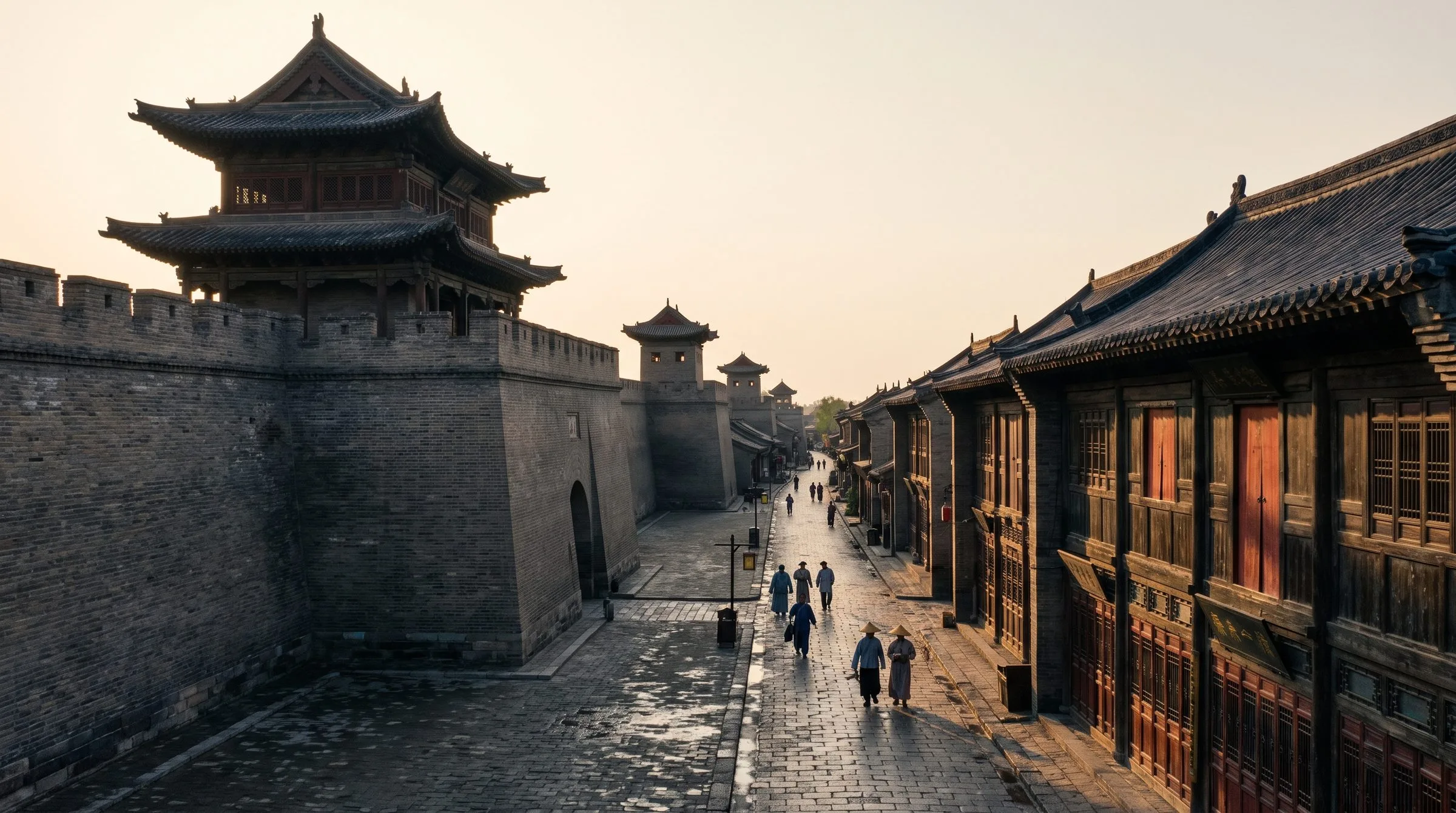
Pingyao (平遥) is the most complete Ming-Qing era walled city in China, and one of the most rewarding short trips you can take from Beijing. The 4-square-kilometer ancient city, founded 2,700 years ago and rebuilt in its current form in 1370, contains 6 km of original Ming-dynasty city wall, more than 300 preserved courtyard houses, and 4,000+ residents who still live, work, and study inside the walls. The city was added to the UNESCO World Heritage list in 1997, alongside the nearby Shuanglin Temple, and is also famous as the birthplace of the Shanxi merchant banks (晋商) — the 19th-century banking pioneers who invented the paper check, the wire transfer, and the modern Chinese bank branch network. The combined ticket (¥125 / $17, valid for 3 days) covers 20+ sites inside the walls.
This 2-day itinerary covers the four pillars of a Pingyao trip: the City Wall (the most complete Ming-dynasty wall in China), the Rishengchang Bank (China’s first modern bank, 1823), the County Office (the oldest surviving county government building in China), and the traditional courtyard inns (the best accommodation option inside the walls). The route assumes you arrive by HSR from Beijing (1.5h, ¥150) or Xi’an (2.5h, ¥200). The plan is doable in 1 day but a 2-day stay lets you catch the famous evening Night Life Show and visit the Shuanglin Temple (8 km west).
Why Pingyao matters
Pingyao sits in central Shanxi province, 90 km south of the provincial capital Taiyuan. The city is in the middle of the Taiyuan basin, the historical heart of the Shanxi merchant culture that dominated Chinese commerce from the 16th to 19th centuries. The merchants (晋商) grew rich on the tea, salt, and silk trade, established the first Chinese banks in the 1820s, and built the spectacular courtyard houses that still define the Pingyao skyline today.
The original Pingyao was founded in the Western Zhou dynasty (827 BC) as a military outpost. The current walls were built in 1370, when the Ming dynasty rebuilt the city as the seat of the Pingyao County government. The walls have been continuously maintained for 650 years, which is why they are the best-preserved ancient city walls in China. (The more famous Xi’an City Wall, by comparison, was rebuilt in 1980s and is a 20th-century reconstruction, not the original Ming work.)
The Ming-Qing streetscape inside the walls is essentially unchanged. 400+ of the original courtyard houses (四合院, sìhéyuàn) are still standing and 300+ are still inhabited. The streets are paved in stone, the shops are in their original locations, and the main commercial street — Ming-Qing Street (明清街) — has been the Pingyao high street for 600 years.
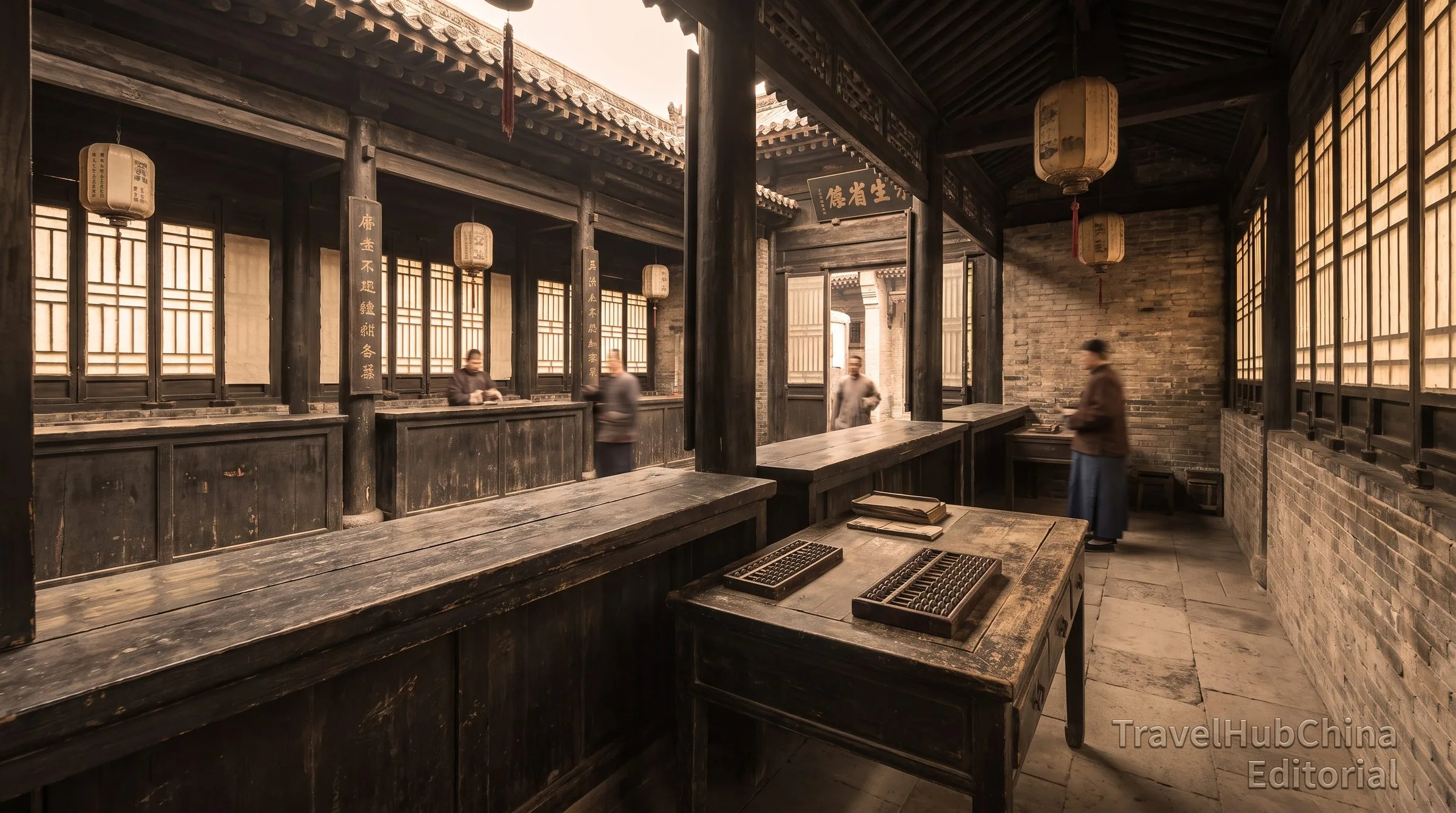
The banking history of Pingyao is the other reason to visit. In 1823, a wealthy Pingyao merchant named Lei Lvtai founded Rishengchang (日昇昌, “Daily Prosperity”), the first draft bank (票号) in Chinese history. The bank pioneered the use of paper drafts (essentially bank checks) and a system of encrypted passwords to verify the drafts. Within 20 years, Rishengchang had 32 branches across China, from Beijing to Guangzhou to Urumqi, and the Shanxi merchant banks controlled most of the long-distance trade of the Qing empire. The Rishengchang branch in Pingyao is now a museum and is one of the most visited sites in the ancient city.
Pingyao at a glance
- Province: Shanxi
- Population: 50,000 (city); 4,000+ residents still inside the walls
- Elevation: 800 m
- Climate: continental, cold dry winters (down to -15°C), hot summers (30°C), pleasant spring and autumn
- Main HSR station: Pingyao Gucheng Station (平遥古城站), 8 km south of the Old Town
- Secondary station: Pingyao Station (平遥站), older slow-train station, 3 km west of the Old Town
- Closest airport: Taiyuan Wusu (太原武宿机场), 100 km north, 1.5h by HSR
- Best months: April-May, September-October
- UNESCO status: inscribed 1997
Getting to Pingyao
From Beijing (most common for foreign visitors)
High-speed rail is the easiest option. From Beijing West Station (北京西站) to Pingyao Gucheng Station (平遥古城站) takes 1.5 hours direct, with G-trains running every 30 minutes from 6:30 AM to 8:30 PM. Second-class fare is ¥150 ($21), first class is ¥239 ($33). The trains are popular, so book 1-2 days in advance for weekends.
From Pingyao Gucheng Station, take a DiDi (¥25, 20 min) or bus 108 (¥1, 40 min, less frequent) to the South Gate of the city wall.
From Xi’an
HSR from Xi’an North Station (西安北站) to Pingyao Gucheng Station takes 2.5 hours direct, with several daily departures. Second-class fare is ¥200 ($28). This is a popular route for travelers combining Xi’an with a Pingyao side trip.
From Taiyuan (Shanxi capital)
The Taiyuan South Station (太原南站) to Pingyao Gucheng HSR is 30 minutes, ¥45 ($6), with 15+ daily departures. The Taiyuan airport is 1.5h HSR from Pingyao. Many travelers fly into Taiyuan (which has more flight options) and then HSR to Pingyao.
From other Shanxi cities
- Datong (Yungang Grottoes): 3h HSR with a transfer at Taiyuan, ¥250 ($35)
- Wutaishan (Buddhist mountain): 2.5h HSR with a transfer at Taiyuan, ¥200 ($28)
- Linfen (Yao Temple, Hukou Waterfall): 1h HSR, ¥80 ($11)
Where to stay
Pingyao’s accommodation scene splits into inside the walls (traditional courtyard inns, the recommended option) and outside the walls (cheaper modern hotels).
Inside the walls (recommended)
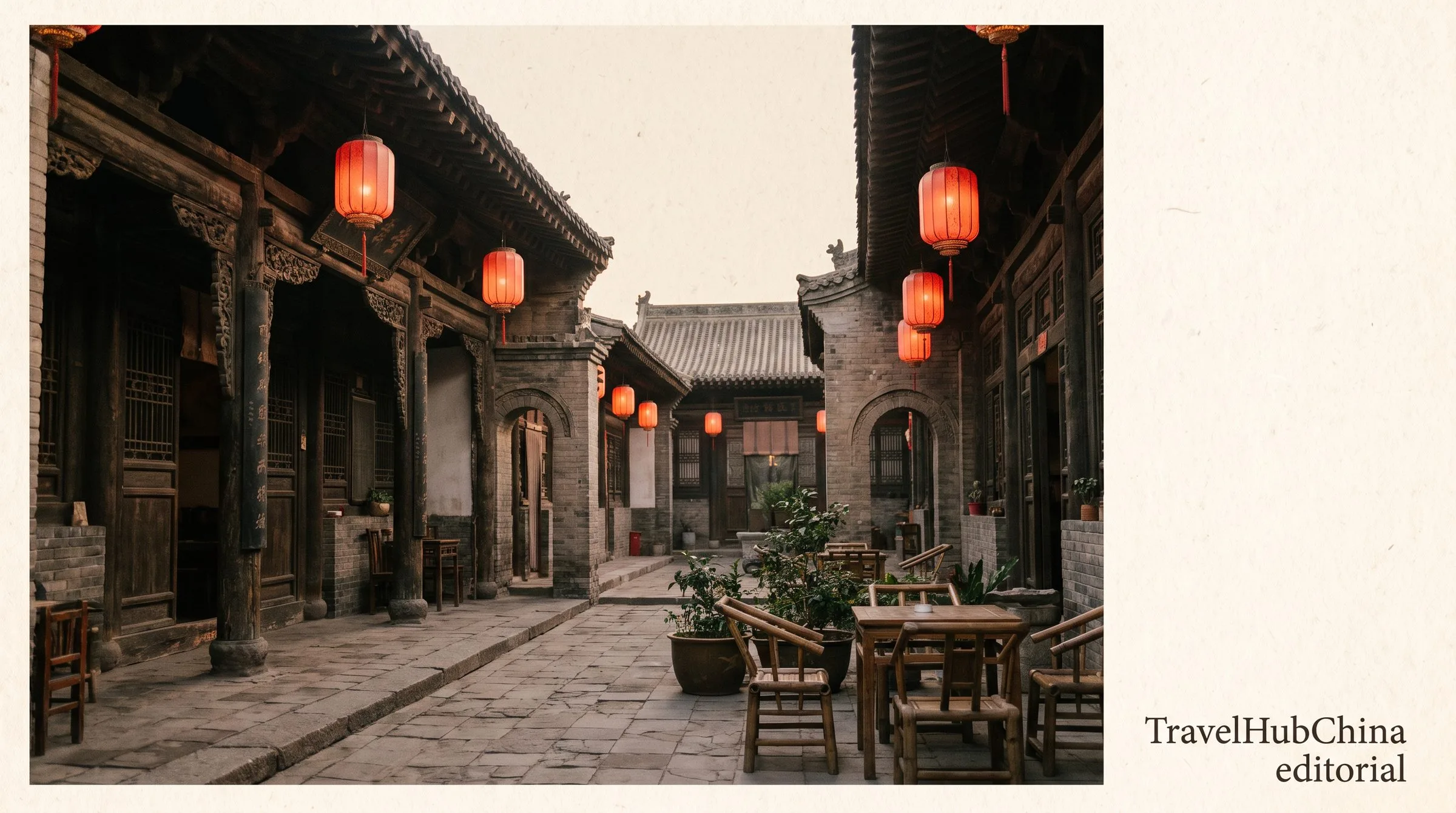
Staying inside the walls is the highlight of any Pingyao trip. The traditional courtyard inns (四合院客栈) are restored Ming-Qing houses with a central courtyard, wooden balconies, paper lanterns, and modern plumbing. Most are family-run, with 5-20 rooms, and include breakfast. The atmosphere is authentic — when you step out of your room into the courtyard at 6 AM, you are walking in the same space that a Pingyao merchant walked in 1800.
The best areas to stay inside the walls are near the South Gate (most restaurants, easiest access) or the Ming-Qing Street (the main shopping street, slightly noisier but more central).
- Budget (¥100-200 / $14-28 per room): Yide Inn (义德客栈), Jingyi Inn (经义客栈), Pingyao Hongyue Inn (平遥红月客栈). Dorms available in some, but most rooms are doubles.
- Mid-range (¥200-500 / $28-70 per room): Jinsheng Residence (金盛客栈, restored 19th-century banker’s house), Tian Yuan Kui Inn (天元奎客栈, near the County Office), Yuchengshan Inn (裕成山客栈).
- Luxury (¥600-1,500 / $84-210 per room): Pingyao Yunjincheng Mansion (平遥云锦成公馆, a restored Qing-dynasty merchant mansion, 30+ rooms, central courtyard, library), Jing’s Residence (景公馆, small boutique, 8 rooms), Harmony Hotel Pingyao (合园饭店, 4-star in a converted merchant compound).
For most travelers, mid-range inside the walls is the sweet spot. A restored merchant courtyard with a comfortable bed, modern bathroom, and breakfast for $50-70/night is excellent value.
Outside the walls (cheaper)
If you don’t want to stay inside, the modern hotels are clustered around the new city (south of the walls). They are cheaper and have more amenities, but you lose the atmosphere.
- Budget (¥100-200 / $14-28): Hanting Express Pingyao, 7 Days Inn Pingyao
- Mid-range (¥200-400 / $28-56): Vienna Hotel Pingyao, Holiday Inn Express Pingyao
- Luxury (¥500-1,000 / $70-140): Pingyao International Hotel (4-star), Sheraton Pingyao
The walk from outside the walls to the South Gate is 10-20 minutes, depending on where you stay.
Top sites in Pingyao
The combined ticket (¥125, 3-day pass) covers 20+ sites. The most important are:
1. Pingyao City Wall (城墙)
The headline site and the most photographed feature of Pingyao.
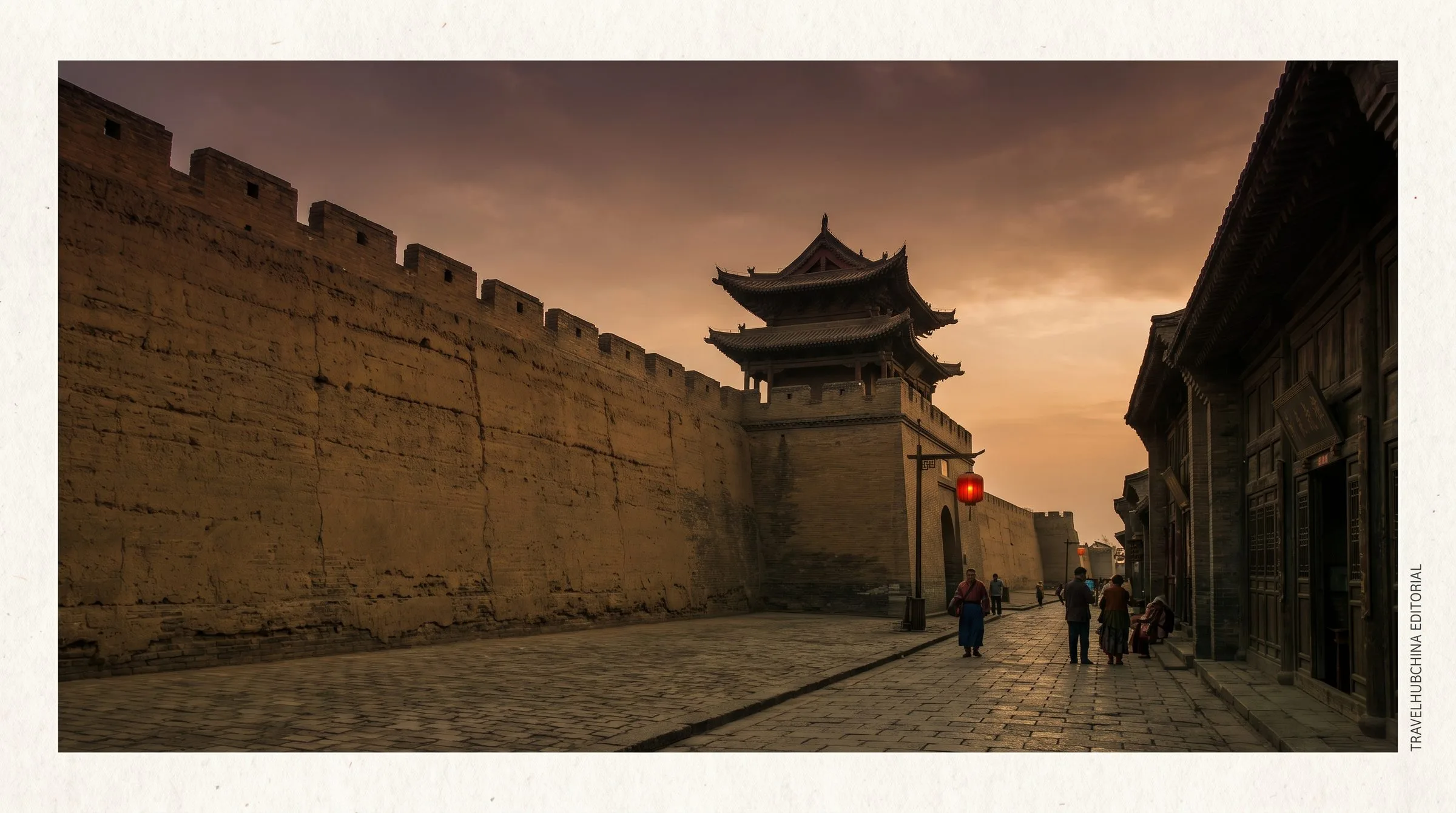
History: built in 1370 under the Ming dynasty as the county seat wall, expanded and reinforced in the 16th century, and continuously maintained for 650 years. The wall is one of the most complete ancient city walls in China — 6 km around, 12 m high, 3-6 m wide on top, with 72 watchtowers, 3,000 crenellations, and a 4-m deep moat.
Practical information:
- Hours: 8:00 AM – 10:00 PM (April-October), 8:00 AM – 6:00 PM (November-March)
- Entry: included in combined ticket
- How long: 2-3 hours for the full loop, 1 hour for a partial walk
- Best time: late afternoon for sunset, or early morning for sunrise
The wall walk:
- Start at the South Gate (南门), the most impressive entrance with a large traditional gatehouse
- Walk clockwise (the wall direction that keeps the sun on your back in the afternoon)
- The 4 main gates (South, North, East, West) each have an original gate tower
- The 72 watchtowers are spaced every 80-100 m along the wall
- The wall top is paved in stone and brick, with low parapets on both sides
- The East Tower has the best sunset view (you can see across the rooftops of the entire Old Town to the mountains beyond)
- The full loop is 6 km, takes 2-3 hours walking, or 1 hour on a rented bike (¥20/hour, available at the South Gate)
What to bring: water, sunscreen, hat, comfortable walking shoes. There are small shops and toilets at each major gate. The wall is exposed to the sun, so bring a hat in summer.
Photography tips:
- The South Gate is the most iconic single shot
- The East Tower is best for sunset
- The moat and the South Gate together make a great evening photo (after the lanterns come on at dusk)
- The rooftops of the Old Town seen from the wall top are the most distinctive Pingyao image
2. Rishengchang Bank (日昇昌)
The birthplace of modern Chinese banking, founded in 1823 by Lei Lvtai, a wealthy Pingyao salt merchant. The original bank operated until 1914, when it was nationalized. The Pingyao branch is now a museum.
The exhibits:
- The original 19th-century wooden counter
- The founder’s office
- A reproduction of the bank’s encrypted password system
- A small exhibition on the history of Chinese banking
- The original draft ledgers (some)
Practical information:
- Address: 38 West Street (西大街38号)
- Hours: 8:00 AM – 6:30 PM
- Entry: included in combined ticket
- How long: 1-1.5 hours
- English tour guides: ¥100-200 for a 1-hour tour, or the audio guide ¥20
What to look for:
- The abacus and ledger at the original counter
- The wall of remittance codes — the encrypted password system the banks used to verify drafts (each branch had its own set of characters)
- The original draft forms from the 19th century
- The founder’s family history (Lei Lvtai was a Qing dynasty merchant who made the bank into China’s first modern financial institution)
The visit is most meaningful if you know a bit about modern banking — the bank’s use of drafts, branches, and encrypted passwords was 50 years ahead of the rest of China’s financial system.
3. County Office (县衙)
The oldest surviving county government building in China, in continuous use from 1346 to 1997 (651 years). The current complex is largely Ming and Qing, with some Song-era foundations.
The highlights:
- The Main Court (大堂), where the county magistrate held trials. The original wooden screen, magistrate’s chair, and witness benches are all in place
- The Second Court (二堂), for civil cases
- The Inner Court (内堂), the magistrate’s private residence
- The courtyard prison (牢房), a small jail with cells for different categories of prisoners
The re-enactment shows: the County Office runs three daily re-enactments of ancient Chinese trials, with actors in Ming-Qing costumes, in the original Main Court:
- 9:30 AM: morning court session (criminal cases)
- 11:00 AM: civil cases
- 3:00 PM: the most famous “ancient trial” show (in Chinese with English subtitles)
Practical information:
- Address: 76 Yamen Street (衙门街76号)
- Hours: 8:00 AM – 6:30 PM (last entry 6 PM)
- Entry: included in combined ticket
- Re-enactment shows: free with ticket
- How long: 1-1.5 hours
4. Qing Xu Temple (清虚观)
A Taoist temple founded in the Song dynasty, in the southeast corner of the Old Town. The current complex is largely Ming and Qing. The temple has a small but well-curated collection of Taoist ritual objects, calligraphy, and a notable brick-carved screen wall (照壁).
Practical information:
- Hours: 8:00 AM – 6:00 PM
- Entry: included in combined ticket
- How long: 45 min - 1 hour
5. Confucius Temple (文庙)
A Confucian temple from 1163, rebuilt in the Ming and Qing. The current complex has the standard layout of a Chinese Confucian temple: the Dacheng Hall (main hall), the Lingxing Gate, and the famous sliding stone steles — a set of carved stone slabs that can be slid aside to reveal Buddhist sculptures from an earlier Tang-dynasty structure on the same site.
Practical information:
- Hours: 8:00 AM – 6:00 PM
- Entry: included in combined ticket
- How long: 45 min
6. China Escort Agency Museum (中国镖局博物馆)
A museum dedicated to the biaoju (镖局), the Qing-dynasty armed escort services that protected merchant caravans. The Shanxi escort agencies were famous, and several operated out of Pingyao. The museum has weapons, uniforms, and a small re-enactment show.
Practical information:
- Address: 22 Ming-Qing Street
- Hours: 8:00 AM – 6:00 PM
- Entry: ¥30 ($4), not in combined ticket
- How long: 1 hour
7. Ming-Qing Street (明清街)
The main commercial street of Pingyao, in continuous use for 600 years. The street is 750 m long, paved in stone, lined with Ming-Qing era shop-houses, and still the most active shopping area in the city. It is busy by day (tourists) and quieter in the evening (when most day-trippers leave).
What to buy:
- Shanxi lacquerware (山西漆器) — Pingyao’s most famous craft. Wooden bowls, plates, boxes, and bracelets finished in 30+ coats of lacquer. ¥30-500 depending on size. The Guangyintang (广银堂) shop on Ming-Qing Street is the best-known, but the smaller workshops produce higher-quality work.
- Shanxi vinegar (山西老陈醋) — Pingyao and the surrounding area produce China’s most famous aged vinegar. The 5-year and 10-year aged bottles (¥30-100) are the best. Avoid the cheap “ancient aged” bottles.
- Pingyao beef (平遥牛肉) — the local cured beef, sliced thin and served cold. Vacuum-packed, ¥50-100 per bag, takes 2-3 days to ship.
- Pushou slippers (推光漆履) — traditional painted shoes, ¥100-300
- Paper cuttings (剪纸) — traditional Chinese folk art
- Woodblock prints (木版年画) — New Year prints
Avoid: the “ancient” silver and jade shops (modern reproductions), the “imperial” tea shops (overpriced), and the antique stalls (most “antiques” are reproductions).
8. Chenghuang Temple (城隍庙)
The City God Temple, founded in the Song dynasty, in the southeast corner of the Old Town. The current complex is Ming and Qing, with some notable painted screens and folk-religion statues.
Practical information:
- Entry: ¥20 ($3), not in combined ticket
- How long: 45 min
9. Shuanglin Temple (双林寺) — outside the city
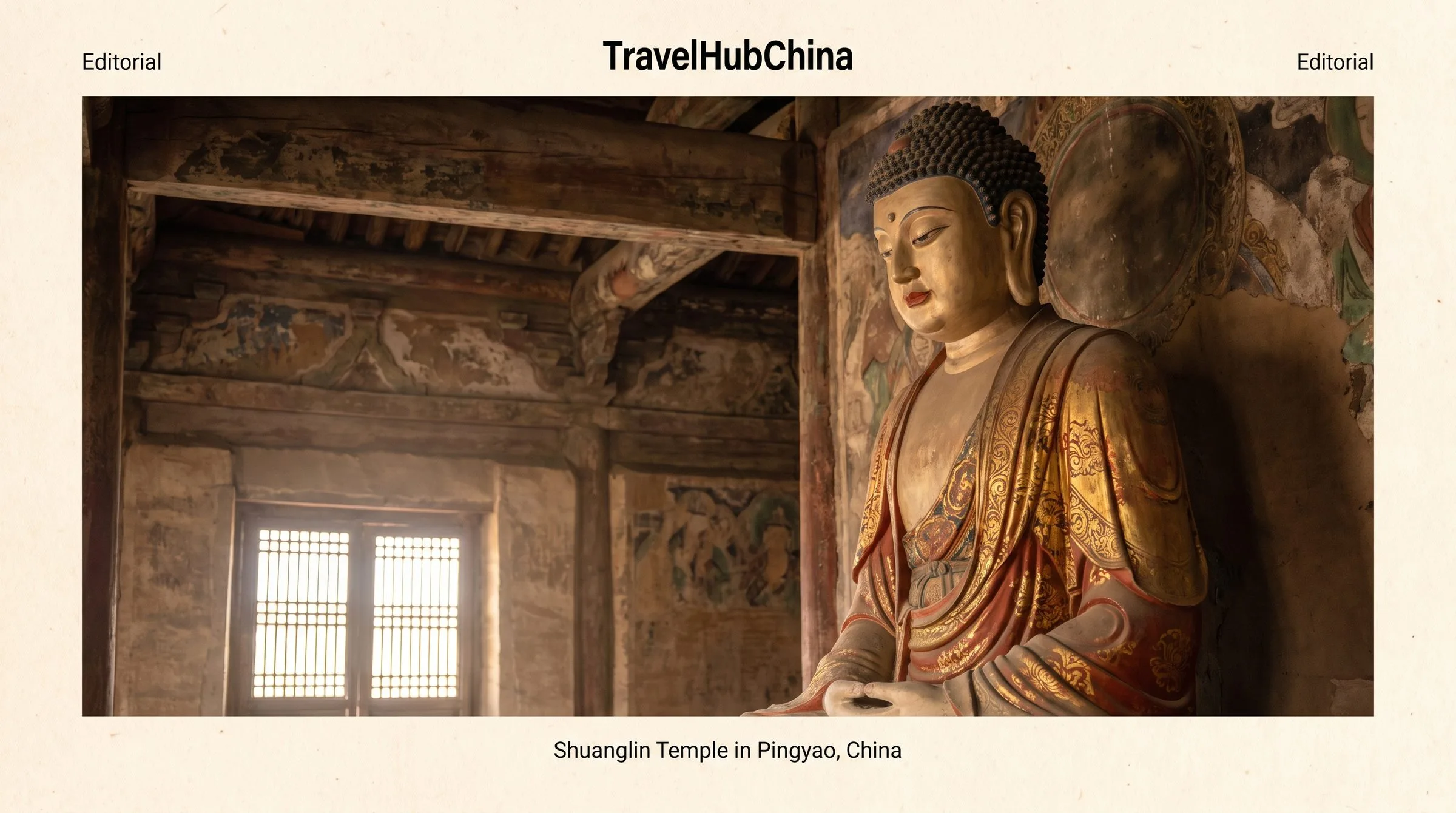
A Buddhist temple 8 km west of the Old Town, a separate UNESCO World Heritage Site (added to the Pingyao UNESCO listing in 1997). The temple is famous for its 2,000+ painted Buddhist sculptures from the Song, Ming, and Qing dynasties, often called the “treasury of Chinese Buddhist sculpture.” The most famous single piece is the Sleeping Sakyamuni (the Buddha entering Nirvana), a life-size wooden sculpture of remarkable grace and pathos.
Practical information:
- Hours: 8:00 AM – 6:30 PM
- Entry: ¥50 ($7), not in combined ticket
- How long: 1.5-2 hours
- Reaching it: DiDi (¥40, 20 min) or bus 108 (¥1, 30 min) from the South Gate
The Shuanglin Temple is the must-see side trip from Pingyao and the single most important Buddhist sculpture site in Shanxi.
Day 1: City Wall + main sites
Morning: walk the city wall
- 8:00 AM: enter at the South Gate (¥125 combined ticket)
- Walk the 6-km loop, or do a partial loop: South Gate → East Tower (best view) → North Gate (3 km, 1.5 hours)
- 10:00 AM: descend at the North Gate, walk to the County Office for the 11:00 AM re-enactment show
Late morning: County Office + Confucius Temple
- 11:00 AM: County Office re-enactment show (45 min)
- 12:00 PM: Confucius Temple (45 min)
- 12:45 PM: lunch at a courtyard restaurant (try Pingyao beef noodles)
Afternoon: Rishengchang + Qing Xu Temple
- 1:30 PM: Rishengchang Bank (1.5 hours)
- 3:00 PM: China Escort Agency Museum (1 hour)
- 4:00 PM: Qing Xu Temple (45 min)
- 4:45 PM: rest at your inn
Evening: Ming-Qing Street + dinner
- 5:30 PM: walk Ming-Qing Street for shopping (lacquerware, vinegar, beef)
- 7:00 PM: dinner at a courtyard restaurant
- 8:30 PM: the Night Life Show (见工夫), a 1-hour outdoor light show on the South Gate wall (¥180 / $25, optional)
- 9:30 PM: return to your inn
Day 2: Shuanglin Temple + remaining sites
Morning: Shuanglin Temple
- 8:00 AM: DiDi to Shuanglin Temple (¥40, 20 min)
- 8:30 AM – 10:30 AM: visit the Shuanglin Temple (2 hours)
- 11:00 AM: return to the Old Town, late lunch
Afternoon: remaining sites
- 12:00 PM: lunch (try kaolao noodles, Shanxi vinegar chicken)
- 1:00 PM: Chenghuang Temple (45 min)
- 2:00 PM: any of the smaller merchant houses you missed (many have ¥20-30 individual tickets, only worth it if you have a specific interest)
- 3:00 PM: climb the City Wall again for a different angle, or relax at your inn
Evening: departure
- 4:00 PM: check out of the inn
- 4:30 PM: DiDi to Pingyao Gucheng Station (¥25, 20 min)
- 5:00 PM: HSR to Beijing West (1.5h) or Xi’an North (2.5h)
- 7:00 PM: arrive in Beijing or Xi’an
The Night Life Show (又见平遥)
A 1-hour outdoor performance held on and around the South Gate wall. The show is directed by Wang Chaoguang, the same team behind the “Impression” series (Impression Liu Sanjie, etc.). It tells the story of a Pingyao escort agent in 1920 who volunteers to bring home a Russian merchant’s widow, leaving his entire household behind in a tragic gesture of trust. The show involves the audience moving through different sets, with live music, traditional instruments, and a powerful ending.
Practical information:
- Hours: 8:30 PM (one show daily, year-round)
- Entry: ¥180 ($25) for standing room, ¥240-380 for assigned seats
- How long: 1 hour
- Book: through Trip.com, Klook, or your inn; popular, book 2-3 days in advance in summer
The show is in Chinese with English subtitles, and the visuals are spectacular. Recommended for anyone with a flexible evening schedule.
Food in Pingyao
Pingyao’s food is Shanxi cuisine (晋菜), which is famous for noodles, vinegar, and wheat-based dishes. The local specialties are:
- Pingyao beef (平遥牛肉) — cured and pressed beef, sliced thin and served cold. The most famous local dish, ¥30-60 per plate.
- Kaolao noodles (莜面栲栳栳) — oat noodles steamed in a small roll shape, served with a vinegar dip. The most famous Shanxi noodle, ¥20-30.
- Shanxi sliced noodles (山西刀削面) — knife-cut noodles, the most common street food, ¥15-25
- Shanxi vinegar chicken (老陈醋鸡) — chicken braised in aged vinegar, sweet-sour, ¥40-60
- Pingyao bowl holder (碗托) — buckwheat or millet porridge in a small bowl, served cold with vinegar, ¥10
- Pingyao dumplings (平遥饺子) — local-style dumplings, ¥20-30
- Pingyao noodles (平遥面) — hand-pulled, ¥15-25
- Shanxi liangpi (山西凉皮) — cold noodles, ¥10
Where to eat:
- Yuchengshan Restaurant (裕成山) — inside a courtyard, well-priced, ¥80-120 per person
- Tian Yuan Kui (天元奎) — near the County Office, popular for Pingyao beef, ¥80-150 per person
- Mao’s Noodle Shop (毛家面馆) — a small noodle shop on Ming-Qing Street, locals eat here, ¥20-30
- The Night Market on Ming-Qing Street — stalls and small restaurants, ¥20-60 per person
Beverages: Shanxi is famous for vinegar (drink small amounts of aged vinegar as a health tonic — Pingyao people take it straight), fenjiu (汾酒, a famous Chinese baijiu, ¥50-300 per bottle), and the local apricot wine.
Practical details
Visa
Pingyao is on the 240-hour visa-free transit list. The most common entry ports are Beijing, Shanghai, and Xi’an. Once inside, you can travel to Pingyao for up to 10 days. See our 240-hour visa-free guide for the full list.
Payment
Most Pingyao restaurants, ticket halls, and shops accept Alipay and WeChat Pay. The smaller inns sometimes prefer cash but most now accept Alipay. Set up Alipay before your trip — see our Alipay setup guide.
Data and connectivity
Pingyao has good 4G/5G coverage. Inside the ancient city, coverage can be slightly weaker in the deep courtyards. Get a China eSIM before your trip — see our eSIM guide.
Language
Mandarin is the only language spoken in Pingyao. The hotels, restaurants, and ticket halls in the Old Town have minimal English. The local accent is heavy Shanxi dialect, which is unintelligible to most Mandarin speakers. Get a translation app before your trip.
Getting around Pingyao
The Old Town is small and walkable. From outside the Old Town, the easiest access is the South Gate (bus 108, ¥1) or the New Town bus station (¥1 to the South Gate). DiDi works in the new city. The Shuanglin Temple is 8 km west, accessible by DiDi (¥40 one-way).
When to visit
- April-May, September-October: the best months — comfortable temperatures, good light, fewer crowds
- June-August: hot (30°C+) and humid, school-trip season
- November-February: cold (down to -10°C at night) but the wall and courtyards look beautiful with snow, and the lantern displays at night are spectacular
The best time of day is the late afternoon to evening — the lanterns come on at dusk, the day-trippers leave, and the Old Town feels most authentic. Most foreign visitors prefer to stay overnight for this reason.
Combining Pingyao with other cities
The most common Pingyao combinations:
- Beijing + Pingyao (4-5 days): 2-3 days Beijing, 2 days Pingyao. The HSR is 1.5h and trains are every 30 min, so it can also be a 2-night side trip from a longer Beijing stay.
- Xi’an + Pingyao (5-7 days): 3 days Xi’an, 2 days Pingyao. The HSR is 2.5h and trains are frequent.
- Beijing + Pingyao + Xi’an (8-10 days): the classic northern China triangle, all HSR-connected.
- Shanxi loop (6-8 days): Taiyuan (Shanxi Museum), Pingyao, Wutaishan (Buddhist mountain), Datong (Yungang Grottoes, Hanging Temple). All in Shanxi, all HSR-connected.
- Beijing + Pingyao + Luoyang (7-9 days): combines the merchant banks of Shanxi with the Buddhist caves of Henan. Both Pingyao and Luoyang are UNESCO sites.
For the broader cultural context of China’s merchant history, see our Hangzhou He Fang imperial street guide for another Chinese merchant town. For the Buddhist art context, see our Luoyang Longmen Grottoes guide. For the broader Silk Road comparison, see our China scenic wonders comparison.
Shopping in Pingyao
Pingyao’s main shopping products are Shanxi craft products:
- Shanxi lacquerware (推光漆器) — Pingyao’s most famous craft. Hand-crafted wooden bowls, plates, and boxes finished in 30+ coats of lacquer, with intricate carved or painted designs. ¥30-500 for small items, ¥1,000-5,000 for larger pieces. The Guangyintang (广银堂) shop is the most established, but the smaller workshops on the side streets are often better.
- Shanxi aged vinegar (山西老陈醋) — 5-year and 10-year aged bottles, ¥30-100. The 3-year bottles are common; the 5-year and 10-year are noticeably better.
- Pingyao beef (平遥牛肉) — vacuum-packed, ¥50-100 per bag. The 1-month aged is the best.
- Pushou slippers (推光漆履) — traditional painted shoes, ¥100-300
- Paper cuttings (剪纸) — folk art, ¥10-50
- Woodblock prints (木版年画) — New Year prints, ¥30-100
- Fen jiu (汾酒) — the famous Shanxi baijiu, ¥50-300 per bottle
For authentic antiques, the Chinese antique market is in Beijing’s Liulichang, not Pingyao. The “ancient” items in the Pingyao shops are modern reproductions.
Booking essentials before you go
- 240-hour visa-free transit: Pingyao is one of the inland cities on the visa-free list — see our 240-hour visa-free guide
- Alipay/WeChat Pay: see our Alipay setup guide — essential for small restaurants and inn payments
- eSIM: see our eSIM guide for data access
- Cultural etiquette: see our China cultural etiquette guide for temple and shrine behavior
- HSR tickets: book Pingyao Gucheng trains 1-2 days in advance for weekends
For a multi-city northern China trip that includes Pingyao, see our 2-week classic China route and Beijing 3-day itinerary. For the China budget side, see our China budget 2026 guide. For solo travelers, see our China solo travel guide.
Book this Pingyao trip
From Pingyao courtyard inn bookings to Shuanglin Temple tours to Beijing or Xi’an HSR tickets — these three platforms cover everything in this itinerary.
Pingyao courtyard inns + HSR tickets
Book Pingyao courtyard inns inside the Old Town walls, plus HSR tickets from Beijing or Xi'an. English interface, accepts foreign cards, free cancellation on most rooms.
Inns from $30/night · HSR from $21
Plan your trip — verified tools
These free tools are built on real, monthly-verified data and help you skip the trial-and-error phase of China trip planning:
- China 240-Hour Visa-Free Transit Checker — 57 countries, 24 provinces, 65 ports. See if you qualify for 10-day visa-free transit, which cities you can visit, and the 5-step process.
- China 6-City 5-Day Budget Calculator — Real 2026 prices for 5 days in Beijing, Shanghai, Guangzhou, Chengdu, Xi’an, or Hangzhou. Budget / mid-range / comfort tiers, broken down line by line.
Verified August 2026 by TravelHubChina Editorial. We re-check prices and policy details monthly so the data doesn’t drift.
Step by step
-
HSR from Beijing West to Pingyao Gucheng
Book a G-train from Beijing West to Pingyao Gucheng (平遥古城站, 1.5h direct, ¥150 second class, every 30 min from 6:30 AM). The trains also stop at Taiyuan if you want to see the Shanxi capital. Arrive 30 min before departure.
-
DiDi to the South Gate of the city wall
From Pingyao Gucheng Station, take a DiDi (¥25, 20 min) or bus 108 (¥1, 40 min) to the South Gate (南门). Buy the combined ticket (¥125) at the South Gate ticket hall. The ticket is valid for 3 days.
-
Walk the 6-km city wall (2-3 hours)
Enter the wall from the South Gate, walk the 6-km loop. The wall is 12 m high, 3-6 m wide on top, with 72 watchtowers. The South Gate is the most impressive; the sunset view from the East Tower is the most photographed. Allow 2-3 hours for the full loop.
-
Visit Rishengchang and the County Office (3-4 hours)
After the wall, walk to Rishengchang (the first bank, ¥0 extra, included in combined ticket), the County Office (oldest in China, ¥0 extra), Qing Xu Bank, and the Confucius Temple. Watch the re-enactment show at the County Office (3 PM show, free with ticket).
-
Ming-Qing Street walking + dinner
Walk Ming-Qing Street (明清街, the main shopping street) in the early evening. Browse the lacquerware shops, vinegar shops, and traditional craft stores. Dinner at a courtyard restaurant (try Pingyao beef and kaolao noodles, ¥50-100 per person).
-
Stay overnight in a courtyard inn + Day 2 sites
Stay in a restored courtyard inn inside the walls (¥150-500). Day 2: visit the Shuanglin Temple (8 km west, ¥50, the city's other UNESCO site), the City Tower at sunrise, and any sites you missed. Train back to Beijing in the late afternoon.
FAQ
-
How do I get to Pingyao from Beijing?
Take the HSR from Beijing West Station to Pingyao Gucheng Station (平遥古城站, 1.5 hours direct, ¥150 second class, every 30 min from 6:30 AM to 8:30 PM). The Pingyao Gucheng Station is 8 km from the Old Town; take a DiDi (¥25, 20 min) or bus 108 (¥1, 40 min) to the South Gate of the city wall. The alternative is to fly into Taiyuan (the Shanxi capital, 1 hour by HSR to Pingyao) or take the slower Z-train (5 hours). -
How much does the Pingyao combined ticket cost and what does it include?
The combined ticket is ¥125 ($17) and is valid for 3 days. It covers 20+ sites including the City Wall, Rishengchang (China's first bank), Qing Xu Bank, the County Office, the Confucius Temple, the City Tower, and several former merchant mansions. You must show the ticket at each site. The ticket does not include the Chenghuang Temple or the China Escort Agency Museum, which cost ¥20-30 extra. -
Should I stay inside the city walls or outside?
Stay inside the city walls. The traditional courtyard inns inside are the highlight of any Pingyao trip — restored Ming-Qing courtyard houses with wooden beds, paper lanterns, and a central courtyard, often at the same price as a basic modern hotel outside. The walls have 4,000+ residents still living inside, and the atmosphere is authentic after 7 PM when the day-trippers leave. Most inns cost ¥150-500/night ($21-70). -
Is Pingyao worth a 2-day trip or can I do it in a day?
Stay 2 days. A single day lets you walk the City Wall and see 3-4 of the main sites. With 2 days you can see all 20+ included sites, watch the re-enactment shows at the County Office, browse the evening Night Life Show, and have time for a side trip to the Shuanglin Temple (8 km west, the city's other UNESCO site). Most foreign visitors stay 2 nights. -
What is Pingyao famous for besides the city wall?
Pingyao is famous as the birthplace of the Shanxi merchant banks (晋商). In the 19th century, Pingyao's banks — Rishengchang in particular — pioneered the modern Chinese banking system: paper money, wire transfers, and branch networks across the Qing empire. Rishengchang (1823) is now a museum. Pingyao is also famous for Shanxi lacquerware, vinegar, beef, and noodles.
Related guides
- Culture & Practical
Solo Female Travel in China 2026: The Honest Safety Guide Foreigners Don't Get
China is statistically one of the safer large countries for solo female travelers, but the safety profile is different from Western countries. What works in Tokyo or Paris may not work in Beijing. The 2026 honest guide: 8 specific safety scenarios (DiDi at night, hostel vs hotel, walking alone, foreigner-targeted scams, hostel harassment, menstruation access, dating safety, embassy backup), ranked by frequency and risk. Includes the 5 phrases every solo female traveler should learn, and the 2 scenarios where you should NOT go alone.
5min read
- Culture & Practical
Is It Safe to Travel to China in 2026? The Complete Foreigner's Safety Guide
Comprehensive 2026 safety guide for China travel: crime statistics, region-specific risks, scams targeting foreigners, US State Department advisory, LGBTQ+ safety, female solo travel, health and medical care, embassy registration, and 5-step arrival safety checklist. Plus: is it safe to travel to China right now in 2026 (yes, with normal precautions).
12min read
- Culture & Practical
Chinamaxxing 2026: 12 Chinese Lifestyle Experiences Every Foreigner Should Try
Chinamaxxing is the 2026 trend of foreign visitors going deep into Chinese daily life — hot water, ba duan jin qigong, hanfu, mahjong, tea ceremony, foot baths, and more. 12 hands-on experiences with where to try each one, what to expect, and how to book.
9min read
- Culture & Practical
Luoyang Longmen Grottoes 2026: UNESCO Buddhist Caves, Peony Festival, Day Trip from Xi'an
Luoyang travel guide for foreign visitors: Longmen Grottoes UNESCO (100,000+ Buddhist statues, ¥90), White Horse Temple, peony festival (April), and 1.5h HSR day trip from Xi'an (¥150 second class).
- Culture & Practical
Nanjing China Travel Guide 2026: Six Dynasties Capital, Massacre Memorial, Purple Mountain
Nanjing travel guide for foreign visitors: 2,600-year history, Six Dynasties and Ming capital, Sun Yat-sen Mausoleum, Nanjing Massacre Memorial Hall (free, deeply moving), Confucius Temple, Ming city wall, and how Nanjing compares to Beijing's Forbidden City.
- Culture & Practical
LGBTQ+ Travel in China 2026: Safety, Apps, Cities & Practical Guide
Practical LGBTQ+ travel guide for China in 2026 — legal status (homosexuality is legal, no same-sex marriage), social attitudes by city, dating apps (Blued, Tantan, Aloha), the 3 most LGBTQ+-friendly cities (Shanghai, Beijing, Chengdu), nightlife, healthcare, family considerations, and 5 ready-made LGBTQ+-friendly city profiles. Updated 2026-08-21 with current legal status and city-by-city social attitudes.