
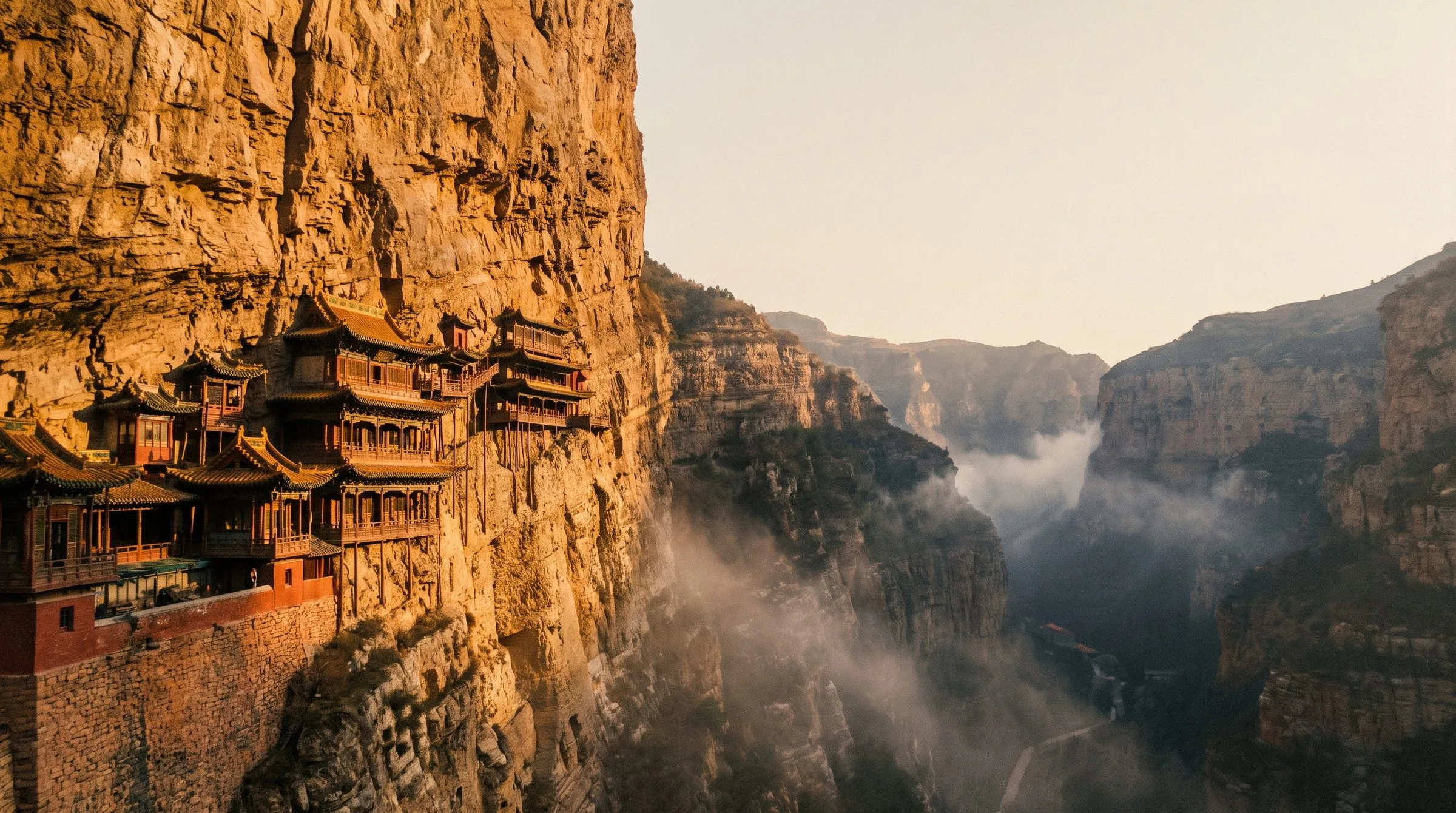
Datong Shanxi 2026: Yungang Grottoes, Hanging Temple, Huayan Temple, Beijing Day Trip
Datong travel guide for foreign visitors: Yungang Grottoes UNESCO (¥120, 5th-6th century Buddhist caves), Hanging Temple on cliff (¥125, 1,500-year-old wooden temple), Huayan Temple (¥50), 1.5h HSR from Beijing (¥150 second class).
Datong does not feel like the rest of China. The city sits at 1,050 meters elevation on the edge of the Mongolian plateau, 350 km west of Beijing, in a dry high-desert climate that gives it the deep blue skies of Inner Mongolia rather than the gray humidity of the capital. Its main street has 1980s Soviet-style civic buildings standing next to restored Ming-dynasty temples. Its 7.24-meter-tall city wall, rebuilt in 2008-2014 but tracing a 630-year-old footprint, encloses a downtown where you can see the Yungang Grottoes-style stone Buddhas carved into hotel façades.
This is a city of contradictions and layers. Datong was the capital of the Northern Wei dynasty (398-494 AD), a 4th-6th century empire that united northern China under Xianbei nomadic rule and sponsored the carving of the Yungang Grottoes, 252 sandstone caves filled with 51,000 Buddhist statues and recognized by UNESCO in 2001 as a World Heritage Site. Datong was the political, military, and economic capital of north China for nearly 100 years. Then in 494 AD the Northern Wei emperor moved the capital south to Luoyang and the Silk Road’s northern terminus went quiet for 1,500 years. The next great Datong moment came in 1622 when the Ming dynasty built a 7.24-meter-tall city wall to defend the frontier, and the city became a major garrison town. Coal mining took over in the 20th century, and the city is still ringed with active and abandoned coal pits.
For foreign visitors, Datong is the perfect 2-day detour from Beijing, or a 1-3 day stop on a longer Shanxi loop that includes Pingyao Ancient City and the Yellow River. Two UNESCO sites (Yungang Grottoes, and Pingyao 2 hours south), one of the most spectacular cliff temples in the world (Hanging Temple), some of the most distinctive food in China (knife-cut noodles), and the easiest reach from Beijing of any major cultural site. This guide covers the practical route, costs, and tips for first-time foreign visitors.
Getting to Datong from Beijing (and Elsewhere)
The Beijing-Datong HSR opened in late 2019 and is the reason Datong is now on the mainstream tourist map. From Beijing North Station (北京北站), the high-speed train takes 1.5-2 hours to Datong South Station (大同南站), and trains run roughly every 30 minutes from 7 AM to 8 PM. Second class fare is ¥150; first class ¥240; business class ¥450. The trip is fast enough that many visitors do Datong as a long day trip from Beijing, but staying overnight lets you add the Hanging Temple, which is 65 km south of downtown and needs a half day on its own.
Booking: Use the 12306.cn website or app (English version available), or Trip.com, or buy at the station ticket window. Book 1-2 weeks ahead for the May, October, and Chinese New Year peaks. Same-day tickets are usually available except during Chinese National Day week (October 1-7).
Other connections:
- Taiyuan (Shanxi capital): 2-2.5 hours by HSR, ¥110 second class. From Taiyuan you can continue south to Pingyao (30 min, ¥40) and the rest of Shanxi.
- Xi’an: 6 hours by HSR via Taiyuan, ¥350. Long but doable as a day trip.
- Pingyao: 3-3.5 hours by HSR, ¥190. The classic Shanxi combo is Beijing → Pingyao → Datong → Beijing in 4-5 days.
- Hohhot (Inner Mongolia): 2.5 hours by HSR, ¥200. Useful for travelers looping through Inner Mongolia.
Datong has a small airport, Datong Yungang Airport (DAT), with limited domestic flights (Beijing 1h, Shanghai 2.5h, Chengdu 2.5h). For most visitors, the train is the better option.
Datong in One Day: The Rush Version
If you have only one day, this is the order. Take the 7:00 AM or 7:30 AM train from Beijing North, arrive Datong South at 9:00 AM, taxi to Yungang Grottoes (¥50, 30 min), spend 3 hours in the caves, return downtown for lunch (knife-cut noodles at any local shop), see Huayan Temple in the afternoon, and catch the 7:00 PM or 8:00 PM train back to Beijing. You skip the Hanging Temple, which is the most photogenic site in the area but also the most time-consuming to reach. The one-day version is exhausting but workable.
Datong in Two Days: The Recommended Plan
Two days lets you see all four key sites plus the city highlights at a comfortable pace. The structure: do Yungang Grottoes and downtown Datong on Day 1, save the longer Hanging Temple and Hengshan excursion for Day 2.
Day 1: Yungang Grottoes + Downtown Datong
Morning: Yungang Grottoes (云冈石窟). The single must-see site in Datong. 16 km west of downtown (about 30 minutes by taxi or 40 minutes by Bus 3 from downtown, ¥4). Entry ¥120, open 8:30-17:00 in winter, 8:00-17:30 in summer. Last entry 16:00. Allow 3-4 hours.
The site is a 1-kilometer-long sandstone cliff face carved with 252 caves and 51,000 stone Buddhas, statues, and reliefs, ranging from 2 centimeters to 17 meters tall. Construction began in 460 AD under the Northern Wei emperor Wencheng and the monk Tan Yao, and the major caves were complete by 525 AD. The art is a unique blend of Indian Gandharan style (heavy drapery, deep-set eyes, Indian-inspired Buddha features), Central Asian influences (Sogdian and Persian decorative motifs), and emerging Chinese aesthetics that would later become the Tang dynasty Buddhist norm. The site is one of three “great” Chinese Buddhist cave complexes, alongside Mogao Caves in Dunhuang (Gansu) and Longmen Grottoes in Luoyang (Henan).
The site is divided into three zones based on the era of carving. Caves 16-20 (the Tan Yao Five Caves, 昙曜五窟) are the earliest, 460-470 AD, the largest statues, each representing a Northern Wei emperor. The open-air Cave 20 Buddha (13.7 meters tall) is the iconic Yungang image, appearing on stamps, posters, and the site’s official logo. Caves 5 and 6 are the high point of the Northern Wei artistic peak (465-494 AD), with Cave 6 featuring 33 carved relief panels narrating the life of Sakyamuni from birth to enlightenment, and Cave 5 housing the tallest indoor Buddha in China (17 meters, larger than the Longmen counterpart). Caves 9-13 (the “Five Hua Caves,” 5 AD) are the only caves with original colored pigments still visible; Cave 12 is the “Music Cave” with carved musicians, dancers, and a full Northern Wei orchestra. Caves 1-4 and Caves 21-45 are smaller and less visited; skip them unless you have 4+ hours and a strong interest in the art.
Plan 2.5-3 hours. The site has a free electric shuttle between the eastern, central, and western cave sections, useful for the 1 km walking distance. Audio guide is ¥30 (Chinese) or ¥40 (English); live guide in English, Japanese, or Mandarin is ¥150-380 per group. The cave areas have stone steps and are not wheelchair friendly in the cave interiors (Caves 1-5 require stairs). The site has a Yungang Museum (included) with 3D-printed replicas of the most important statues, useful for understanding the original state.
After Yungang, taxi or Bus 3 back to downtown for lunch. Try knife-cut noodles (刀削面) at one of the local shops near the Drum Tower; a bowl with beef, egg, and tomato is ¥18-25. The noodles are characteristically long, thin, and slightly curved (the chef shaves them with a curved blade directly into the boiling water). Yang za tang (羊杂汤, mutton-offal soup) is the other Datong signature, served with flatbread strips you tear and dip in.
Afternoon: Huayan Temple (华严寺). 2 km south of the city center, walkable from the Drum Tower in 25 minutes. Entry ¥50, open 8:30-17:00. Founded in 1038 AD under the Liao dynasty, Huayan Temple is one of the largest and most important Buddhist temple complexes in northern China. The lower temple (下华严寺) houses the largest wooden Buddhist hall in China, the Daxiong Baodian (大雄宝殿), 9 rooms wide, with the original Liao-dynasty interior intact. The upper temple (上华严寺) is a Liao-Jin hybrid famous for the Bodhisattva of Mercy (观音菩萨) statue. The temple also has a small museum of Liao-dynasty Buddhist art including painted sculptures from the 11th-12th centuries. Allow 1.5-2 hours.
From Huayan Temple, walk 15 minutes north to the Nine-Dragon Wall (九龙壁, Jiulongbi). Entry ¥10. The wall is 45.5 meters long, 8 meters high, and 2 meters thick, with nine coiling glazed-tile dragons on a background of 635 other dragons. Built 1392 AD as the screen wall for the son of the Ming dynasty’s Hongwu Emperor; it is one of only three original Ming-dynasty nine-dragon walls in China (the others are in Beijing’s Forbidden City and the old city of Datong’s other palace). Allow 30-45 minutes.
Evening: Datong City Wall and Old Town. The restored Ming-dynasty city wall (¥30 entry, climb 17:00-21:30 in summer) is 7.24 km in circumference, 14 meters tall, and the largest restored city wall in China after Xi’an’s. Walking the full loop takes 2.5-3 hours; the most scenic section is the 1.5 km between the West Gate and the North Gate, with views over the old town and the coal-bearing mountains to the west. The wall is lit from 19:30 to 22:00, making the evening walk magical. Inside the wall, the Drum Tower (鼓楼) and Bell Tower (钟楼) pedestrian streets have been restored with traditional Shanxi-style facades and house the local restaurants and craft shops. Dinner: try Youmian kaolao (莜面栲栳栳), oat noodles served in a small clay pot with mushroom and mutton sauce, a Shanxi specialty; ¥30-50 per person.
Day 2: Hanging Temple + Mount Hengshan
Morning: Hanging Temple (悬空寺). The Hanging Temple is 65 km south of downtown Datong in Hunyuan County, 1.5 hours by car (¥300-400 round trip with a 4-hour wait, or ¥600-800 with a private driver for the day). Public transport: Bus 8 from Datong East Bus Station to Hunyuan town (¥20, 1.5 hours), then a 10-minute taxi to the temple. Allow 1.5-2 hours at the temple.
The temple was first built in 491 AD during the late Northern Wei, making it nearly 1,500 years old. The original name was “Xuanguange” (玄空阁, “Mysterious Hanging Pavilion”), later changed to Hanging Temple because the characters for “hanging” (悬) and “mysterious” (玄) are homophones in Chinese. The structure is built into a recessed cliff face on Cuiping Peak, 75 meters above the valley floor, supported by 27 crossbeams made of locally-treated hemlock wood that have been driven into the rock and held there by wedge-and-tendon construction. Despite appearances, the visible vertical wooden pillars below the temple are mostly decorative; the real weight is held by the crossbeams. The temple is small, only 32 meters long end-to-end, with three main halls (south, north, and a connecting corridor) totaling 40 rooms. The 1,500-year structural survival is one of the great engineering feats of ancient China.
The temple’s other distinction is religious: it is the only existing temple in China that combines all three traditional Chinese religions, Buddhism, Taoism, and Confucianism, with shrines to Shakyamuni, Laozi, and Confucius side by side. The Three Teachings Hall (三教殿) at the highest level is the only such joint shrine in the country.
Tickets: The basic entry is ¥15 (no climbing), and the climb-up ticket is ¥100 (¥125 combined in some vendors). The climb-up is what most visitors want. The climb-up is now strictly limited to 2,475 visitors per day (down from a higher pre-2023 limit) for safety reasons, split into morning (8:00-12:00) and afternoon (12:00-16:30) sessions. You must book in advance on the Hengshan WeChat mini-program or via the official Hengshan tourism site 7 days ahead. The morning session has better light for photography. The walkways are narrow, only 1 meter wide in places, and you can see straight down through metal grates. If you are afraid of heights, you can see most of the temple from the lower viewing platform and skip the climb-up.
Afternoon: Mount Hengshan (恒山). The Hanging Temple sits at the foot of Hengshan, one of the five sacred Taoist mountains of China (with Tai Shan, Hua Shan, Heng Shan [Hunan], and Song Shan). Hengshan is the “North Mountain” (北岳), and was the imperial sacrifice site for the northern territories during the Han, Tang, and Ming dynasties. The cable car to the summit (¥70 round trip) takes 8 minutes and saves 1,400 meters of vertical climb. The summit area (Tianfeng Ridge, 天峰岭) has a Taoist temple complex, the Beiyue Temple (北岳庙), and views into Inner Mongolia on a clear day. The cable car area is a 10-minute walk from the Hanging Temple. Allow 2-3 hours including the cable car and summit walking. Note: if you only have time for one of Hanging Temple or Hengshan, do the Hanging Temple; Hengshan is scenic but the temple is the unique experience.
Return to Datong for an early dinner, then catch the 7:00 PM or 8:00 PM HSR back to Beijing.
Where to Stay in Datong
The downtown area inside the city wall has most of the mid-range and luxury hotels. Budget options cluster around the train station and south of the wall.
Mid-range (¥250-450/night): Holiday Inn Datong (4-star, near the south wall), Atour Hotel Datong Drum Tower (boutique, central), Hanting Express Datong Railway Station (budget chain, near HSR station). Most have English-speaking reception staff.
Splurge (¥500-1,200/night): Datong Yungang Hotel (the historic government guest house), Wyndham Grand Plaza Datong (the top international option, with a 24-hour gym and indoor pool).
Boutique / character: Datong Huayan Temple Hotel (converted traditional courtyard house near Huayan Temple, ¥400-800/night, often fully booked by Chinese travelers), Datong Drum Tower Inn (small family-run guesthouse in a restored Qing courtyard).
For a unique experience, stay at the Hunyuan Hengshan Hotel (¥300-500/night) near the Hanging Temple if you want to do sunrise at Hengshan. The hotel is basic but functional and saves 1.5 hours of driving.
Book on Trip.com, Booking.com, or via the hotel’s WeChat mini-program. May, September, and October are peak seasons; book 2-3 weeks ahead.
What to Eat in Datong
Datong is the regional capital of northern Shanxi cuisine, distinct from the southern Shanxi style of Pingyao. The food is hearty, heavy on wheat and meat, with a sharp vinegar edge.
Must-try dishes:
- 刀削面 (dao xiao mian, knife-cut noodles): the signature Datong dish. The chef holds a dough ball in one hand and shaves thin strips directly into boiling water with a curved blade. ¥15-25 per bowl.
- 羊杂汤 (yang za tang, mutton-offal soup): mutton, liver, tripe, and tendon in a milky-white broth, served with flatbread strips. ¥25-40 per bowl.
- 莜面栲栳栳 (youmian kaolao lao): rolled oat noodles steamed in a small clay pot, served with mushroom-mutton sauce. ¥30-50 per portion.
- 大同铜火锅 (Datong copper hot pot): a Ming-dynasty tradition, copper pot with charcoal in the chimney, mutton and thin-sliced lamb as the main ingredients. ¥80-150 per person.
- 凉粉 (liang fen, cold mung-bean jelly): the local street snack, served with chili oil, vinegar, and garlic. ¥8-15.
- 沙棘 (sha ji, sea buckthorn): a regional fruit used in juices and ice cream; bright orange and very tart.
Where to eat:
- Yonghe Braised Noodles (永和削面) chain has branches across the city, reliable knife-cut noodles for ¥18.
- Kaige Restaurant (凯鸽酒楼) near the Drum Tower is the local institution, popular for groups.
- Lao Datong Ren (老大同人) for the full Shanxi set meal, ¥60-100 per person.
- Yujian Mutton Soup (御见羊杂汤) in the South Street is a clean modern take on the local mutton-offal soup.
- The night market at the South Gate of the city wall runs 18:00-23:00 with street snacks and skewers.
The Shanxi vinegar (老陈醋, Lao Chen Cu) is the most distinctive local product. Vinegar aged 3-8 years in earthenware jars, dark as soy sauce and with a 4-5% acidity. Most restaurants have it on the table; the souvenir-quality aged vinegar is sold in small bottles for ¥15-50. A bottle of 8-year vinegar makes an unusual gift.
Practical Tips for Foreign Visitors
Language. English is rare outside the international hotel chains and the Yungang Grottoes visitor center. The Yungang site has English audio guides and English-speaking guides on call; Huayan Temple and the Hanging Temple have minimal English signage. Translation apps (Google Translate, Baidu Translate) work well for text but poorly for the local accent, which is heavy northern Mandarin with Shanxi-specific vocabulary.
Weather. Datong is at 1,050 meters elevation, with cold dry winters and mild summers. Average January temperature -11°C (with -25°C possible), July 22°C. Spring (April-May) is dusty and windy; autumn (September-October) is the best season, with clear skies and 15-22°C days. Pack layers even in summer: evening temperatures drop below 15°C, and the Yungang cave areas are noticeably cooler than the city.
Altitude and air. Datong has good air quality by Chinese standards (it’s too cold and dry for the heavy smog of the North China Plain), but dust storms in March-April can reduce visibility. The altitude is not high enough to cause altitude sickness; the air is dry, so bring lip balm and hand cream.
Cash and payment. All major sites accept WeChat Pay and Alipay. Most hotels and many restaurants do too. The Hanging Temple climb-up ticket is currently only available on the Hengshan WeChat mini-program, so you need a working WeChat or Alipay account. See our Alipay for Foreigners 2026 guide if you need help setting this up.
What to wear. The Yungang Grottoes have stone steps and uneven surfaces; the Hanging Temple is a cliff walk. Wear shoes with good grip, not flip-flops. Modest clothing (covered shoulders and knees) is required for Huayan Temple and the Hanging Temple, in keeping with Chinese religious-site norms.
Photography. Tripods are forbidden inside the cave areas of Yungang Grottoes (caves 1-20) and may require a permit (¥20-50) at other sites. The Yungang Grottoes’ last 5 caves (16-20) are open to the air and you can photograph the Buddhas freely; the earlier caves (1-13) have mesh barriers and flash is forbidden. The Hanging Temple is one of the most photographed religious sites in China; bring a wide-angle lens for the full cliff face from the lower viewing platform.
Drones. Permitted outside the scenic-area perimeters but banned inside Yungang Grottoes, Hanging Temple, and Hengshan. Datong airport has a strict no-drone zone within 10 km.
What Datong Is Not
A few things Datong is not, and why some travelers find it disappointing:
It is not a typical Chinese tourist city. There are no major shopping streets, no nightlife district to speak of, no signature food street comparable to Xi’an’s Muslim Quarter. The main attraction is the historical sites; if you come looking for a “Chinese experience” with street food and lanterns, you will be underwhelmed.
The Yungang Grottoes, while spectacular, are more weathered and less visually impressive than the Mogao Caves in Dunhuang. The Mogao have the painted murals and the Library Cave; the Yungang have monumental sculpture but limited surviving color. If you have to choose between Datong and Dunhuang, choose Dunhuang for art and Dunhuang + Datong if you have a week.
The restored city wall is impressive at sunset but the inside of the wall encloses a somewhat charmless 1980s-2000s city. Don’t expect a Pingyao-style ancient town inside the wall; that is 2.5 hours south.
Coal mining and industrial activity are still present on the edges of the city. The coal-fired power plants to the west are visible from the Yungang Grottoes scenic area; a small price to pay for the historical depth but worth knowing.
Beyond Datong: Shanxi Province and the Yellow River
Datong is the northern anchor of the Shanxi cultural route, which extends 500 km south through Mount Wutai, Taiyuan, Pingyao, and the Yellow River at Hukou Waterfall. Most visitors combine Datong with one or more of these.
Datong + Pingyao in 3-4 days (the classic Shanxi loop):
- Day 1: Beijing → Datong by HSR, afternoon at Yungang.
- Day 2: Hanging Temple + Hengshan, late train south to Pingyao.
- Day 3: Pingyao Ancient City (UNESCO 1997, the best-preserved Ming-Qing walled city in China).
- Day 4: Pingyao → Taiyuan → Beijing.
Datong + Mount Wutai (五台山) in 3 days: Mount Wutai is one of the four sacred Buddhist mountains, 4 hours east of Datong by HSR. Wutai has 47 active monasteries and is the home of the Tibetan-influenced Gelug school in China. Plan 2 days on the mountain.
Datong + Hukou Waterfall (壶口瀑布) in 4 days: The Yellow River’s most dramatic waterfall is 4 hours southwest of Datong. Most striking in September-October when the autumn water level is highest and the river runs red with loess silt.
Datong + the Silk Road: The Northern Wei’s Silk Road heritage means Datong is a natural starting point for the overland Silk Road route west. The Yungang Grottoes’ Indian-Gandharan influences are the eastern end of the same artistic tradition that produced the Dunhuang murals 2,000 km west.
When to Visit
Best months: May, September, October. Comfortable temperatures, low rainfall, clear skies, the autumn foliage turns red and gold on the Hengshan slopes. The October Golden Week (Oct 1-7) is the peak domestic tourism season; sites are crowded and hotels book out 2-3 weeks in advance, but the autumn weather is the best of the year.
Shoulder months: April and June. Still pleasant, fewer crowds, lower hotel prices. Some risk of late-spring dust storms (April) and early-summer thunderstorms (June).
Avoid: December-February if you do not like cold. January temperatures drop to -20°C and the Yungang Grottoes’ outdoor walk between cave sections is unpleasant in the cold. The Hanging Temple climb-up is also more dangerous in icy conditions and is sometimes closed entirely in heavy snow.
Festival timing: The Datong Yungang International Buddhist Cultural Festival is held in late May (dates vary by lunar calendar), with cultural performances and food stalls around the grottoes. The Datong International Wall Culture Festival in September celebrates the city wall with light shows and historical reenactments.
Budget and Daily Cost
A realistic mid-range 2-day Datong trip from Beijing, two people traveling:
- HSR round trip (Beijing-Datong second class): ¥300 per person. Total ¥600 (~$85).
- Hotel (1 night in Datong downtown): ¥350/night mid-range. Total ¥700 (~$100).
- Local transport (taxi, bus, plus Hanging Temple car): ¥500 (~$70).
- Entrance fees: Yungang ¥120 + Huayan ¥50 + Nine-Dragon Wall ¥10 + Hanging Temple climb-up ¥100 + Hengshan cable car ¥70 = ¥350 per person. Total ¥700 (~$100).
- Meals: ¥120/day per person. Total ¥480 (~$70).
Total for two people, 2 days, mid-range: ¥3,000, approximately $400-420. Per person: $200-220.
For backpacker travel using hostels (Datong has few good ones; YHA has a branch near the train station at ¥80-120/bed) and bus-based transport, you can do it for $80-100 per person. For comfort-level travel with a private driver throughout, plan $350-450 per person.
A Note on Recent Changes
The Hanging Temple climb-up ticket is the one part of the route that has changed significantly in 2024-2026. Following increased concerns about structural safety and visitor management, the daily limit dropped from approximately 3,500 to 2,475 per day in 2024, and the booking window moved from 3 days to 7 days ahead. The afternoon session (12:00-16:30) sells out faster than the morning. Book through the official Hengshan WeChat mini-program or the Hengshan tourism site 7-10 days in advance for guaranteed entry.
The Yungang Grottoes’ cave access has also tightened: as of 2025, the visitor center is now at the eastern end (not the original western entrance), the cave-area walk is one-way east to west, and the cave lighting is significantly more conservative than it was a decade ago. The caves look dimmer; bring a small flashlight for the interior carvings.
The Datong city wall is now lit from 19:00 to 22:30 (later than in 2020), and the wall-walk entrance has moved to four gates (East, South, West, North) rather than just the South Gate. The East Gate and South Gate are the best for sunset views.
Final Notes
Datong is a 2-day cultural deep dive that punches well above its tourist weight. Two UNESCO World Heritage Sites within an hour of the city center, one of the most spectacular religious buildings in the world at the Hanging Temple, distinctive Shanxi cuisine, and a 1.5-hour train ride from Beijing. The combination of the Northern Wei imperial history, the Silk Road heritage, and the dramatic cliff geography of Hengshan makes Datong one of the most rewarding short trips in northern China.
For travelers with more time, the Shanxi loop to Pingyao and Mount Wutai is one of the most under-rated cultural routes in the country. For travelers with limited time, the Beijing-Datong-Beijing overnight is the single best day-trip extension from the capital. See our Beijing 3-day itinerary for how to add a Datong side trip, and the China 240-hour visa-free guide if you are visiting on the new transit-visa exemption. The Yungang Grottoes are within the visa-free eligible zone as of 2026.
The 1,500-year-old Hanging Temple is not going to be there forever, and the climb-up ticket limits reflect the very real wear and tear on a structure that has survived longer than the United States has existed. Visit soon.
Related articles
Step by step
-
Take HSR from Beijing to Datong
Beijing North Station to Datong South Station, 1.5-2 hours, ¥150 second class, departures every 30 min. Book on Trip.com or 12306.cn 1-2 weeks ahead in peak season. Buy return tickets at the same time.
-
Day 1 Morning: Yungang Grottoes
Take a 30-minute taxi from Datong South Station to Yungang Grottoes (or Bus 3 from downtown). Arrive 8:30 AM opening, spend 3-4 hours on caves 5-6, 9-13, and 16-20. Return to downtown for lunch.
-
Day 1 Afternoon: Huayan Temple + Nine-Dragon Wall
Walk Huayan Temple (¥50, 1.5h), China's largest Liao-dynasty Buddhist temple with the largest wooden hall in the country. Then walk to the Nine-Dragon Wall (¥10, 30 min), the largest glazed-tile dragon wall still standing, built 1392 AD.
-
Day 1 Evening: Datong City Wall + Old Town
Climb the restored Ming-dynasty city wall at sunset (¥30) for views over the old town. Walk the bell-and-clock-tower pedestrian streets and have knife-cut noodles for dinner.
-
Day 2: Hanging Temple + Mount Hengshan
Take a 1.5-hour car to Hanging Temple (¥125) and Mount Hengshan (恒山 ¥47 + cable car ¥70 round trip). Visit Hanging Temple first, then ride the cable car up Hengshan for the Taoist mountain scenery. Return to Datong for evening HSR to Beijing.
-
Budget and Booking Tips
Book Hanging Temple climb-up tickets 7 days ahead on the Hengshan WeChat mini-program. Total 2-day budget: $80-150 per person including HSR, hotels, meals, and entrance fees. Best months: May, September, and October. Avoid Chinese National Day week (Oct 1-7).
FAQ
-
How do I get from Beijing to Datong?
The Beijing North to Datong South high-speed rail takes 1.5-2 hours and costs about ¥150 second class. Trains run roughly every 30 minutes from 7 AM to 8 PM. The new line opened in late 2019 and replaced the older 6-hour service. A bus from Beijing Liuliqiao takes 4-5 hours. There is no direct international flight to Datong; fly into Beijing and transfer. -
How long do I need in Datong?
Two full days covers all four main sites (Yungang, Hanging Temple, Huayan Temple, Nine-Dragon Wall) plus the city museum and a walk on the restored city wall. One long day is possible if you take an early HSR from Beijing, do Yungang + Hanging Temple in one rush, and return on the late evening train. Three days allows Mount Hengshan or a side trip to Yingxian Wooden Pagoda. -
Do I need a guide for the Yungang Grottoes?
Not strictly, but it helps. The site has 45 open caves, and the official audio guide is ¥40 per person and runs 2 hours. Without a guide you will still see the major caves (5, 6, 9-13, 16-20) but will miss context on the Northern Wei royal patronage, the Indian Gandharan influence, and the Cave 12 music carvings. Independent travelers with a guidebook or downloaded audio tour do fine; first-time Buddhist art visitors benefit from a guide. -
Is the Hanging Temple safe to visit?
Yes, with caveats. The temple is a 1,500-year-old wooden structure clinging to a cliff face, supported by 27 crossbeams driven into the rock. The wooden walkways are only 1 meter wide in places, with metal grates you can see through to the drop below. Climbers with severe vertigo should not go up; those with mild discomfort usually manage. The climb-up ticket (separate from the entry ticket) is currently limited to 2,475 people per day for safety and is split into morning and afternoon sessions, advance booking via the Hengshan WeChat official account is mandatory. -
What is Datong famous for in terms of food?
Datong is the home of Shanxi knife-cut noodles (刀削面 dao xiao mian, the long thin noodles shaved directly into boiling water by a chef with a curved blade), mutton soup with flatbread (羊杂汤 yang za tang), Youmian kaolao (oat noodles steamed in a small stone pot), and the famously strong Shanxi aged vinegar. A bowl of knife-cut noodles costs ¥15-25 and is a Datong must-try. The vinegar is so potent it is sold in souvenir bottles.
Related guides
- Itineraries
China Cool 2026: 8 Best Summer Escapes from the Heat (Foreigners' Guide)
China Cool is the 2026 trending travel movement — escaping the summer heat to China's mountain and forest retreats averaging 18-26°C. 8 hand-picked destinations with transport, stay, and food tips for foreign visitors.
11min read
- Itineraries
China's 15 Hidden Gem Cities: The 2026 Reverse Tourism Guide for Foreigners
Skip Beijing and Shanghai. China's 15 hidden gem cities for 2026 — verified lesser-known destinations (Wuyuan, Fenghuang, Songpan, Dali, Wuyi, Tengchong, Jianshui, etc.) with how to get there, what to do, where to stay, and food. Reverse tourism trend up 187% YoY in 2026.
14min read
- Itineraries
China Honeymoon 2026: The Ultimate Romantic Travel Guide (Itineraries, Cost, Visas)
China is the surprise 2026 honeymoon destination — cheaper than Bali/Maldives, less crowded than Paris, with hidden romantic gems. 4 ready-made itineraries (7 / 14 / 21 / 30 days) covering Yunnan, Sichuan, Jiangnan, and Tibet-Yunnan grand circuits. 2026 visa rules, costs, best seasons, and how to avoid the 5 most common honeymoon mistakes in China.
16min read
- Itineraries
2 Weeks in China: The Classic Beijing-Xi'an-Chengdu-Shanghai Route (2026)
A complete 14-day China itinerary for first-time visitors: 3 days Beijing, 2 days Xi'an, 2 days Chengdu, 4 days Shanghai, with day-by-day timing, costs, transit between cities (high-speed rail vs flight), hotel recommendations, and which days to skip if you have less time. Budget: ¥15,000-22,000 per person excluding international flights.
12min read
- Itineraries
3 Days in Chongqing: Hongya Cave Night, Hotpot, Yangtze Cable Car (2026 Itinerary)
The perfect 3-day Chongqing itinerary: Hongya Cave at night, Chongqing hotpot, Yangtze River cable car over the river, Jiefangbei, Ciqikou ancient town, and a Dazu Rock Carvings day trip. With prices, transit times, and a foreigner-friendly hotpot survival guide.
10min read
- Itineraries
First Time in China 2026 Guide
First-time China 2026: visa-free entry, Alipay + WeChat Pay setup, the apps to install at home, common scams, and 30-50% savings. Verified 2026.
14min read