
Luoyang Longmen Grottoes 2026: UNESCO Buddhist Caves, Peony Festival, Day Trip from Xi'an
Luoyang travel guide for foreign visitors: Longmen Grottoes UNESCO (100,000+ Buddhist statues, ¥90), White Horse Temple, peony festival (April), and 1.5h HSR day trip from Xi'an (¥150 second class).
Luoyang (洛阳) is one of the four great ancient capitals of China, and the most underrated. From 770 BC to 937 AD it served as the capital of thirteen successive dynasties — Eastern Zhou, Eastern Han, Cao Wei, Western Jin, Northern Wei, Sui, and Tang among them — accumulating more than 1,500 years as the political center of China. For a foreign visitor, that history is concentrated in two remarkable places: the Longmen Grottoes (龙门石窟), a UNESCO World Heritage cliff face with 100,000+ Buddhist statues carved over four centuries, and the White Horse Temple (白马寺), the first Buddhist temple ever built in China, founded in 68 AD. Add the Peony Festival every April, the Water Banquet (a 24-course Tang-dynasty meal that is half a day on its own), and a 1.5-hour HSR connection to Xi’an, and Luoyang is one of the most rewarding day trips or one-night stops in the country.
This guide covers the four key reasons foreign travelers come to Luoyang: the Buddhist cave art at Longmen, the city’s foundational role in Chinese Buddhism, the peony festival, and the food culture. It also covers the practical layer: which train to take, where to stay, what to eat, and how to combine Luoyang with Xi’an, Beijing, or the rest of Henan. Budget for 1-2 days. If you only have a single day, do it as a day trip from Xi’an — the HSR is fast and cheap.
Why Luoyang matters
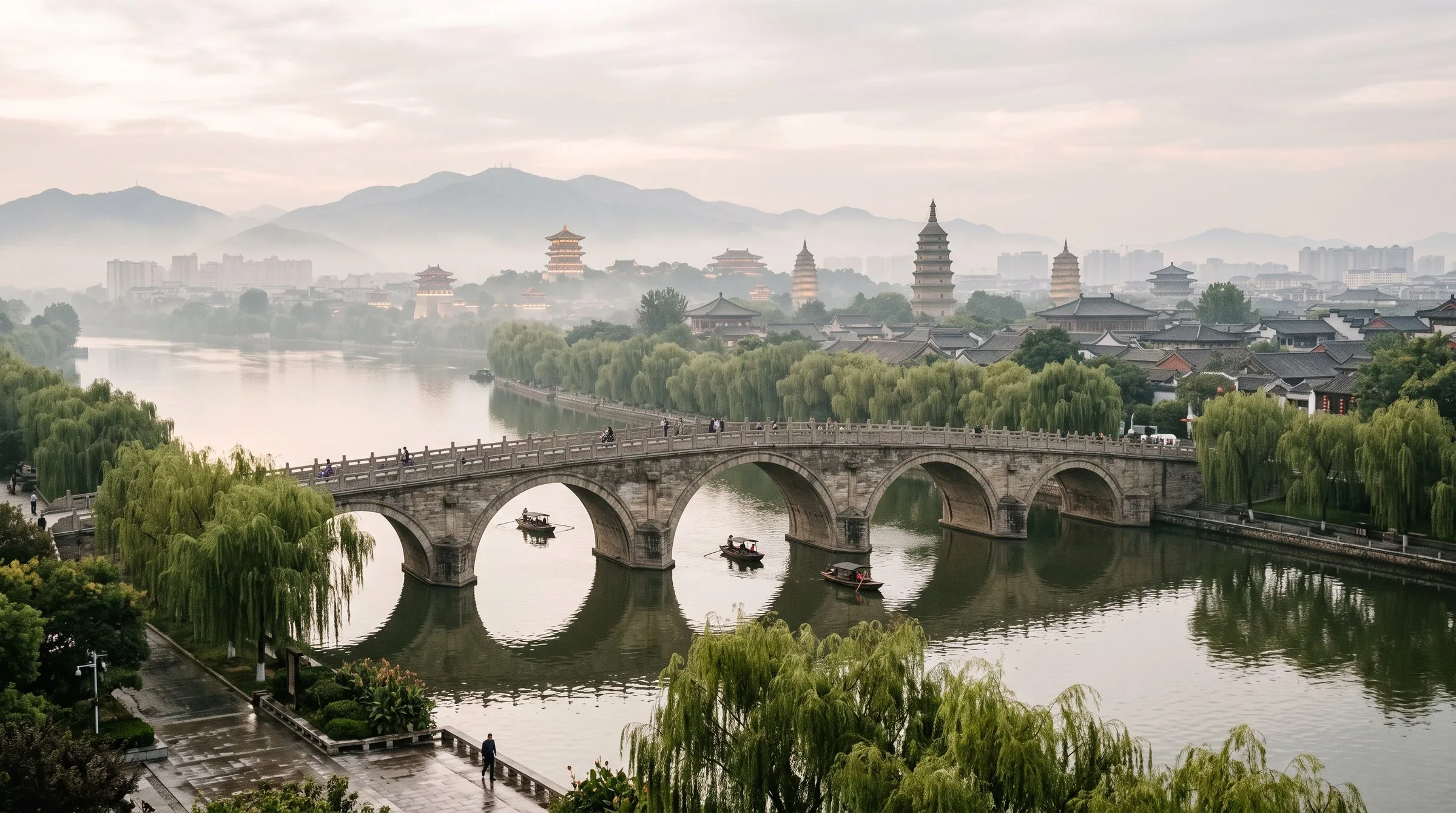
Luoyang sits in a basin on the Luo River (洛河), 200 km west of Zhengzhou in Henan province. The strategic position — at the eastern end of the Wei River valley, controlling the gap between the Loess Plateau and the Huai plain — made it the natural capital of every dynasty that ruled western China. The original site of the city was chosen by the Duke of Zhou in 770 BC, and the name itself (洛阳, “north of the Luo”) is fixed in Chinese political thought as the alternative capital to Chang’an (today’s Xi’an). When the eastern dynasties — Eastern Zhou, Eastern Han, Cao Wei, Western Jin, Northern Wei, Sui, Tang — wanted to be in a more central position, they came to Luoyang. When they wanted to be on the western frontier facing Central Asia, they returned to Chang’an.
What you see today in Luoyang is mostly Tang and later. The original Eastern Zhou city walls are gone, the Han palace foundations are buried under the modern city, and the Sui-Tang imperial palace is now a museum site. The two physical reminders of the ancient capital’s importance are the Longmen Grottoes and the White Horse Temple. Both are in the south of the city, 10-12 km apart, and both can be visited in a single day.
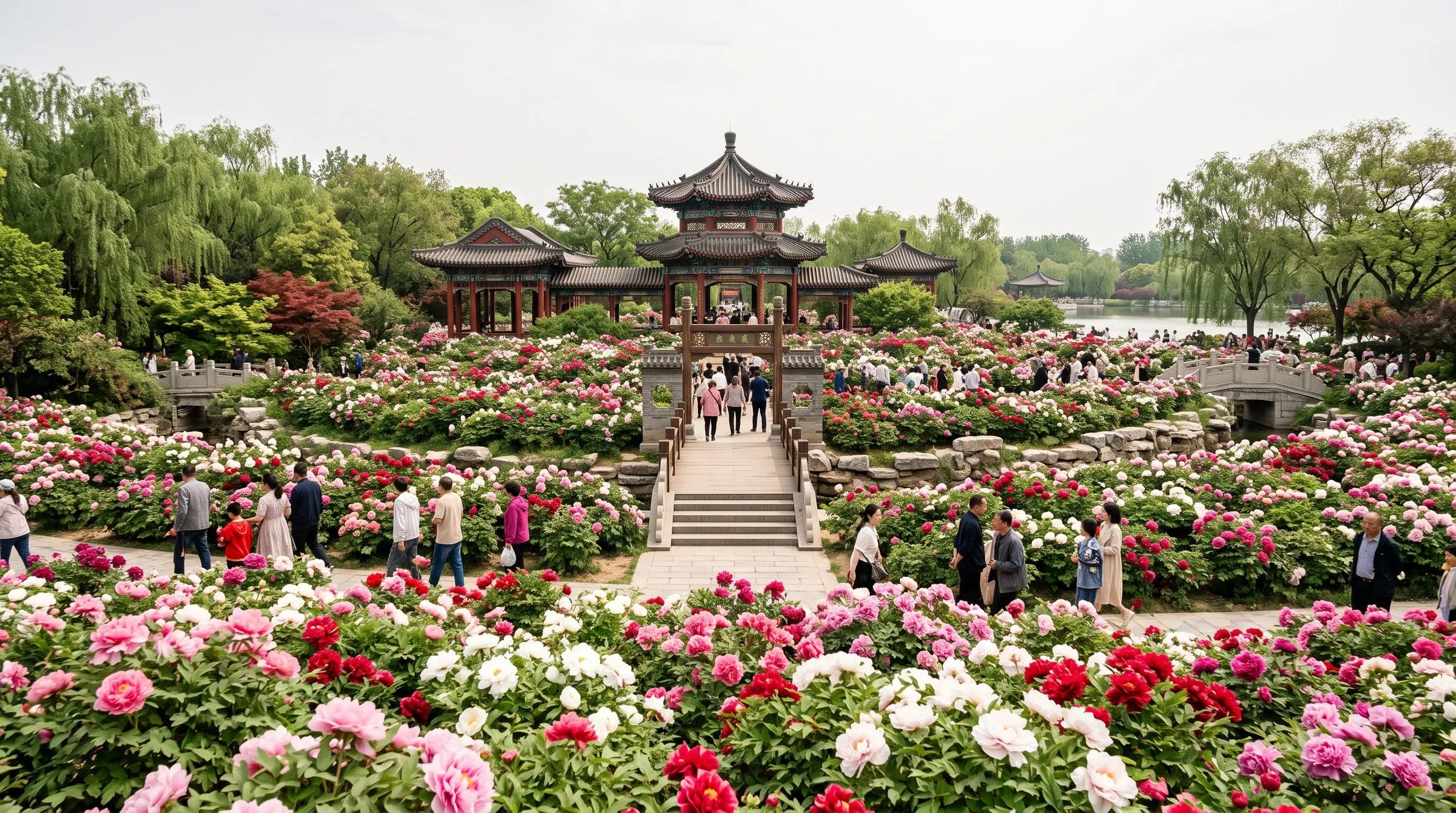
A secondary reason Luoyang matters is the Peony (牡丹). The tree peony was first cultivated here in the Sui dynasty (around 600 AD) and the city has been China’s peony capital ever since. Tang emperors built gardens for it; Song poets wrote about it; the city seal still includes a peony. The annual Peony Festival in April is the most-attended spring event in central China.
Luoyang at a glance
- Province: Henan
- Population: 7.1 million (2025 estimate)
- Elevation: 144 m
- Climate: humid continental, cold winters, hot summers, best in April-May or September-October
- Main HSR station: Luoyang Longmen (洛阳龙门站) — for Longmen Grottoes, 10 km south of the city
- Secondary HSR station: Luoyang (洛阳站) — for Old Town and White Horse Temple, in the city center
- Airport: Luoyang Beijiao (洛阳北郊机场) — limited flights, mostly to Beijing, Shanghai, Guangzhou
- Closest major airports: Zhengzhou Xinzheng (1.5h HSR) and Xi’an Xianyang (1.5h HSR)
Getting to Luoyang
From Xi’an (most common)
High-speed rail is the best option. From Xi’an North Station to Luoyang Longmen Station takes 1.5 hours direct, with G-trains running every 30 minutes from 6 AM to 9:30 PM. Second-class fare is ¥150 ($21), first class ¥237 ($33), business class ¥448 ($63). The Luoyang Longmen Station is 10 minutes’ walk to the West Gate of the Grottoes. The alternative HSR station is Luoyang Station in the city center, 30 minutes from Luoyang Longmen by metro Line 2. Driving from Xi’an via the G30 expressway is 3.5 hours but not faster than HSR.
From Beijing
The fastest route is HSR from Beijing West to Luoyang Longmen, 4-4.5 hours, ¥309 second class ($43). Multiple daily trains, some direct, some with a transfer at Zhengzhou. Flying into Luoyang Beijiao is rarely worth it — the airport has limited flights, and the HSR from Zhengzhou to Luoyang is 35 minutes and ¥75 ($10).
From Shanghai
The fastest HSR route is Shanghai Hongqiao → Luoyang Longmen via Zhengzhou, 5.5-6 hours, ¥440 second class ($62). Flying into Zhengzhou and connecting by HSR is sometimes faster (Shanghai to Zhengzhou 2.5h flight, then 35 min HSR to Luoyang).
From within Henan
Luoyang is also easy from other Henan cities. Zhengzhou East to Luoyang Longmen is 40 minutes, ¥75. Kaifeng to Luoyang is 1 hour, ¥130 with a transfer. Luoyang to Jiaozuo (Yuntai Mountain) is 1.5 hours, ¥140.
Where to stay
Luoyang has three main areas to stay:
Old Town — best for walking access
The Old Town is the area inside the Ming-era city walls in the center of Luoyang. The most atmospheric place to stay, with the Lijiangmen walking street, the Drum Tower, the night market, and most Water Banquet restaurants in walking distance. Hotels are concentrated near Lijiangmen Gate (丽景门).
- Budget (¥150-300 / $21-42): Luoyang Old Town Hostel, 7 Days Inn Lijiangmen
- Mid-range (¥400-800 / $56-112): Luoyang Peony Hotel (4-star, near Wangcheng Park), Christian’s Hotel (boutique courtyard in restored Ming house)
- Luxury (¥1,200-3,000 / $168-420): Luoyang Marriott Hotel (New District, 20 min DiDi to Old Town), Dharma Hotel (boutique Tang-style in Old Town)
Wangcheng Avenue / New District — best for newer hotels
The modern hotel zone along Wangcheng Avenue (王城大道). Easier for DiDi pickup, more chain hotels, more English spoken. Less walking access to the Old Town.
- Mid-range (¥400-800): Holiday Inn Express Luoyang City Center, Hanting Express Wangcheng, Ibis Luoyang
- Luxury (¥900-1,800): Pullman Luoyang, Le Méridien Luoyang, Holiday Inn Luoyang
Longmen Grottoes area — best for early-morning cave visits
If your plan is to be at the Grottoes at 7 AM (gates open 7:30), consider staying near the Longmen Grottoes ticket hall.
- Mid-range (¥300-600): Luoyang Longmen Hotel, Vienna Hotel Longmen Branch, Holiday Inn Express Luoyang Longmen
For most travelers, stay in the Old Town unless arriving late and leaving early for the Grottoes.
Top sites in Luoyang
1. Longmen Grottoes (龙门石窟)
The single most important site in Luoyang, and the reason most foreign visitors come.
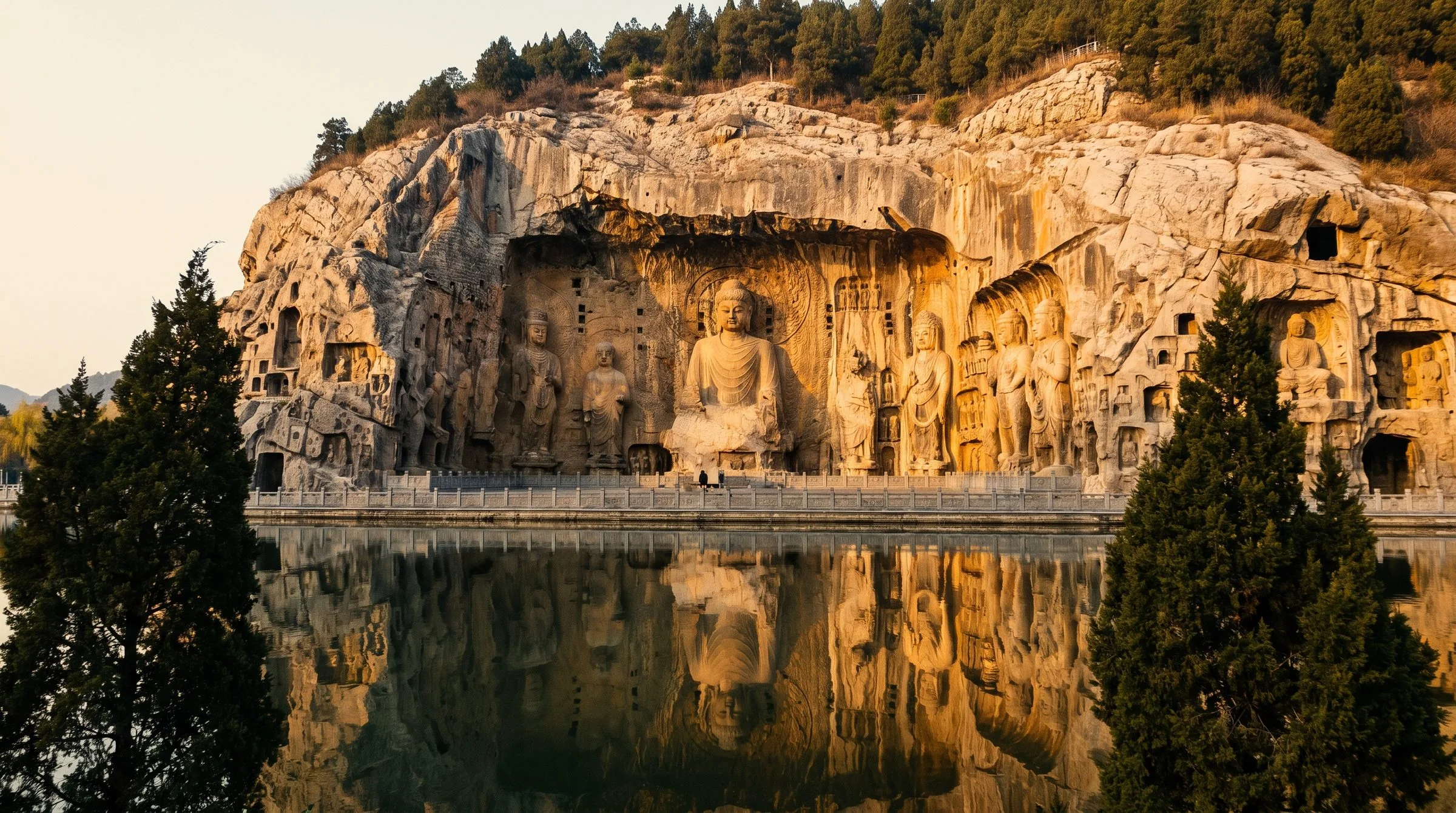
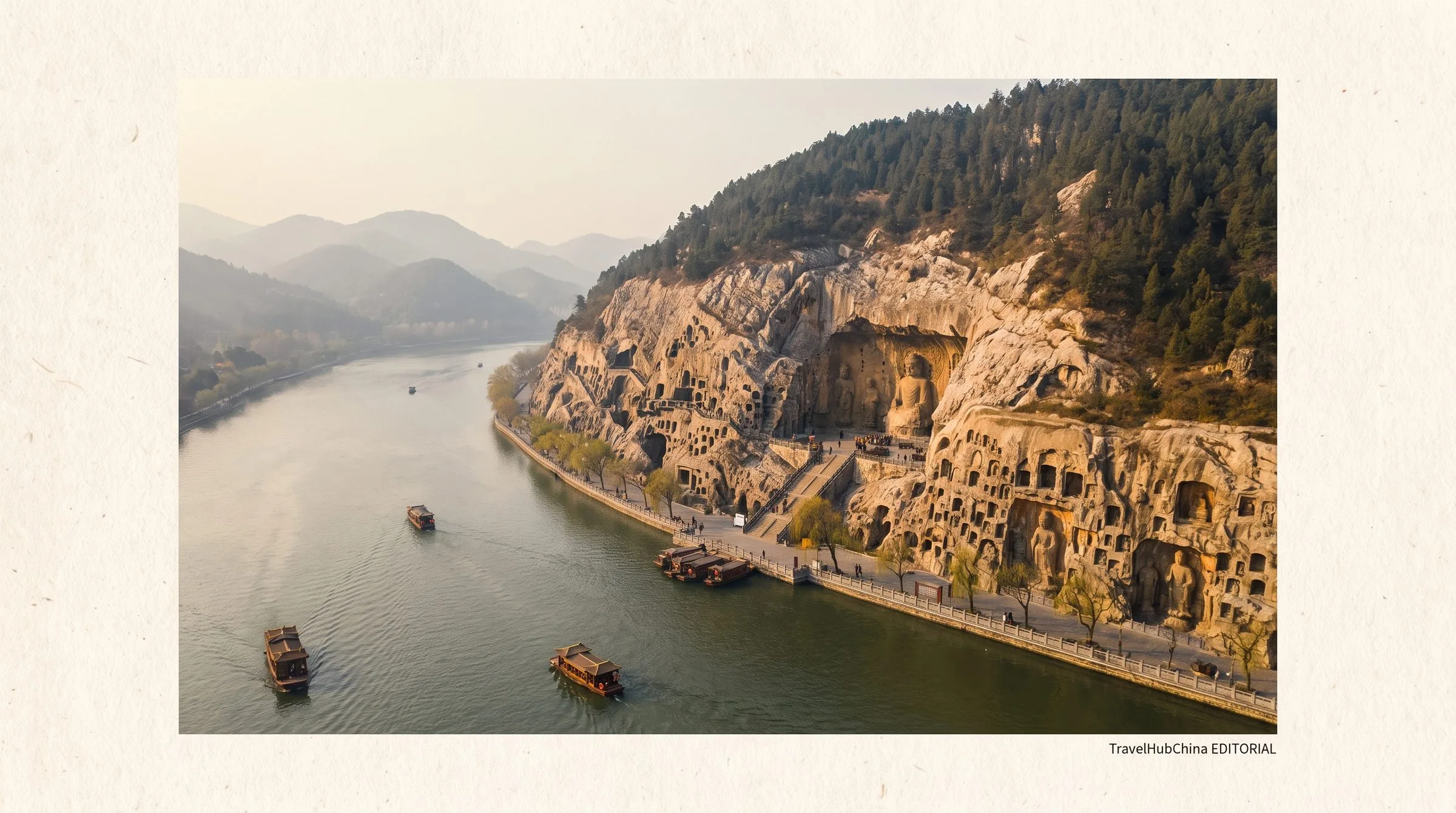
History: The Longmen Grottoes are a 1-km stretch of limestone cliff on both banks of the Yi River (伊河), 12 km south of Luoyang. Construction began in 493 AD under Emperor Xiaowen of the Northern Wei dynasty and continued for over 400 years, through the Northern Wei, Sui, Tang, and Song dynasties. The total number of niches and caves is around 2,345, holding more than 100,000 individual statues and 60+ pagodas. The cliff is one of the finest examples of Chinese Buddhist art in the world.
The construction was initiated in 493 AD when the Northern Wei court moved its capital from Pingcheng (Datong) to Luoyang. The Wei emperors were devout Buddhists and wanted a new cave complex to rival the Yungang Grottoes (云冈石窟) in Datong, which they had left behind. The initial carving was in the Northern Wei style — long, thin, slightly androgynous figures with flowing robes. After 618 AD, the Tang dynasty continued the work in a much more naturalistic style, with rounded faces, fuller bodies, and a more secular influence. The most famous example is the Fengxian Temple niche, a Tang-dynasty work completed in 675 AD.
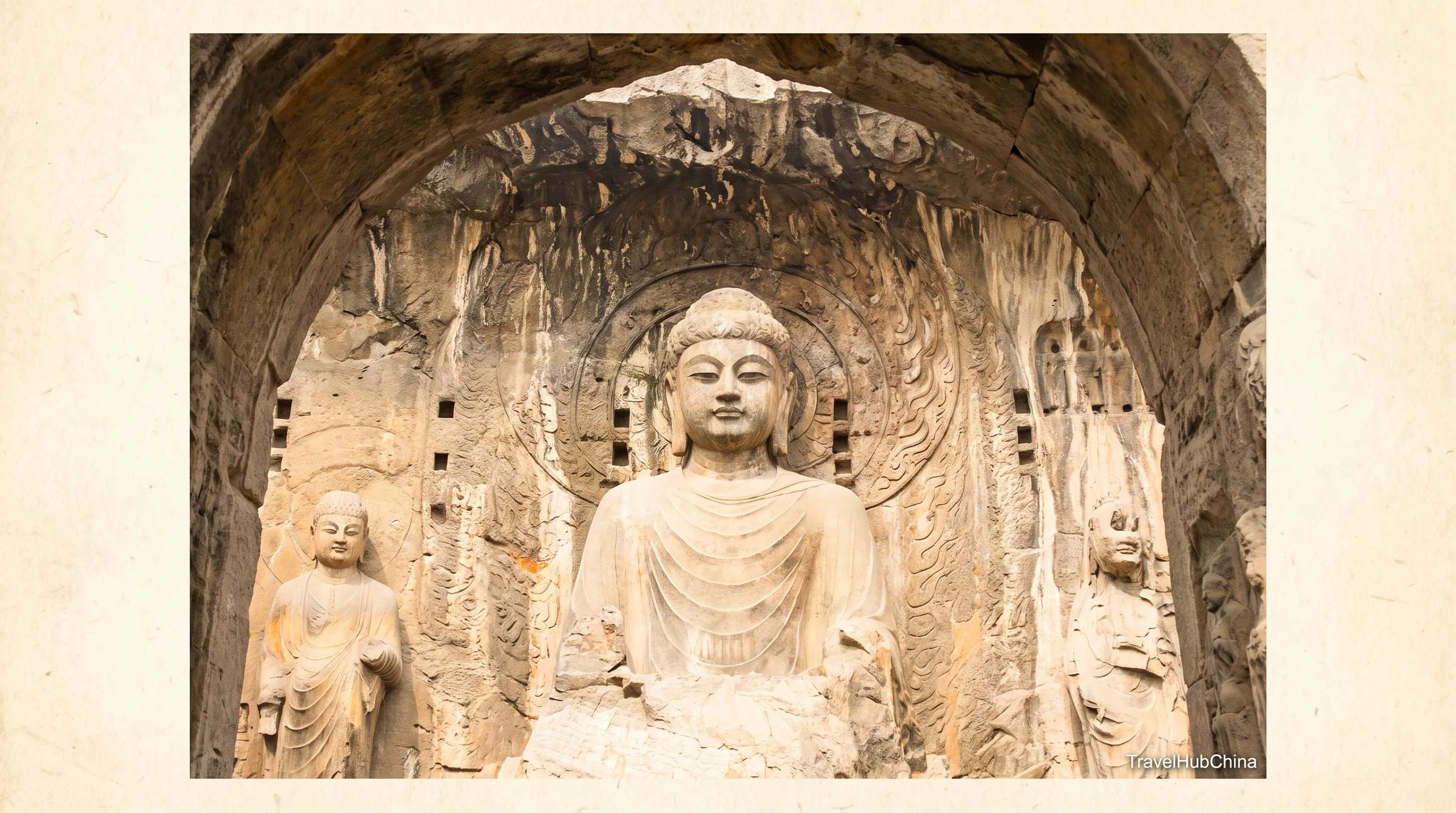
The Fengxian Temple niche (奉先寺) is the single most famous feature of the Grottoes. The central Buddha is the Vairocana (卢舍那大佛), 17.14 meters tall, said to be modeled on the Tang empress Wu Zetian. Flanking the Buddha are his disciples Ananda and Kasyapa, two heavenly kings, and two Vajrapani guardians. The arrangement is symmetrical and the craftsmanship is extraordinary — a single Tang-era project that took 3 years and 800,000 man-days to complete.
Practical information:
- Address: Longmen Town, Luoyang City (洛阳市洛龙区龙门镇)
- Hours: 8:00 AM – 6:00 PM (April-October), 8:00 AM – 5:00 PM (November-March)
- Entry: ¥90 ($13), free for under-18 and 60+ with passport
- Audio guide: ¥30 ($4), available in English, Japanese, French, German
- Photography: allowed outside the caves; flash and tripods banned inside
- How long: 3-4 hours minimum, half a day if you cross to the East Side cliffs
- Best light: morning, when the sun hits the West cliffs
- Night visit: April-October on selected dates, the caves are illuminated 7:30-10:00 PM, special ticket ¥180 ($25)
The route through the Grottoes: enter at the West Gate (西入口), walk east along the Yi River with the cliff on your right. The first major stop is the Fengxian Temple niche (the Vairocana Buddha), reached about 20 minutes from the West Gate. Continue east past the Guyang Cave (古阳洞, the oldest Northern Wei cave, 502 AD), the Wanfo Cave (万佛洞, with 15,000+ small Buddhas on the walls), the Lianhua Cave (莲花洞, named for its carved lotus ceiling), and the Medical Caves (药方洞, with 140+ Tang-era herbal prescriptions carved into the wall). Cross the bridge to the East Side cliffs and continue to the East Gate.
The East Side cliffs are less crowded but contain some of the most interesting small temples, including the Shiku Temple (石窟寺), the Gaozhuang Temple (高棕寺), and the Cuiyun Cave (翠云洞). Most tour groups skip the East Side; if you have time, do not.
Avoid the touts: outside the East Gate ticket hall there are unofficial guides offering English tours for ¥200-300 ($28-42). The official audio guide is ¥30 and is sufficient for most visitors. If you want a human guide, the official tour desk in the West Gate ticket hall charges ¥200-400 for a 2-3 hour English tour, which is better than the street touts.
2. White Horse Temple (白马寺)
The first Buddhist temple ever built in China, 68 AD, during the Eastern Han dynasty. The name comes from the white horses that carried two Indian monks (Kasyapa Matanga and Dharmaratna) and the original Buddhist sutras from India to Luoyang.
The current complex includes not just the original Eastern Han temple but also four international Buddhist halls built in the 2000s to commemorate the cultural exchange: a Thai-style hall (1992), a Burmese-style hall (2014), and an Indian-style hall (2008), plus a Japanese-style garden (2010). Walking through the White Horse Temple complex is essentially walking through the history of Buddhism’s transmission to East Asia.
Practical information:
- Address: 6 Luoyang White Horse Temple Road (洛阳市白马寺镇6号)
- Hours: 7:30 AM – 6:30 PM
- Entry: ¥50 ($7) for the original Han temple area; the international halls and gardens are additional ¥20-30 ($3-4) each, or ¥70 ($10) combined
- How long: 1.5-2 hours
- Reaching it: DiDi from the Old Town (¥25-35, 25 min), bus 56 from Luoyang Station (¥1, 50 min)
The two original attractions inside the original Han temple:
- The Qiyun Pagoda (齐云塔), a 13-story brick pagoda from the Tang dynasty, 25 m tall. Climbable (¥10)
- The Cool Buddha Terrace (清凉台), the original lecture hall where Kasyapa Matanga translated the sutras
The White Horse Temple is not visually as impressive as the Longmen Grottoes, but its historical importance is unmatched. Every other Buddhist temple in China is, in some sense, a copy of this one.
3. Guanlin Temple (关林)
A small but significant temple complex in the south of Luoyang, dedicated to Guan Yu (关羽), the general of the Three Kingdoms period who became the Chinese god of war and brotherhood. Guanlin is the only head-wrapped-and-buried-in-the-form-of-an-emperor site for Guan Yu in China — most other Guan Yu temples only have shrines.
Practical information:
- Address: 2 Guanlin South Road (洛阳市关林南路2号)
- Hours: 8:00 AM – 6:00 PM
- Entry: ¥40 ($5.50)
- How long: 1-1.5 hours
- Reaching it: DiDi from the Old Town (¥20, 20 min), bus 58 from Luoyang Station (¥1, 40 min)
The Stone Forest (石狮群) in front of the temple is the main attraction — 80+ Tang and Song dynasty stone lion sculptures lining the spirit way, including the famous Yongzhao Lions which are the largest stone lions in China. The main hall contains a painted statue of Guan Yu on a palanquin, and the Emperor Tomb Mound at the back is the alleged burial site of Guan Yu’s head (his body is traditionally buried in Jingzhou, Hubei).
Worth visiting if you are interested in Three Kingdoms history or Chinese folk religion. Skip if your schedule is tight.
4. Luoyang Museum (洛阳博物馆)
A free municipal museum in the New District, well-curated and a useful orientation before visiting the Longmen Grottoes. The collection covers the entire 1,500-year span of Luoyang as a capital, from Eastern Zhou bronzes to Tang tri-color pottery (唐三彩) to modern archaeology.
Practical information:
- Address: 1 Nie Tai Road, Luolong District (洛阳市洛龙区聂泰路1号)
- Hours: 9:00 AM – 5:00 PM, closed Mondays
- Entry: Free, ID/passport required
- How long: 1.5-2 hours
- Reaching it: DiDi from the Old Town (¥20-30, 20 min), bus 1 from Luoyang Station (¥1, 50 min)
The highlights: the Eastern Zhou bronze ritual vessels (8th-3rd century BC), the Tang tri-color glazed pottery (horse figurines, court ladies), the Sui dynasty stone tomb carvings, and the Northern Wei Buddhist sculptures (including miniature versions of the Longmen style for context). Audio guide in English ¥20.
Allow 2 hours. The museum is especially worth visiting on a rainy day or as a half-day substitute if the Longmen Grottoes are too crowded.
5. Peony Festival (牡丹文化节)
The single biggest reason to time your Luoyang visit for April. The tree peony was first cultivated in Luoyang in the Sui dynasty, and the city has been China’s “peony capital” for 1,400 years. The annual festival runs from April 1 to May 5 every year, with peak bloom usually in mid-to-late April.
The two main venues:
- Wangcheng Park (王城公园), in the city center, 5 min walk from Wangcheng Avenue. ¥30 ($4). Smaller but more central, with mass plantings of red, white, pink, yellow, and purple peonies. Crowded on weekends.
- Luoyang National Peony Garden (洛阳国家牡丹园), 10 km north of the city. ¥40 ($5.50). Much larger, with 1,000+ varieties including rare black peonies. Better for serious peony enthusiasts.
For most visitors, Wangcheng Park is enough. Allow 1.5-2 hours.
Peony cuisine: in April many restaurants serve peony-themed dishes — peony duck soup, peony shrimp, peony cake. They are not all great, but trying one is part of the festival experience. The Peony Banquet (牡丹宴) is a 12-course meal featuring the flower in various forms, ¥300-500 per person at the better restaurants. The Luoyang Hotel and the Peony Hotel both run Peony Banquets in April.
Avoid weekends: the festival attracts 2-3 million visitors over 4 weeks, mostly domestic. The crowds are worst on Saturdays and Sundays. Visit on a weekday morning.
6. Old Town and Lijiangmen (老城, 丽景门)
The Old Town is the area inside the Ming-era city walls in the center of Luoyang. Most of the original walls were demolished in the 20th century, but the Lijiangmen Gate (丽景门) was rebuilt in 2002 and is the symbolic center of the Old Town. From the gate, a pedestrian street runs north to the Drum Tower (鼓楼) and south to the Peony Square.
The Old Town is best in the evening: the walking street fills with food stalls, the night market on Lijiangmen opens, and the Drum Tower is lit up. Street food here is excellent — try the Luoyang Water Banquet mini-portions, the peony cakes (in season), the fried tofu, the stir-fried river snails, and the various Shanxi-style hand-pulled noodles.
Old Town walking tour (no tickets, free):
- Lijiangmen Gate (丽景门) — start here, climb the gate tower for ¥30 ($4) for a panoramic view
- East walking street — toward Drum Tower
- Drum Tower (鼓楼) — the symbol of the Old Town, lit up at night
- Peony Square (牡丹广场) — central plaza, good for people-watching
- Luoyang Catholic Church (洛阳天主教堂) — 20th-century Gothic, in the Old Town, free
Allow 1.5-2 hours in the evening.
7. Songyang Academy (嵩阳书院)
A Song-dynasty Confucian school at the foot of Mount Song (嵩山), 50 km southeast of Luoyang. Founded in 484 AD, it was one of the Four Great Academies of the Song dynasty (along with Yuelu in Changsha, Bailudong in Lushan, and Yingtian in Nanjing). The complex has been restored multiple times — the current buildings are Qing dynasty — but the historical importance is real.
Practical information:
- Address: Songyang Road, Dengfeng City (登封市嵩阳路)
- Hours: 8:00 AM – 5:30 PM
- Entry: ¥30 ($4) for Songyang Academy, but most visitors combine it with the Mount Song scenic area ticket bundle
- How long: 1.5-2 hours for the Academy alone, full day if combined with the Shaolin Temple and the Gaocheng Astronomical Observatory
- Reaching it: 1 hour by DiDi (¥150-200), or tour bus from Luoyang Longmen Station
The two famous trees in the Academy courtyard are the General Cypress (大将军柏) and the Second General Cypress (二将军柏), both planted in the Han dynasty and now over 2,000 years old. Most visitors combine Songyang with the Shaolin Temple (少林寺) and the Gaocheng Astronomical Observatory (告成观星台) — the combined ticket is ¥100 ($14). From Luoyang, allow a full day.
8. Other sites
- Luoyang Christian’s Church (Old Town Gothic Revival church, 1908, free)
- Ancient Tombs Museum (古墓博物馆, ¥0, 1.5h, underground museum of Han and Tang tombs relocated from Henan)
- Emperor Yang of Sui Mausoleum (隋炀帝陵, 30 min outside the city, free, only for serious history buffs)
- Mount Song hiking (Shaolin Temple hike is the most accessible)
The Water Banquet (洛阳水席)
A must-try culinary experience, and the dish most associated with Luoyang.
What it is: a 24-course meal where every dish is a soup or a broth-based dish, served in two parts: 8 cold dishes (凉菜) and 16 hot dishes (热菜). The name (水席, “water banquet”) comes from the soup being poured and the hot dishes moved on the table like flowing water.
The signature dish is Peony Yan (牡丹燕菜), a sliced radish dish shaped like a peony, originally created for Empress Wu Zetian. Other highlights: braised pork belly (扣碗), tofu with pepper oil, steamed river fish, and the closing eight-treasure soup.
Where to eat:
- Zhenqingtang (真不同饭店) — the most famous, near the Old Town, opened 1899. ¥120-200 per person, expect 30-60 min queue
- Luoyang Banquet Hall (洛阳水席园) — slightly more polished, near the New District, ¥150-250 per person, better English menu
- Guanlin Town Water Banquet (关林水席) — a local favorite, less touristy, ¥80-150 per person
Tips:
- Most restaurants only serve the full 24-course set; you can order 8 or 12 courses for a smaller meal
- The meal takes 2-3 hours; bring a flexible waistband
- Not all dishes will be familiar to Western palates; the radish-and-chicken soup (燕菜) is the most accessible
Luoyang day-by-day plans
1-day plan (as a day trip from Xi’an)
| Time | Activity | Cost |
|---|---|---|
| 8:00 AM | HSR from Xi’an North to Luoyang Longmen | ¥150 |
| 9:30 AM | Arrive Luoyang Longmen, walk to West Gate | — |
| 9:30 AM – 1:00 PM | Longmen Grottoes (3.5 hours) | ¥90 |
| 1:00 PM | Lunch at Longmen Grottoes restaurant (Peony Yan) | ¥80 |
| 2:00 PM | DiDi to White Horse Temple (25 min) | ¥30 |
| 2:30 PM – 4:00 PM | White Horse Temple (1.5 hours) | ¥50 |
| 4:30 PM | DiDi to Old Town (30 min) | ¥30 |
| 5:00 PM | Walk the Old Town, Drum Tower, Lijiangmen Gate | ¥30 |
| 6:30 PM | Dinner at Zhenqingtang (Water Banquet) | ¥150 |
| 8:00 PM | Walk Lijiangmen night market | — |
| 9:00 PM | DiDi to Luoyang Longmen Station, HSR back to Xi’an | ¥30 + ¥150 |
| 10:30 PM | Arrive Xi’an | — |
| Total | ~¥790 ($110) |
2-day plan (recommended)
Day 1: Longmen Grottoes (full morning, including East Side cliffs); lunch at the Grottoes restaurant; afternoon Peony Festival (April) or Luoyang Museum (other months); evening Old Town walking, Drum Tower, Water Banquet dinner at Zhenqingtang.
Day 2: White Horse Temple (morning, 2 hours); lunch at the temple vegetarian restaurant; afternoon Guanlin Temple (1.5 hours); late afternoon Songyang Academy or Ancient Tombs Museum; evening Lijiangmen night market.
If you have a 3rd day, add the Mount Song scenic area (Shaolin Temple + Songyang Academy + Gaocheng Observatory).
Day trip from Xi’an: practical details
If you are planning Luoyang as a day trip from Xi’an (the most common scenario for first-time visitors to central China):
Train tickets: book 1-2 days in advance on Trip.com, 12306.cn (China Railway’s official site — passport registration required), or at the Xi’an North Station ticket counter. Same-day tickets are usually available but you may not get your preferred time.
Best train: any G-train before 9 AM. The 7:30 AM and 8:00 AM departures are the most popular; the 9:00 AM and 9:30 AM are less crowded. Avoid the 10:30 AM and 11:00 AM trains — they get you to Luoyang after noon.
Returning: the last direct HSR from Luoyang Longmen to Xi’an North is around 9:30 PM. Plan to leave the city by 7:30 PM. If you miss the last train, there is a slower D-train at 10:30 PM, but it is not recommended for the same-day plan.
Luggage: the Luoyang Longmen Station has coin lockers (¥20-30 for 24 hours) if you want to leave bags while visiting the Grottoes.
E-sim/data: see our eSIM guide. DiDi and maps both work in Luoyang.
Payment: see our Alipay setup guide. Most Luoyang restaurants and ticket halls accept Alipay and WeChat Pay.
Combining Luoyang with other cities
The most common Luoyang combination trips:
- Xi’an + Luoyang (4-5 days): 3 days Xi’an (Terracotta Warriors, City Wall, Muslim Quarter), 2 days Luoyang. The HSR between them is 1.5 hours and the cities share a Silk Road heritage.
- Beijing + Luoyang + Xi’an (8-10 days): the classic northern China triangle, all HSR-connected.
- Henan loop (6-8 days): Zhengzhou (Henan Museum), Kaifeng (Song capital), Luoyang (Han and Tang capital), Dengfeng (Shaolin Temple), Jiaozuo (Yuntai Mountain). All in Henan, all HSR-connected.
- Shanghai + Luoyang + Xi’an + Beijing (10-14 days): the standard 4-city first trip to China. Luoyang fits naturally as the 2-3 day stop between Xi’an and Beijing.
For the cultural depth of Luoyang’s Silk Road heritage, our Dunhuang 2-day itinerary is the natural extension. For the broader Silk Road comparison, see our China western region comparison.
Food beyond the Water Banquet
For longer stays, Luoyang’s food culture goes well beyond the Water Banquet:
- Luoyang Mutton Soup (洛阳羊肉汤) — a clear mutton broth with glass noodles, served for breakfast at small shops all over the Old Town, ¥15-25 per bowl. The most authentic Luoyang breakfast.
- Ganshi Mutton (干煸羊肉) — a stir-fried mutton dish with cumin and chili
- Bowl Holder (碗团) — buckwheat or millet porridge in a small bowl
- Peony Cake (牡丹饼) — flaky pastry filled with peanut and sesame
- Peony Banquet (牡丹宴) — only in April, the 12-course peony-themed meal
For casual dinner, the Lijiangmen night market has the best concentration of street food stalls. For a sit-down local meal, try Mao Jian Chuan (毛尖串) for Shanxi-style grilled lamb skewers, Lao Lu’s Noodle Shop (老路烩面) for the mutton soup, or Yang Xiaoping Beef (杨小平和牛肉) for the dry-pot beef.
Shopping
Luoyang’s main shopping product is Tang tri-color pottery (唐三彩) — the glazed ceramic horse figurines and court ladies that are the signature Tang-dynasty art form. Modern reproductions are sold in the Luoyang Tang San Cai Museum Shop and the Old Town antique market on Lijiangmen, ¥50-200 for a small horse. Other Luoyang purchases include peony-themed products (April only), paper cuttings, Longmen Grottoes souvenirs, and White Horse Temple incense. Avoid the “ancient silver” and “imperial jade” shops on Lijiangmen — they are tourist traps.
When to visit
- April: the Peony Festival, busiest month, but the best for combining the Grottoes with the flowers. Book hotels 2-3 weeks ahead.
- May–June: pleasant, fewer crowds, peonies are gone
- July–August: hot (35°C+) and humid, school-trip season at the Grottoes
- September–October: autumn, clear, comfortable, the second-best season
- November–February: cold (down to -5°C), the Grottoes are less crowded but the experience is less pleasant; some smaller sites have reduced hours
The best month is mid-to-late April for the festival, or October for the autumn colors and comfortable weather.
Booking essentials before you go
- 240-hour visa-free transit: Luoyang is on the inland visa-free list — see our 240-hour visa-free guide
- Alipay/WeChat Pay: see our Alipay setup guide — essential for Water Banquet restaurants
- eSIM: see our eSIM guide for data access
- High-speed rail tickets: book through Trip.com 1-2 days in advance; Xi’an-Luoyang trains are popular on weekends
- Cultural etiquette: see our China cultural etiquette guide for temple and grotto behavior
For the broader Silk Road art context, our Dunhuang 2-day itinerary and Mogao Caves scenic guide cover the other end of the Chinese Buddhist cave art tradition. For overall China budget planning, see our China budget 2026 guide. For how Luoyang compares to China’s other great scenic wonders, see our China scenic wonders comparison.
Book this Luoyang trip
From Longmen Grottoes entry tickets to White Horse Temple tours to Old Town courtyard hotels — these three platforms cover everything in this itinerary.
Luoyang hotels + Longmen tickets
Book Old Town courtyard hotels or Wangcheng Avenue 4-stars, plus Longmen Grottoes entry tickets and Peony Festival packages. English interface, accepts foreign cards.
Hotels from $30/night · Tickets from $13
Plan your trip — verified tools
These free tools are built on real, monthly-verified data and help you skip the trial-and-error phase of China trip planning:
- China 240-Hour Visa-Free Transit Checker — 57 countries, 24 provinces, 65 ports. See if you qualify for 10-day visa-free transit, which cities you can visit, and the 5-step process.
- China 6-City 5-Day Budget Calculator — Real 2026 prices for 5 days in Beijing, Shanghai, Guangzhou, Chengdu, Xi’an, or Hangzhou. Budget / mid-range / comfort tiers, broken down line by line.
Verified August 2026 by TravelHubChina Editorial. We re-check prices and policy details monthly so the data doesn’t drift.
Step by step
-
Take the HSR from Xi'an North to Luoyang Longmen
Buy a ticket for the next 1.5-hour G-train from Xi'an North to Luoyang Longmen (¥150 second class, ¥237 first class, every 30 min from 6 AM). Arrive 30 min before departure. The train is faster, cheaper, and more reliable than driving.
-
Luoyang Longmen Station to the Grottoes
From Luoyang Longmen Station, walk 10 minutes north to the West Gate ticket hall (most scenic entry). Alternatively, take a DiDi (¥15) or bus 81 (¥1) to the East Gate if arriving later in the day. The West Gate is the recommended starting point.
-
Buy tickets and enter the Grottoes
Buy entry at the ticket hall (¥90 / $13, free for under-18 with passport, free for 60+ with passport). No advance booking required. The audio guide is ¥30 ($4) — worth it for understanding which caves to prioritize. Plan 3-4 hours.
-
Walk west to east along the Yi River
From the West Gate, walk east along the river. Stop at the Fengxian Temple niche (the 17.14m Vairocana Buddha, the most famous), then the Wanfo Cave, the Medical Caves, and the Guyang Cave. Photography is allowed outside; flashes are not.
-
Cross the bridge to the East Side cliffs
From the East Gate end of the main cliff, cross the footbridge to the East Side. Less crowded, with the small but excellent Lianhua, Shiku, and Gaozhuang temples. Continue to the East Gate exit.
-
Return to Luoyang by HSR or stay overnight
Same-day return: Luoyang Longmen to Xi'an North, last train 9:30 PM. If staying overnight, head to the Old Town area (3 km east of the station) and walk the Ming-era city wall, then the night street-food market on Lijiangmen.
FAQ
-
How long should I spend at the Longmen Grottoes?
Plan 3-4 hours for a full visit, walking from the West Gate to the East Gate along the Yi River. The main caves (Fengxian Temple, the Vairocana Buddha, the Wanfo Cave, the medical caves) are spread over about 1 km of cliff face. Photography is allowed outside the caves but the inside of most caves is closed to flash to protect the murals. -
What is the cheapest way to get from Xi'an to Luoyang?
The high-speed rail from Xi'an North to Luoyang Longmen is the best option: 1.5 hours direct, ¥150 second class, ¥237 first class, with departures roughly every 30 minutes from 6 AM to 9 PM. The Luoyang Longmen Station is a 10-minute walk to the Grottoes ticket hall. Driving the G30 expressway is also fast (3.5 hours) but the HSR is faster and cheaper. -
Is the Longmen Grottoes worth it as a day trip from Xi'an?
Yes — it's one of the easiest high-impact day trips in China. Train at 8 AM, arrive 9:30 AM, 3-4 hours at the Grottoes, train back by 7 PM, in Xi'an by 8:30 PM. You can combine the Grottoes with the White Horse Temple (¥50, 30 minutes by DiDi) in a single day if you skip the museums and start early. -
When is the Luoyang Peony Festival?
The annual festival runs from April 1 to May 5, with peak bloom in mid-to-late April depending on the year's temperature. The two main venues are Wangcheng Park (¥30, in the city center) and the Luoyang National Peony Garden (¥40, larger, more variety, slightly outside the city). Allow 2-3 hours for either. -
What is the Luoyang Water Banquet and where should I try it?
The Luoyang Water Banquet (洛阳水席) is a 24-course meal where every dish is a soup or a broth-based dish, served in 8 cold and 16 hot courses. Originated in the Tang dynasty's imperial kitchens, ¥100-200 per person. The two most famous restaurants are Zhenqingtang (真不同, the old standard, near the Old Town) and Luoyang Banquet Hall (洛阳水席园, the slightly more polished modern option).
Related guides
- Culture & Practical
Solo Female Travel in China 2026: The Honest Safety Guide Foreigners Don't Get
China is statistically one of the safer large countries for solo female travelers, but the safety profile is different from Western countries. What works in Tokyo or Paris may not work in Beijing. The 2026 honest guide: 8 specific safety scenarios (DiDi at night, hostel vs hotel, walking alone, foreigner-targeted scams, hostel harassment, menstruation access, dating safety, embassy backup), ranked by frequency and risk. Includes the 5 phrases every solo female traveler should learn, and the 2 scenarios where you should NOT go alone.
5min read
- Culture & Practical
Is It Safe to Travel to China in 2026? The Complete Foreigner's Safety Guide
Comprehensive 2026 safety guide for China travel: crime statistics, region-specific risks, scams targeting foreigners, US State Department advisory, LGBTQ+ safety, female solo travel, health and medical care, embassy registration, and 5-step arrival safety checklist. Plus: is it safe to travel to China right now in 2026 (yes, with normal precautions).
12min read
- Culture & Practical
Chinamaxxing 2026: 12 Chinese Lifestyle Experiences Every Foreigner Should Try
Chinamaxxing is the 2026 trend of foreign visitors going deep into Chinese daily life — hot water, ba duan jin qigong, hanfu, mahjong, tea ceremony, foot baths, and more. 12 hands-on experiences with where to try each one, what to expect, and how to book.
9min read
- Culture & Practical
China Historic Capitals 2026: Beijing vs Nanjing vs Luoyang vs Xi'an vs Hangzhou
Comparison of China's 5 great historic capitals: Beijing (Ming/Qing), Nanjing (Six Dynasties, early Ming), Luoyang (Eastern Han, Northern Wei), Xi'an (Tang), Hangzhou (Southern Song). What to see, which to pick, how to combine.
- Culture & Practical
Nanjing China Travel Guide 2026: Six Dynasties Capital, Massacre Memorial, Purple Mountain
Nanjing travel guide for foreign visitors: 2,600-year history, Six Dynasties and Ming capital, Sun Yat-sen Mausoleum, Nanjing Massacre Memorial Hall (free, deeply moving), Confucius Temple, Ming city wall, and how Nanjing compares to Beijing's Forbidden City.
- Culture & Practical
Pingyao Ancient City 2026: UNESCO Ming-Qing Town, 2-Day Itinerary from Beijing
Pingyao travel guide for foreign visitors: 2,700-year-old UNESCO ancient city, Ming-Qing architecture, Shanxi merchant banking museum, 1.5h HSR from Beijing (¥150), tickets ¥125 (3-day pass), 2-day itinerary.