
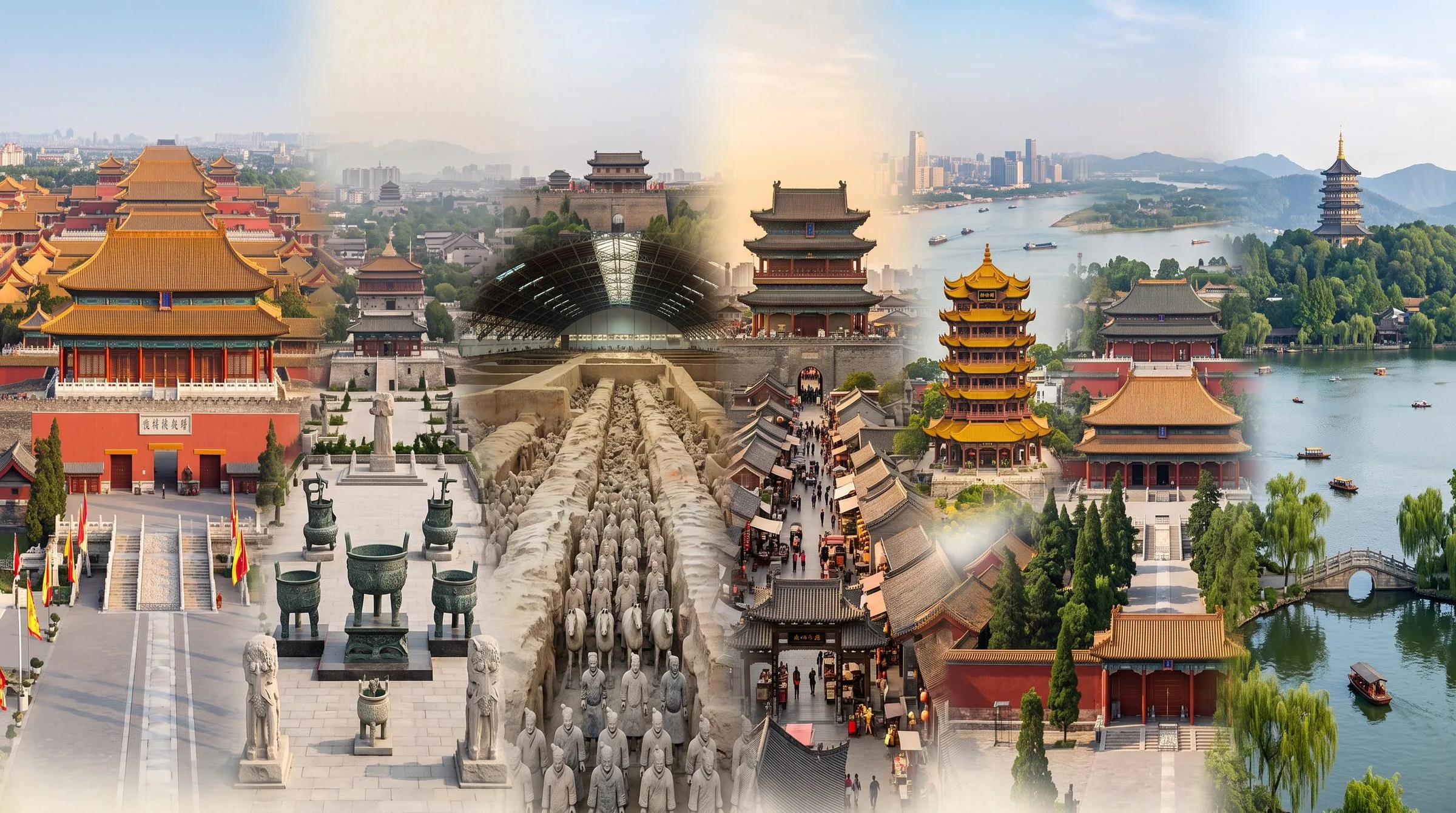
China Historic Capitals 2026: Beijing vs Nanjing vs Luoyang vs Xi'an vs Hangzhou
Comparison of China's 5 great historic capitals: Beijing (Ming/Qing), Nanjing (Six Dynasties, early Ming), Luoyang (Eastern Han, Northern Wei), Xi'an (Tang), Hangzhou (Southern Song). What to see, which to pick, how to combine.
For more than 3,000 years, the political center of China moved between a handful of cities on the North China Plain and the lower Yangtze. The five that historians consistently rank as the “great capitals” (五大古都) are Beijing, Xi’an, Luoyang, Nanjing, and Hangzhou. Each held the imperial throne for a defining dynasty; each built a city that still reads, today, as one of the architectural achievements of human civilization. This guide compares them side by side, walks through the practical combination routes, and helps you decide which one to prioritize if you cannot see them all.
The Five Capitals at a Glance
| Capital | Region | Defining Dynasty | Capital Years | Defining Sites | Modern Status |
|---|---|---|---|---|---|
| Beijing | North China | Ming + Qing | 1421-1911 (590 years) | Forbidden City, Temple of Heaven, Great Wall | National capital, 21 million people |
| Xi’an | Northwest | Western Zhou, Qin, Western Han, Sui, Tang | 1,100+ years total | Terracotta Army, City Wall, Big Wild Goose Pagoda | Shaanxi provincial capital, 13 million |
| Nanjing | East China | Six Dynasties, Southern Tang, early Ming | 400+ years | Sun Yat-sen Mausoleum, Ming City Wall, Confucius Temple | Jiangsu provincial capital, 9 million |
| Hangzhou | East China | Southern Song, Wuyue kingdom | 200+ years | West Lake, Lingyin Temple, Longjing tea | Zhejiang provincial capital, 12 million |
| Luoyang | Central China | Eastern Han, Cao Wei, Western Jin, Northern Wei, Sui, Later Tang | 1,500 years | Longmen Grottoes, White Horse Temple | Henan prefecture-level city, 3 million |
These are not the only imperial capitals in Chinese history. Kaifeng served as the Northern Song capital 960-1127, Anyang was the late Shang capital 1300-1046 BC, Chengdu hosted multiple short-lived dynasties, and there are secondary capitals (洛阳 parallel, 北京 parallel 南京, 陪都) at various times. But the five above are the consensus great capitals and the focus of this guide.
The key historical pattern: Chinese capitals moved north and south based on the dynasty’s ethnic origin and the strategic challenges of the time. Northern dynasties (often of nomadic or semi-nomadic origin, like the Qin, Han, Tang, Ming, Qing) put their capitals in the north, on or near the central plains. Southern dynasties (often displaced northeners, like the Southern Song) put their capitals in the south, in the Yangtze basin. The Ming dynasty is unusual because it moved its capital from Nanjing to Beijing in 1421, a northward shift that has stuck for 600 years.
Beijing: The Must-See First Pick
Beijing is the easiest and the most obvious place to start. It is the current national capital, the most internationally connected city in China after Shanghai, and the home of the largest concentration of UNESCO World Heritage sites in the country.
History. The city that became Beijing has been an important settlement for at least 3,000 years, but as a capital it is relatively recent. The Yuan dynasty (1271-1368) built Dadu here, the Liao and Jin had it as a secondary capital, but the modern Beijing essentially dates to 1421 when the Ming Yongle Emperor moved the capital from Nanjing to Beijing. From 1421 to 1911, Beijing served as the capital of the Ming and Qing dynasties, 490 consecutive years. The Republic of China kept Beijing as the capital from 1912 to 1928, and the People’s Republic made it the capital again in 1949. So Beijing has been the seat of continuous Chinese power for 600 years, longer than any other city.
The defining sites:
- The Forbidden City (紫禁城, Zijin Cheng). UNESCO 1987 (combined with the Great Wall and other Beijing sites). The imperial palace from 1420 to 1912, 24 emperors, 980 surviving buildings across 74 hectares. The largest wooden building complex in the world. ¥60 entry (advance booking required via the official WeChat mini-program or Trip.com), 4-hour minimum visit. The Forbidden City is best entered through the Meridian Gate (Wumen) on the south, walked through the central axis, and exited through the Gate of Divine Prowess (Shenwu) at the north, with a side climb up Jingshan Park (¥10) for the iconic overhead view. Allow a full morning or afternoon.
- The Temple of Heaven (天坛, Tiantan). UNESCO 1998. The imperial complex where Ming and Qing emperors performed the annual prayer for good harvest. The Hall of Prayer for Good Harvests is the iconic circular blue-roofed building on the ¥1 Chinese banknote note. ¥35 entry, allow 2-3 hours. Best in the morning when locals do tai chi in the surrounding park.
- The Great Wall at Mutianyu (慕田峪). 1.5-2 hours north of the city. ¥45 entry, ¥120 round-trip cable car. The most popular section for foreign visitors; less crowded than Badaling and more scenic than Juyongguan. Allow a full day including transit.
- The Summer Palace (颐和园, Yiheyuan). UNESCO 1998. The largest and best-preserved imperial garden in China, dominated by Kunming Lake and the Long Corridor. ¥30 entry (low season) to ¥60 (peak), allow 3-4 hours.
- The Beijing Central Axis (北京中轴线). UNESCO 2024. The 7.8-kilometer north-south line through the old city from Yongdingmen in the south to the Bell and Drum Towers in the north, including the Forbidden City, Jingshan Park, the Imperial City, and Tiananmen Square. A walking tour of the full axis is the single best 1-day introduction to Beijing.
Time needed. 4 days is the right amount: Day 1 for the Forbidden City, Day 2 for the Great Wall, Day 3 for the Temple of Heaven + Summer Palace, Day 4 for hutongs + Beijing Central Axis. Three days is doable; 5 days is luxury.
What Beijing is not. It is not the most photogenic Chinese city. The traditional architecture is impressive but the modern Beijing is a 21-million-person mega-city with severe traffic and pollution. The hutongs are charming but the old town is small and surrounded by skyscraper canyons. The Great Wall is the highlight for most first-time visitors, not the city itself.
Internal links. See our Beijing 3-day itinerary, Great Wall scenic guide, Forbidden City scenic guide, and Beijing hutong food tour for deeper coverage.
Xi’an: The Second Pick, the Tang Capital
Xi’an is the most historically significant city in China. As the capital of the Zhou, Qin, Western Han, Sui, and Tang dynasties, it served as the imperial seat for more than 1,100 years, longer than any other city on earth. The Silk Road started here. The Terracotta Army was buried 35 km east of the city. The city was the largest in the world for centuries.
History. The city that became Xi’an has been continuously inhabited for more than 6,000 years. As Chang’an (长安, “Eternal Peace”), it was the eastern terminus of the Silk Road, the capital of China’s most powerful dynasties, and one of the largest cities in the world during the Tang dynasty (618-907 AD), with up to 1 million residents within the city walls. The current Xi’an is a 13-million-person industrial city in Shaanxi province; the historical center is relatively compact and walkable, ringed by the best-preserved Ming-dynasty city wall in China.
The defining sites:
- The Terracotta Army (兵马俑, Bingmayong). UNESCO 1987. The funerary army of China’s first emperor, Qin Shi Huang (221-210 BC). Approximately 8,000 life-sized soldiers, 130 chariots with 520 horses, and 150 cavalry horses, all individually carved, originally painted in vivid colors that have since oxidized. The site is 40 km east of Xi’an; allow 3-4 hours including transit. ¥120 entry, ¥30 for the optional shuttle from the visitor center to Pit 1. Best to arrive at opening (8:30 AM) to beat the tour buses.
- The Xi’an City Wall (西安城墙). The best-preserved city wall in China, 12 m tall, 12-14 m wide at the top, 13.7 km in circumference. Built 1370-1378 AD in the Ming dynasty on the foundation of the Tang imperial city. ¥54 entry, walkable in 3-4 hours, or rent a bike (¥45 single, ¥90 tandem) for the 1.5-2 hour loop. The South Gate (Yongningmen) is the most dramatic entry, with a drawbridge and gate towers.
- The Big Wild Goose Pagoda (大雁塔, Dayanta). UNESCO combined with Small Wild Goose Pagoda (2014). A 64-meter Tang-dynasty brick pagoda built 652 AD to store Buddhist sutras brought from India by the monk Xuanzang. ¥50 entry to climb, free to view from the surrounding square. The North Square has a large musical fountain show nightly (free).
- The Shaanxi History Museum (陕西历史博物馆). Free entry (advance booking required). One of the best provincial museums in China, with the Tang-dynasty gold and silver work, the Zhou bronzes, and the famous Tang figurines. Allow 2-3 hours.
- The Muslim Quarter (回民街, Huimin Jie). A 600-year-old neighborhood of Hui Muslim merchants descended from Silk Road traders, with a vibrant food and night market. The biangbiang noodles, rou jia mo (Chinese “hamburger”), and persimmon cakes are local musts. The Great Mosque of Xi’an (¥25) is the oldest and one of the largest in China, dating to 742 AD, hidden down a narrow alley off the Muslim Quarter.
- The Tang Dynasty Show. Evening dinner-and-show performances in the Tang-palace style, with traditional music, dance, and dumpling banquets. The most famous are the Tang Dynasty Palace (¥300-500) and the Huaqing Palace show (¥300).
Time needed. 3 days is right: Day 1 for the City Wall, Bell Tower, Muslim Quarter, and Shaanxi History Museum; Day 2 for the Terracotta Army and Han Yangling (the Western Han emperor’s tomb, 30 km north of Terracotta); Day 3 for the Big Wild Goose Pagoda, the Tang show, and a final walk on the wall at sunset.
Internal links. See our 4-day Xi’an itinerary, Terracotta Army scenic guide, and China budget 2026 for full Xi’an coverage.
Nanjing: The Third Pick, the Six Dynasties and Early Ming
Nanjing is the underrated one. It was the capital of the Eastern Wu (229-280 AD), Eastern Jin (317-420), Southern Dynasties (420-589), Southern Tang (937-975), and the Ming dynasty before 1421. Six Dynasties era alone, the city was the southern capital of the Chinese empire for 370 consecutive years. Even Beijing, the dominant modern capital, is essentially a Ming invention built by an emperor who came from Nanjing.
History. Nanjing (“Southern Capital”) has been an important city since 495 BC, when the Yue kingdom built a fort here. It reached its peak under the early Ming, when the Hongwu Emperor (Zhu Yuanzhang) made it the capital of the newly-founded Ming dynasty in 1368. The city he built was the largest in the world, with a wall 33.4 km long, much larger than today’s surviving wall. The Ming capital moved to Beijing in 1421; Nanjing retained its status as the “southern capital” but lost political primacy. The city was the Republic of China capital from 1927 to 1949, and was the site of the 1937 Nanjing Massacre by the Imperial Japanese Army, a major event in modern Chinese history commemorated by the Nanjing Massacre Memorial Hall.
The defining sites:
- The Sun Yat-sen Mausoleum (中山陵). A 5-km climb up the Purple Mountain (Zijin Shan) to the tomb of Sun Yat-sen, the founder of the Republic of China. Free entry, 1-2 hours. Designed by Lü Yanzhi in 1929, with a 392-step staircase and a white marble memorial hall at the top. The panoramic view of Nanjing from the summit is worth the climb.
- The Nanjing Massacre Memorial Hall (侵华日军南京大屠杀遇难同胞纪念馆). Free entry, but emotional and disturbing. A powerful documentary of the 1937 atrocity with survivor testimonies, photos, and excavated mass-grave sites. Allow 2-3 hours. The memorial is one of the most important historical museums in modern China and a required stop for understanding 20th-century Chinese history.
- The Confucius Temple (夫子庙, Fuzimiao). A Qinhuai River neighborhood of restored traditional architecture, with a Confucian temple complex (¥30), river boats (¥80 evening cruise), and street food. The original temple dates to 1034 AD, but most of the current structures are Qing-dynasty restorations.
- The Ming City Wall (明城墙). The Ming wall surrounding the old city is 25.1 km long, second only to the original wall of Nanjing (most of which was destroyed in the 19th-20th centuries). The best-preserved section is the 4 km between the Zhonghua Gate (China Gate, the largest city gate in the world) and the East Gate. ¥50 entry to climb at Zhonghua Gate.
- The Ming Xiaoling Tomb (明孝陵). UNESCO 2003 (as part of the “Imperial Tombs of the Ming and Qing Dynasties”). The tomb of the Hongwu Emperor, founder of the Ming dynasty, and his empress. 2 km from Sun Yat-sen Mausoleum, on the south side of Purple Mountain. ¥70 entry. The “Spirit Way” of stone animals is one of the finest in China. Allow 2-3 hours.
- The Nanjing Museum (南京博物院). One of the top three museums in China, with extensive collections of Six Dynasties and Ming artifacts. Free entry, allow 2-3 hours.
Time needed. 2 days is right: Day 1 for the Sun Yat-sen Mausoleum and Ming Xiaoling Tomb on Purple Mountain, plus the Nanjing Museum; Day 2 for the Confucius Temple, Ming City Wall, and Nanjing Massacre Memorial.
What Nanjing is not. It is not a visually distinctive city; the modern skyline and the traffic are not endearing. The Six Dynasties sites are mostly archaeological fragments, not standing monuments. The best reason to visit is the historical depth (Nanjing has been a capital more often than any other Chinese city except possibly Beijing) and the emotional weight of the Massacre Memorial. Skip if you have only 7-10 days in China.
Internal links. The Nanjing Massacre Memorial is a single anchor in any China history-focused trip; for a deeper view, see our China 240-hour visa-free guide for the visa situation as of 2026.
Hangzhou: The Optional, the Southern Song
Hangzhou is the romantic one. The Southern Song capital (1127-1276), it was the largest city in the world in the 13th century under the Song, and the Marco Polo of China described it as “the finest and most splendid city in the world.” Today, the West Lake is one of the most beautiful urban landscapes in China.
History. Hangzhou was a regional capital under the Wuyue kingdom (907-978) and became the capital of the Southern Song dynasty in 1127 after the Jurchen Jin invasion forced the Song court to flee from Kaifeng. The Song emperor held the throne in Hangzhou for 150 years, and the city became the cultural capital of southern China. Marco Polo visited in the late 13th century, under the Yuan dynasty, and called it “Quinsai” (Lineagesai in Chinese), the finest city he had ever seen. The city is the home of Longjing (Dragon Well) green tea, one of China’s most famous tea varieties.
The defining sites:
- West Lake (西湖, Xi Hu). UNESCO 2011. A 6.4-square-kilometer freshwater lake surrounded by hills on three sides, the defining image of Hangzhou. The “Ten Scenes of West Lake” (西湖十景) have inspired Chinese poetry and painting for 1,000 years. The best visit is by boat: the official ¥70 boat tour visits three islands (Mid-Lake Pavilion, the island of the Three Pools Mirroring the Moon, and the island of Yuhuang Hill). A complete West Lake walk around the perimeter is 13 km, 3-4 hours. Free entry to the lake itself. The “Broken Bridge” (断桥) at the north end is the most photographed spot, especially in winter snow or spring rain.
- Lingyin Temple (灵隐寺). The largest and most important Buddhist temple in southern China, founded 326 AD, in a forested valley west of the West Lake. ¥75 entry to the temple, ¥30 additional for the Flying Peak Feilai Feng Buddhist grottoes (470-1300 AD). Allow 2-3 hours. The temple is best visited in early morning when the crowds are thin and the monks are chanting.
- Longjing Tea Village (龙井村). UNESCO combined with West Lake. The home of Dragon Well green tea, terraced up the hillsides southwest of West Lake. Allow half a day for a walk through the village, a visit to a tea farmer, and a traditional tea tasting. Most tea houses charge ¥80-200 per person for a 1-2 hour tea ceremony. The 18 Imperial Tea Trees (御茶) at the top of the village are Ming-dynasty trees whose leaves were reserved for the imperial court.
- Hefang Ancient Street (河坊街). A restored Ming-Qing era pedestrian street with traditional craft shops, herbalists, and snack vendors. The most photogenic block is the Drum Tower area, ¥5 to climb for the view. Free entry to the street.
- The Six Harmonies Pagoda (六和塔, Liuhe Ta). A 60-meter Song-dynasty pagoda (970 AD rebuilt 1153 AD) on the Qiantang River. ¥30 entry to climb for the river view. Worth a side trip if you are in the south of the city.
Time needed. 2 days is right: Day 1 for West Lake (boat tour in the morning, walk in the afternoon) and Lingyin Temple; Day 2 for Longjing Tea Village in the morning and Hefang Ancient Street in the afternoon.
What Hangzhou is not. It is not cheap. Hangzhou is one of the most expensive Chinese cities after Shanghai and Beijing, with hotel rates 30-50% higher than other tier-2 cities. The West Lake area is heavily touristed on weekends and Chinese holidays. The tea village has become commercialized, with aggressive vendors and a 2-3x markup on the same tea you can buy at a Hangzhou supermarket. Skip if you have only 7-10 days in China, or pair Hangzhou with Shanghai (the HSR between them is 1 hour, ¥80).
Internal links. See our Hangzhou West Lake complete guide, Hangzhou 3-day itinerary, Hangzhou Lingyin Temple Flying Peak, and Hangzhou Longjing tea experience for deeper coverage.
Luoyang: The Niche Pick, the Eastern Han and Northern Wei
Luoyang is the deep-cut. It was the capital of the Eastern Han (25-220 AD), Cao Wei (220-265), Western Jin (265-316), Northern Wei (493-534), Sui (581-618), and Later Tang (923-936). The city served as the Chinese capital for more than 1,500 years across multiple dynasties, more years than any other city. Today, it is a 3-million-person industrial city in western Henan, with two UNESCO sites within an hour and a long list of under-visited historical sites.
History. Luoyang (“Luo River’s sunny side”) is the senior of the five great capitals by initial establishment. The Eastern Zhou dynasty (770-256 BC) made it the capital in 770 BC, and the city has been a significant settlement ever since. At its Eastern Han peak (1st-2nd century AD), Luoyang was one of the largest cities in the world, with a population of nearly 1 million. The city was the eastern terminus of the Silk Road in some periods, and the gateway for Buddhism entering China. The White Horse Temple, founded 68 AD, is considered the first Buddhist temple established in China. The Longmen Grottoes, with 100,000+ Buddhist statues carved into the cliffs along the Yi River, are a UNESCO World Heritage Site (2000).
The defining sites:
- The Longmen Grottoes (龙门石窟, Longmen Shiku). UNESCO 2000. A 1-kilometer-long cliff face with 2,345 caves and niches holding 100,000+ Buddhist statues, ranging from 2 cm to 17 meters tall. Carved 493-1127 AD, peak in the Tang dynasty (618-907). The companion to the Yungang Grottoes in Datong and the Mogao Caves in Dunhuang, completing the “three great Chinese Buddhist cave complexes” trio. 12 km south of Luoyang, ¥90 entry, allow 3-4 hours. The largest Buddha (17.14 m) is the Vairocana Buddha of the Fengxian Temple (奉先寺), the iconic image. Best in the morning light, before the afternoon tour groups arrive.
- The White Horse Temple (白马寺). Considered the first Buddhist temple in China, founded 68 AD. The original building was destroyed and rebuilt multiple times; the current structures are Ming-Qing era. The temple has a “Buddhist Diplomacy” international section with replicas of Indian, Thai, Burmese, and Japanese Buddhist temples. ¥50 entry, allow 1.5-2 hours.
- The Luoyang Museum (洛阳博物馆). Free, allow 2 hours. Good collections of Eastern Han bronzes, Tang sancai ceramics, and ancient tombs.
- The Ancient Tombs Museum (古墓博物馆). A unique museum in the suburbs that reopens tombs in situ. Free, allow 1.5-2 hours. Not for the claustrophobic.
- The Luoyi Ancient City (洛邑古城). A restored historical district with traditional architecture, snack streets, and night views. ¥60 entry (free after 21:00), allow 2 hours for the evening walk.
- The Peony Festival (牡丹文化节). Held in April when the Luoyang peonies bloom; the city has been famous for peonies since the Tang dynasty. Plan to visit in mid-April if peonies are a draw.
Time needed. 2 days: Day 1 for the Longmen Grottoes and the White Horse Temple; Day 2 for the Luoyang Museum and a walk in the Luoyi Ancient City.
What Luoyang is not. It is not a tier-1 tourist city. The historical sites are spread out, the modern city is industrial and not particularly photogenic, and English-language tourism infrastructure is limited. Most foreign visitors do Luoyang as a day trip from Xi’an (1.5h HSR) or as a 1-night stop on the Beijing-Xi’an HSR (3-4h from either). It is the right choice for history buffs, the wrong choice for casual visitors.
Internal links. Pair with Xi’an itinerary for the classic Xi’an + Luoyang 4-day trip.
How to Combine the Five Capitals
The One-Week Plan: Beijing + Xi’an (the Must-See Pair)
If you have only 7 days in China, do Beijing (4 days) + Xi’an (3 days) and skip the rest. The two are connected by direct HSR (4.5h, ¥300) and represent the two most important dynasties in Chinese history: Ming/Qing (Beijing) and Tang (Xi’an). You will see the Forbidden City, the Great Wall, the Terracotta Army, the Ming city wall, and the Tang pagodas. You will eat Peking duck, knife-cut noodles, and Muslim Quarter biangbiang. This is the standard 7-day China first trip, and it is enough to get a strong sense of what China is.
The 10-Day Plan: Beijing + Xi’an + Nanjing
Add 2 days in Nanjing between Beijing and Xi’an (HSR via Hefei, 3h). The route: Beijing 3 days → Nanjing 2 days → Xi’an 3 days → fly home from Xi’an. This adds the Six Dynasties and early Ming perspective, the Sun Yat-sen Mausoleum on Purple Mountain, and the Nanjing Massacre Memorial, which together give a much fuller picture of Chinese history.
The Two-Week Grand Tour: All Five Capitals
The full two-week tour visits all five capitals in a natural east-west or west-east direction. The most efficient route is:
- Days 1-4: Beijing (Forbidden City, Great Wall, Temple of Heaven, hutongs).
- Day 5: HSR to Xi’an (4.5h, ¥300).
- Days 5-7: Xi’an (Terracotta Army, City Wall, Tang show, Muslim Quarter).
- Day 8: HSR to Luoyang (1.5h, ¥150).
- Day 8-9: Luoyang (Longmen Grottoes, White Horse Temple).
- Day 9: HSR to Nanjing (4-5h with connection, ¥250-350, or fly Luoyang-Nanjing ¥400-700).
- Days 10-11: Nanjing (Sun Yat-sen Mausoleum, Ming tombs, Confucius Temple).
- Day 12: HSR to Hangzhou (1h, ¥80).
- Days 12-13: Hangzhou (West Lake, Lingyin Temple, Longjing tea).
- Day 14: HSR to Shanghai (1h, ¥80). Fly home from Shanghai.
Total transit time: ~12-15 hours of HSR across the 14 days. Cost: ¥2,500-3,500 for the HSR segments.
Alternative Routes
The 14-day East-West: Reverse the above, starting in Shanghai (fly in), going to Hangzhou (1h HSR), Nanjing (1h HSR), Beijing (3.5h HSR), Xi’an (4.5h HSR), Luoyang (1.5h HSR), fly back to Shanghai from Luoyang via Xi’an (3-4h, ¥400-600) or from Xi’an directly. This is the most common routing for travelers flying in via Shanghai.
The 10-day Long-Haul: Beijing → Xi’an → Lhasa (3.5h flight, ¥1,200-2,000) → Chengdu (2h flight) → return. Skips the southern capitals, adds Tibet and Sichuan pandas. For travelers who have been to China before and want a new angle.
The 7-day Beijing-only Deep Dive: 7 days in Beijing alone, with day trips to the Great Wall, the Ming Tombs, the Summer Palace, the hutongs, the Temple of Heaven, the Olympic Park, the 798 Art District, and a Beijing opera or acrobatics show. Best for travelers who want to fully experience one city rather than rush through five.
How to Choose Your Capitals
The choice depends on three questions:
How much time do you have?
- 1 week: Beijing + Xi’an.
- 10 days: + Nanjing.
- 2 weeks: all five.
- 3 weeks: + Pingyao, Datong, Shanghai, Suzhou, Hongcun/Xidi, and Luoyang more thoroughly.
What is your main interest?
- Imperial architecture and dynastic history: Beijing (Ming-Qing), Xi’an (Tang), Luoyang (Northern Wei, Tang peak).
- Buddhist art: Datong (Yungang), Luoyang (Longmen), Dunhuang (Mogao).
- Tea culture: Hangzhou (Longjing), Wuyishan (Da Hong Pao).
- Modern Chinese history: Nanjing (Massacre Memorial, Sun Yat-sen Mausoleum, Republic of China).
- Romance and scenery: Hangzhou (West Lake), Suzhou (gardens), Guilin (Li River).
What season are you going?
- April-May: best for Beijing (spring), Hangzhou (peonies and spring), Xi’an (mild). Nanjing is also at its best.
- September-October: best for all five, but October 1-7 is the National Day rush, avoid the Forbidden City, West Lake, and Terracotta Army that week.
- December-February: Beijing, Xi’an, and Nanjing are cold (down to -10°C in Beijing, -5°C in Xi’an). Hangzhou and the southern cities are more comfortable. Snow scenes in Beijing and Hangzhou are spectacular.
- June-August: hot and humid, with afternoon thunderstorms. All five cities are workable but plan for indoor afternoons.
Practical Costs and Logistics
Per-city budget (2-3 days mid-range per city):
- Beijing: $80-120/day per person (hotels $60-100, meals $20-30, transport $10-15, sites $10-20).
- Xi’an: $60-100/day (hotels $40-80, meals $15-25, transport $10-15, sites $20-30).
- Nanjing: $50-80/day.
- Hangzhou: $70-100/day (more expensive).
- Luoyang: $40-70/day.
Two-week grand tour (all five):
- Mid-range: $1,800-2,500 per person (excluding international flights).
- Comfort (4-star hotels, private drivers): $3,500-5,000 per person.
- Backpacker: $800-1,200 per person.
Tickets and entry fees (approximate, per person):
- Beijing: Forbidden City ¥60 + Temple of Heaven ¥35 + Summer Palace ¥60 + Mutianyu Great Wall ¥45 = ¥200 ($28).
- Xi’an: Terracotta Army ¥120 + City Wall ¥54 + Big Wild Goose Pagoda ¥50 + Shaanxi History Museum free = ¥224 ($31).
- Nanjing: Sun Yat-sen Mausoleum free + Ming Xiaoling ¥70 + Confucius Temple ¥30 + Ming City Wall ¥50 = ¥150 ($21).
- Hangzhou: West Lake free + Lingyin Temple ¥75 + Longjing tea tasting ¥100 = ¥175 ($25).
- Luoyang: Longmen Grottoes ¥90 + White Horse Temple ¥50 = ¥140 ($20).
Transportation:
- All five cities are connected by HSR. The Beijing-Xi’an HSR is 4.5h direct, the Xi’an-Luoyang HSR is 1.5h, the Luoyang-Nanjing HSR requires a connection (usually via Zhengzhou or Shanghai, 4-5h total), the Nanjing-Hangzhou HSR is 1h, and the Hangzhou-Shanghai HSR is 1h.
- For travelers flying in, the best entry hubs are Beijing (PEK or PKX) or Shanghai (PVG or SHA). The best exit hub is Shanghai (more international flight options) or Xi’an (if your trip ends there).
- For the visa-free 240-hour transit policy, all five cities are in the eligible zone; see our China 240-hour visa-free guide for details.
Best booking lead times:
- HSR tickets: 2-3 weeks in peak season (April-May, September-October, Chinese holidays).
- Forbidden City tickets: 1-2 weeks (limited to 80,000 per day).
- Hotels: 2-4 weeks in peak season, especially in Beijing and Hangzhou.
- Tour guides: 1-2 weeks.
A Note on Crowds
The Forbidden City and the Terracotta Army are the two most crowded sites in China. Expect 50,000+ visitors per day at the Forbidden City in peak season, with the worst crowds 10:00-14:00. The Terracotta Army can hit 30,000+ on Golden Week. The practical advice: arrive at opening (8:30 AM for the Terracotta, 8:30 AM for the Forbidden City), work the major sites in the morning, save the smaller sites or the indoor museums for the afternoon.
West Lake in Hangzhou is similarly crowded on weekends and holidays, but the 6.4-square-kilometer lake absorbs crowds better than a single building. The most crowded spot is the Broken Bridge (断桥) at the north end; the south end and the western hillsides are quieter.
Nanjing and Luoyang are noticeably less crowded than Beijing, Xi’an, and Hangzhou. The Longmen Grottoes in Luoyang averages 5,000-8,000 visitors per day, manageable and not overwhelming.
How This Trip Fits in a Longer China Itinerary
For a 2-week China first trip, the most popular structure is:
- Days 1-3: Beijing (3 days)
- Days 4-5: Xi’an (2 days)
- Days 6-7: Shanghai (2 days)
- Days 8-9: Hangzhou (2 days)
- Days 10-11: Guilin + Longji Rice Terraces (2 days)
- Days 12-14: Chengdu + pandas (3 days)
This is a different itinerary than the all-five-capitals grand tour. It mixes capitals (Beijing, Xi’an) with non-capital highlights (Shanghai, Hangzhou, Guilin, Chengdu) for a broader first-tour experience. See our China 2-week classic route and 7-day classic China route for the full structure.
Internal Links for Further Reading
For deeper coverage of the individual capitals, see:
- Beijing 3-day itinerary
- Great Wall scenic guide
- Forbidden City scenic guide
- 4-day Xi’an itinerary
- Terracotta Army scenic guide
- Hangzhou West Lake complete guide
- Hangzhou 3-day itinerary
- China 2-week classic route
- China 240-hour visa-free
- China budget 2026
The five great historic capitals are the spine of Chinese civilization. They are also a practical framework for any first-time China trip: pick one, pick two, or pick all five, and you will see the heart of 3,000 years of Chinese history. The 14-day grand tour is one of the great travel experiences of the world; the 7-day Beijing + Xi’an is the most efficient introduction. Either way, the cities you visit will reshape how you understand China.
Related articles
Step by step
-
Decide which capitals to include
If you have one week, do Beijing + Xi'an (the must-see pair). If you have 10 days, add Nanjing. If you have two full weeks, add both Hangzhou and Luoyang. History buffs should not skip Luoyang; families and first-timers can safely skip it. Travelers short on time should never skip Beijing.
-
Book HSR tickets in advance
Buy tickets on 12306.cn or Trip.com 2-3 weeks ahead for the Beijing-Xi'an and Xi'an-Luoyang segments, especially in April-May and September-October. The Beijing-Xi'an HSR runs 18 trains daily; the route takes 4.5-5.5 hours. Second class ¥300, first class ¥480.
-
Start in Beijing (4 days)
Day 1: Tiananmen Square, Forbidden City, Jingshan Park. Day 2: Great Wall at Mutianyu or Jinshanling. Day 3: Temple of Heaven, Summer Palace, Beijing Central Axis walk. Day 4: hutong rickshaw tour, Olympic Park, departure for Xi'an.
-
Continue to Xi'an (3 days)
Day 5: Arrive Xi'an, walk the City Wall, Muslim Quarter, Bell Tower. Day 6: Terracotta Army and Han Yangling full-day tour. Day 7: Shaanxi History Museum, Big Wild Goose Pagoda, Tang dynasty show, departure for Luoyang (or skip if not included).
-
Add Luoyang (2 days) and Nanjing (2 days) if time allows
Luoyang: Longmen Grottoes, White Horse Temple, Luoyi Ancient City. Nanjing: Sun Yat-sen Mausoleum, Confucius Temple, Nanjing Massacre Memorial, Ming Xiaoling Tomb. HSR segments are short (1-5 hours) but plan transit time.
-
End in Hangzhou and Shanghai (3-4 days)
Hangzhou: West Lake cruise, Lingyin Temple, Longjing tea village. Shanghai: The Bund, Yu Garden, French Concession, departure. Shanghai has the best international flight connections. Total 2-week budget: $1,800-2,500 per person mid-range.
FAQ
-
Which Chinese historic capital should I visit first?
Beijing is the strongest first pick. It is the most recent of the five great capitals (Ming and Qing dynasties, 1421-1911), the most intact, and combines three UNESCO sites within the city: the Forbidden City, the Temple of Heaven, and the Beijing Central Axis (2024). The Great Wall is 1-2 hours outside the city. Xi'an is the natural second pick with the Terracotta Army and the 1,000-year Tang capital heritage. If you have only one week, do Beijing + Xi'an. -
How many Chinese capitals are there?
There have been more than 200 capital cities in Chinese recorded history, but historians commonly identify five 'great' capitals: Beijing, Xi'an, Luoyang, Nanjing, and Hangzhou. They served as capital across the main imperial dynasties over 1,500 years. Beyond these five, there are secondary capitals including Kaifeng (Northern Song, 960-1127), Anyang (Shang dynasty, 1300-1046 BC), and Chengdu (Shu Han and Five Dynasties). -
How much time do I need to see the five great capitals?
Two weeks is realistic for a thorough visit. Plan 4 days Beijing (Forbidden City, Great Wall, Temple of Heaven, Summer Palace), 3 days Xi'an (Terracotta Army, City Wall, Big Wild Goose Pagoda, Tang show), 2 days Nanjing (Sun Yat-sen Mausoleum, Confucius Temple, Ming city wall), 2 days Hangzhou (West Lake, Lingyin Temple, tea villages), 2 days Luoyang (Longmen Grottoes, White Horse Temple). 10 days if you skip Luoyang; 5 days for just Beijing + Xi'an. -
What is the best season to visit the historic capitals?
April-May and September-October are best for all five. Spring brings the cherry blossoms in Beijing and Hangzhou; autumn brings clear skies in Xi'an and Nanjing. Avoid the Chinese National Day Golden Week (Oct 1-7) when the Forbidden City and West Lake are at their most crowded. Winter (December-February) is cold but uncrowded and offers snow scenes in Beijing and Hangzhou that are extraordinary. -
How do I get between the five capitals?
All five are connected by HSR. Beijing-Xi'an is 4.5h direct (¥300), Xi'an-Luoyang is 1.5h (¥150), Luoyang-Nanjing requires a connection via Zhengzhou or Wuhan (4-5h, ¥250-350), Nanjing-Hangzhou is 1h (¥80), Hangzhou-Xi'an is a longer 6-7h with a connection, or fly (1.5h, ¥400). For a 2-week grand tour, the natural route is Beijing → Xi'an → Luoyang → Nanjing → Hangzhou → Shanghai, with Shanghai as the exit hub.
Related guides
- Culture & Practical
Solo Female Travel in China 2026: The Honest Safety Guide Foreigners Don't Get
China is statistically one of the safer large countries for solo female travelers, but the safety profile is different from Western countries. What works in Tokyo or Paris may not work in Beijing. The 2026 honest guide: 8 specific safety scenarios (DiDi at night, hostel vs hotel, walking alone, foreigner-targeted scams, hostel harassment, menstruation access, dating safety, embassy backup), ranked by frequency and risk. Includes the 5 phrases every solo female traveler should learn, and the 2 scenarios where you should NOT go alone.
5min read
- Culture & Practical
Is It Safe to Travel to China in 2026? The Complete Foreigner's Safety Guide
Comprehensive 2026 safety guide for China travel: crime statistics, region-specific risks, scams targeting foreigners, US State Department advisory, LGBTQ+ safety, female solo travel, health and medical care, embassy registration, and 5-step arrival safety checklist. Plus: is it safe to travel to China right now in 2026 (yes, with normal precautions).
12min read
- Culture & Practical
Chinamaxxing 2026: 12 Chinese Lifestyle Experiences Every Foreigner Should Try
Chinamaxxing is the 2026 trend of foreign visitors going deep into Chinese daily life — hot water, ba duan jin qigong, hanfu, mahjong, tea ceremony, foot baths, and more. 12 hands-on experiences with where to try each one, what to expect, and how to book.
9min read
- Culture & Practical
Beijing Hutongs: A Complete Guide to the City's Ancient Alleyways (History, Map, How to Visit)
Complete guide to Beijing's hutongs: the 700-year history from Yuan dynasty to today, why hutongs are disappearing, the 6 best hutong areas to visit as a foreigner, how to navigate them on foot or by rickshaw, the etiquette rules, and how to experience the real local hutong life (not the tourist-trap version).
8min read
- Culture & Practical
Beijing Hutong Rickshaw Tour: The Complete Guide (2026)
Everything you need to know about Beijing's hutong rickshaw tours: the history of the rickshaw, the 3 main rickshaw stands, how to negotiate a fair price (¥150-300/hour), the 4 most popular routes, what the rickshaw driver typically explains, how to avoid the commission-shop scams, and whether to do a self-walk or rickshaw tour.
7min read
- Culture & Practical
10 Best Beijing Hutongs to Visit (Beyond the Tourist Traps)
Beyond the crowded Nanluoguxiang: 10 specific hutongs worth visiting, from the most authentic residential alleys to the most photogenic, with what makes each one unique, exact addresses, how to get there, and when to visit. Includes a printable walking map.
9min read