
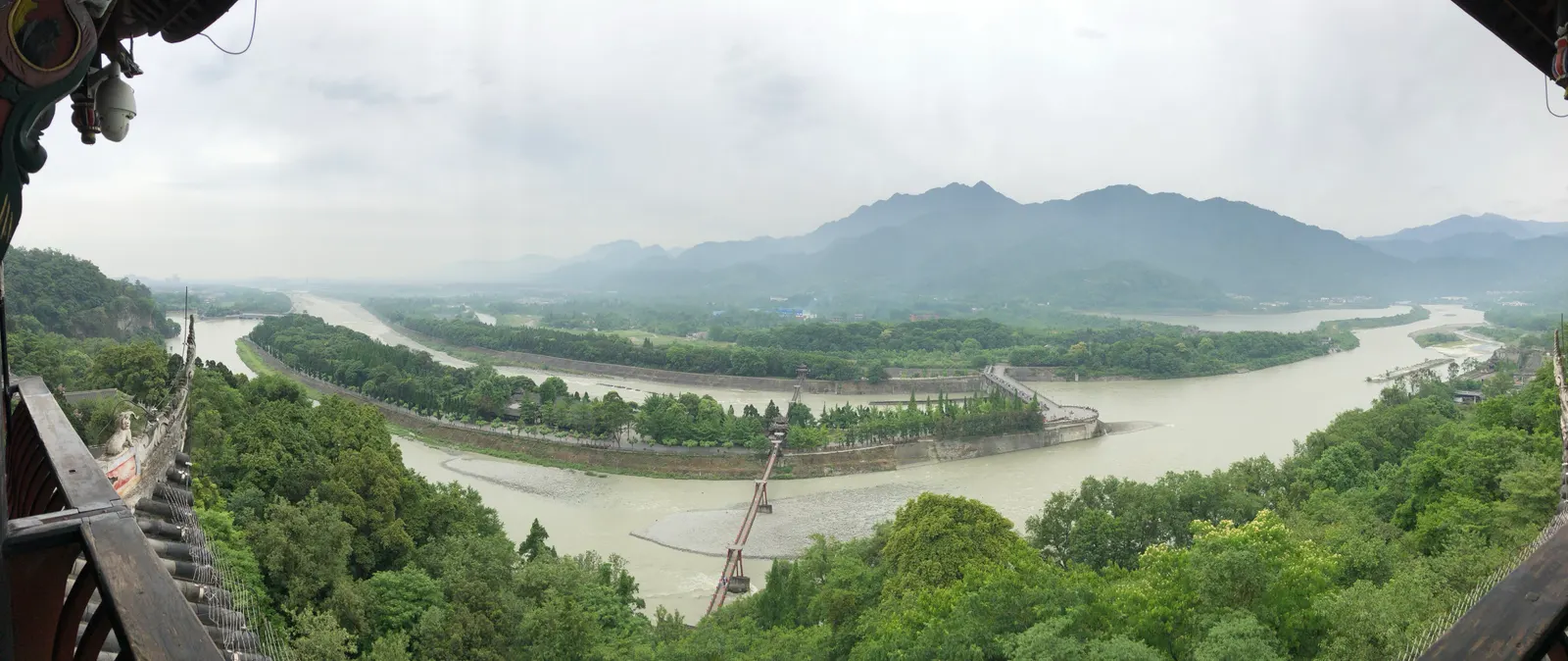
Dujiangyan Irrigation System (都江堰景区), Dujiangyan City
都江堰景区 · Dūjiāngyàn Qǐngqū
Quick answer
Entry is real-name and timed for everybody, and the scenic area publishes an explicit procedure for foreign documents. Book online with your ID details and scan the same document at the gate — one document per person. Hong Kong, Macau and Taiwan visitors buy with their travel permit number and enter through the manual channel. Foreign visitors choose passport or foreigner residence permit when booking and also enter through the manual channel; you can instead go to the on-site ticket window and show the document there. Children aged 6 or under, or 1.3 m and under, enter free — that includes Hong Kong, Macau and Taiwan children and foreign children — but must be accompanied and supervised by an adult.
Why visit
- 1 The oldest surviving and the only still-running large-scale damless irrigation system in the world, begun by Li Bing, the Qin governor of the Shu commandery, and his son in the third century BC
- 2 Part of the UNESCO World Heritage property "Mount Qingcheng-Dujiangyan" since 2000, and on the World Irrigation Engineering Heritage list in its own right since 2018 — two separate lists, two separate honours
- 3 Three structures doing the whole job: the Fish Mouth dike that divides the Min River, the Flying Sand spillway that throws silt back, and the Bottle-Neck intake that feeds the plain
- 4 The area it actually irrigates is about 13.3 million mu (1,330 万亩), and it is still dredged every winter under a rule written down in the third century BC
- 5 The rare page on this site with an officially published entry procedure for foreign passports, Hong Kong, Macau and Taiwan travellers, down to which gate to use
Essential tips for foreigners
- Book online with a real-name reservation before you go. Everybody needs it, up to 15 days ahead, and entry is split into four windows: 08:00-10:00, 10:00-12:00, 12:00-14:00 and 14:00-17:30.
- Foreign passport? Use the manual channel. Book under passport or foreigner residence permit and go to the manual gate. If you did not book, the on-site ticket window will issue the ticket against your document. Bring the same document you booked with — one document, one person.
- Buy the ticket from a published channel only. The official WeChat accounts 青城山都江堰 and 悦游都江堰, and the authorised platforms Meituan and Ctrip. The scenic area warns that tickets bought through channels it has not published can mean no entry and no refund, and that you should not listen to the touts outside the gate.
- The ¥80 is entry to the Dujiangyan Scenic Area and nothing else. The sightseeing bus, the escalator and the commentary are separate; hire a guide at the visitor centre if you want one. Mount Qingcheng is a separate scenic area with a separate ticket — this is not a joint ticket.
- The clock is tighter than it looks in the off-season. From 1 November to 1 March the last ticket check is 17:30, same-day tickets stop at 17:00 and the last exit is 19:30.
- Allow three to four hours, and watch the cap. The daily limit is 48,000 and entry is suspended at 43,000, so a late start on a busy weekend can run into the limit.
Dujiangyan (都江堰) has been diverting the Min River onto the Chengdu Plain since the third century BC, and it still does. The Dujiangyan Scenic Area (都江堰景区) sits on the west side of Dujiangyan city (都江堰市), administered by Chengdu. Inside it is the oldest surviving and the only one still running on a large scale: a damless diversion water conservancy project.
Li Bing, the Qin governor of the Shu commandery, and his son began the works in the Warring States period, roughly 256 to 251 BC. In 2000 “Mount Qingcheng-Dujiangyan” was inscribed on the World Heritage List (UNESCO criteria ii, iv and vi); in 2018 the works were inscribed on the World Irrigation Engineering Heritage list.
The ticket is ¥80, everybody books online under a real-name reservation, and the scenic area’s own figure for a visit is 3-4 hours.
What is Dujiangyan famous for?
For the works themselves, and for the fact that they still do the job they were built to do: the Min River brings down more water than the plain can use, and carries a great deal of silt, so the solution at the gorge’s outlet was to divide the river, not dam it.
| Structure | What it does | Published size |
|---|---|---|
| 鱼嘴 Fish Mouth dike | Splits the Min River into the inner river and the outer river | — |
| 飞沙堰 Flying Sand spillway | Throws silt back into the outer river | more than 200 m wide |
| 宝瓶口 Bottle-Neck intake | The main intake into the channel network | more than 20 m wide |
| Supporting works | 百丈堤 Baizhang dike, 二王庙 Erwang Temple waterway, 人字堤 Renji dike | — |
The hub sits at 726 m above sea level, and the area it actually irrigates is about 13.3 million mu (1,330 万亩). Around the works: 伏龙观 Fulong View, the 二王庙 Erwang Temple for Li Bing and his son, and the 安澜索桥 Anlan suspension bridge.
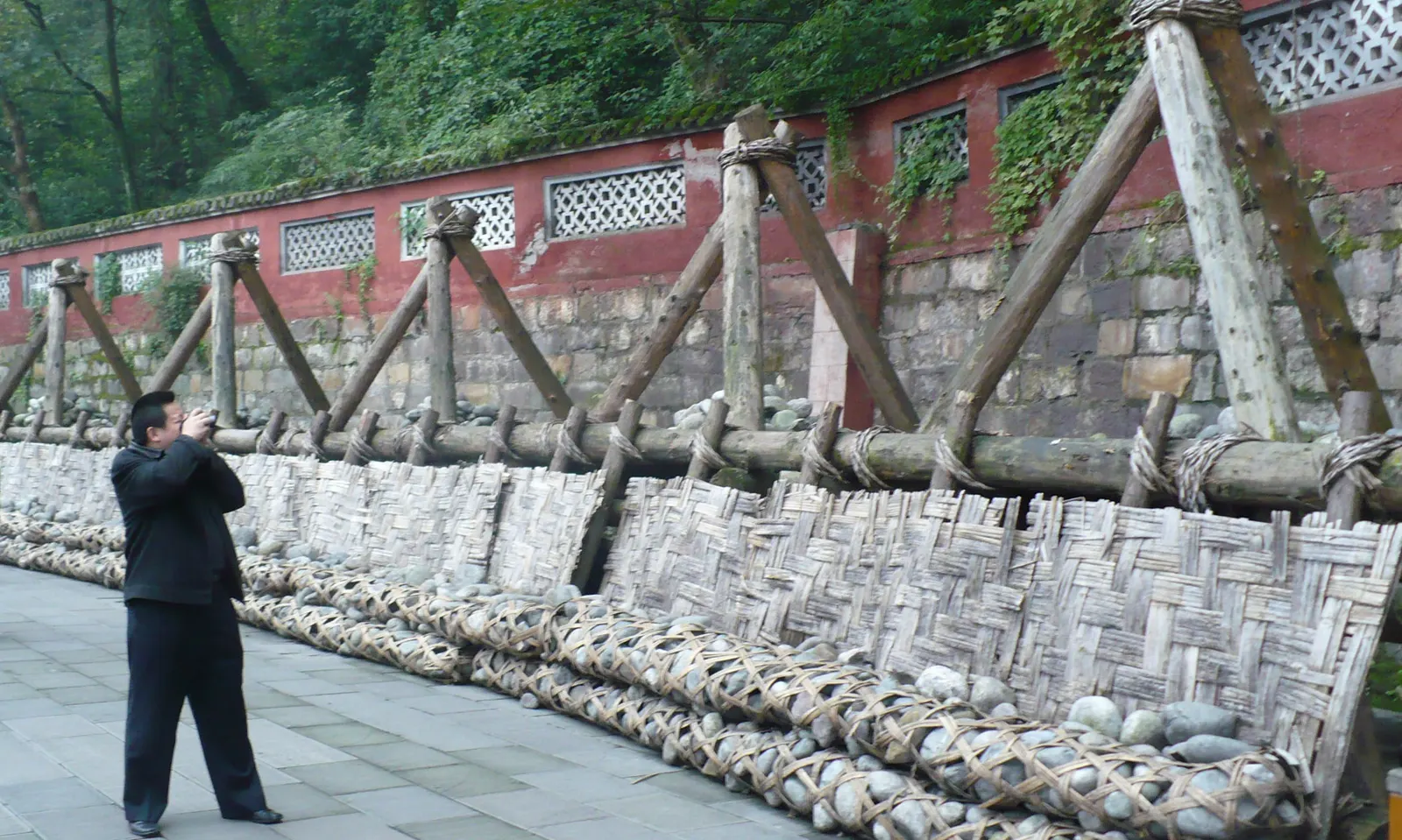
The Fish Mouth is not a dam — the river is simply divided, with no wall across it. Photo: Wikimedia Commons / CC BY-SA 3.0 — Colin W. Source
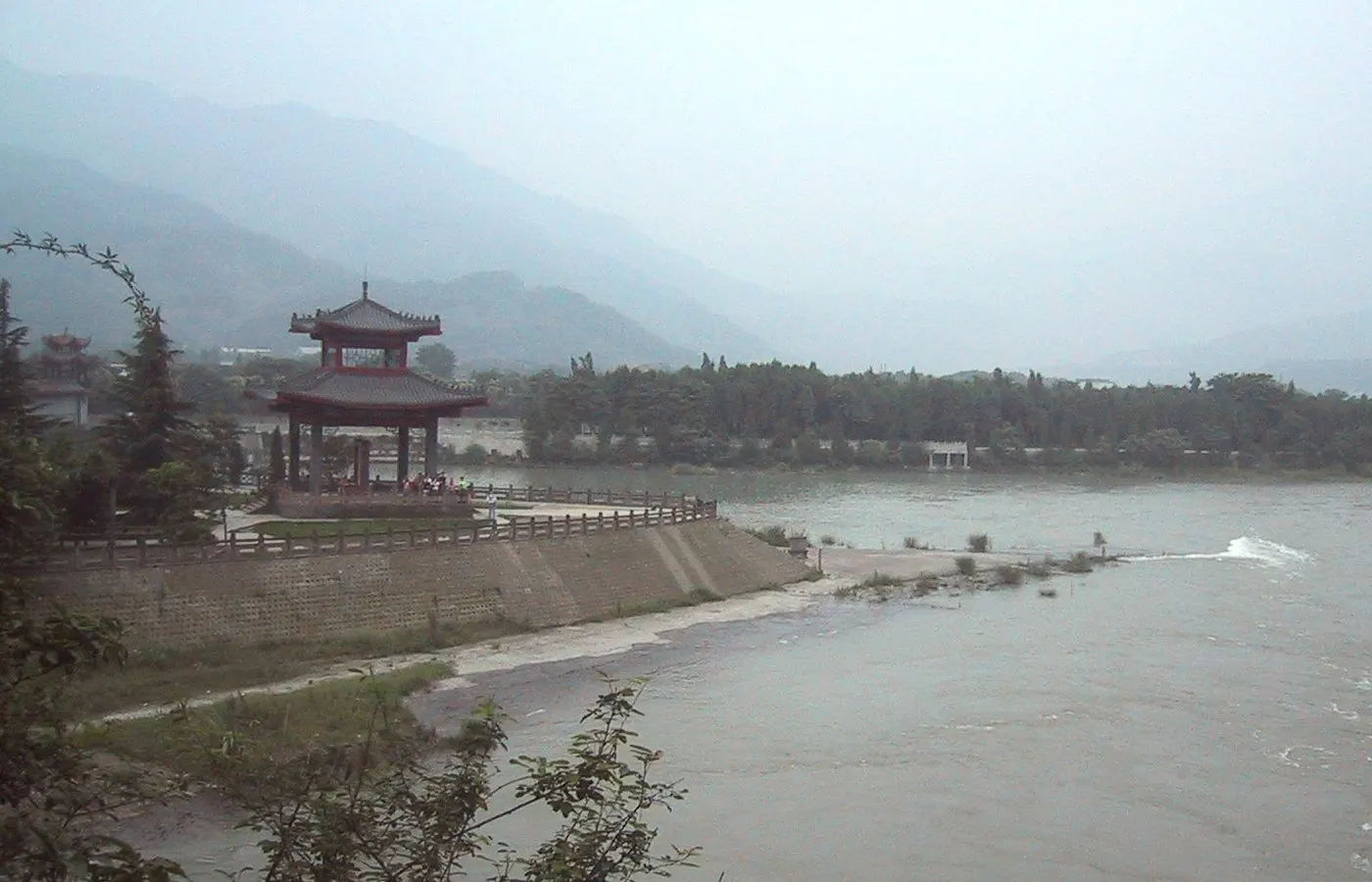
The Flying Sand spillway, which throws excess silt back into the outer river. Photo: Wikimedia Commons / CC BY-SA 3.0 — Gjl at English Wikipedia. Source
How does the Dujiangyan irrigation system work?
Three structures in sequence, then a channel network. The design stores nothing: the river is used as it is found.
- The Fish Mouth sits in the river and divides the flow — the inner river carries water towards the plain, the outer river carries it away.
- The Flying Sand spillway is downstream of that split. Surplus water spills over it, and the bend throws the heavier silt back to the outer river.
- The Bottle-Neck is the intake, the narrow throat feeding the channel network onto the plain.
This is a maintained system, not a monument: the builders’ rule — “深淘滩、低作堰”, dig the riverbed deep, build the weir low — still holds, and every winter the channels are dredged and the weir repaired.
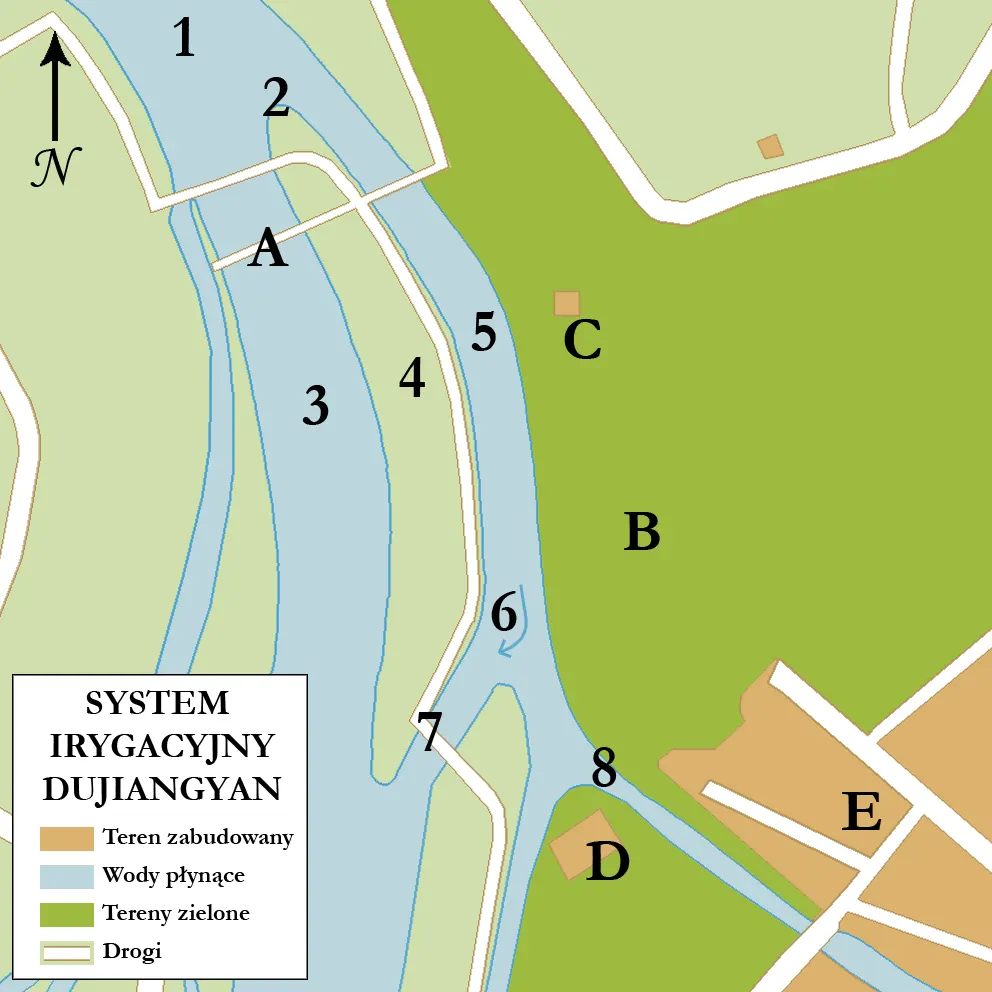
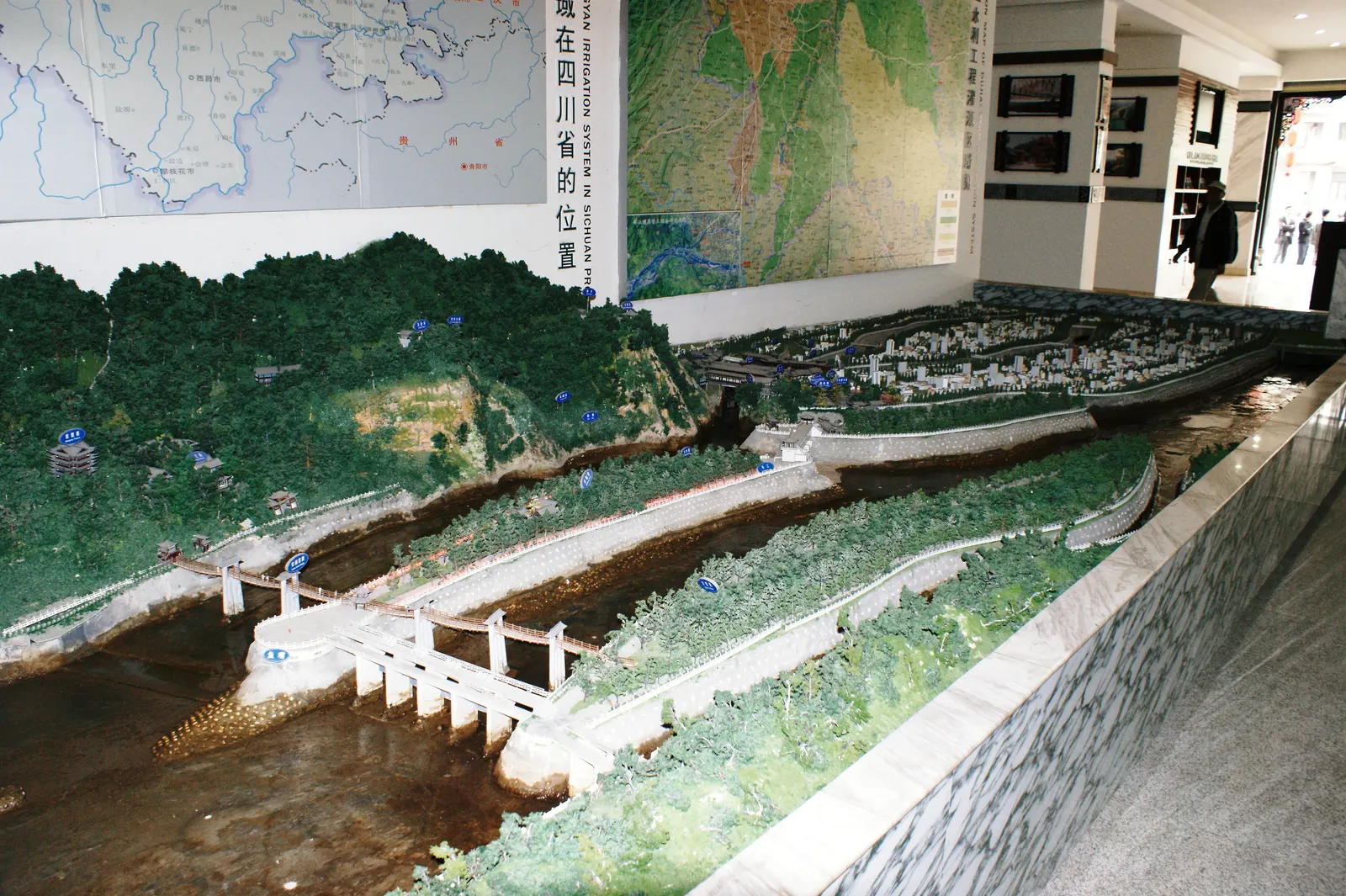
How the three main structures fit together — Fish Mouth, Flying Sand and Bottle-Neck. Photo: Wikimedia Commons / CC BY-SA 4.0 — X ziomal X. Source
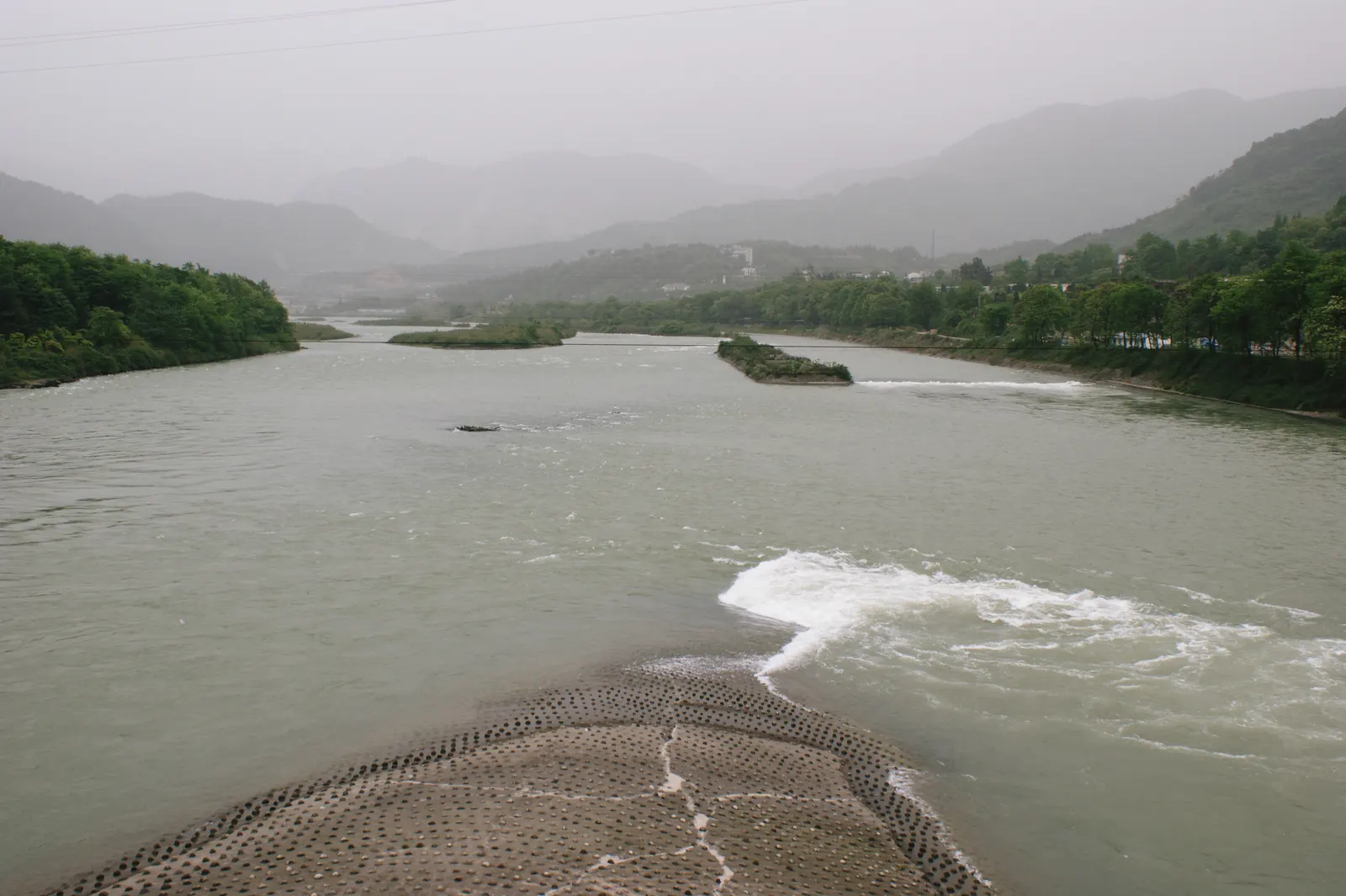
The Bottle-Neck channel, with the iron bar that measures the flow into the plain. Photo: Wikimedia Commons / CC BY-SA 2.0 — Hugh Llewelyn from Keynsham, UK. Source
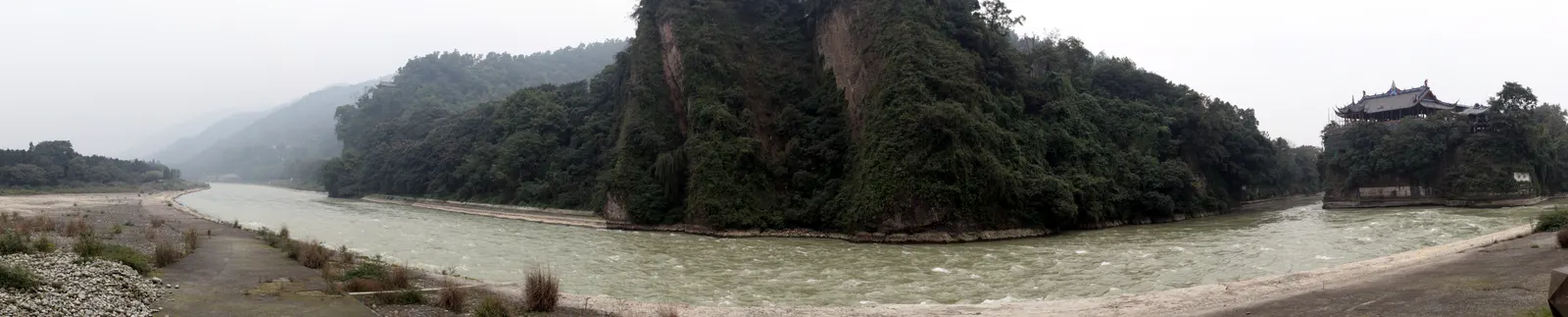
The inner river, the channel that carries water to the plain. Photo: Wikimedia Commons / CC BY-SA 3.0 — Mlogic. Source
How many years to build Dujiangyan irrigation system?
No build duration is published. The official record gives a window instead: Li Bing and his son began the works in the Warring States period, about 256 to 251 BC — on that reckoning, roughly five years.
That figure is also the least interesting number on the site: the works have been dredged and repaired every winter since.
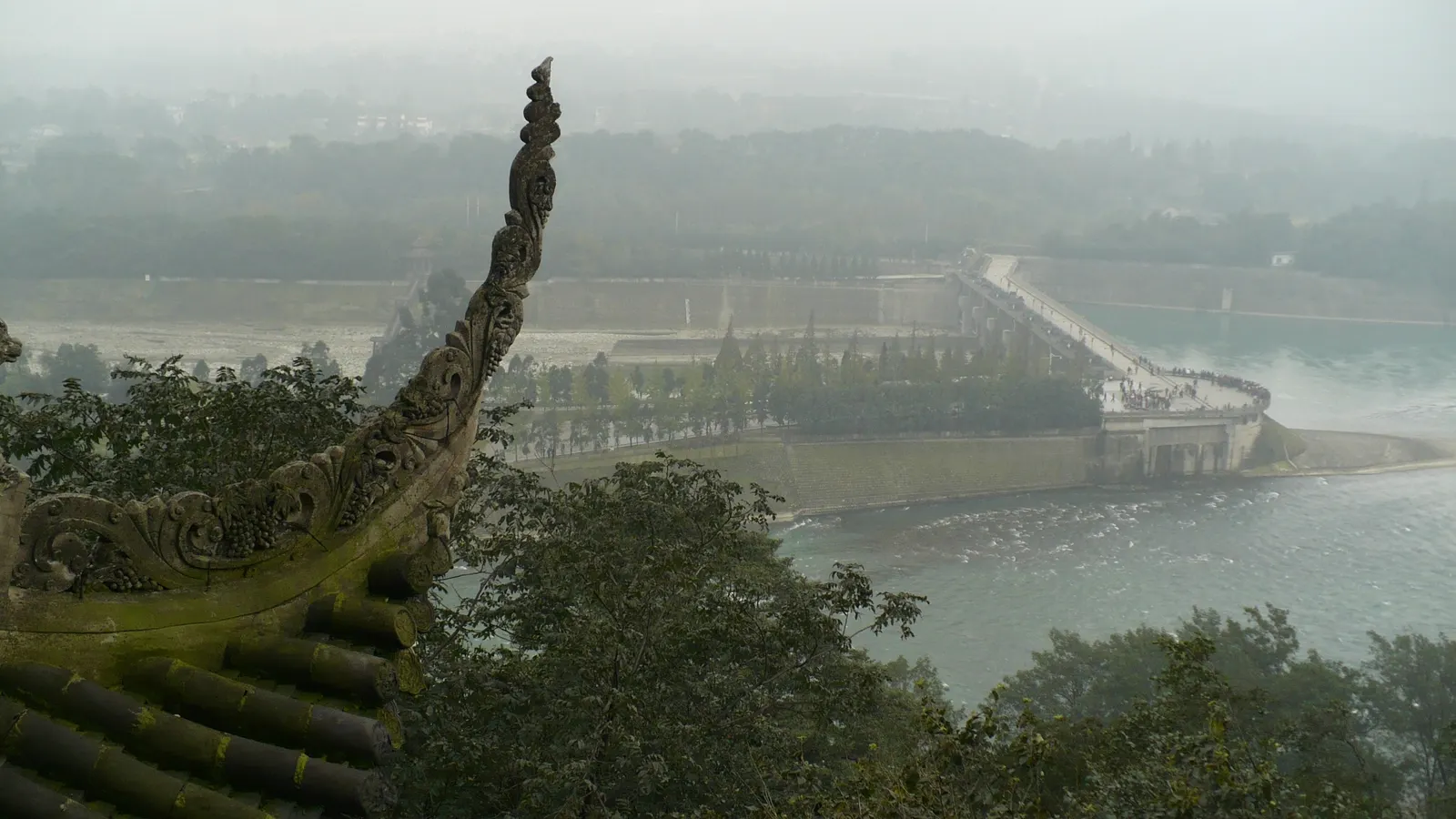
The carved hand at Dujiangyan, a tribute to Li Bing, the governor who built the system. Photo: Wikimedia Commons / CC BY-SA 3.0 — Colin W. Source
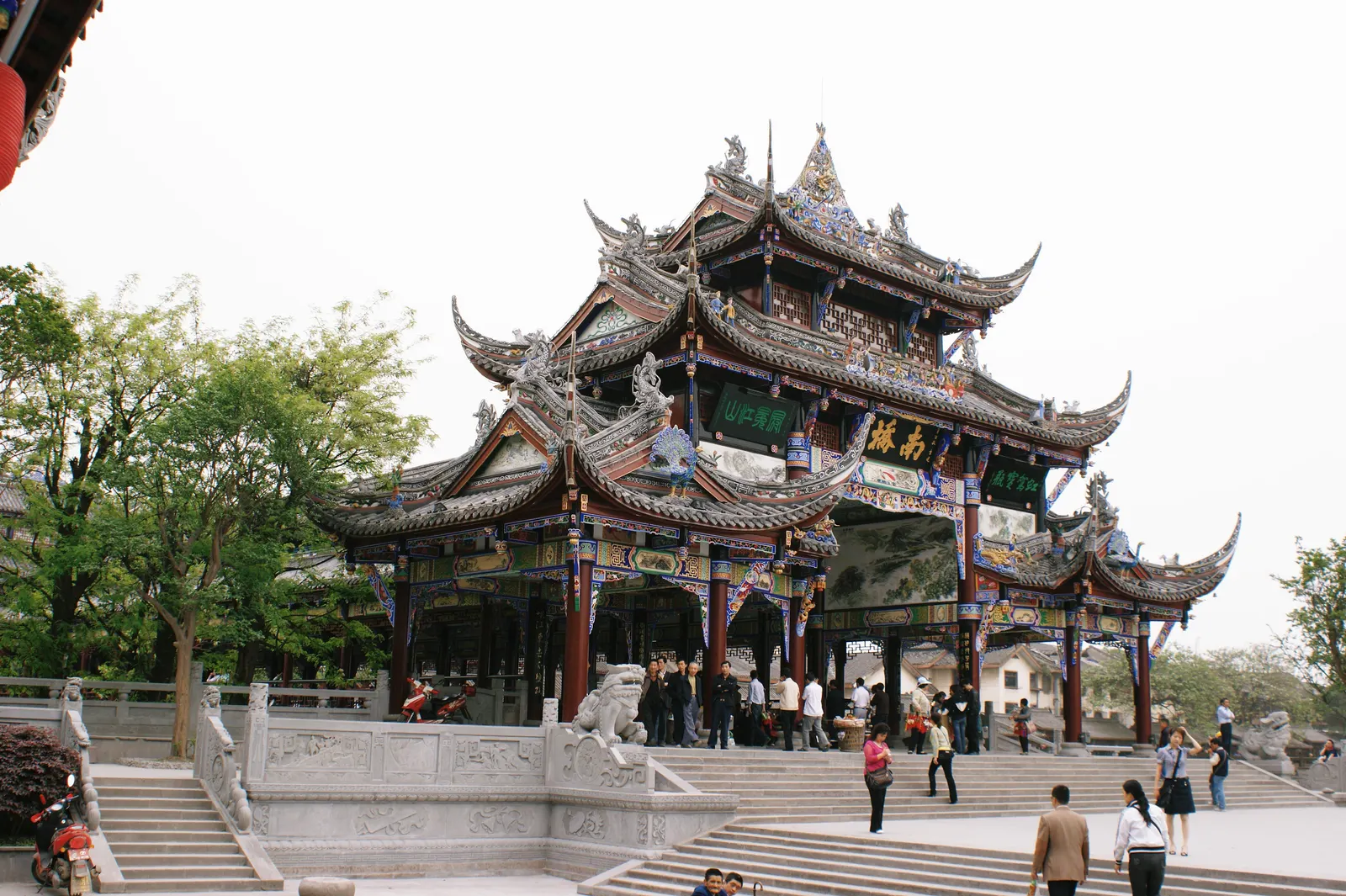
The Erwang Temple, built for Li Bing and his son, on the Yulei Mountain ridge. Photo: Wikimedia Commons / CC BY-SA 2.0 — Hugh Llewelyn from Keynsham, UK. Source
How many hours in Dujiangyan irrigation system?
Three to four hours — the scenic area’s own figure, not ours. The site is a walking route along the river: the three main structures, the Anlan suspension bridge, the Erwang Temple. The tour map numbers the sights in walking order.
The bus and the escalator are not in the ¥80, and the commentator is arranged at the visitor centre, not at the gate.
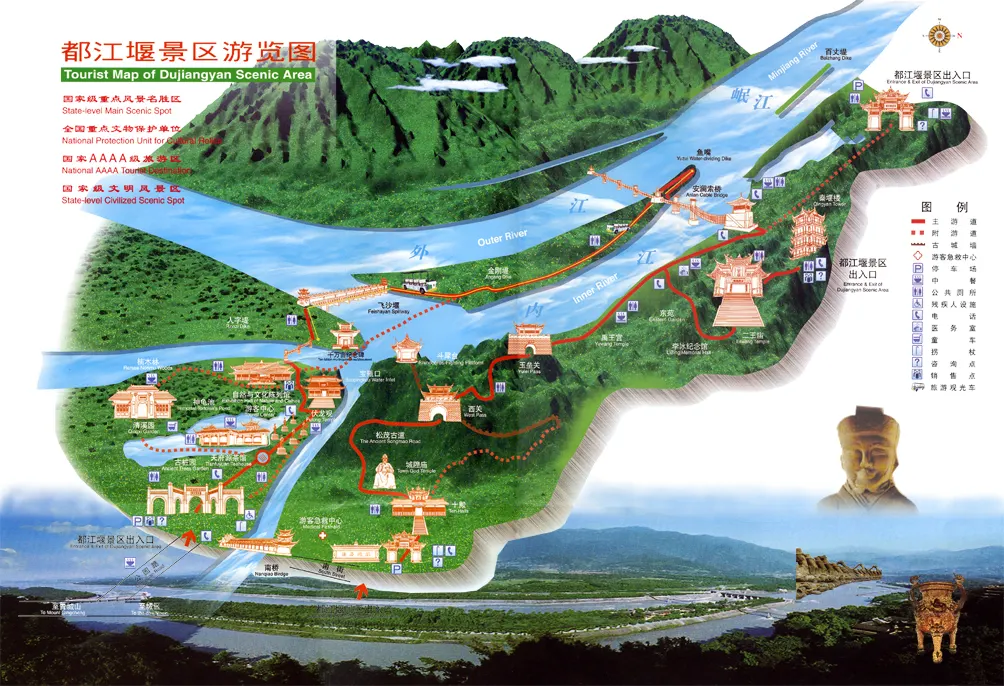
The scenic area tour map, with the sights numbered in walking order. Photo: Wikimedia Commons / CC BY-SA 4.0 — Ihtc2015. Source
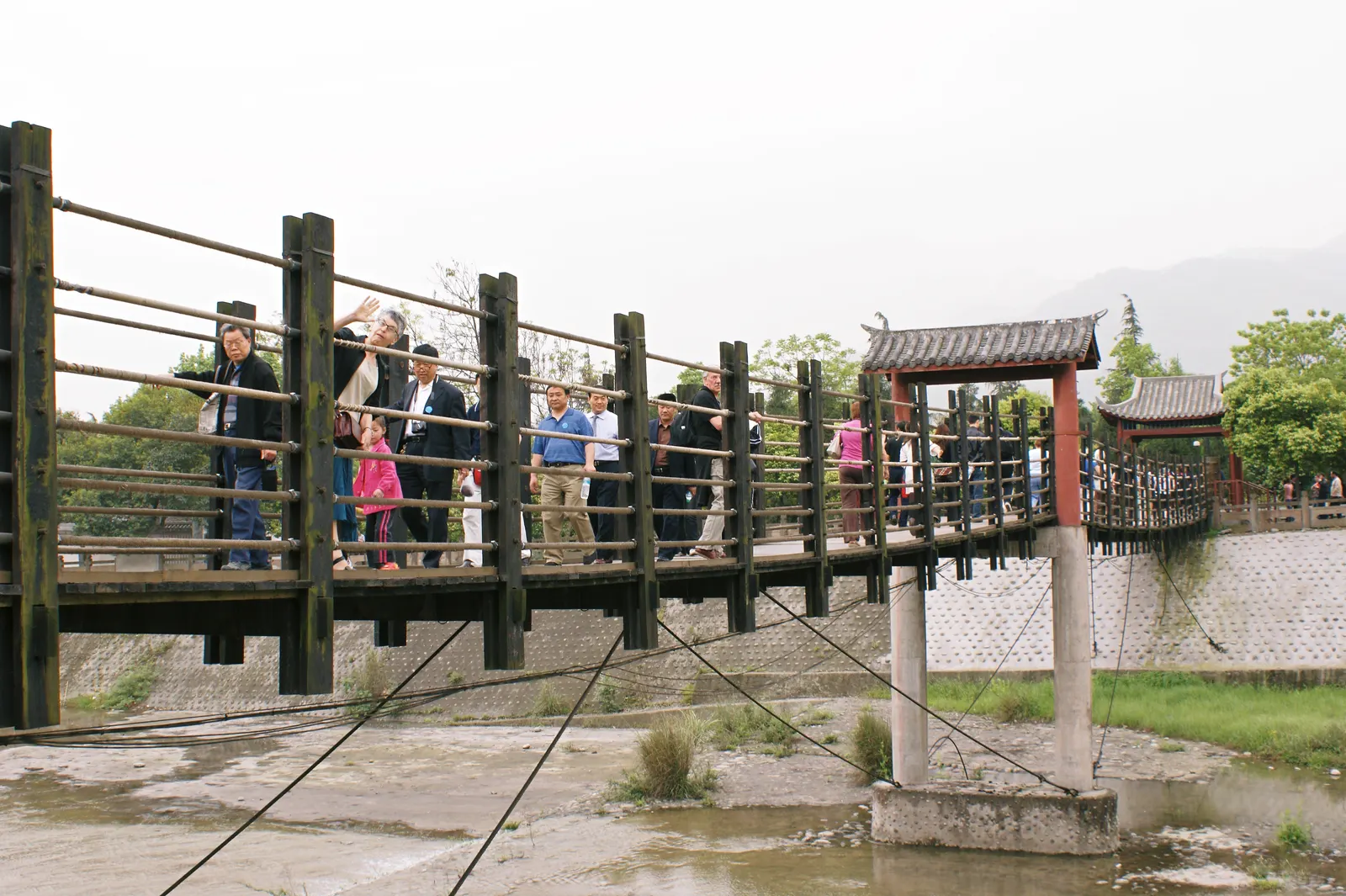
Crossing the inner river on the Anlan bridge. Photo: Wikimedia Commons / CC BY-SA 2.0 — Hugh Llewelyn from Keynsham, UK. Source
How to get to Dujiangyan irrigation system from Chengdu?
About an hour from central Chengdu. The scenic area sits on the west side of Dujiangyan city, where the Min River leaves the mountains.
| From central Chengdu | About an hour by road |
| By car | P2 and P3 car parks, or 南桥坊 No. 1 and No. 2 — 5-10 minutes’ walk to the scenic area |
We are not going to print a public-transport route we have not checked against the scenic area’s own channels; 028-96526 has the current arrangements.
Is Dujiangyan a day trip from Chengdu?
Yes, and this is the standard Chengdu day trip: about an hour there, 3-4 hours for the visit — a day with a car in it, not an evening errand.
- Book the slot before you go. Entry runs in four windows from 08:00 to 17:30, the daily cap is 48,000, and entry is suspended at 43,000.
- Do not add an evening to it. In the off-season the last ticket check is 17:30, same-day tickets stop at 17:00, and the last exit is 19:30.
- Do not add Mount Qingcheng to it. The Front Mountain is a separate scenic area with its own ticket and hours; the ¥80 here is not a joint ticket.
Is the Dujiangyan Irrigation System worth visiting?
Yes — with one expectation set in advance. This is a working engineering site, not a scenic showpiece: you walk a river crossed by dikes, with two temples and a bridge above.
The case for it is unusual: it is the oldest surviving and the only still-running large-scale damless irrigation system in the world, part of a UNESCO World Heritage property, irrigating about 13.3 million mu.
The caveat is that the parts that look like ruins are mostly not ruins — they are maintained structures.
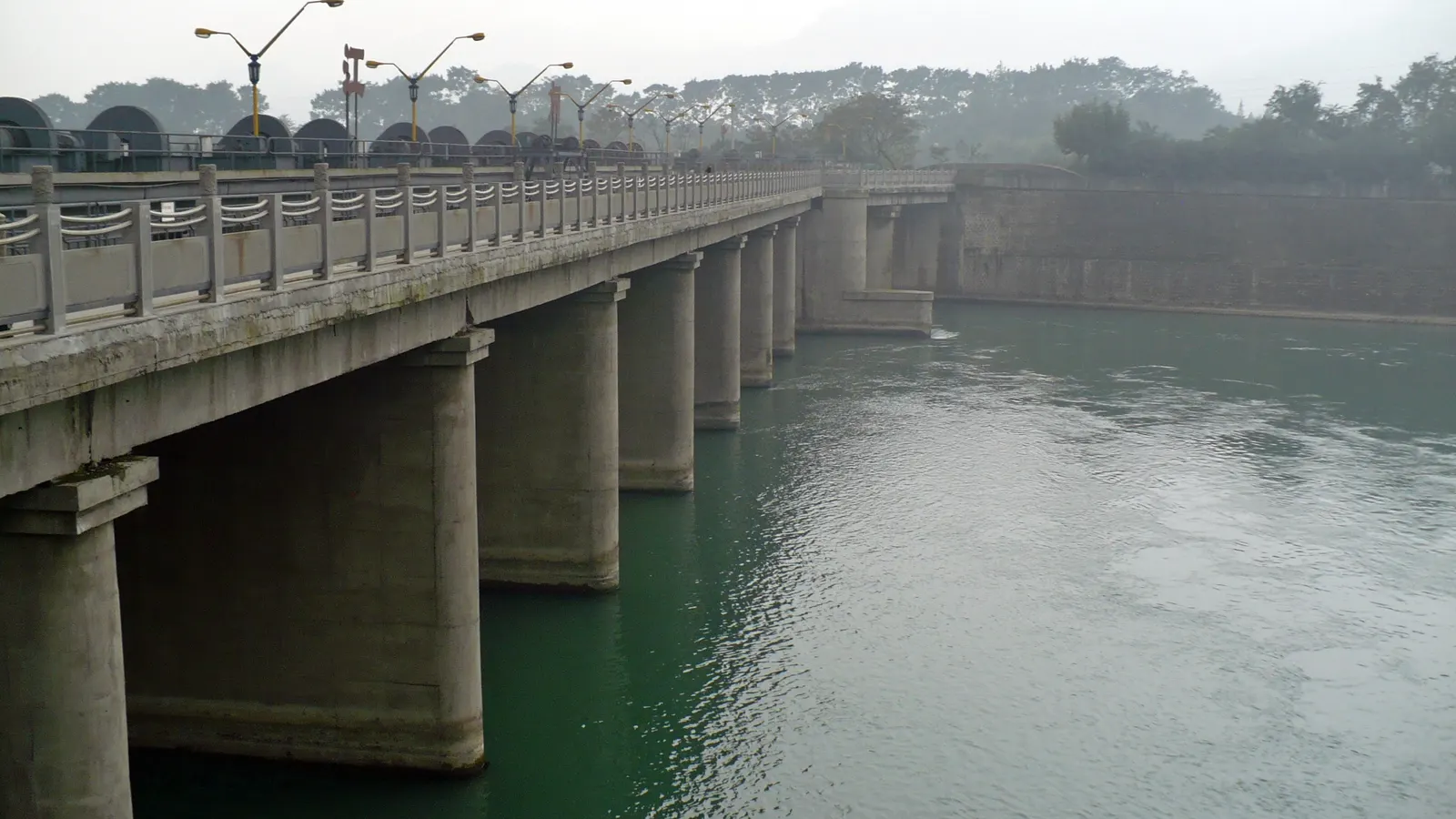
Water and sediment spilling over the Flying Sand weir during high flow. Photo: Wikimedia Commons / CC BY-SA 2.0 — Hugh Llewelyn from Keynsham, UK. Source
The Anlan suspension bridge, the easiest way to walk to Yulei Mountain. Photo: Wikimedia Commons / CC BY-SA 3.0 — Colin W. Source
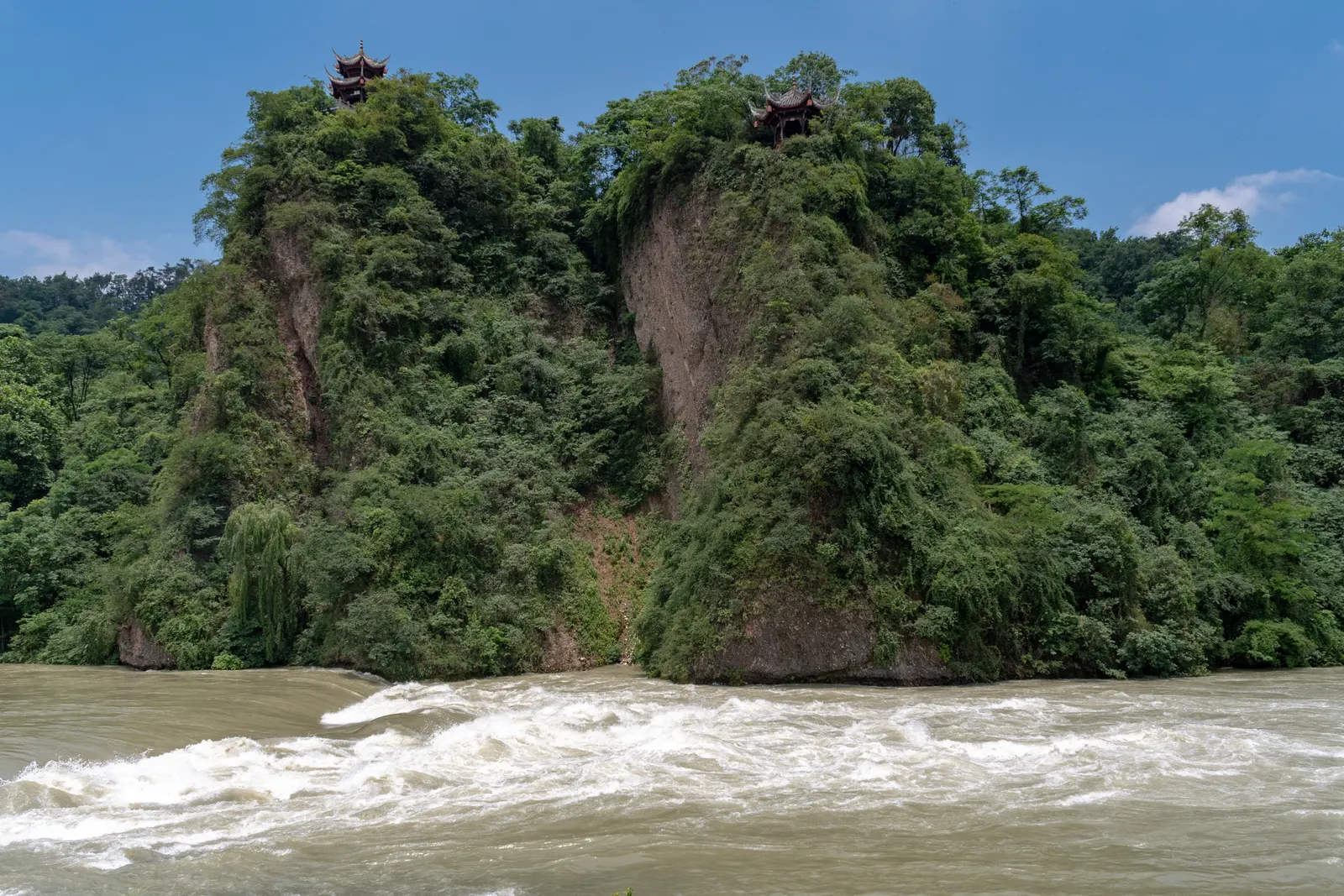
The river channel through the scenic area below Yulei Mountain. Photo: Wikimedia Commons / CC BY 2.0 — xiquinhosilva. Source
Tickets, opening hours and the booking rules
| Ticket | ¥80, Dujiangyan Scenic Area — entry only; the sightseeing bus, cableway, escalator and guided commentary are separate |
| Sightseeing bus (Stele Pavilion - Fish Mouth) | ¥10 one way, ¥15 return; under 1.3 m free; summer 08:30-18:00, winter 09:00-17:30 |
| Buyunlang escalator | ¥40 return, ¥20 one way; 1.3 m and under free; summer 08:00-18:00, winter 08:00-17:30 |
| Peak season (2 March - 31 October) | Ticket checks 08:00-18:00; same-day tickets stop 17:30; last exit 20:00 |
| Off-peak (1 November - 1 March) | Ticket checks 08:00-17:30; same-day tickets stop 17:00; last exit 19:30 |
| Free entry | Children 6 or under, or 1.3 m and under |
| Booking | |
|---|---|
| Entry windows | 08:00-10:00 / 10:00-12:00 / 12:00-14:00 / 14:00-17:30 |
| Daily cap | 48,000; entry suspended at 43,000 |
| Official channels | WeChat 青城山都江堰 and 悦游都江堰; Meituan and Ctrip |
| Night tour 都江·夜堰 | Official mini-programme, Douyin, Ctrip, Meituan, the two WeChat accounts; 028-68181696, 13:00-22:30 |
Buy the ticket from a published channel only. The scenic area’s own warning: a ticket bought through a channel it has not published may not let you in and may not be refundable, and you should not listen to touts outside the gate.
Foreign visitors, Hong Kong, Macau and Taiwan travellers
The scenic area publishes an explicit procedure for foreign documents, so here it is in full.
- Booking is real-name and one document per person. Buy the ticket with your ID details, then scan the same document at the gate.
- Hong Kong, Macau and Taiwan visitors buy with the number of their travel permit and enter through the manual channel.
- Foreign visitors choose passport or foreigner residence permit when they book, and also enter through the manual channel. If you did not book online, go to the on-site ticket window and show the document there.
- Children aged 6 or under, or 1.3 m and under, enter free — including Hong Kong, Macau and Taiwan and foreign children — but must be accompanied and supervised by an adult.
Everybody, foreign or domestic, needs the timed real-name reservation, and the booking window opens 15 days ahead. If the documents are unclear, call 028-96526.
Where this fits
Dujiangyan is the half-day half of a Chengdu trip. It pairs with Mount Qingcheng as the same city and the same UNESCO property, though the two are separate scenic areas with separate tickets.
In the city, the closest pairings are the panda base and the old streets: Chengdu Research Base of Giant Panda Breeding, Jinli and Wuhou Shrine. Our Chengdu page covers the city itself; the Leshan and the Buddha day-trip guide and the night markets and food guide cover the rest.
Also nearby
- Mount Qingcheng (青城山) — the Taoist mountain in the same city, with its own ticket.
- Wuhou Shrine (武侯祠) — Three Kingdoms history in the city centre.
- Chengdu Research Base of Giant Panda Breeding — the other standard day out from Chengdu.
Best photo spots
-
The Bottle-Neck channel, looking back up the gorge
The intake itself, with the mountains behind it — the view that makes the engineering legible, because you can see the river arriving and being narrowed.
-
The Fish Mouth dike
The point where the Min River is split. Standing on it is the clearest proof that there is no dam here: the stonework divides the flow rather than blocking it.
-
The Anlan suspension bridge
The footbridge over the inner river and the classic frame for the works. It also puts you in the middle of the river that the whole system exists to manage.
Frequently asked questions
What is Dujiangyan famous for?
For the oldest surviving and the only still-running large-scale damless irrigation system in the world. Three structures do the work: the Fish Mouth dike, which splits the Min River into the inner river and the outer river; the Flying Sand spillway, which uses a bend to throw silt back; and the Bottle-Neck intake, which feeds the plain. Begun by Li Bing and his son around 256-251 BC, it is part of the UNESCO World Heritage property "Mount Qingcheng-Dujiangyan" since 2000, and the area it actually irrigates is about 13.3 million mu.
How does the Dujiangyan irrigation system work?
Without a dam or a reservoir. The Fish Mouth splits the Min River in two; the Flying Sand spillway downstream lets surplus water over and, thanks to the shape of the bend, throws the heavier silt back into the outer river; the Bottle-Neck draws the water you want into the channel network. What makes it durable is the maintenance rule the builders wrote down — "deep-dig the riverbed, build the weir low" — and the channels are still dredged every winter in the low-water season.
How many years to build Dujiangyan irrigation system?
No build duration is published. The official record gives a window instead: Li Bing, the Qin governor of the Shu commandery, and his son began the works in the Warring States period, about 256 to 251 BC — on that reckoning, roughly five years. The more useful point is that construction was never the whole story: the works have been dredged and repaired continuously ever since, every winter in the low-water season.
How many hours in Dujiangyan irrigation system?
Three to four hours — the scenic area's own figure for a normal visit. It is a walking route along the river past the three main structures, the Anlan suspension bridge and the Erwang Temple. The sightseeing bus (¥10 one way, ¥15 return) and the Buyunlang escalator (¥20 one way, ¥40 return) are paid separately and can cut the walking if you want them to.
How to get to Dujiangyan irrigation system from Chengdu?
About an hour from central Chengdu. Dujiangyan is a county-level city administered by Chengdu and the scenic area sits on its west side, where the Min River leaves the mountains. If you drive, park at P2 or P3, or at the 南桥坊 No. 1 and No. 2 car parks, and walk the last 5-10 minutes. For current transport arrangements on the day you travel, the city tourism line is 028-96526.
Is Dujiangyan a day trip from Chengdu?
Yes — it is the standard Chengdu day trip, and two published numbers set its shape: about an hour to get there and 3-4 hours for the visit. Book an entry slot (four windows from 08:00 to 17:30, up to 15 days ahead) and go early; the daily cap is 48,000 with entry suspended at 43,000. Mount Qingcheng's Front Mountain is a separate scenic area with its own ticket and hours, so the ¥80 here is not a joint ticket.
Is the Dujiangyan Irrigation System worth visiting?
Yes, with one expectation set: this is a working engineering site, not a scenic showpiece. You walk a river crossed by dikes, with two temples and a suspension bridge on the ridge above, and the reward is that the machine still in front of you is the one built in the third century BC. If you want a viewpoint, spend the day elsewhere; if you want to stand in front of something that has been diverting a river for over two millennia without a dam in sight, it is worth the ¥80.
Sources
- 国家文物局 (State Administration of Cultural Heritage) — 都江堰:始建年代、世界遗产名录、工程主体、尺寸、实灌面积 · Government of the PRC
- 宁夏水利厅 (Ningxia Water Resources Department) — 都江堰:工程性质、无坝引水、岁修制度、古迹、2018 年世界灌溉工程遗产 · Government of the PRC
- 四川发布 — 都江堰景区外籍及港澳台游客购票与检票入园流程 · scpublic.cn
- 景区官方公众号「青城山都江堰」「悦游都江堰」中秋提示(转载) — 都江堰景区门票、旺季与淡季检票时间、游览时长 · c.m.163.com
- Wikidata Q824157 — Dujiangyan Irrigation System coordinates (P625, precision 0.000028°) · Wikidata
Related guides
Attractions
Mount Qingcheng
Attractions
Jinli Ancient Street, Chengdu
Attractions
Wuhou Shrine (Temple of Marquis Wu), Chengdu
Attractions
Chengdu Research Base of Giant Panda Breeding
Rescue card
🆘 Ask How To Get There
Rescue card
🆘 Ask Is That Place Far From Here
Rescue card
🆘 Ask How Much Is This




