
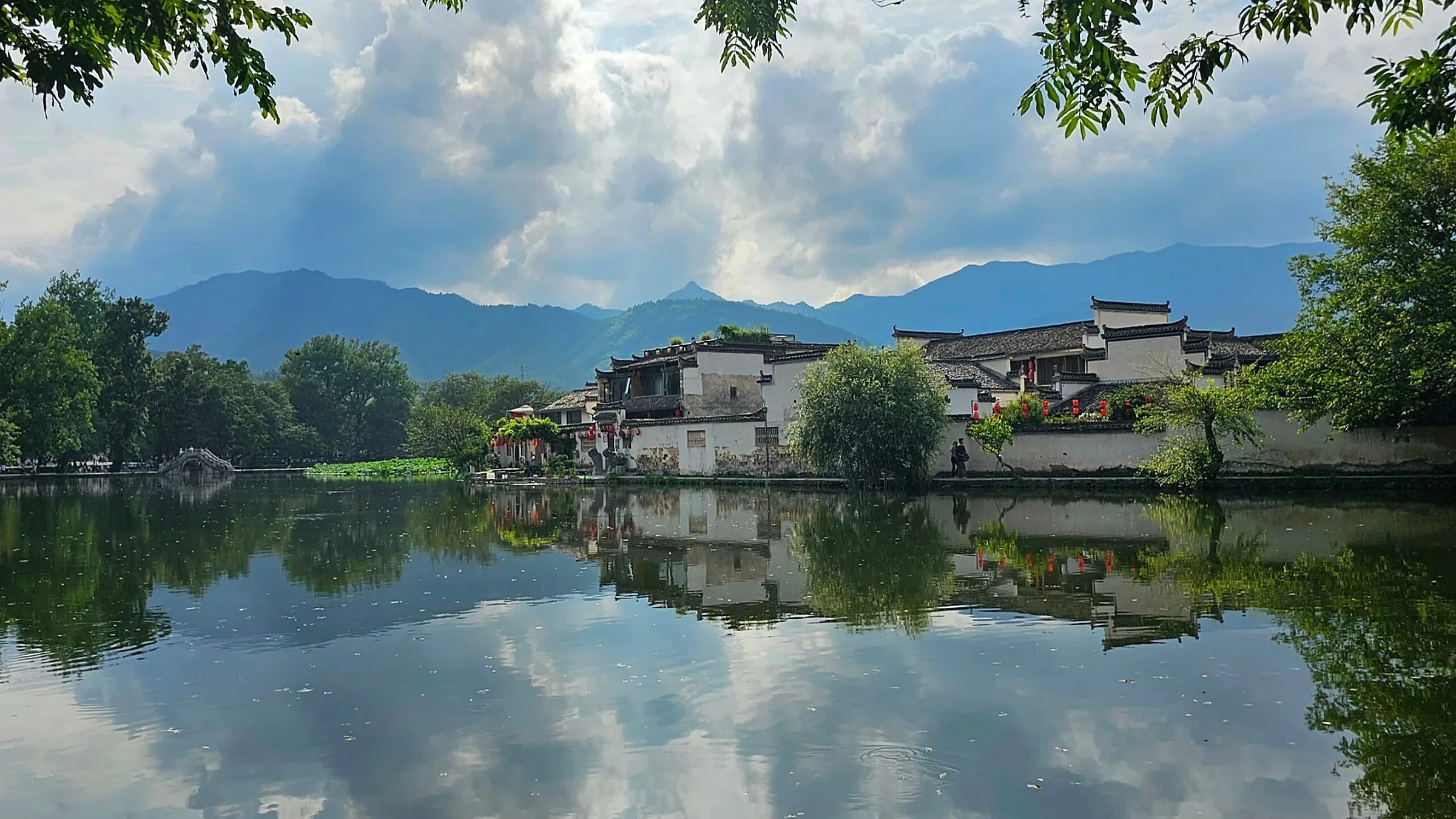
Hongcun Ancient Village
宏村 · Hóngcūn
Quick answer
Carry your passport: the ticket category you are charged depends on it, and there is no national ID alternative for a foreign visitor. Two practical things have changed for foreigners recently and are worth knowing. Foreigners were once barred from sleeping inside the village and had to use a government-run hotel outside it; since September 2019 foreigners are allowed to stay at hotels within the village. And the village is a real settlement, not a film set, so people still live here - the fish drying on the front walls and the washing on the canals are domestic life, not decoration for tourists.
Why visit
- 1 A UNESCO World Heritage Site since 2000, inscribed jointly with Xidi as the Ancient Villages in Southern Anhui under criteria iii, iv and v
- 2 The entire village plan is said to read as an ox: Leigang Hill is the head, two trees the horns, four bridges the legs, the canal system the intestines, the Moon Pond the stomach and the South Lake the abdomen
- 3 A water system about four centuries old that carries spring water from the hillside behind the village past the front yard of every house
- 4 Chengzhi Hall (承志堂), built by a salt merchant and called the Folk Imperial Palace, with more than sixty rooms and gilded carvings of nature, myth and Qing-daily life
- 5 Crouching Tiger, Hidden Dragon filmed on location, which is why so many visitors arrive already knowing what the village looks like
- 6 Rated a national AAAAA tourist site in 2011 and named in the first batch of traditional Chinese villages in 2012
Essential tips for foreigners
- Go early. The lanes themselves are open all day, but the ticketed halls inside the village stop taking visitors in the late afternoon, and those halls are the reason most people come.
- Buy the village ticket once and keep it. It is checked when you leave and again when you come back, so a single purchase covers a whole day of coming and going.
- Stay inside the village if you can. Foreigners were excluded from village accommodation until September 2019; they are now allowed to use the in-village hotels, which puts you in the lanes before and after the day-trippers have left.
- Eat outside the village gates if you are on a budget. Restaurants inside charge tourist prices and will push a local fish dish that is not on the menu and costs several times a normal plate. Plain noodles near the south bridge cost a few yuan.
- Do not treat the residents as scenery. This is a village with people in it. The drying fish and the washing on the canals are somebody's daily life.
Suggested route
- 08:00 30 min Arrive at the village entrance early and buy the ¥104 ticket before the coach groups land
- 08:30 30 min Cross the bridge into the village and walk to the Moon Pond (月沼), the small half-moon water at the centre that the ox plan treats as the stomach
- 09:00 45 min Continue to South Lake (南湖), the artificial Ming-dyasty lake shaped like an archer's bow, and cross its long stone bridge
- 09:45 45 min Walk the canal lanes and look at the backs and fronts of the houses; the water runs past the front yard of nearly every one
- 10:30 1 hour Go inside Chengzhi Hall (承志堂) while it is still admitting visitors, and look for the fading slogans on the walls
- 11:30 1 hour Walk the lanes behind the village up towards Leigang Hill, the hill the ox plan treats as the head, and the two trees on it that stand as horns
- 12:30 1 hour Eat outside the village near the south bridge rather than inside it, where the tourist prices and the unlisted fish dishes are
- 14:00 1 hour Walk back through the lanes once more, by which point the coach groups have thinned out
The village that is also a water system
Hongcun is not really a village that happens to have water in it. It is a plumbing scheme that happens to have houses around it. A spring in the hillside behind the village feeds a channel, the channel is divided so that water reaches the front yard of essentially every household, and the ponds at the centre are both the picturesque part and the drainage. That arrangement is roughly four centuries old and it still works.
The village was established in 1131 by Wang Wen, a general of the Southern Song, and it flourished through the Ming and Qing dynasties when its residents, like their neighbours in Xidi, made money in trade. What you walk through now is the accumulated fabric of merchant families who built, and could afford to carve, over several centuries.
In 2000 Hongcun was inscribed together with Xidi as a UNESCO World Heritage Site, listed as the Ancient Villages in Southern Anhui under criteria iii, iv and v. The inscription is about the survival of an urban plan, not just about individual pretty buildings: the street pattern, the water system and the relationship between them have all stayed intact through a period when most Chinese villages were rebuilt.
Photo: Wikimedia Commons / CC BY-SA. Source: stored in this repository as the Hongcun village reference image.
Reading the plan as an ox
The most useful thing anyone will tell you about Hongcun is that the village is laid out to look like an ox, or like the Chinese character for cow. The description is consistent across the sources, and once you have it the plan stops being arbitrary:
- Leigang Hill at the western end is the head.
- Two trees standing on the hill are the horns.
- The village body is the mass of houses.
- Four bridges across the front and back of the village are the legs.
- The canal network running behind the houses is the intestines.
- The Moon Pond (月沼) at the centre is the stomach.
- The South Lake (南湖) is the abdomen.
This is not a marketing invention layered onto a grid. The streams are where the topography put them, and the bridges are where people needed to cross. The symbolic reading was attached later and has stuck.
Two ponds, and they are not interchangeable
Most first-time visitors see one pond and conclude they have seen the village. There are two, and they behave completely differently in a photograph.
The Moon Pond (月沼) is the small half-moon of water near the centre. Because houses enclose it on three sides, what it reflects is architecture rather than sky. It is a tight, inward-looking space and it is the one that appears in most of the older images of the village.
The South Lake (南湖) is the artificial lake built during the Ming dynasty that wraps around the front of the village in the shape of an archer’s bow, with a long stone bridge crossing it. It is open to the sky and it reflects the mountains as well as the roofs. The South Lake Academy sits on the lakeside next to the bridge.
If you have time for one, take the South Lake first: it is the wider view and it establishes the shape of the settlement. Go back to the Moon Pond afterwards, when the light is lower.
Chengzhi Hall and the slogans on the wall
Chengzhi Hall (承志堂) is the largest residence open to visitors and the one with the best story. It was built by a wealthy salt merchant, and the sign at the front calls it the Folk Imperial Palace, a nickname its own builders would probably have approved of. It has nine open roofed courtyards and more than sixty rooms, not all of which open. One supporting beam is deliberately shaped like the character for good fortune. The beams and wall panels carry gilded carvings of natural subjects, Chinese myth and scenes of everyday Qing-dynasty life, which is the reason the hall matters: it is a document of how people lived, not just how rich they were.
It also has a twentieth-century layer. The Red Army quartered in the hall during the Long March, and fading yellow slogans painted by the soldiers are still on the walls. The account worth knowing is that the usual practice when the Red Army encountered art depicting figures from ancient China was to deface it by cutting away the faces. Here that did not happen, and the carvings survived intact. Whether that was deliberate leniency or simply a gap in a hurried occupation is not something the sources settle.
How crowded it is, and when it is not
Hongcun is busier than Xidi, and the pressure is all in the morning. Coaches bring groups from Huangshan city through the middle of the day, and the lanes fill. In the evening they empty. This is the strongest practical argument for staying inside the village rather than day-tripping from Tunxi: if you are sleeping there, you walk the lanes before the coaches arrive and after they leave, and those are the hours when the place is worth walking.
The village is small and essentially flat, so walking is the only way to get around, and the scale means three to four hours covers it comfortably. Getting lost is not really a risk. Every lane eventually returns you to the Moon Pond or the South Lake, and both are impossible to miss.
The thing most visitors get wrong
Hongcun is a village where people live. The fish hanging out to air-dry on the front of a house are not a tourist attraction and are not for sale. The washing on the canal banks is somebody’s washing. The pattern that surprises visitors used to traditional Chinese villages is that the daily life is simply left in view rather than staged or fenced off, and the reaction that usually follows is either discomfort or a much better understanding of the place.
That is also why the food situation is what it is. Eating inside the village is expensive, and you can expect to be strongly recommended a local fish dish that is not on the menu and costs several times a normal plate. Ask for the price before you order. The plain noodle shops just outside the village, near the south bridge, are where the budget version of the same food is, and the flatbread baked in portable drum ovens by older women in the lanes is a few yuan and worth stopping for.
Getting there
By road the village is about 85 km from Tunxi, which is the city you arrive in, and about 11 km from the county seat of Yi County. Buses run from the Huangshan bus station and from the station next to Huangshan North railway station, and there are local services out of Yi County.
We are not quoting bus fares here. The figures published in the English guides for these routes are several years old and the routes change, and a wrong number in a guide is worse than no number. Ask at the station in Tunxi on the day, and buy your ticket at the village entrance when you arrive rather than in advance.
Best photo spots
-
The south bridge at South Lake · Early morning, before the coaches arrive
The classic Hongcun frame: the long stone bridge crossing the Ming-dyasty lake with the white walls and dark roofs behind it and the whole range doubled in the water. Low sun and no crowd both matter here.
-
Moon Pond (月沼) from the lane on the uphill side · Mid-morning
The small half-moon pond at the centre of the ox plan. Because it is enclosed on three sides by house walls it reflects the buildings rather than the sky, and the effect is very different from the open South Lake.
-
The canal lanes behind the houses · Late afternoon to evening, after the coaches leave
The narrow working channels behind the dwellings, where you see the water system as infrastructure rather than as scenery. This is the part of the village most visitors never walk.
-
Leigang Hill above the western end · Late afternoon
The hill the village plan reads as the ox's head, with the two trees on it as horns. Climbing gives the only elevated view back over the roofscape and the pond system.
Frequently asked questions
How much does Hongcun cost?
Village admission is ¥104, and the ticket is valid for several days and is checked each time you enter or leave. Individual houses inside the village may charge a small extra fee of their own, which is not part of the ¥104.
How long do I need at Hongcun?
Half a day is the right unit. The village is small and flat, so three to four hours covers walking the lanes, the Moon Pond, the South Lake and one or two of the open houses without rushing.
What time does Hongcun open and close?
We could not verify a published clock time, so we are not going to quote one. The lanes are walkable at any hour because people live there, but the ticketed houses stop admitting visitors in the late afternoon and the ticket offices close before the lanes do. The posted times are at the gate on the day.
Can foreigners stay inside Hongcun?
Yes, and this is recent. Foreigners used to be required to stay in a government-run hotel outside the village. Since September 2019 they have been allowed to use the hotels inside the village itself.
How do I get to Hongcun from Huangshan city?
By road it is about 85 km from Tunxi. Buses run from the Huangshan bus station and from the station near Huangshan North railway station, and there are also services from Yi County, which is 11 km away. We could not verify current fares, so treat the published coach prices in older guides as out of date and ask at the station.
Is Hongcun or Xidi better?
Hongcun has the water system and the ponds and is the busier, more photographed of the two. Xidi is quieter, has more of the merchant-mansion carving, and has fewer coach groups in the daytime. They are close enough to see both in a long day, and the village guides we checked advise you do not need to if time is short.
Is Hongcun crowded?
During the day, yes. Coach groups arrive from Huangshan city through the morning. In the evening it empties out, and if you stay inside the village you get the lanes to yourself after the coaches have gone, which is the better time to walk them.
What is Chengzhi Hall?
The largest open residence in the village, built by a wealthy salt merchant. Its sign calls it the Folk Imperial Palace. It has nine open roofed courtyards and more than sixty rooms, with gilded carvings of natural subjects, Chinese myth and scenes of Qing-daily life on the beams and wall panels. It is also the one place with a modern layer: the Red Army quartered here during the Long March and the fading slogans they painted are still on the walls.
Sources
- Hongcun — English Wikipedia (established 1131 by the general Wang Wen during the Southern Song, UNESCO inscription with Xidi in 2000 under criteria iii, iv and v, the ox-shaped village plan with Leigang Hill as the head and the Moon Pond and South Lake as internal organs, the 400-year-old waterway linking each household, Crouching Tiger Hidden Dragon filmed on location) · Wikipedia
- Hongcun — Wikidata Q4008 (administrative containment in Hongcun Town, Yi County, Huangshan, Anhui; UNESCO reference 1002; coordinate 30.003611 / 117.981667) · Wikidata
- Hongcun — Wikivoyage (¥104 village admission valid for several days and checked on re-entry, Chengzhi Hall and the Red Army slogans left in it, the ¥104 and the coach-group timing, foreigners barred from village accommodation until September 2019 and allowed in afterwards, distances from Tunxi and Yi County, local food and prices) · Wikivoyage
- Ancient Villages in Southern Anhui - Xidi and Hongcun — UNESCO World Heritage Centre (the joint inscription of the two villages, criteria iii, iv and v) · UNESCO World Heritage Centre
- Hongcun village on OpenStreetMap (village node 8431964966 at 30.0047840 / 117.9847312, inside Hongcun Town, Yi County) · openstreetmap.org

