
Yuantong Temple
圆通寺 · Yuántōng Sì
Quick answer
No passport check and no foreign-passport surcharge. Pay the small ¥6 admission at the entrance, in cash or by Alipay/WeChat Pay. This is an active place of worship, so dress modestly — covered shoulders and knees — and be quiet in the halls. Photography is generally fine in the courtyards; ask before photographing inside the halls or during services.
Why visit
- 1 The largest Buddhist temple inside Kunming's old city walls, and the seat of the Yunnan and Kunming Buddhist associations
- 2 The rare downhill layout — the mountain gate stands high and the main hall sits low, so the whole garden is visible in one view from the entrance
- 3 The octagonal pavilion (八角亭) standing in the release-life pond, reached by white marble arch bridges
- 4 A Buddhist hall ringed by water on three sides — a layout described as unusual in China
- 5 Halls for three different Buddhist traditions — Mahayana, Theravada and Tibetan — under one roof
- 6 About ¥6 and about an hour: cheap, compact, and easy to pair with Green Lake or the city centre
Essential tips for foreigners
- Go early, before 09:00. Tour groups from the city centre arrive through the morning, and the octagonal pavilion and the main hall are far more atmospheric when you have the courtyard more or less to yourself.
- Dress modestly — this is a working temple, not just a monument. Cover shoulders and knees, and take shoes off inside the halls if asked.
- Budget about an hour. The precinct is compact; it is not a half-day site. Pair it with Green Lake Park or the Yunnan Provincial Museum, both close by.
- Look down, not up. The layout runs downhill from the mountain gate to the main hall, so the reward for walking in is the view back through the whole complex.
- Bring cash or a payment app. The ¥6 admission is small and may not always be card-friendly. A small donation is welcome but entirely optional.
- Note that a large hall stands empty. The main hall once held a Guanyin statue; it was destroyed in the 1871 flood and replaced with a Sakyamuni triad during a later Qing restoration.
Suggested route
- 08:00 20 min Metro Line 3 to 五一路站 (Wuyi Road), walk to Yuantong Street; or arrive by taxi early
- 08:20 10 min Enter through the mountain gate and the 圆通胜境 archway, taking in the downhill layout
- 08:30 20 min Longhua Hall, then the release-life pond and the octagonal pavilion reached by the marble bridges
- 08:50 20 min Yuantong Hall and the Tibetan and Copper Buddha halls behind it
- 09:10 30-60 min Optional: walk on around Yuantong Hill, or continue to Green Lake Park
Kunming’s biggest temple, built downhill
Yuantong Temple (圆通寺, Yuántōng Sì) is the largest Buddhist temple inside Kunming’s old city walls, sitting at the southern foot of Yuantong Hill on Yuantong Street. It is also the seat of both the Yunnan and the Kunming Buddhist associations — which makes it as much a working institution as a monument, and worth visiting with that in mind.
The thing that catches people out, and the thing that makes the temple distinctive, is its layout. Yuantong is built in a rare downhill (倒坡式) arrangement: the mountain gate stands at the high point and the main hall sits at the low point. The practical effect is that the moment you walk in through the gate you can see the entire garden laid out below you. It is the opposite of the usual Chinese temple climb, and it means an hour is genuinely enough.
Admission is roughly ¥6 for the precinct, and it is open approximately 08:00-17:00 (confirm locally, since a working temple adjusts its hours for services and festivals).
What draws people here
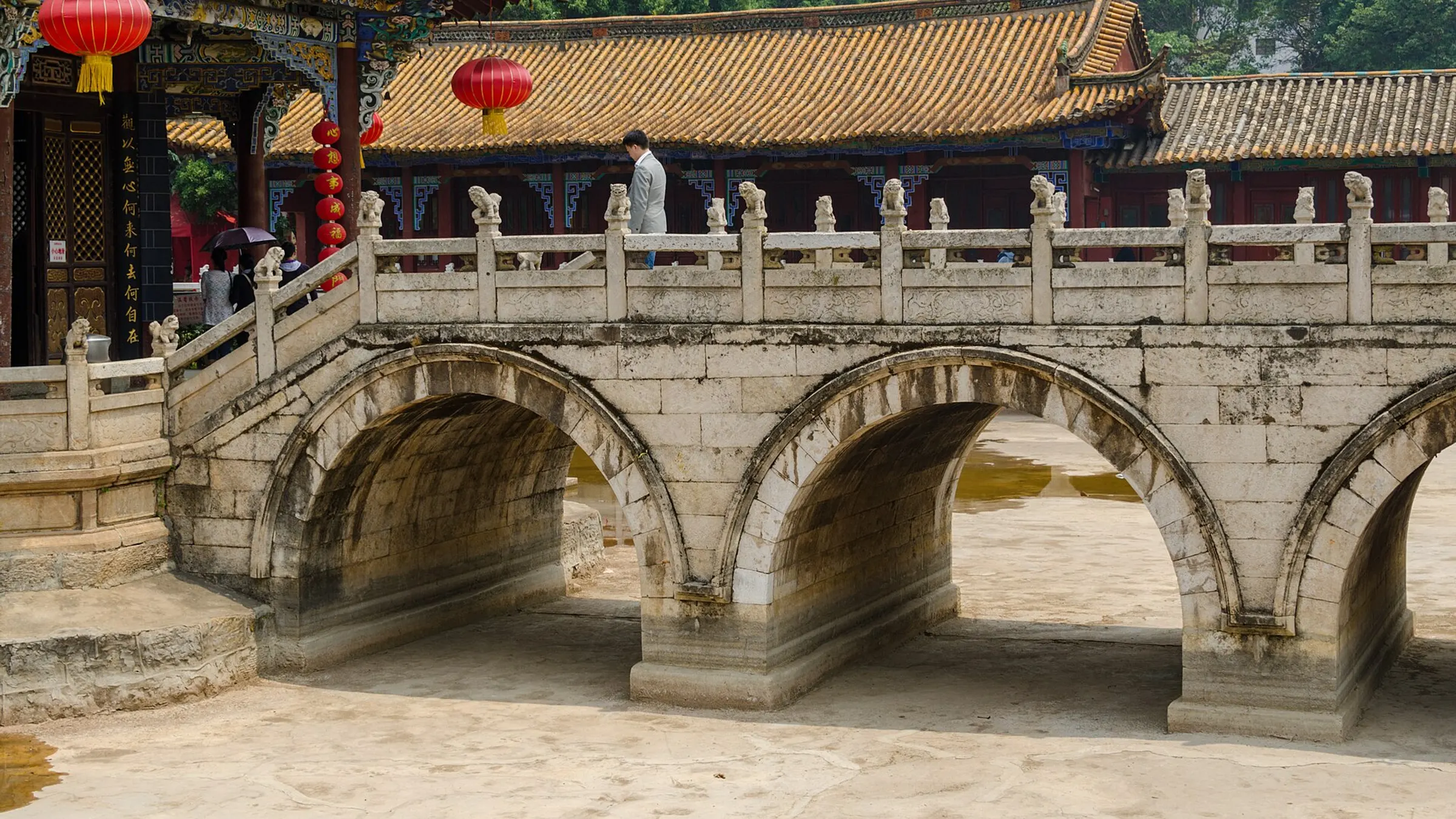
The single most photographed feature is the octagonal pavilion (八角亭) — a heavy, multi-eaved pavilion standing in the middle of the release-life pond (放生池), which is the pond between Longhua Hall and the Yuantong Hall. It is reached by two three-arched white marble bridges on its north and south sides, and the pool is flanked by covered walkways. This arrangement — a Buddhist hall ringed by water — is described as unusual in China, and the pavilion-and-pond axis is what makes Yuantong instantly recognisable.
The second draw is the hall of gold statues. The Yuantong Hall (圆通宝殿) is the main hall: seven bays wide, a double-eaved hip roof, and golden-orange glazed roof tiles. Inside are the Twelve Perceptions, the Twenty-Four Devas and bodhisattvas from the ten directions. Beside it is a hall for Tibetan Buddhism (普光明殿), and behind is the Copper Buddha Hall (铜佛殿), added in the 1980s to house a bronze Shakyamuni image presented by the Thai Buddhist association. Yuantong is unusual in having halls for three traditions at once — Mahayana, Theravada and Tibetan Buddhism — under one roof, with Mahayana the principal.
A short history
The temple was first built during the Nanzhao period, originally named 补陀罗寺 (Putuoluo Temple), and from the start a shrine to Guanyin, the Bodhisattva of Compassion. It burned down in 1255, during Kublai Khan’s southern campaign. It was rebuilt in 1301 and renamed 圆通寺, taking Guanyin’s title “Yuantong”. It was substantially rebuilt and enlarged in the Qing period, taking roughly its present form.
One historical detail explains something that otherwise puzzles visitors. The main hall originally enshrined a Guanyin statue, but the 1871 flood destroyed it; during a later Qing restoration the hall was re-consecrated to a Sakyamuni triad, and the Guanyin image was moved into the octagonal pavilion — where the pavilion’s central figure stands today. If a guide tells you the main hall “used to be a Guanyin hall,” this is why.
How to visit it
It is compact, central and cheap — about an hour, roughly ¥6. Enter through the mountain gate and the 圆通胜境 archway (Yuantong Wonderful Realm, a four-pillar three-bay brick-and-timber gate dating to the Qing), and work down the central axis: Longhua Hall with its Maitreya and the Four Heavenly Kings, then the pond and the octagonal pavilion, then Yuantong Hall, the Tibetan hall and the Copper Buddha Hall.
Two further things are worth knowing if you have the time. Behind the halls is a long stone cliff face, the 衲霞屏, more than 300 m long and covered in cliff inscriptions carved over the centuries — among the oldest carvings in Kunming and the reason the writer Sun Ranweng is associated with this spot. A path along the cliff, the 采芝径, climbs the hill and connects to the Kunming Zoo at the summit.
Go early, ideally before 09:00, and you will have the courtyard largely to yourself before the tour groups from the city centre start arriving. This is a working temple: dress modestly, keep your voice down in the halls, and ask before photographing inside them or during services. Because it sits in the middle of the old city, it pairs naturally with Green Lake Park or the Yunnan Provincial Museum, both close by.
Best photo spots
-
The octagonal pavilion across the release-life pond · Early morning, when the courtyard is quiet
The twin-arched white marble bridges framing the heavy-roofed octagonal pavilion standing in the pond — the defining view of the temple, and the reason most visitors come.
-
Yuantong Hall · Mid-morning, for the light on the golden roof tiles
The main hall, seven bays wide with a double-eaved hip roof and golden-orange glazed tiles, flanked by covered corridors running beside clear pools.
-
The 圆通胜境 archway, looking back into the precinct · Late morning
Looking back through the four-pillar, three-bay brick-and-timber archway with the whole downhill garden laid out beyond it.
Frequently asked questions
How much does it cost to enter Yuantong Temple?
Roughly ¥6 for the temple precinct. It is one of the cheapest ticketed sights in central Kunming. Because it is a working temple rather than a closed museum, a donation is normal but entirely optional.
What is the most striking thing about Yuantong Temple?
The layout. The complex is built downhill — the mountain gate is high and the main hall is low — so from the entrance you look down across the whole garden. The signature image is the octagonal pavilion (八角亭) standing in the middle of the release-life pond, reached by low white marble arch bridges on its north and south sides.
How long should I spend at Yuantong Temple?
About an hour. It is a compact precinct in the middle of the city, not a full-day site. Most of the time goes on the axis from the mountain gate through the 圆通胜境 archway, past the Longhua Hall and the octagonal pavilion, to the Yuantong Hall and the Copper Buddha Hall.
Is Yuantong Temple an active place of worship?
Yes. It is the seat of the Yunnan and Kunming Buddhist associations, and it is listed among the nationally important Han Chinese Buddhist temples. Dress modestly, keep your voice down in the halls, and ask before photographing inside the halls or during services.
What is the history of Yuantong Temple?
It was first built as 补陀罗寺 (Putuoluo Temple) during the Nanzhao period, originally as a Guanyin shrine. The temple burned down in 1255 during Kublai Khan's southern campaign, was rebuilt in 1301, and was renamed 圆通寺 (Yuantong) after Guanyin's title. It was substantially rebuilt and enlarged in the Qing, taking roughly its present form.
Is Yuantong Temple worth combining with other Kunming sights?
Yes — it sits in the middle of the old city. Green Lake Park and the Yunnan Provincial Museum are both within a short walk or a short metro ride, so an hour at the temple fits easily into a half-day walking itinerary.