
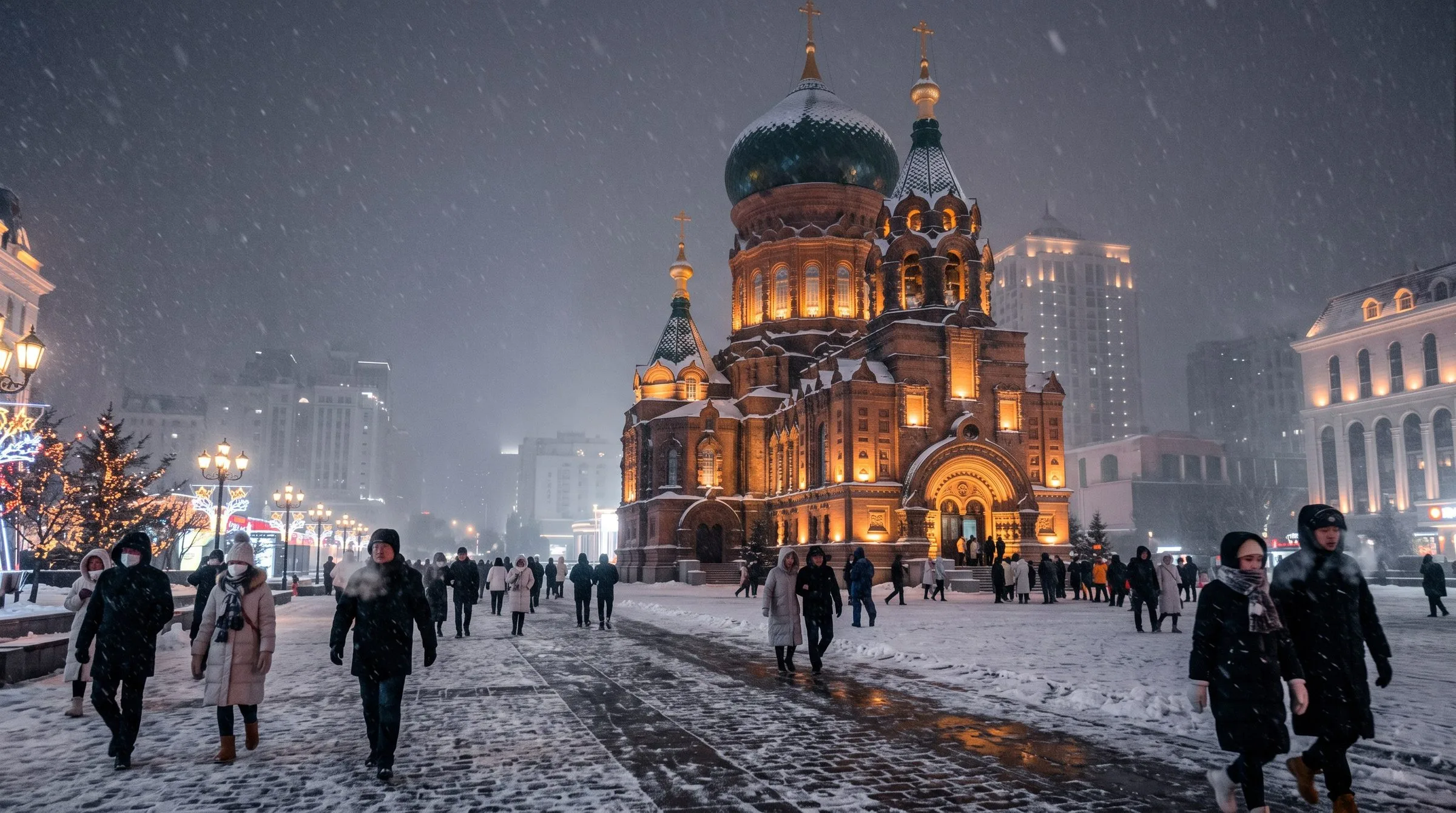
Harbin Winter Travel Guide 2026: Ice Festival, Snow Town, -30°C Survival
Harbin winter travel guide for first-time visitors: Ice and Snow Festival (Dec 2026-Feb 2027), staying warm at -30°C, Yabuli ski resort, China Snow Town day trip, Saint Sophia Cathedral, and a 4-day winter itinerary.
Harbin (哈尔滨, Hā’ěrbīn) is the capital of Heilongjiang Province in far northeast China, 1,200 km north of Beijing. The city sits on the south bank of the Songhua River and has a population of about 10 million, of whom roughly 50,000 are ethnic Russian and Korean. Harbin’s winter is one of the great urban festivals of the world: the Harbin Ice and Snow Festival (哈尔滨国际冰雪节), running from late December to late February, draws 18 million visitors and produces more ice sculpture than the rest of the world combined.
This is a practical guide for first-time visitors in 2026-2027: when to come, the festival venues, the 4-day route, the day trip to China Snow Town, and how to survive -30°C.
Quick facts
- Elevation: 150m above sea level (low elevation, sea of cold air from Siberia)
- Population: ~10 million
- Temperature in January: -15°C to -30°C (record low -42°C in 1970)
- Temperature in July: 19°C to 28°C (surprisingly mild summer)
- Language: Standard Mandarin with a strong Dongbei (northeast) accent; Russian is widely understood in the older generation; English is limited outside the international hotels
- Currency: Chinese yuan (¥, CNY). $1 = ¥7.20 in 2026
- Time zone: UTC+8 (China Standard Time)
- Best season: December to February for the festival; June to August for the cool summer (Harbin is one of China’s top summer escapes from the southern heat)
- Visa: standard Chinese tourist visa (L). 240-hour visa-free transit applies (Harbin is on the list)
- Founded: 1898 as a Russian railway town
Why Harbin: history and the festival
Harbin was founded in 1898 as the eastern terminus of the Chinese Eastern Railway (a Russian-built branch of the Trans-Siberian). The city was designed by Russian engineers and built with Russian capital — within a decade, Harbin was the largest Russian city outside the Russian Empire, with a population of 100,000+ Russian, Jewish, and Polish immigrants. The city kept its Russian character through the Japanese occupation (1931-1945), the Soviet liberation (1945), and the first 30 years of the People’s Republic. Today, the central area has more Russian Baroque and Art Nouveau buildings than any city outside Moscow or St. Petersburg.
The Ice and Snow Festival started in 1963 as a local park lantern show, was suspended during the Cultural Revolution, and was relaunched in 1985 as an international festival. The 2026-2027 edition is the 42nd. The festival is technically one event but in practice is a collection of 5-6 major venues spread across the city. The total ice volume used each year is roughly 300,000 cubic meters — all cut as blocks from the frozen Songhua River between December and early January, when the river ice reaches the required 40-cm thickness.
When to come
| Window | Dates | Conditions | Crowds |
|---|---|---|---|
| Early festival | Dec 24 - Jan 4 | Cold (-15 to -25°C), freshly carved ice, lower crowds | Low |
| Peak pre-Spring | Jan 5 - Jan 28 (approx) | Coldest (-25 to -30°C), all venues open, best ice | High |
| Spring Festival | Late Jan or early Feb (dates vary) | Cold, but Chinese families on holiday, prices spike 50-100% | Very high |
| Late festival | Feb 8 - Feb 28 | Warmer (-10 to -20°C), some melting, fewer venues | Moderate |
| Off-season | March - November | No festival, but cool summer | Low |
Best window: the first 3 weeks of January (after New Year but before Spring Festival). All venues are open, the ice is freshly carved, the temperature is consistently cold enough to keep the sculptures intact, and the Chinese New Year travel rush has not yet started.
Avoid: the Spring Festival week (usually late January or early February, dates vary) unless you specifically want the cultural chaos. Flights and hotels triple in price, and the festival venues are wall-to-wall with Chinese families.
Cold weather note: Harbin winter is dry, not damp. -30°C in Harbin feels like -20°C in coastal cities like Qingdao, because there is no wind chill factor from humidity. The trade-off is that the air is also extremely dry (15-25% humidity indoors), so moisturize and drink more water than usual.
Getting to Harbin
Fly into Harbin Taiping Airport (HRB)
Harbin Taiping International Airport is 33 km southwest of the city center. Direct domestic flights:
| City | Flight time | Daily flights | Round-trip price |
|---|---|---|---|
| Beijing (PEK) | 2h | 10+ | $150-300 |
| Shanghai (PVG) | 3h | 8+ | $200-400 |
| Guangzhou (CAN) | 4h 30m | 5+ | $280-500 |
| Shenzhen (SZX) | 4h | 4 | $250-500 |
| Qingdao (TAO) | 2h 30m | 3 | $180-350 |
| Dalian (DLC) | 1h 30m | 4 | $130-250 |
International direct flights: Vladivostok, Seoul (Incheon), Tokyo (Narita), Bangkok, and Taipei. Limited but growing.
DiDi works at HRB but is sometimes slow during peak festival. The airport bus (¥20, 5 AM to last flight, 60 min to Central Square) is the most reliable option. Taxis are ¥80-100 fixed price to the city.
High-speed rail
Harbin is on the high-speed rail network. Recommended routes:
- Beijing to Harbin: 5h30m, $80-120 second class, $150-200 first class, 8+ daily trains. The train is more reliable than flying in winter weather.
- Dalian to Harbin: 4h, $70-110
- Shenyang to Harbin: 2h, $40-70
- Changchun to Harbin: 1h, $25-45
For a full guide on high-speed rail, see the China high-speed rail guide.
4-day Harbin route
This is the standard 4-day Harbin + Snow Town day trip route. It assumes you arrive in the afternoon of Day 1 and depart on Day 4 evening.
Day 1: Arrive Harbin, Central Street, Saint Sophia Cathedral, Zhaolin Park
- Afternoon: arrive Harbin, check into hotel, dress warmly. Walk Central Street (中央大街), the 1.4-km pedestrian street paved with granite cobblestones (1900s). Look for the Russian Baroque facades at Modern Hotel (now a bank, the painted dome is original 1906), the Jewish-owned former Manchurian Hotel, the Maslennikov Bakery (founded 1900, still selling rye bread ¥10-15), and the Saint Nicholas Cathedral ruins (now a shopping arcade).
- Evening: dinner at Huamei Western Restaurant (华梅西餐厅, on Central Street) for Russian borscht, Olivier salad, and beef stroganoff. ¥80-150 per person. Walk to Saint Sophia Cathedral (¥20 to enter the small museum inside) for night photography of the illuminated onion dome. End with the Zhaolin Park ice lantern show (¥200) — smaller than Ice and Snow World but more accessible and free to walk around the park perimeter for the lights.
Day 2: Ice and Snow World (full day, plus illuminated evening)
- Morning: hotel breakfast. Take Metro Line 3 to the terminus or a DiDi to Ice and Snow World (30 min, ¥40-60).
- 10 AM: enter Ice and Snow World (¥300 daytime, ¥200 evening from 4 PM, ¥400 combined). The park has 100+ full-size ice buildings sculpted from blocks cut from the Songhua River. Replicas of the Great Wall, the Taj Mahal, the Potala Palace, the Shanghai Tower, and original designs. The ice slides, ice skating, ice bicycles, and the ice cinema are all free with the ticket. Allow 3 hours during the day.
- Lunch: inside the park (¥60-120 per person, dumplings and noodles, surprisingly decent for a festival venue).
- 4 PM: re-enter for the illumination (the ticket is valid all day). The colored lighting turns on at sunset (4-4:30 PM in January). The best 90 minutes is 5-7 PM: fully dark, all lights on, the crowds peak and the temperature drops. Bring a tripod for long-exposure photos.
- 7 PM: taxi back to the city. Hot pot or Russian dinner. Early sleep — the cold and the walking are exhausting.
Day 3: Sun Island Snow Sculpture Expo + Siberian Tiger Park
- Morning: taxi to Sun Island (太阳岛) on the north bank of the Songhua River (15 min, ¥30-40). The Snow Sculpture Art Expo (雪雕博览会, ¥240) is a separate venue from Ice and Snow World — the snow sculptures are larger, more sculptural, and more figure-focused (full-size horses, figures, abstract forms). Allow 3 hours.
- Lunch: at Sun Island or back in the city.
- Afternoon: Siberian Tiger Park (东北虎林园, ¥90 + ¥50 for the caged-walk-through tour bus), 30 km north of the city. The world’s largest breeding center for Siberian (Amur) tigers, with 700+ tigers. The tour bus goes through the tiger enclosures — you can feed the tigers live chickens (¥30) from the bus. Allow 2 hours. Taxi ¥80-100 each way.
- Evening: dinner at a Dongbei (northeast) hot pot place (¥80-150) or a Russian restaurant. Stroll the night lit-up Songhua River bank.
Day 4: Day trip to China Snow Town OR Yabuli ski resort OR departure
- Option A: China Snow Town (中国雪乡, also called Xuexiang) — 280 km east, 5-6h drive each way. The village is a small hamlet of 200+ households transformed into a winter fairyland of mushroom-shaped snow roofs and red lanterns. Horse-drawn sleigh rides (¥50), snowmobiling (¥150-300), tubing, the Yangzhe Mountain viewpoint (snow village panorama, climb 1.5 km in 30-45 min, ¥60 entry). Most agencies do an overnight: day 1 drive out, day 2 morning at Snow Town, day 2 afternoon drive back. Cost: ¥800-1,500 per person including transport, 1 night in a heated village inn, and 3 meals. Independent transportation is not practical.
- Option B: Yabuli ski resort (亚布力滑雪场) — 200 km southeast, 2.5h drive. The largest ski resort in China with 50+ trails (beginner, intermediate, advanced), cable cars, equipment rental, and ski school. Day trip ¥600-1,000 per person including transport, lift ticket, and basic ski package (skis, boots, poles). Beginners can do a half-day lesson (¥300-500).
- Option C: Free day in Harbin — if you have time before flying out, visit the Harbin Polarland (¥150) for the polar bear and walrus shows, the Volga Manor (¥200, a Russian-themed resort on the Acheng river with Russian architecture and folk shows), or the Heilongjiang Provincial Museum (free, 1-2 hours for context on Russian-era Harbin).
Where to stay in Harbin
Harbin has a wide range of hotels from budget guesthouses to international 5-star chains. Most are in the Daoli or Daowai districts near Central Street.
International 5-star (¥800-2,500 / $110-350 per night)
- Shangri-La Hotel Harbin (香格里拉): the top international hotel, near Central Street, 350+ rooms, heated indoor pool, the best breakfast in town. ¥1,200-2,500/night.
- Sofitel Harbin (索菲特): French luxury chain, near Saint Sophia Cathedral, 350+ rooms, French-Russian design. ¥1,000-1,800/night.
- Sheraton Harbin Songbei (喜来登): newer, in the Songbei district, 400+ rooms, good for Ice and Snow World access. ¥800-1,500/night.
Mid-range (¥400-800 / $55-110 per night)
- Harbin Astoria Hotel: 4-star near Central Street, comfortable, ¥500-800/night.
- Jinjiang Inn (various locations): reliable budget chain, ¥250-450/night.
- Hanting Express (various locations): budget chain, ¥200-350/night.
- Holiday Inn Express Harbin Central Street: 3-star near Central Street, ¥400-600/night.
What to look for in a Harbin winter hotel
- Insulation and heating: critical. The best hotels have underfloor heating and double-glazed windows. Avoid older guesthouses with poor insulation — the inside can be as cold as the outside.
- Hot water 24/7: most hotels have this, but the pressure can be weak on the top floors.
- In-room humidifier: the dry Harbin winter (15-25% humidity indoors) cracks skin and causes nosebleeds. Mid-range and up hotels often provide humidifiers.
- English-speaking staff: only at the international hotels. Budget places have very limited English.
Where to eat in Harbin
Harbin’s food scene reflects its Russian-Dongbei (northeast) heritage. Expect hearty meat dishes, dumplings, Russian bread, and hot pot. Portions are large and prices are lower than Beijing or Shanghai.
Russian
- Huamei Western Restaurant (华梅西餐厅): the oldest Russian restaurant in Harbin, founded 1925, on Central Street. Borscht, Olivier salad, beef stroganoff, Russian bread. ¥80-150 per person.
- Russian Kitchen 1906 (1906 俄式厨房): a newer Russian restaurant near Central Street. More modern, slightly cheaper. ¥60-120 per person.
- Maslennikov Bakery: the original Russian bakery, on Central Street, founded 1900. Rye bread, Russian sausages, and pastries. ¥30-50 per person.
Dongbei (northeast Chinese)
- Dongbei Ren Jia (东北人家): classic Dongbei homestyle. Guobaorou (sweet-and-sour pork), jiaozi (dumplings), di san xian (three earth treasures: potato, eggplant, pepper). ¥60-100 per person.
- Yu Lian Xuan (玉麟轩): a higher-end Dongbei restaurant, near Central Street. Famous for Russian-influenced Dongbei fusion. ¥100-200 per person.
Hot pot
- Dongbei Lao Ma (东北老马): classic copper-pot hot pot, ¥80-150 per person. The hot pot is essential in Harbin winter.
- Hai Di Lao (海底捞): the international chain, always reliable. ¥80-150 per person.
Barbecue and skewers
- Chuan Wei Shao Kao (串味烧烤): Dongbei-style lamb skewers, ¥3-5 each. The night barbecue scene is a major part of Harbin life, especially at the open-air Daoli night market.
Getting around Harbin
DiDi
DiDi works in Harbin (unlike Lhasa). Download and set up the app before arrival. See the using DiDi guide for setup. DiDi is the easiest way to get between festival venues.
Taxi
Taxis are cheap and abundant. ¥10-20 for most trips in the central area, ¥30-60 to the festival venues on the north bank. Drivers speak limited English — have your hotel write the destination in Chinese characters. Most taxis do not use meters — agree on the price before getting in.
Metro
Harbin has a small metro: Line 1 (red, 2013) running east-west through the city center, and Line 3 (orange, 2017) running from the city center to the Ice and Snow World terminus. ¥2-5 per ride. English signage is good. Avoid during peak hours (7-9 AM, 5-7 PM).
Bus
Public buses are ¥1-2 and cover the city, but rarely used by visitors due to the language barrier and the cold (waiting at bus stops in -25°C is brutal).
Walking
Walking is the only way to see the central area properly. Bundle up — the wind on the Songhua River bridge is the coldest part of the city.
Day trip to China Snow Town (Xuexiang)
China Snow Town (中国雪乡) is 280 km east of Harbin, a 5-6h drive each way through snowy forest. The village is a small hamlet of 200+ households, transformed every winter into a fairyland of mushroom-shaped snow roofs and red lanterns. The unique snow formation is called 雪蘑菇 (snow mushrooms) — the thick snow on the rooftops droops over the eaves like mushrooms, formed by the high humidity from the Songhua River and the long cold nights.
What to do at Snow Town
- Walk the village: the main street is 1 km of wooden buildings, red lanterns, and snow-capped roofs. Photography is the main activity. The light is best 7-8 AM and 4-5 PM.
- Climb Yangzhe Mountain (羊山/羊角山): 1.5 km climb, 30-45 min, ¥60 entry. Panoramic view of the entire village and the surrounding snowy forest.
- Horse-drawn sleigh ride: ¥50, a 30-min ride through the village and the forest edge.
- Snowmobiling: ¥150-300 for 30-60 min through the forest trails.
- Snow tubing: ¥50-100 per run, the village has a tubing hill.
- Dog sledding: ¥200-400 per ride, the village has a husky kennel.
Practicalities
- Most agencies do an overnight (Day 1 drive out, Day 2 morning at Snow Town, Day 2 afternoon drive back) rather than a single-day round trip. Cost: ¥800-1,500 per person including transport, 1 night in a heated village inn, 3 meals, and the entrance fee.
- Independent transportation is not practical for foreign visitors. The road is icy and the language barrier is severe. Book through your hotel or a Harbin tour agency.
- Snow Town inns are basic but warm: heated kang beds (traditional heated platform), shared or private bathrooms, no English spoken. Bring your own toiletries and towel.
- Pack extra warm clothes: Snow Town is 500m higher than Harbin and the temperature can be -5 to -10°C colder.
China Snow Town alternative: Yabuli ski resort
Yabuli (亚布力) is 200 km southeast of Harbin, 2.5h drive. The largest ski resort in China with 50+ trails (beginner, intermediate, advanced, expert), 6 cable cars and chair lifts, equipment rental, ski school, and a few luxury slope-side hotels. The resort hosted the 1996 Winter Asian Games and is the most-developed ski infrastructure in China.
- Day trip package: ¥600-1,000 per person including transport, lift ticket (4-6 hours), and basic ski package (skis, boots, poles).
- Beginner lesson: ¥300-500 for a 2-hour group lesson (4-6 people) or ¥500-800 for a private lesson.
- 2-day stay at slope-side hotel: ¥1,500-3,000 per person including transport, 1 night hotel, 2-day lift ticket, and ski rental.
- Best for: skiers and snowboarders who want actual downhill. Not good for non-skiers (the resort is built around the skiing, with limited alternative activities).
Cold weather survival guide
-30°C is serious, but it is also dry and there is rarely wind. With proper clothing, you can be outdoors for 60-90 minutes at a time. Here is the full kit.
Clothing checklist
- -30°C-rated down jacket — Bosideng, Canada Goose, Uniqlo, or Decathlon. ¥800-3,500. Do not buy a fashion coat.
- Thermal underwear top and bottom — Uniqlo Heattech or Decathlon. ¥80-200.
- Fleece mid-layer — Patagonia, Decathlon, or any fleece. ¥150-400.
- Snow pants — Columbia, North Face, or local. ¥300-800. Optional for daytime venues, essential for Snow Town and outdoor festivals.
- Insulated snow boots — rated to -30°C. Sorel, Columbia, Bosideng, or local. ¥500-1,500. Waterproof and slip-resistant.
- Wool socks — 2-3 pairs, mid-weight to heavy. ¥30-80 each.
- Balaclava or neck gaiter — for face and neck. ¥50-150.
- Hat that covers the ears — wool or fleece. ¥50-200.
- Insulated gloves — waterproof, with grip. ¥80-200.
- Thin liner gloves — for phone use and fine motor. ¥30-80.
- Hand warmers — ¥2-3 each, buy 10-20 at any Harbin supermarket. 6-12 hours of heat each.
- Sunglasses or ski goggles — snow blindness is real at -30°C, the reflection off the ice and snow is intense. ¥100-500.
- Lip balm with SPF — ¥20-50.
- Moisturizer — the dry air cracks skin fast. ¥50-150.
- Phone power bank — the cold drains phone batteries in 2-3 hours. ¥100-300.
What NOT to do
- Do not wear cotton as a base layer. Cotton absorbs sweat and freezes — this is how you get hypothermia. Use synthetic or merino wool.
- Do not drink alcohol to stay warm. Alcohol dilates blood vessels, which actually lowers your core temperature.
- Do not stay outdoors for more than 90 minutes at a time without going somewhere warm.
- Do not touch metal with bare skin — it can cause instant frostbite.
- Do not let your phone stay in your pocket for long — the cold drains the battery. Keep it in an inner pocket close to your body.
- Do not wear wet shoes or socks. Carry an extra pair of socks.
- Do not skip sunscreen. The sun reflects off the ice and snow and you can burn even at -25°C.
Practical tips
Money and payment
Harbin is fully cashless in the central area. Alipay and WeChat Pay are accepted in 95% of shops, hotels, and restaurants. Set up Alipay before arrival — see the Alipay setup guide. Carry ¥200-500 in cash for small purchases and taxis. ATMs are widely available in the central area; they accept foreign Visa and Mastercard with a daily limit of ¥2,500-5,000 per transaction.
Language
Standard Mandarin with a strong Dongbei accent. Russian is still spoken by some older residents. English is limited outside the international hotels. Download Pleco and Google Translate with the Chinese offline pack before arrival. See the essential Chinese phrases guide for the most useful 20 phrases.
Connectivity
VPN: access to Google, Instagram, WhatsApp, Facebook, and most Western news sites is blocked in China. Download and configure a VPN before arrival. See the China VPN guide for current recommendations.
SIM card: buy a China Unicom or China Mobile SIM at the airport or any carrier store. eSIM via Airalo or Holafly also works; see the eSIM setup guide. For broader app setup, see the essential apps guide.
Cultural etiquette
- Dress warmly even indoors. Harbin locals wear thick coats inside the shopping malls and restaurants. The inside heating is strong but the airlock doors and entrances are freezing.
- Be loud and friendly. Dongbei culture is famously boisterous and direct. The locals are warm to foreign visitors, especially anyone who attempts any Chinese at all.
- Eat with both hands when holding a whole fish or a large dumpling. The local etiquette treats food as a celebration.
- Ski and skate at your own risk. The festival venues have ice slides and skating rinks; watch the locals first and avoid the more extreme ones.
- For broader etiquette, see the China cultural etiquette guide and the China travel etiquette guide.
Photography
Photography is generally allowed everywhere except the Jokhang-equivalent (none in Harbin) and the Siberian Tiger Park caged-walk-through bus (no flash, for the tigers’ safety). The festival venues are spectacular for night photography: bring a tripod for long exposures of the illuminated ice buildings. Phones drain fast in the cold — keep a power bank in your inner pocket.
Health and safety
Harbin is safe for foreign visitors. The main risks are cold-weather injuries (frostbite, hypothermia), slips on icy sidewalks, and the long walking distances between festival venues. Dress properly, take taxis between venues, keep your phone charged, and limit outdoor exposure to 60-90 minutes at a time. Most hotels have a doctor on call. The Harbin Medical University Hospital is the main medical center.
For broader safety context, see the China travel safety guide.
Budget breakdown: 4-day Harbin
For a mid-range traveler (mid-range hotel, festival tickets, 1 day trip):
| Item | Cost (per person) |
|---|---|
| Hotel (3 nights, mid-range) | ¥1,500-2,400 ($210-330) |
| Ice and Snow World ticket (day + evening) | ¥400-500 ($55-70) |
| Sun Island Snow Sculpture Expo | ¥240 ($33) |
| Siberian Tiger Park | ¥140 ($19) |
| Saint Sophia Cathedral | ¥20 ($3) |
| Snow Town day trip OR Yabuli ski | ¥600-1,000 ($85-140) |
| Meals (4 days, mid-range) | ¥500-800 ($70-110) |
| Local transport (DiDi, taxis) | ¥200-400 ($30-55) |
| Cold weather gear (if not already owned) | ¥800-2,000 ($110-280) |
| Total ground (4 days) | ¥4,500-7,500 ($625-1,040) |
| Beijing-Harbin round-trip flight | ¥1,000-2,500 ($150-350) |
| International flight to Beijing (US round-trip) | $600-1,200 |
| Total trip (5-6 days from abroad) | $1,400-2,200 per person |
Budget travelers can do it for $1,000-1,400. Luxury travelers (Shangri-La Harbin, private 4WD for Snow Town, private guide) will spend $4,000-6,000 total.
Frequently asked practical questions
Do I need a Chinese visa for Harbin? Yes, the standard Chinese tourist visa (L) is required for most nationalities. The 240-hour visa-free transit (57 nationalities) applies — Harbin is on the list. See the China 240-hour visa-free guide for details.
Can I use Alipay in Harbin? Yes, Alipay works everywhere in the central area. See the Alipay setup guide for setup.
Do I need a Chinese SIM card? Recommended. Buy a SIM at the airport or a carrier store. eSIM also works. See the eSIM guide and the essential apps guide.
What about the eastern scenic wonder destinations comparable to Harbin? The snow-and-ice experience of Harbin is unique in China. For other winter destinations, see the Hulunbuir scenic guide (Inner Mongolia grassland in winter, -40°C) and the China scenic wonders comparison.
Is Harbin expensive? Mid-range, comparable to other Chinese second-tier cities. The international flights and the festival tickets are the biggest costs. See the China budget 2026 guide for cost comparisons.
Is the festival kid-friendly? Yes — Harbin is one of the best winter destinations for families. Children love the ice slides, the tiger park, and the snowmobiling. For broader family travel planning, see the China family vacation guide.
Is the festival accessible for disabled visitors? The main Ice and Snow World venue has accessible paths and the main ice buildings have ramps. The Sun Island venue is partially accessible. The Siberian Tiger Park is not accessible. Contact the venue in advance for specific accommodations.
Harbin is one of the great urban winter experiences in the world — the largest ice festival on earth, the most genuine Russian architecture outside Russia, and a city that has turned the brutality of -30°C into a celebration. The cold is real, the planning is real, but the reward is a winter memory that lasts a lifetime. Bundle up, set up Alipay, and go.
Step by step
-
Plan around the festival dates (Dec 24 2026 to Feb 28 2027)
The festival runs December 24, 2026 to February 28, 2027. The first 2 weeks of January (after New Year but before Chinese New Year) are the sweet spot: all venues are open, the ice is freshly carved, the weather is consistently cold but stable. Avoid the first week of January and the Spring Festival week (dates vary, usually late January or early February) — hotels triple in price and venues are packed. Book flights and hotels 60-90 days ahead for the best rates. The full festival window plus 2 days travel from abroad fits in 5-6 days.
-
Fly into Harbin Taiping Airport (HRB)
Harbin Taiping International Airport is 33 km southwest of the city center, about 45 min by airport bus (¥20) or 40 min by taxi (¥80-100). Direct flights from Beijing (2h, $150-300 round-trip), Shanghai (3h, $200-400), Shenzhen (4h, $250-500), Guangzhou (4h30m, $280-500), and a growing list of international cities including Vladivostok, Seoul, Tokyo, and Bangkok. Alternative: high-speed rail from Beijing (5h30m, $80-120), Dalian (4h, $70-110), or Shenyang (2h, $40-70). The train is more reliable in winter weather and arrives centrally.
-
Day 1: Central Street, Saint Sophia Cathedral, and Zhaolin Park
Morning: walk Central Street (中央大街, Zhongyang Dajie), the 1.4-km pedestrian street paved with cobblestones and lined with Russian Baroque and Art Nouveau buildings. Stop at the Modern Hotel (formerly the Jewish-owned Modern Hotel, 1906), the Russian Maslennikov Bakery (founded 1900, still selling rye bread ¥10), and the Saint Nicholas Cathedral ruins. Lunch at Huamei Western Restaurant (¥80-150) for Russian borscht and herring. Afternoon: Saint Sophia Cathedral (圣索菲亚教堂, ¥20 to enter, free to photograph from outside), the largest Eastern Orthodox church in the Far East, a 1907 brick onion-dome structure. Evening: Zhaolin Park ice lantern show (¥200, smaller than Ice and Snow World but free to walk around the park).
-
Day 2: Ice and Snow World (full day, plus illuminated evening)
Ice and Snow World (冰雪大世界) is the centerpiece of the festival. ¥300 daytime ticket, ¥200 evening illumination ticket (after 4 PM), or ¥400 for a combined pass. Located on the north bank of the Songhua River, 10 km from the city center (30 min by taxi, ¥40-60, or Metro Line 3 to the terminus). The park has 100+ full-size ice buildings — replicas of the Great Wall, Shanghai Tower, the Potala Palace, and the Burj Khalifa — all sculpted from blocks cut from the Songhua River. Allow 4-5 hours: 2-3 hours during the day to walk through, 2 hours after 4 PM for the colored illumination. The ice slides, ice bicycles, and ice skating rink are free with the ticket. The most dramatic light time is 5-7 PM.
-
Day 3: Sun Island Snow Sculpture Expo + Siberian Tiger Park
Sun Island (太阳岛) on the north bank of the Songhua River hosts the Snow Sculpture Art Expo (雪雕博览会, ¥240), a separate venue from Ice and Snow World. The snow sculptures are larger and more sculptural than the ice carvings — figure-grounding pieces, full-size animals, and abstract works. Allow 3 hours. Combine with the Siberian Tiger Park (东北虎林园, ¥90 + ¥50 for the caged-walk-through tour bus), the world's largest breeding center for Siberian (Amur) tigers, with 700+ tigers. Allow 2 hours. The two venues are 5 km apart; taxi ¥20-30 between them. Return to central Harbin for dinner at Russian Kitchen 1906 or a Dongbei hotpot dinner (¥80-150).
-
Day 4: Day trip to China Snow Town (中国雪乡) OR Yabuli ski resort
Pick one for the day. China Snow Town (中国雪乡, also called Xuexiang) is 280 km east of Harbin, a 5-6h drive each way through snowy forest. The village is a small hamlet transformed into a winter fairyland of mushroom-shaped snow roofs and red lanterns, with horse-drawn sleigh rides, snowmobiling, and the Yangzhe Mountain viewpoint. Most agencies do an overnight (¥800-1,500 per person including transport, 1 night in a heated village inn, and meals). Yabuli ski resort (亚布力滑雪场) is 200 km southeast, 2.5h drive. The largest ski resort in China with 50+ trails, lifts, equipment rental, and beginner slopes. Day trip ¥600-1,000 including transport and basic ski package.
-
Stay warm: -30°C clothing checklist
You will not enjoy the festival without proper clothing. Buy or bring: 1) -30°C-rated down jacket (Canada Goose, Bosideng, Uniqlo, or Decathlon, ¥800-3,500), 2) thermal underwear top and bottom (Uniqlo Heattech, Decathlon, ¥80-200), 3) fleece mid-layer (¥150-400), 4) snow pants (¥300-800, optional for daytime but essential for Snow Town), 5) insulated snow boots (rated to -30°C, Sorel, Columbia, or local Bosideng, ¥500-1,500), 6) wool socks (2-3 pairs), 7) balaclava or neck gaiter (¥50-150), 8) hat that covers the ears, 9) insulated gloves (¥80-200), 10) thin liner gloves for phone use, 11) hand warmers (¥2-3 each, buy 10-20 at any supermarket), 12) sunglasses or ski goggles (snow blindness is real at -30°C), 13) lip balm, 14) moisturizer (the dry cold cracks skin). Everything is also available locally in Harbin — Central Street has several outdoor equipment shops.
-
Get around: DiDi works, taxis are cheap, the metro is new
Harbin has a small but reliable public transport network. DiDi (China's Uber) works in Harbin — download and set up before arrival. Taxis are cheap (¥10-20 for most trips in the central area, ¥30-60 to the festival venues on the north bank). The Harbin Metro Line 1 (red, 2013) and Line 3 (orange, 2017) cover the central area and connect to the Ice and Snow World terminus. Buses are ¥1-2 but rarely used by visitors due to the language barrier. For airport transfers, the airport bus (¥20) runs 5 AM to last flight; taxis are ¥80-100 fixed price.
FAQ
-
When is the Harbin Ice and Snow Festival 2026-2027?
The festival officially runs from December 24, 2026 to February 28, 2027, with the main Ice and Snow World venue opening around December 24. Peak season is January 5 to February 15, when all venues are open and the ice sculptures are at their best. The Zhaolin Park ice lantern show usually opens earlier, in late November. Avoid the first week of January (Chinese New Year travel rush starts early) and the Spring Festival week (late January or early February) for lower crowds. -
How cold does Harbin actually get and how do I dress?
Harbin winter temperatures range from -15°C to -30°C in January, with wind chill pushing it to -40°C on the coldest days. You need a real -30°C-rated down jacket (not a fashion coat), thermal underwear top and bottom, fleece mid-layer, snow pants for the outdoor venues, insulated snow boots (rated to -30°C), a balaclava or neck gaiter, a hat that covers the ears, insulated gloves, hand warmers (¥2-3 each), and sunglasses or ski goggles to prevent snow blindness. Exposed skin can get frostbite in 5-10 minutes at -30°C. -
Do I need a visa for Harbin?
Yes, the standard Chinese tourist visa (L) is required for most nationalities. The 240-hour visa-free transit (57 nationalities) lets you transit through mainland China visa-free for 240 hours — Harbin is a permitted transit city, but you must enter through one of the 65 designated ports and have a confirmed onward ticket. For the full rules, see the China 240-hour visa-free guide. -
How much does a Harbin winter trip cost?
Budget $80-120 per day per person excluding international flights. A 4-day Harbin trip with day trip to China Snow Town: $400-600 ground costs (3 nights mid-range hotel, festival tickets ¥300 + ¥240, Snow Town day trip ¥500-800, meals, taxis). Add international flight to Beijing ($600-1,200 round-trip) and the Beijing-Harbin flight ($150-400 round-trip) or the high-speed rail (5h30m, $80-120). Total trip from abroad: $1,400-2,200 per person for 5-6 days. Budget travelers can do it for $1,000-1,400. -
Is it safe to visit Harbin in winter?
Yes — Harbin is safe for foreign visitors, with low violent crime and a tourist-friendly atmosphere. The main risks are cold-weather injuries (frostbite, hypothermia), slips on icy sidewalks, and the long walking distances between festival venues. Dress properly, take taxis between venues, keep your phone charged (cold drains batteries fast), and limit outdoor exposure to 60-90 minutes at a time. The Harbin cold is dry, not damp, so the actual feeling is less brutal than the same temperature in, say, Beijing.
Related guides
- Itineraries
Yabuli and China Snow Town from Harbin 2026: Ski + Snow Village Day Trips
Side trips from Harbin: Yabuli ski resort (2h drive, full day or 2-day) and China Snow Town (5h drive, 1-2 day) compared — which to pick, how to get there, costs, ski pass prices, and Yabuli vs Snow Town for first-timers.
- Culture & Practical
Harbin Ice and Snow Festival 2026: Dates, Tickets, What to See, Where to Stay
Complete guide to the 2026-2027 Harbin Ice and Snow Festival: opening dates, ticket prices (¥300 Ice and Snow World, ¥240 Sun Island), what to see, where to stay, how to stay warm at -30°C, and the best photo times.
- Culture & Practical
Solo Female Travel in China 2026: The Honest Safety Guide Foreigners Don't Get
China is statistically one of the safer large countries for solo female travelers, but the safety profile is different from Western countries. What works in Tokyo or Paris may not work in Beijing. The 2026 honest guide: 8 specific safety scenarios (DiDi at night, hostel vs hotel, walking alone, foreigner-targeted scams, hostel harassment, menstruation access, dating safety, embassy backup), ranked by frequency and risk. Includes the 5 phrases every solo female traveler should learn, and the 2 scenarios where you should NOT go alone.
5min read
- Culture & Practical
Is It Safe to Travel to China in 2026? The Complete Foreigner's Safety Guide
Comprehensive 2026 safety guide for China travel: crime statistics, region-specific risks, scams targeting foreigners, US State Department advisory, LGBTQ+ safety, female solo travel, health and medical care, embassy registration, and 5-step arrival safety checklist. Plus: is it safe to travel to China right now in 2026 (yes, with normal precautions).
12min read
- Culture & Practical
Chinamaxxing 2026: 12 Chinese Lifestyle Experiences Every Foreigner Should Try
Chinamaxxing is the 2026 trend of foreign visitors going deep into Chinese daily life — hot water, ba duan jin qigong, hanfu, mahjong, tea ceremony, foot baths, and more. 12 hands-on experiences with where to try each one, what to expect, and how to book.
9min read
- Itineraries
China Snow & Winter 2026: 8 Best Ski Resorts, 5 Ice Festivals, and Foreigners' Complete Cold-Weather Guide
China's 2026 winter is the breakout year for foreign ski tourism — 8 world-class resorts (Yabuli, Wanlong, Nanshan, Songhua Lake, Thaiwoo, Duolemeidi, Changbaishan, Jiangjun'ao) and 5 ice festivals (Harbin flagship + 4 regional). Full foreigner guide: equipment rental, ski school in English, transport from Beijing/Shanghai, lift ticket prices, and how to avoid the 5 most expensive cold-weather mistakes.
14min read