Songzanlin Monastery (噶丹·松赞林寺), Shangri-La
噶丹·松赞林寺 · Gádān·Sōngzànlín Sì
Quick answer
There is no separate foreigner rate and no passport or visa condition in the material published by the official scenic-area site on 4 November 2026. One set of prices applies to every visitor, and the concessions are listed by category rather than by nationality: free entry for children 1.2 m and under, visitors over 70 and disabled military personnel; discounted entry for students aged 24 and under, serving military personnel, children between 1.2 m and 1.4 m, and visitors over 60.
Why visit
- 1 Founded in 1679 and still the centre of the Gelug (Yellow Hat) school in this part of the plateau — the official site calls it the region's most important Tibetan Buddhist monastery
- 2 The "Little Potala Palace": gold-roofed halls stepping down a hillside above the lake at 3,282 m, with the monastery itself standing above 3,300 m
- 3 A 5A-rated scenic area with one published full price of 90 yuan that already includes the return sightseeing bus and the guided commentary
- 4 Lijiang is the gateway: the monastery is 2.5-3 hours away, and bus route 3 runs straight to it from Dukezong Old Town for 2 yuan
- 5 Half price is 62 yuan; the staffed counter sells a ticket plus a one-way bus ticket for 65 yuan; children 1.2 m and under, visitors over 70 and disabled military personnel enter free
Essential tips for foreigners
- Book online at 90 yuan rather than buying at the window. The online price is the bundle — entry, the return sightseeing bus and the guided commentary. The 65 yuan counter ticket is a ticket plus a one-way bus ticket, so the ride back and the commentary are not in it.
- Read the notice on the day. Different ticketing channels publish opening times between 7:40 and 8:00 and closing times between 17:00 and 18:30, so there is no single published window to plan around.
- Clothing is the climb you did not budget for. The monastery sits above 3,300 m and the lake in front of it at 3,282 m — this is not Lijiang old town weather.
- It is a working monastery, not a stage. The commentary in your ticket is the part that explains the complex; keep it and use it.
- Go via Dukezong Old Town. Bus route 3, 2 yuan, runs straight to the monastery from the old town, which is also the town the 5A scenic area is named for.
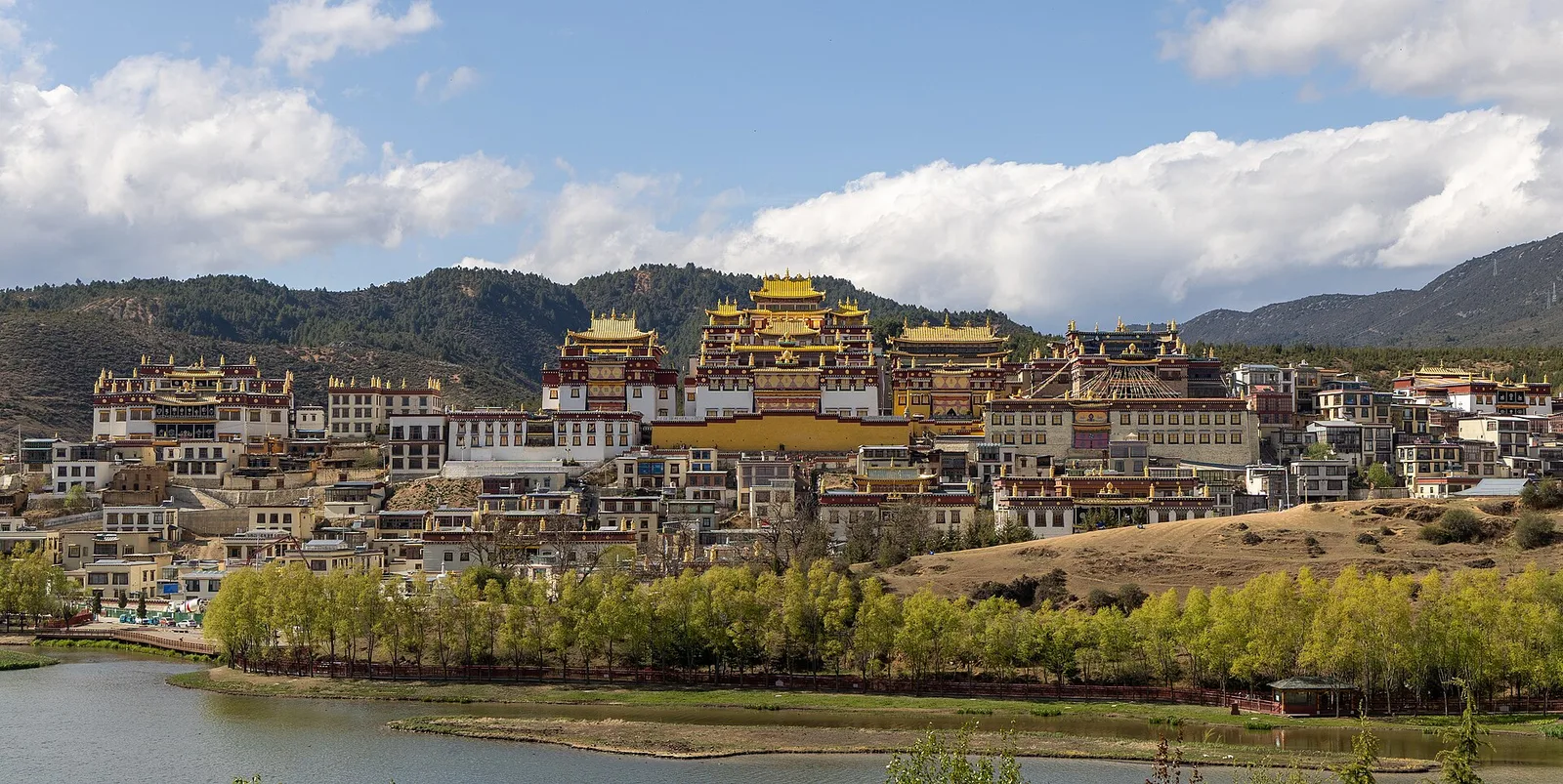
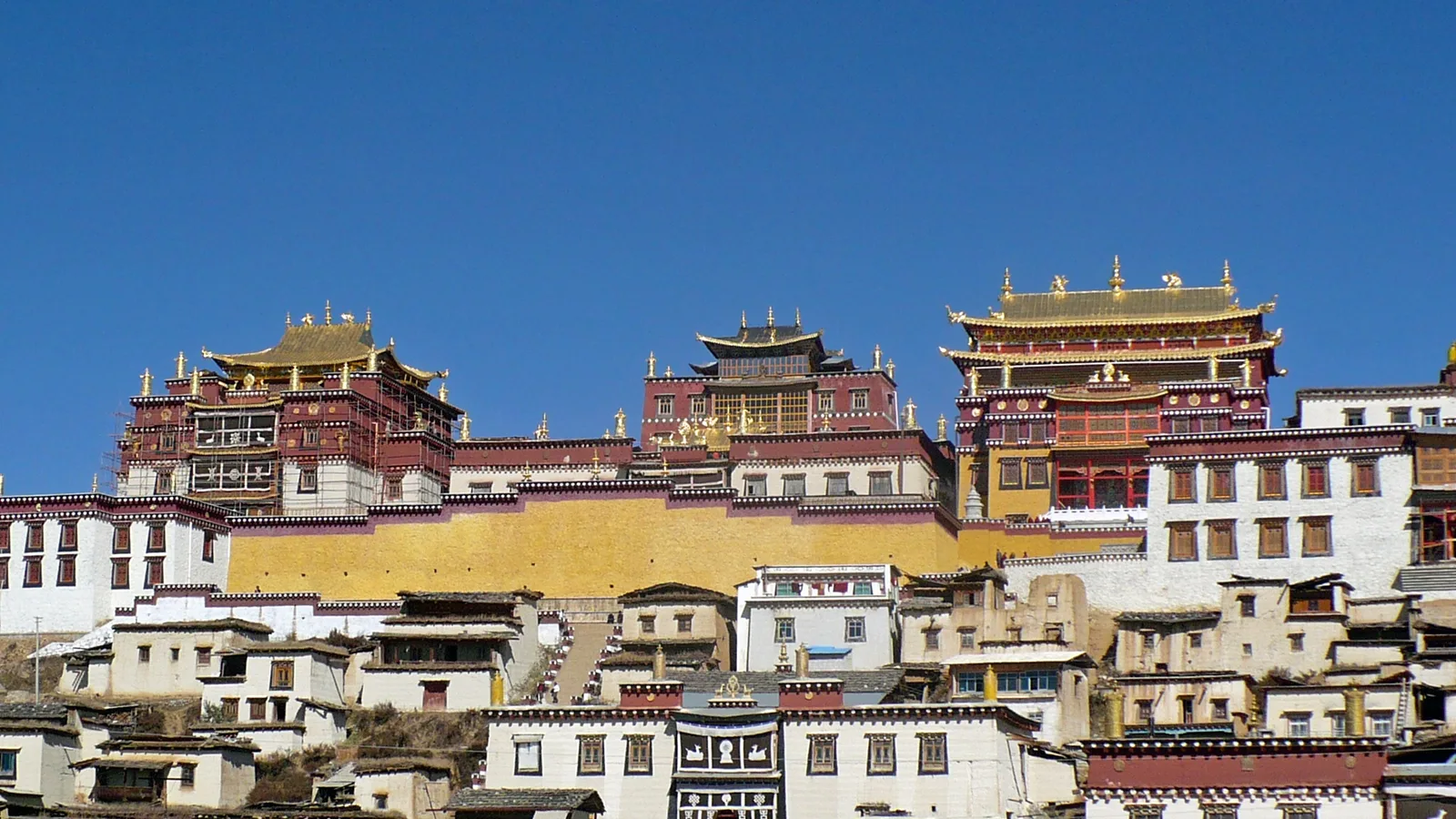
Songzanlin Monastery (噶丹·松赞林寺), also called Ganden Sumtseling and historically 归化寺, sits on a hillside above a lake in the city of Shangri-La, Diqing Tibetan Autonomous Prefecture, Yunnan. It was founded in 1679, and the official scenic-area site describes it as the centre of the Gelug — the Yellow Hat school — in this part of the plateau, and as one of the largest Tibetan Buddhist monasteries in Yunnan. It is a 5A-rated scenic area, and from the lake side the gold roofs read like a smaller copy of the Potala Palace, which is where the nickname “Little Potala Palace” comes from.
Two practical points before anything else. First, where it is: the monastery stands in Shangri-La city, 2.5-3 hours from Lijiang. It is filed on this Lijiang page because Lijiang old town is the gateway nearly every traveller comes from — you sleep in Lijiang and drive or ride north-west for the better part of a morning. Second, what it costs: the full price is 90 yuan, and that 90 yuan is a bundle — entry, the return sightseeing bus and the guided commentary.
The altitude is the other thing to plan for. The monastery stands above 3,300 m and the lake in front of it at 3,282 m, so this is not the same climate as the old town you left that morning.
The complex is not one building. The official scenic-area site lists the monastery and the lake in front of it — 拉姆央措湖, at 3,282 m — as the two headline points of the area, and the halls step across the hillside between them rather than standing in a single block. The town of Dukezong sits below, and the whole site is read from the lake side, which is where the “Little Potala Palace” view comes from.
Can you enter Songzanlin Monastery?
Yes, and the ticket is the same for everybody. There is no separate foreigner rate and no passport or visa condition in what the official scenic-area site publishes.
| Ticket | Price |
|---|---|
| Full price, booked online | ¥90 — entry plus the return sightseeing bus and the guided commentary |
| Full price, at the staffed counter | ¥65 — a ticket plus a one-way bus ticket |
| Half price | ¥62 |
| Free entry | Children 1.2 m and under, visitors over 70, disabled military personnel |
| Concessions | Students aged 24 and under, serving military personnel, children 1.2-1.4 m, visitors over 60 |
Two things are worth reading carefully in that table. The first is that 90 yuan and 65 yuan are not the same product: the online price includes the ride back and the commentary, while the counter price is a ticket plus one-way bus. The second is that the concessions are written by category rather than by nationality, so there is nothing foreigner-specific to claim and nothing foreigner-specific to pay.
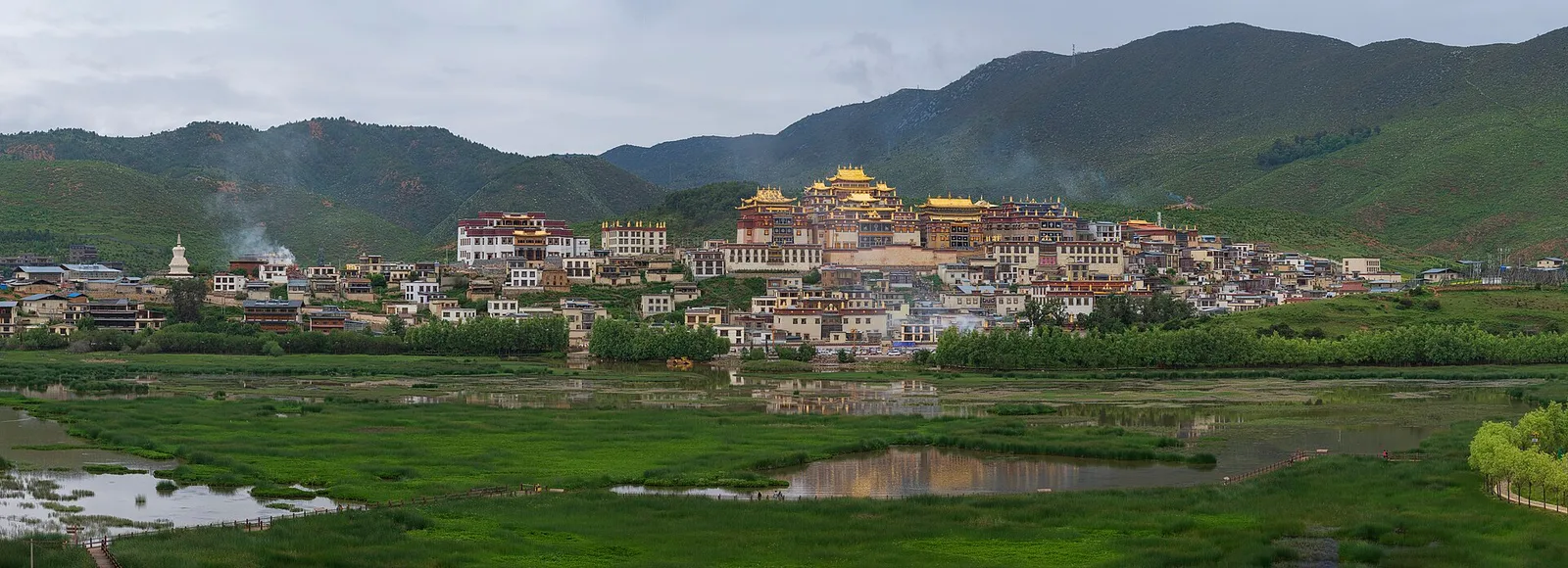
The whole monastery complex. Photo: Wikimedia Commons / CC BY-SA 4.0 — Chensiyuan. Source
The main temple halls. Photo: Wikimedia Commons / CC BY-SA 3.0 — Colin W. Source
How many steps are there to climb to Songzanlin Monastery?
No step count is published on the official scenic-area site, so we are not going to invent one for you.
What the site does publish is the thing that makes the question less important: the 90 yuan ticket includes the return sightseeing bus, so the bus is what carries you between the gate and the monastery and the climb is a choice rather than a requirement. The same ticket includes the guided commentary, which is what tells you what you are actually looking at once you are up there — the halls are a working Gelug monastery, and the commentary is the difference between a building and a building you understand.
The one number that is published, and the one that matters for how you dress, is the altitude: the complex stands above 3,300 m, with the lake in front of it at 3,282 m.
Is Songzanlin worth visiting?
Yes — if what you came to this part of Yunnan for is Tibetan Buddhist architecture and it is the largest such complex in the area. Founded in 1679, a 5A-rated scenic area, and the official site itself places it at the centre of the Gelug school for the region.
The reason to plan it properly rather than treat it as a photo stop is that the site rewards the people who slow down. The complex runs across a hillside, the lake sits in front of it, and the commentary that comes with the ticket is the difference between a quick look at gold roofs from the car and a visit you remember. The people who get the most out of it are the ones who allow a half day rather than the twenty minutes the road from Lijiang makes it look like it should be.
The honest caveat is that it is a working monastery, and it is treated as one. The visitors walk a defined route, and the commentary explains what you are being shown.
There is a second reason to come, and it is the lake. 拉姆央措湖 at 3,282 m sits immediately in front of the complex, and the gold roofs reflected in it are the shot most people leave with. The lake is one of the scenic area’s own listed points and the 90 yuan ticket is sold by the scenic area, so it belongs to the visit rather than being a separate excursion — which is a good part of why half a day is a sensible minimum and an hour is not.
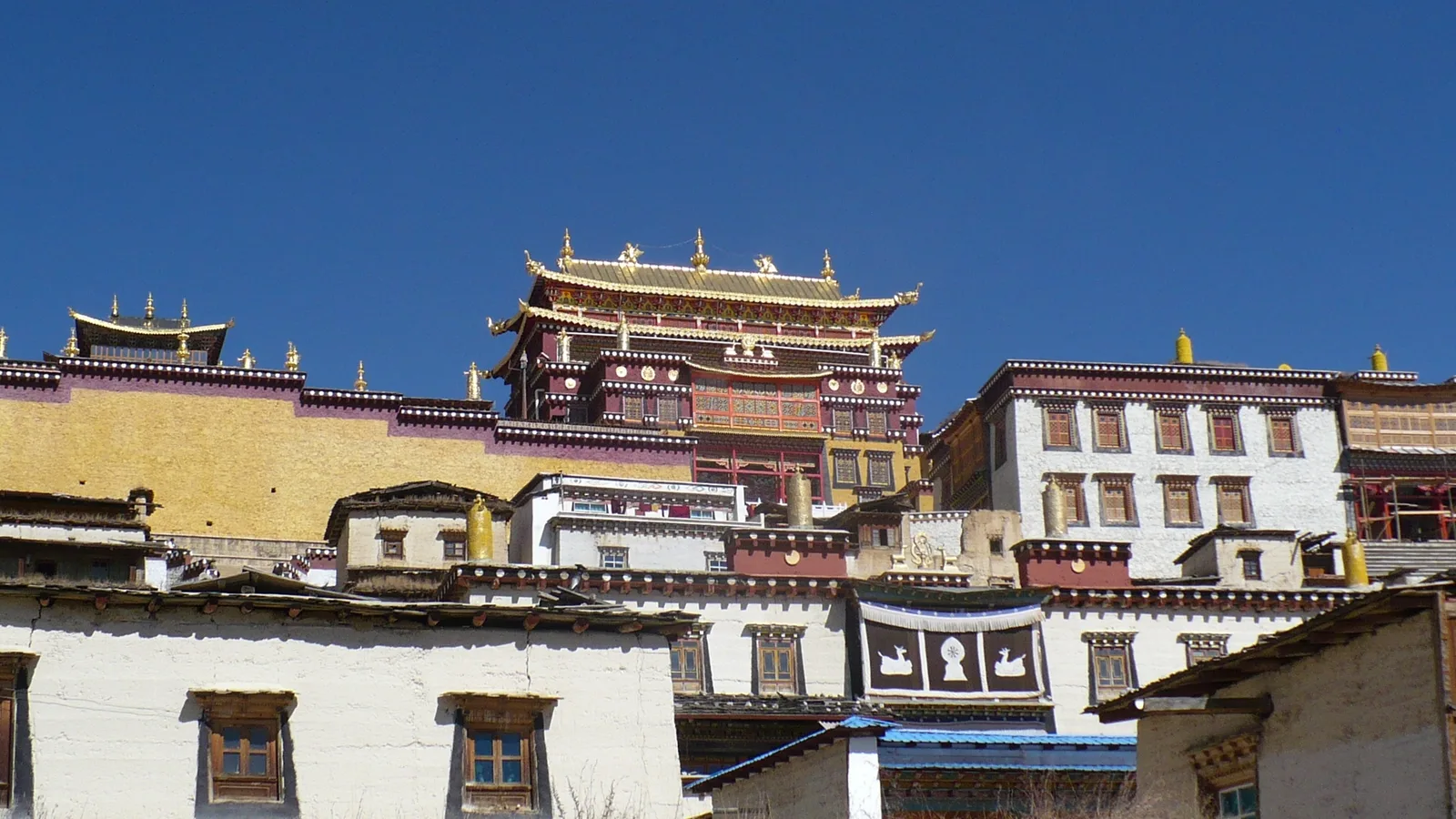
The Little Potala Palace. Photo: Wikimedia Commons / CC BY-SA 3.0 — Colin W. Source
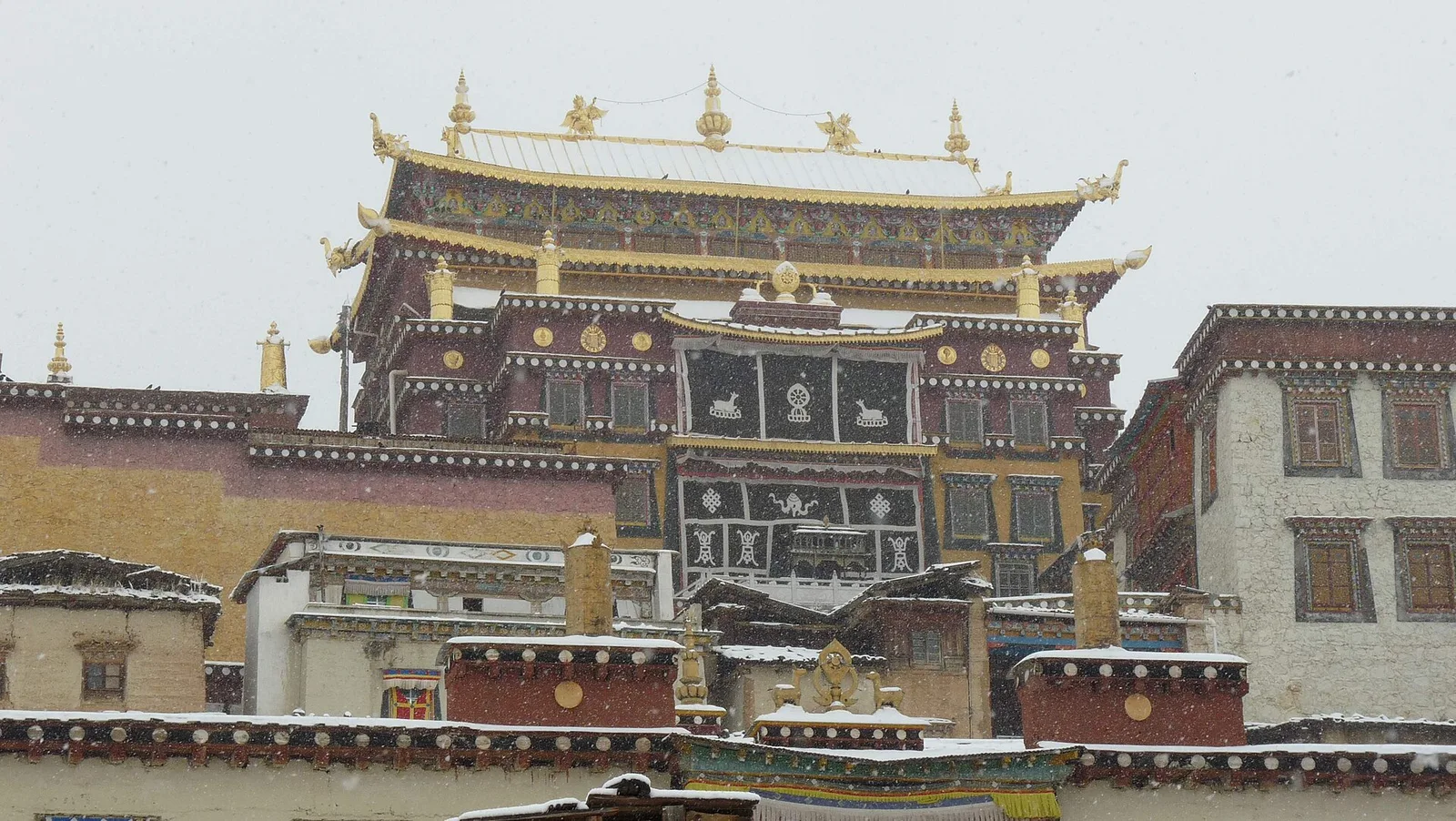
Roof details on the main halls. Photo: Wikimedia Commons / CC BY 3.0 — Caihm. Source
How long does it take to visit Songzanlin Monastery?
No visiting time is published, so the published windows are the guide:
| Published window | |
|---|---|
| Opening | Different ticketing channels publish opening times between 7:40 and 8:00 |
| Closing | Different ticketing channels publish closing times between 17:00 and 18:30 |
| Which one to plan against | The notice for the day you travel |
That is not us being vague — the official site genuinely publishes more than one window, and the honest instruction is to go by the day’s notice rather than pick one of them and treat it as the answer.
In practice, half a day is the unit that works: the 90 yuan ticket already covers the return bus and the commentary, so the complex and the lake are what the time goes on.
Getting there and getting around
| From Lijiang | About 2.5-3 hours |
| From Dukezong Old Town (独克宗古城) | Bus route 3, 2 yuan, straight to the monastery |
| Ticketing enquiries | 15758459023 |
| Scenic area line | 0887-8229411 |
| Official site | xgllszljq.cn |
Because the monastery is 2.5-3 hours from Lijiang, it is a day trip rather than an evening one — start early, and do not plan to be back in the old town for sunset. If you are coming up from Lijiang the same morning, the bus is the cheaper and simpler half of the journey: once you are in Dukezong Old Town, route 3 for 2 yuan takes you straight to the gate.
Where this fits
Songzanlin belongs to the north-west Yunnan leg of a Lijiang trip. Our honeymoon in Lijiang guide covers the city and the surrounding day trips, and the Lhasa and Tibet travel guide covers the plateau side of the same overland route if you are continuing north.
In the city itself, the closest things to pair with it are the old town and the water town: Lijiang Old Town, Shuhe Old Town, Mu Mansion, Black Dragon Pool, Lashi Lake and Jade Dragon Snow Mountain.
Also nearby
- Lijiang Old Town (丽江古城) — where most travellers sleep before the run north.
- Shuhe Old Town (束河古镇) — the quieter old town, and the quieter base.
- Jade Dragon Snow Mountain (玉龙雪山) — the same plateau landscape, on the other side of the city.
Best photo spots
-
The monastery above the lake
The whole complex spread across the hillside with the town below it — the shot the "Little Potala Palace" nickname comes from.
-
The main temple halls
The red and gold buildings of the working monastery itself, in the part of the complex that the commentary walks you through.
-
The gold roofs
The multi-tiered golden roofs that read as a smaller Potala Palace from the lake side.
Frequently asked questions
Can you enter Songzanlin Monastery?
Yes — the 90 yuan ticket includes entry, and children 1.2 m and under, visitors over 70 and disabled military personnel enter free. There is no separate foreigner rate and no passport or visa condition in what the official scenic-area site publishes; the concessions are listed by category, with discounted entry for students aged 24 and under, serving military personnel, children between 1.2 m and 1.4 m, and visitors over 60.
How many steps are there to climb to Songzanlin Monastery?
No step count is published on the official scenic-area site, so we cannot give you a number. What the site does publish is the 90 yuan ticket, which includes the return sightseeing bus — the bus is what carries you between the gate and the monastery, so the climb is a choice rather than a requirement — and the guided commentary, which is what tells you what you are looking at once you are up there. The complex stands at more than 3,300 m, above the lake at 3,282 m.
Is Songzanlin worth visiting?
Yes, if what you want is the largest Tibetan Buddhist monastery in this part of the plateau. It was founded in 1679, it is a 5A-rated scenic area, and the official site describes it as the centre of the Gelug (Yellow Hat) school and one of the largest Tibetan Buddhist monasteries in Yunnan. The visual case is the gold-roofed halls stepping down the hillside above the lake — the reason it is called the "Little Potala Palace".
How long does it take to visit Songzanlin Monastery?
No visiting time is published, so use the published windows instead: opening times run from 7:40 to 8:00 and closing times from 17:00 to 18:30 depending on the ticket channel. Half a day is the practical unit — the return sightseeing bus and the guided commentary are both inside the 90 yuan ticket, so the complex itself and the lake in front of it are what take the time.
Sources
- 香格里拉松赞林景区官方站(噶丹·松赞林寺景区保护开发有限责任公司)— 门票、开放时间与票务咨询 · xgllszljq.cn
- 松赞林景区官方站 — 景区景点:噶丹·松赞林寺(始建 1679 年、地址、开放时间、门票) · xgllszljq.cn
- Songzanlin Monastery coordinates — the site's own generated coordinates table (src/lib/attraction-coords.ts, key shangri-la::songzanlin, Wikidata + OpenStreetMap, high confidence) · Wikidata