
Chengdu Hotpot: The Local's Guide to Sichuan's Fiery Feast (2026)
Complete Chengdu hotpot guide for foreigners: how to order at a local restaurant, the 9-grid pot explained, the 3 essential dipping sauces, ingredient order, spice levels for beginners, the difference between Chengdu and Chongqing styles, and the 7 best hotpot restaurants locals recommend.
Chengdu hotpot is the dish that built Sichuan’s reputation as China’s spice capital — but the version you eat in Chengdu itself is more nuanced than the chili-heavy reputation suggests. The secret is in the broth: a slow-simmered base of beef tallow, 30+ spices, doubanjiang (fermented broad bean paste), and a dozen dried chilies that cooks for 4-6 hours before service. The result is a fragrant, complex liquid that’s spicy without being punishing, numbing without being one-note. The other Chengdu innovation is the 九宫格 (jiǔgōnggé) pot — a copper pot divided into nine squares, each with slightly different heat and oil concentration, so you can cook different ingredients in their ideal zone.
This guide covers how to order like a local, the 3 essential dipping sauces, the cooking order for ingredients, spice-level recommendations for first-timers, the Chengdu vs Chongqing distinction (for a broader Chinese hotpot overview across all 4 styles), and 7 specific hotpot restaurants that locals actually go to (not the tourist-trap chains in Chunxi Road). Pair your hotpot night with a Chengdu night market crawl for the full Sichuan after-dark experience, and time your trip to a 3-day Chengdu itinerary that includes pandas + hotpot + mapo tofu.
The 3 types of hotpot pot you need to know
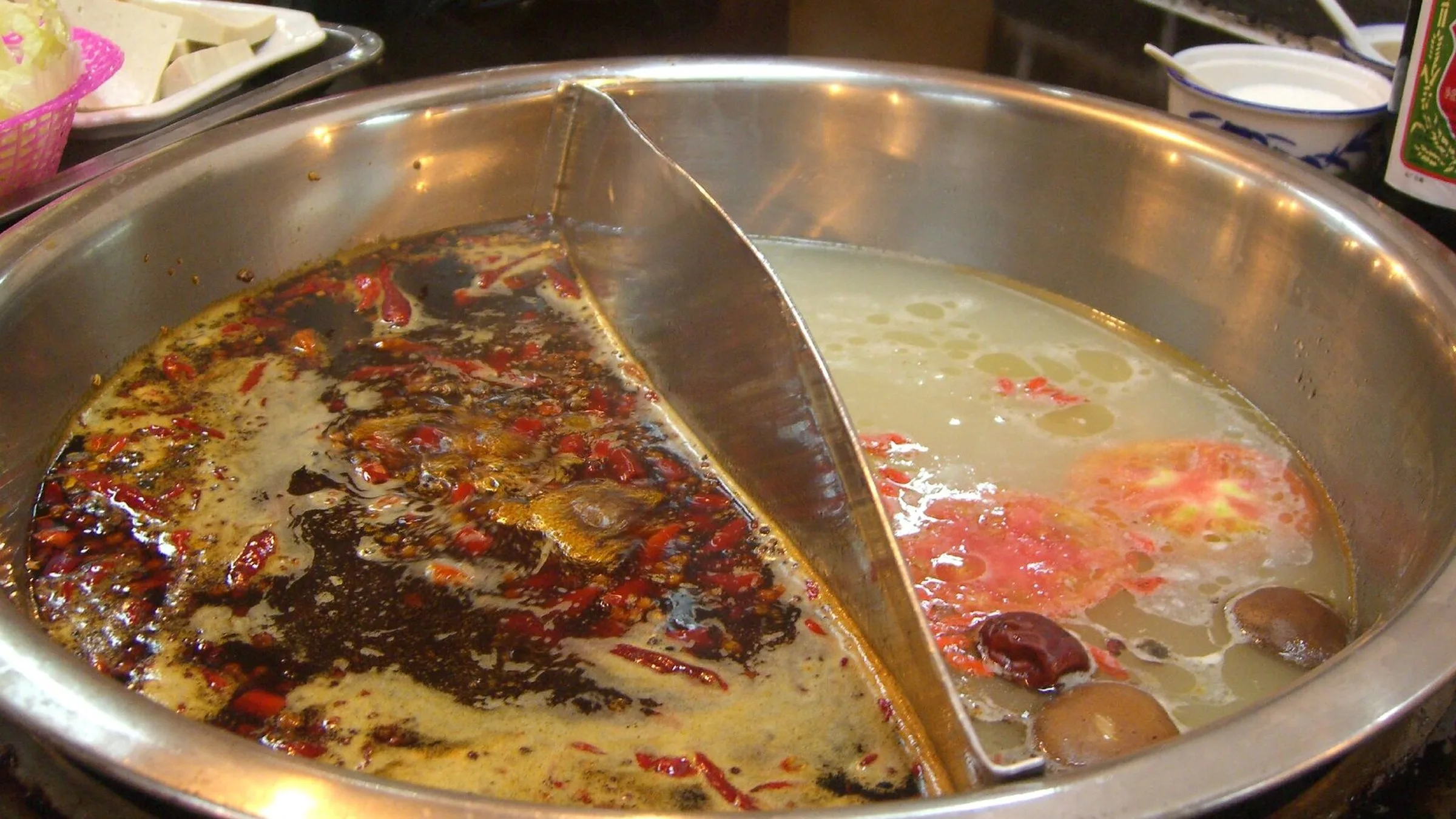
1. 鸳鸯锅 (yuānyāng guō) — half-and-half pot. The beginner’s choice. Half the pot is the spicy mala broth (red, oily, fragrant); the other half is a clear bone broth or mushroom broth (mild, sweet, savory). You can dip ingredients in either side depending on your spice tolerance. Most locals order this even when they’re spice veterans — they use the mild side for delicate ingredients like fish or leafy greens. ¥80-120 for a medium pot.
2. 九宫格 (jiǔgōnggé) — the 9-grid pot. The Chengdu classic. A copper pot divided into 9 small squares by metal dividers. The heat isn’t uniform — the center is hottest, the corners are milder. The traditional cooking method assigns each ingredient to a specific square:
- Center square (highest heat): For thin meats like beef tallow slice (毛肚) and duck intestine that need 8-12 seconds
- Cross squares (medium heat): For thicker meats like beef and lamb that need 1-2 minutes
- Corner squares (low heat): For vegetables, tofu, and ingredients that need slow cooking like quail eggs
The 9-grid system is genius for group dining — everyone cooks their own ingredients in their own square without crowding. ¥60-100 for a small pot.
3. 全红锅 (quánhóng guō) — all-spicy pot. The serious-eaters-only choice. The whole pot is the mala broth. Locals who’ve eaten hotpot all their lives often order this. As a foreigner, skip it your first three visits. ¥60-90.
How to order at a hotpot restaurant
Step 1: Choose your pot. 鸳鸯 (half-and-half) for your first visit. The waiter will ask “几位?” (how many people?) — answer with the number of diners.
Step 2: Choose your spice level. If ordering all-spicy, the waiter may ask 辣度 (làdù):
- 微辣 (wēilà) — mild (still has Sichuan peppercorn)
- 中辣 (zhōnglà) — medium
- 特辣 (tèlà) — extra spicy (locals’ default)
Step 3: Order ingredients (the fun part). Menus are usually ordered by category, and waiters will bring a marker to write on the paper menu. You mark the items and quantities, then they bring them. Categories:
- 肉类 (meat, ¥20-40/plate): 肥牛 (beef tallow slice), 羊肉卷 (lamb rolls), 毛肚 (beef tripe — the iconic 8-second cook), 鸭肠 (duck intestine), 虾滑 (shrimp paste)
- 蔬菜 (vegetables, ¥8-15/plate): 土豆片 (potato), 藕片 (lotus root), 冬瓜 (winter melon), 茼蒿 (chrysanthemum greens), 金针菇 (enoki)
- 豆制品 (tofu, ¥10-20): 豆腐皮 (tofu skin), 老豆腐 (firm tofu), 豆芽 (bean sprouts)
- 丸滑 (balls, ¥15-30): 虾丸 (shrimp balls), 牛肉丸 (beef balls)
- 主食 (carbs, ¥10-20): 手工面 (handmade noodles), 粉条 (glass noodles), 年糕 (rice cakes)
Pro tip: Start with 4-5 plates for 2 people, then order more as you go. Over-ordering is the most common mistake.
The 3 essential dipping sauces
1. Oil + garlic + cilantro (the classic, recommended for beginners). Every table has a small dish and a sauce bar. Pour the fragrant sesame oil (麻油) into your dish, add minced garlic, then a sprinkle of cilantro. The oil coats your mouth and protects it from the spice. This is the dish that lets you survive spicy hotpot.
2. Sesame paste (麻酱) sauce — northern Chinese style. If you can’t handle the oil-based sauce, the northern style is sesame paste thinned with a little vinegar, soy sauce, and sugar. Creamy, sweet, and the spice rides on top instead of attacking your tongue.
3. Dry mix — for spice lovers. Crushed dried chilies + ground Sichuan pepper + peanuts + sesame seeds + salt. The aggressive option. Locals use this when they want maximum mala sensation.
Don’t add: Soy sauce (too salty), vinegar (interferes with the broth’s flavor balance), MSG (the broth is already seasoned).
The cooking order (this matters)
Hotpot is a multi-stage process. Cooking everything at once crowds the pot and the timing goes wrong. Locals follow this sequence:
- First round (5 min): 鸭肠 (duck intestine) and 毛肚 (beef tripe) — dip in spicy broth for 8-12 seconds, then in the oil sauce. They should be slightly curled but still tender.
- Second round (5 min): 肥牛 (beef tallow slice) and 羊肉 (lamb) — these cook in 30 seconds. Dip and pull out as soon as they change color.
- Third round (10 min): Mushrooms, leafy greens, lotus root, winter melon — these need 2-3 minutes in the broth.
- Fourth round (5 min): 虾滑 (shrimp paste) and 鱼丸 (fish balls) — cook 2-3 minutes until they float.
- Final round (5 min): 粉条 (glass noodles) or 手工面 (handmade noodles) — they soak up the broth’s remaining flavor. The noodles are the best part of the meal.
Important: Never leave the pot boiling dry — add broth from the side kettle if it gets low. And never stir the pot — locals will look at you like you’ve insulted their grandmother.
Spice level advice for first-timers
Your first visit: Order 鸳鸯 (half-and-half) with mostly mild side. Even the mild side will have some Sichuan peppercorn (this is unavoidable — it’s what makes the dish Sichuan).
Your second visit: Try a 鸳鸯 with 50/50 ratio. Dip in the spicy side after dipping in the oil sauce — this coats the meat and reduces the heat.
Your third+ visit: Try 鸳鸯 with 70% spicy. The spice builds up — your palate adapts over multiple meals.
If it’s too spicy: Drink warm water or beer (not cold), eat a piece of plain white rice, or have a bite of 凉粉 (cold jelly) — a Chengdu side dish specifically served to cool the palate.
7 hotpot restaurants locals recommend
These are not the chains advertised in every travel guide. They’re independent restaurants with long-time local followings.
1. 小龙坎 (Xiǎo Lóng Kǎn) — multiple locations, Chengdu-born chain. The most famous Chengdu hotpot brand, founded 2014. Their original Chunxi Road location has a 2-hour wait at peak. Excellent 鸳鸯 pot. Signature: 冰球鹅肠 (ice-bowl goose intestine — flash-cooked, very tender). ¥120-180/person.
2. 大龙燚 (Dà Lóng Yì) — multiple locations. Another Chengdu-born chain, slightly more modern interior. Their 龙腾锅 (dragon pot) is more fragrant than spicy. Famous for 牛肉丸子 (beef balls). ¥100-150/person.
3. 川西坝子 (Chuān Xī Bà Zi) — multiple locations. Slightly more upscale, with full-table induction burners (no open flame). Slightly more expensive but excellent quality. ¥150-200/person.
4. 蜀九香 (Shǔ Jiǔ Xiāng) — multiple locations. Long-time local favorite (since 2000). Their 九宫格 (9-grid) pot is a textbook example. ¥100-140/person.
5. 皇城老妈 (Huáng Chéng Lǎo Mā) — 琴台路 Qintai Road location. Old-school Chengdu hotpot institution. Their broth is slightly more herbal than typical. The 琴台路 location has a beautiful traditional courtyard. ¥120-160/person.
6. 牛华绿叶 (Niú Huá Lǜ Yè) — 芳沁街 Fangqin Street location. Famous for 串串香 (skewer hotpot) — smaller portions, more variety, lower price. Locals come here for the casual atmosphere. ¥60-100/person.
7. 钢管厂五区 (Gāngguǎn Chǎng Wǔ Qū) — 学道街 Xuedao Street location. The most “local” option on this list. No English menu, no English-speaking staff, but the 鸭肠 (duck intestine) is legendary. For adventurous eaters. ¥80-130/person.
Pro tip: Most of these locations are walk-in only. Arrive at 5:30 PM (before the 6:30 PM rush) or 9 PM (after the 8 PM rush) to avoid the wait.
The Chengdu vs Chongqing distinction
If you’ve had hotpot outside Chengdu (especially in the US or Europe), you’ve probably had Chongqing-style. The two are very different:
| Feature | Chengdu | Chongqing |
|---|---|---|
| Broth base | Rapeseed oil + 30+ spices | Beef tallow only |
| Spice sensation | Numbing + aromatic (麻辣) | Aggressive heat (辣) |
| Typical pot | 9-grid (分区) | Single broth, no divisions |
| Ingredient style | Thin-sliced meats, vegetables | Larger cuts, more organ meats |
| Best for | First-timers, aromatic lovers | Spice veterans, intense heat seekers |
If you’re only going to try Sichuan hotpot once, do it in Chengdu. The aromatic complexity of the broth is unique to the city.
What to do the day after
You’ll be sore. Your lips may be slightly swollen. Your digestive system will be… different. Don’t plan anything too ambitious the next day. Recommended recovery:
- 早茶 (early tea) at a 茶馆 (teahouse) — Renmin Park’s 鹤鸣茶社 is iconic
- 鸳鸯 (yuānyāng — half-coffee, half-milk) or simple 美式咖啡
- 抄手 (chāoshǒu) — Chengdu wontons, a milder dish to ease back into Sichuan food
- 冰粉 (bīngfěn) — the cold jelly dessert that locals eat specifically to cool the palate after hotpot
You’ll be back to normal by lunch. The hotpot may not be, but you will be.
Book your Chengdu hotpot trip
Chengdu hotel (Jinli or Chunxi base)
Trip.com's Chengdu hotel listing with 2,000+ foreigner-friendly properties. Stay near Chunxi Road for walkable hotpot access (Shu Jiu Xiang, Xiaolongkan, Niu Niu within 1 km) or near Jinli for the touristy-but-good cluster.
Hotels from $60/night
Affiliate disclosure: We earn a small commission at no extra cost to you. See full disclosure.
Plan your trip — verified tools
These free tools are built on real, monthly-verified data and help you skip the trial-and-error phase of China trip planning:
- China 6-City 5-Day Budget Calculator — Real 2026 prices for 5 days in Beijing, Shanghai, Guangzhou, Chengdu, Xi’an, or Hangzhou. Budget / mid-range / comfort tiers, broken down line by line.
- China OTA Comparison 2026 — Trip.com vs Booking.com vs Agoda vs Klook across 5 booking types. Inventory, pricing, foreign card support, English service, per-OTA verdict.
Verified August 2026 by TravelHubChina Editorial. We re-check prices and policy details monthly so the data doesn’t drift.
Step by step
-
Pick a 鸳鸯-friendly restaurant for your first visit
Shu Da Xia (蜀大侠), Xiaolongkan (小龙坎), or any local chain works. Avoid the Chunxi Road tourist traps — look for restaurants 2-3 blocks off the main street where locals queue.
-
Order a 鸳鸯 (half-and-half) pot on your first try
Tell the waiter 鸳鸯锅 (yuānyāng guō, ¥80-120). One side is mala spicy broth, the other clear bone or mushroom broth. Ask for 微辣 (mild) if you're nervous.
-
Set up the essential dipping sauce
Small dish: 2 tbsp sesame oil + 1 tbsp chopped garlic + 1 tsp soy sauce + cilantro. Locals use this for every ingredient — it cools the palate and adds aroma. Vinegar and chili flakes are optional.
-
Cook in the right order, in the right square
If using 九宫格 (9-grid), put thin meats in the high-heat center (8-12 sec), thick meats in cross squares (1-2 min), vegetables in the corner squares. Dip cooked meat in the sauce before eating.
-
Pair with 唯怡 soy milk and warm barley tea
Avoid cold water (shocks the stomach). 唯怡 (Wéi yí) soy milk or 雪花 beer are the local drinks. Barley tea (大麦茶) is the gentlest. Total bill: ¥120-180/person.
FAQ
-
Is Chengdu hotpot too spicy for first-timers?
Order a 鸳鸯 (yuānyāng) pot, which is half-spicy and half-bone-broth. The mild side lets you ease in. You can also ask for 微辣 (mild) or 鸳鸯 with mostly mild broth. Locals won't judge — they remember being first-timers too. -
How much does hotpot cost in Chengdu?
¥80-150 per person for a full meal including drinks. The base pot is ¥50-100, ingredients ¥10-40 per plate (vegetables ¥10-15, meat ¥20-40). Avoid peak hours (6-8 PM) to skip the queue. -
What's the difference between Chengdu and Chongqing hotpot?
Chongqing uses pure beef tallow (numbing, aggressive) and is much oilier. Chengdu is more aromatic — uses rapeseed oil + 30+ spices + herbs, less aggressive on the palate, more fragrant. Most foreigners find Chengdu more approachable. -
Do I need to know Chinese to order?
Most popular hotpot chains (Shu Da Xia, Xiaolongkan) have picture menus. At independent restaurants, you can point to what others are eating. Trip.com's Chengdu food tour includes an English-speaking guide who orders for you. -
How long does a hotpot meal take?
Plan 1.5-2 hours. The cooking itself is part of the social experience — you'll cook each ingredient 30 seconds to 5 minutes depending on type. Locals eat slowly and chat between rounds. -
Can vegetarians eat hotpot?
Yes, very well. Vegetable options include lotus root (¥10), potato slices (¥8), mushroom medley (¥15), tofu skin (¥10), and winter melon (¥8). Order the bone-broth side of the 鸳鸯 pot — completely meat-free. -
Why does hotpot make my mouth numb?
That's Sichuan peppercorn (花椒, huājiāo). It's the signature Sichuan spice and contains hydroxy-alpha-sanshool which creates a tingling/numbing sensation. It's not dangerous — locals call it 麻 (má) and consider it a flavor, not a side effect. Drink warm water or beer to reset your palate. -
What drink pairs with hotpot?
Cold beer (local 雪花啤酒) or 唯怡 soy milk (slightly sweet, cools the palate). Avoid cold water — it shocks the stomach. Warm water or barley tea (大麦茶) is gentlest. Don't drink hot tea — it amplifies the spice.
Related guides
- Food & Dietary
Mapo Tofu: The Authentic Sichuan Dish (Recipe Origins + 5 Best Places in Chengdu)
Complete guide to authentic mapo tofu: the 1862 origin story, what makes a real mapo tofu vs. a Western imitation, the 7 essential ingredients (doubanjiang, Sichuan peppercorn, etc.), where to find the original Chen's Mapo Tofu in Chengdu, and 4 other historic restaurants that locals still visit for this iconic dish.
7min read
- Food & Dietary
Chengdu's Three Famous Snacks: Dan Dan Noodles, Zhong Dumplings, Long Chao Shou (2026)
Complete guide to Chengdu's iconic snack trio: 担担面 (dan dan noodles), 钟水饺 (Zhong dumplings), and 龙抄手 (Long chao shou). Includes each dish's history, where to find the original restaurants, how to order, what they taste like, average prices, and how these local dishes differ from their national imitations.
7min read
- Food & Dietary
Chengdu Night Markets: Where to Eat After Dark (2026 Local's Guide)
Complete guide to Chengdu's best night markets and evening food streets: 玉林 Yulin, 建设路 Jianshe Road, 奎星楼街 Kuixinglou, 锦里 Jinli, 宽窄巷子 Kuanzhai Alley, and the in-park night markets. Includes what to eat at each, opening hours, how to avoid tourist traps, average prices, and the 12 specific dishes to try.
8min read
- Food & Dietary
China Food by City: 8 Cities, 24 Iconic Dishes
A guide to Chinese regional food by city — the 8 most foodie-worthy cities for foreign visitors, the 3 iconic dishes in each, and where to find them. Beijing, Shanghai, Chengdu, Guangzhou, Hong Kong, Xi'an, Hangzhou, Chongqing.
14min read
- Food & Dietary
Street Food in China: 20 Safe Dishes for First-Timers
20 iconic Chinese street foods with pinyin, English names, what they taste like, regional origin, average price in USD, and which ones are safe for first-time visitors. Plus food-safety rules.
10min read
- Food & Dietary
Chinese Hotpot Guide: 4 Styles + How to Eat It
A practical guide to Chinese hotpot (火锅) for foreign visitors — the 4 main styles (Sichuan, Chongqing, Beijing, Cantonese), how to eat it, the 20 essential ingredients, and where to try it in each city.
11min read