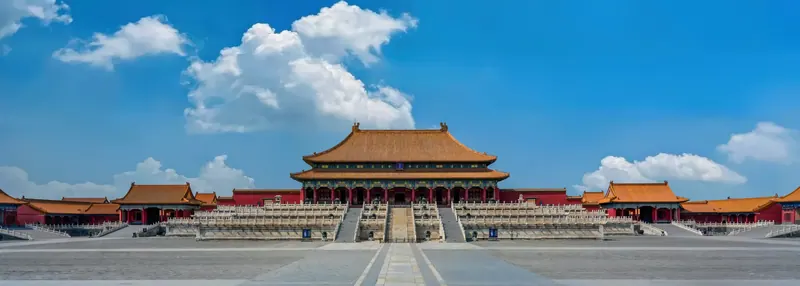
Xidi Ancient Village
西递村 · Xīdì
Quick answer
Carry your passport for the ticket category. Two things that surprise people here: cars are not permitted on the old streets at all, so there is no parking-and-walking convenience you may have had elsewhere, and a considerable number of the people you will see painting in the lanes are art students living in the village rather than tour groups. Many small restaurants let you walk into the kitchen and point at what you want eaten, so ask the price before you order rather than after.
Why visit
- 1 First built in the Song dynasty between 1049 and 1053 and originally called Xichuan, the West River, after the streams that run through it
- 2 Inscribed by UNESCO in 2000 jointly with Hongcun, under criteria iii, iv and v, for the survival of a medieval village plan rather than for individual buildings
- 3 224 ancient residential buildings spanning the 14th to 19th centuries, 124 of them well-preserved Ming and Qing timber houses with carved beams and panels
- 4 The Hu Wenguang Memorial Arch, a Ming-dyasty stone paifang carved with deer, cranes, tigers, lions and the Eight Immortals
- 5 A merchant village at its height in the 18th and 19th centuries, when it held about 600 residences before the collapse of the Anhui trading houses
- 6 Quieter and less crowded than Hongcun, with cars banned from the old streets and a large resident population of art students
Essential tips for foreigners
- Get the orientation right before you plan the day. Xidi is the southern village and Hongcun is the northern one, about 11 km apart. Buses run the corridor and stop at Xidi on the way to Hongcun, which is the usual source of the reversed impression.
- Buy the ticket at the west entrance. There are many entrances into the village and most of them only check tickets, but the west entrance is the one that sells them.
- The buildings inside are free. Once you have paid for the village, the halls and merchant residences are free to enter, so the marginal cost of looking at more of them is nothing.
- No cars in the old streets. Park outside and walk; the lanes are granite-flagged and flat, but closed to traffic.
- Stop at the rice wine brewery just inside the entrance for free tastings before you buy anything, and ask the price before you order in the small restaurants.
Suggested route
- 09:00 30 min Arrive at the west entrance, which is the one that sells tickets, and buy village admission before walking in
- 09:30 30 min Walk the main east-west street with its two parallel lanes and the narrow alleyways joining them
- 10:00 30 min Go to the Hu Wenguang Memorial Arch in the south-west of the village and look at the stone carving on the arch
- 10:30 45 min Cross to the Hall of Respect (敬爱堂) and the Hall of Reminiscence (膺福堂), the public halls that anchor the small open spaces in the plan
- 11:15 1 hour Walk into the lanes behind the main street where the 124 preserved Ming and Qing timber residences are, several of which are open
- 12:15 1 hour Eat in one of the small restaurants; you can usually walk into the kitchen and point at what you want
- 13:30 30 min Taste the rice wine at the brewery a short way inside the entrance, where the tastings are free
- 14:00 1 hour Loop back towards the south gate as the daytime groups thin out and the art students still working in the lanes become the main activity
The southern village of the UNESCO pair
Xidi is the quieter and, in architectural terms, the more concentrated of the two villages that UNESCO inscribed together in 2000 as the Ancient Villages in Southern Anhui. It is also the southern one, about 11 km below Hongcun on the map, and that ordering is worth getting right before you plan a day, because it is very commonly stated the other way round.
The confusion is understandable. Coaches on the corridor between Huangshan city and the villages stop at Xidi on the way to Hongcun, and several write-ups imply the reverse geography. Three independent coordinate sources and the administrative boundary of Xidi Town all agree: Hongcun is at 30.00 degrees north, Xidi is at 29.90, and Xidi is lower.
What the village was originally called is a useful corrective to the modern tourist framing. It was built during the Huangyou era of Emperor Renzong, between 1049 and 1053, and it was called Xichuan, the West River, after the streams that run through it. The name Xidi, Western Post or Western Delivery, refers to the courier station that the settlement grew up around.
Photo: Wikimedia Commons / CC BY-SA 4.0 (EditQ). Source
What is Anhui famous for?
Anhui’s headline draw for most itineraries is the Huizhou region around Huangshan City, and the part international visitors actually queue for is its UNESCO-listed villages — Xidi and Hongcun, inscribed together in 2000 under criteria iii, iv and v for the survival of a medieval village plan rather than for any individual building.
The second thing Anhui is known for is the architecture that plan produced: tall white walls, carved roof ridges, granite-flagged lanes, and merchant houses with timber frames and carved beams and panels. Xidi still holds 224 ancient residential buildings, of which 124 are well-preserved Ming and Qing timber houses, and the village was founded between 1049 and 1053 — which is why the plan on show today is medieval rather than reconstructed.
The third is food, and the list is short and specific: Huangshan baked flatbread as the local staple, stinky mandarin fish as the celebrated Anhui dish, river fish from the small streams, Wucheng dried tea cake, and Huizhou-style tea and sweet pastries. Anhui also has one of the most recognisable pieces of stonework in the south — the Ming-dynasty Hu Wenguang Memorial Arch in Xidi, carved in relief with deer, cranes, tigers, lions and the Eight Immortals.
Huangshan city itself is the base for both the villages and the rest of the region, and it is where you will be before the coach leaves: Tunxi Old Street is the working street at its centre, and an easy stop either side of the village run.
Is Xidi north or south of Hongcun?
South — Xidi is about 11 km below Hongcun on the map. Hongcun sits at 30.00 degrees north and Xidi at 29.90, and three independent coordinate sources agree on that ordering: Wikidata gives Xidi at 29.904444 / 117.9875, the OpenStreetMap village node at 29.9061111 / 117.9912865, and the English Wikipedia infobox at 29.9033 / 117.9960.
The confusion has an obvious cause. Coaches running the corridor between Huangshan city and the villages stop at Xidi on the way to Hongcun, so most people meet Xidi first and remember it as the place they passed through on the way to somewhere else. The administrative boundary says the same thing the map does: Xidi sits in Xidi Town (西递镇), a separate town from Hongcun Town, and both villages are in Yi County (黟县) — not She County, which is the home of Huizhou Ancient City, a different site entirely.
The ordering matters in one practical way if you are planning transport: tickets for Xidi are sold only at the west entrance, and the staffed buildings inside the village close to visitors in the late afternoon, so arriving on the Hongcun leg of the coach run can leave you entering the village at the wrong end with too little light to do it justice.
A merchant village that peaked and then stopped
The shape of Xidi’s history explains almost everything about it. The village was founded by a single family, the Hu, whose line descends from Hu Shiliang of Wuyuan, itself descended from an imperial son of the Tang dynasty adopted into a local family. The village rose as the Hu family rose.
By 1465, during the Ming, family members were trading as merchants and could afford both major private buildings and public infrastructure. By the middle of the seventeenth century the family’s influence had moved out of commerce and into politics. The prosperity peaked in the eighteenth and nineteenth centuries, when the village held about six hundred residences.
Then it stopped. The disintegration of the feudal system in China and, specifically, the decline of the merchant communities across Anhui ended the expansion late in the nineteenth century. That is the reason the village looks the way it does. It was not designed as a museum and then preserved; it stopped growing, and then it was protected, and the fabric that survived is the fabric of a specific and fairly short commercial peak.
What UNESCO actually inscribed
The inscription covers criteria iii, iv and v, and the interesting part is what is being protected: a medieval rural settlement plan, still intact. That is why the things to look at are the street geometry and the water, not only the buildings.
The plan is a main road running east-west, flanked by two parallel streets, with a dense mesh of narrow alleyways joining them. The paving is original Yi County granite. The houses cluster around three streams. And the small open spaces are deliberately confined to the areas immediately in front of the major public buildings, the Hall of Respect, the Hall of Reminiscence and the archway.
Inside that frame are 224 ancient residential buildings dating from between the fourteenth and nineteenth centuries. Of those, 124 are well-preserved timber houses from the Ming and Qing dynasties with carved beams and panels, and they are the major attraction. The typical residence is a central courtyard surrounded by symmetrical bays of rooms, and many of them are open to the public.
How long do I need at Xidi?
About three hours on foot is the honest figure, and it is a short visit compared with the effort of getting there. Xidi is compact and flat, the lanes are pedestrian-only, and the ticket you pay gets you into the buildings as well as the lanes — so the time goes on looking rather than on walking. A typical morning fills those three hours with specific stops: 30 minutes at the west entrance and along the main east-west street, 30 minutes at the Hu Wenguang Memorial Arch, 45 minutes across the Hall of Respect and the Hall of Reminiscence, and an hour in the lanes behind the main street where the 124 preserved Ming and Qing timber residences are — with lunch and the free rice wine tasting just inside the entrance after that.
Three hours is also the floor rather than the target. If you want the 224 ancient residential buildings rather than a taste of them, budget the full morning: the point of the place is the quantity of carved beams and panels, and the lanes behind the main street are where that quantity is.
If you are combining the two villages, the practical version is half a day at Xidi and the rest of the day at Hongcun. They are about 11 km apart, so both fit in a long day, and since the west entrance is the one that sells tickets, get the admission sorted before you walk in.
Two buildings worth the detour
The Hu Wenguang Memorial Arch stands in the south-west of the village. It is a Ming-dynasty stone paifang built in memory of Hu Wenguang, a Ming official from the village, and it is carved in relief with deer, cranes, tigers, lions and the Eight Immortals of Chinese legend. It is one of the most recognisable pieces of stonework in southern Anhui and it is the reason many people come to Xidi specifically rather than for the plan.
The Da Fu Grand House was built during the Qing dynasty on the main street. The doors of its main hall are carved with plum blossom patterns and the windows with paper cuts in the Ming manner. It is no longer a private house; it is used for local performances, including a traditional throwing-embroidered-ball piece. It is a good example of a merchant house that has been repurposed rather than evacuated.
Cars, gates and where to buy
Two practical mechanics catch people out.
No cars are permitted on the old streets. You park outside the village and walk in. The lanes are flat, granite-flagged and entirely pedestrian, so this costs you nothing except the walk.
Tickets are sold at the west entrance only. The village has many entrances into it and most of the others will simply check a ticket you already hold. If you have not bought one, the west entrance is where it happens, and it is worth knowing which end you are starting from before you set off.
The third mechanic is a pleasant surprise: the buildings inside the village are free. Your admission buys the village, and the halls and merchant residences are open at no extra charge. There is no per-building ticket counter. That means the cost of looking at four houses instead of two is zero, which is not true at most Chinese heritage sites.
The coaches that serve both villages come out of Huangshan city, and the same city is the base for Huangshan Yellow Mountain — the mountain is the other reason people come to this part of Anhui, and the villages are the slower half of the same trip.
How much does Xidi cost?
Village admission is around ¥104, and you should know that a figure of ¥105 is also in circulation — we could not reconcile the two, so treat ¥104 as the working number and check at the gate. Village admission is the only charge: the individual halls and residences inside are free to enter, so there is no per-building counter and the marginal cost of looking at four houses instead of two is zero. The rice wine tasting just inside the entrance is free as well.
What you are buying with that ticket is the village itself: the east-west main street with its two parallel lanes, the narrow alleyways joining them, the original Yi County granite paving, and access to the 224 ancient residential buildings, 124 of them well-preserved Ming and Qing timber houses, several of which are open to the public. A tight budget should not weigh that against a paid attraction elsewhere — one village admission is the whole cost of the heritage walk.
The one practical cost is time and transport rather than entry. Xidi sits in the historical Huizhou region about 11 km south of Hongcun, and if you are coming from Huangshan city on a coach, plan to be at the west entrance early: the staffed buildings inside the village close to visitors in the late afternoon.
The students are residents
A large number of art students live in Xidi, and they are the reason the daytime lanes look the way they do. Eeasels and paintboxes line the streets, and they are not there for tourists. This is the single biggest difference in atmosphere between Xidi and Hongcun, which is busier and more commercial.
Combined with the fact that there are fewer daytime coach groups here than in Hongcun, the result is a village that is busy but not crowded, and that goes properly quiet in the evening when the groups have left and the students are still working.
Should I see Xidi or Hongcun?
They are different rather than one better, and the difference is architectural rather than about quality. Xidi is the quieter of the pair, denser in carved merchant houses, and it has the Ming-dynasty Hu Wenguang Memorial Arch — a stone paifang carved in relief with deer, cranes, tigers, lions and the Eight Immortals, and the reason a lot of people come to Xidi specifically rather than for the plan. Hongcun has the water system, the ponds and the more famous photographs.
Atmospherically the gap is wider than the distance. Xidi has fewer daytime coach groups, and a large number of the people you will see painting in the lanes are art students living in the village rather than tour groups; in the evening, when the groups have gone, the lanes go quiet. Hongcun is busier and more commercial. If you have a long day, do both — they are about 11 km apart on the same coach corridor. If you have time for one, Xidi is the one that rewards a slower visit, and it is also the smaller commitment: one ¥104 village admission, with the halls and residences inside free to enter.
| Aspect | Xidi | Hongcun, for comparison |
|---|---|---|
| Position | About 11 km south of Hongcun, at 29.90 N | About 11 km north of Xidi, at 30.00 N |
| Admission | ¥104 village ticket, with ¥105 also quoted; the halls and residences inside are free to enter | Not covered on this page |
| Signature sight | The Ming-dynasty Hu Wenguang Memorial Arch | The water system, the ponds and the more famous photographs |
| Atmosphere | Quieter, fewer daytime coach groups, resident art students in the lanes | Busier and more commercial |
| Getting there | Coaches between Huangshan city and the villages stop here on the way to Hongcun | The same corridor runs 11 km further north |
| Time on the ground | About 3 hours on foot | Both villages fit into one long day, 11 km apart |
Two practicalities decide it for most people. Tickets for Xidi are sold at the west entrance only, and the village’s staffed buildings close to visitors in the late afternoon, so Xidi rewards an early start. And the photography is different in kind: Xidi is a medieval street grid of lanes and alleyways, while Hongcun’s draw is the water system and the ponds.
If the comparison sends you north rather than south, our page on Hongcun covers the ponds and the water system in the same detail.
What to eat, and how to order it
There are many small restaurants in the village, and the local custom is helpful: you can usually walk into the kitchen and point at the ingredients and the dish you want. The advice that matters with that system is to ask the price before you order rather than discovering it afterwards.
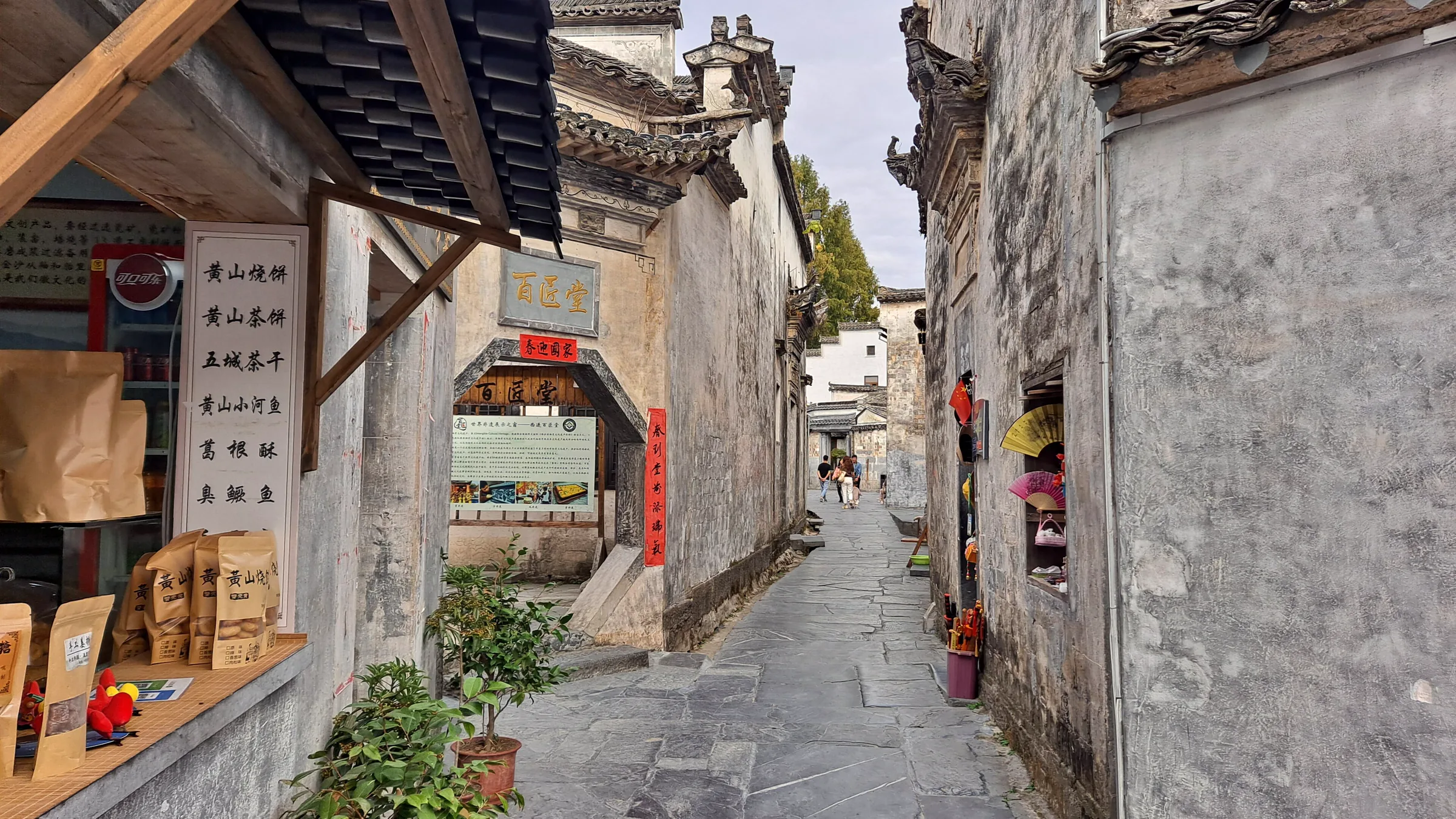
The food in the lane photographs is the same food on most tables. Huangshan baked flatbread is the local staple and you will see it being sold from paper bags on the street. Stinky mandarin fish, the celebrated Anhui dish, appears on the handwritten menus along with river fish from the small streams, Wucheng dried tea cake, and Huizhou-style tea and sweet pastries.
Just inside the entrance there is a rice wine brewery where you can taste several kinds free before committing to buying a bottle, which is the sensible order of operations.
Best photo spots
-
The Hu Wenguang Memorial Arch in the south-west · Mid-morning, when the carving has raking light across it
The village's signature monument. Arrive early enough to get past the groups and close enough to read the carved animals and immortals on the stone, which is the point of the structure.
-
The main east-west street looking along its length · Late afternoon, when the light comes down the street rather than across it
The plan is a main street with two parallel streets and narrow alleyways between them. Shot down the axis, the granite paving, the tall white walls and the roofline of carved ridges stack into a strong depth composition.
-
The lanes behind the main street · Late morning, when the easels are set up
Where the preserved timber residences are, and where the resident art students work. This is the part of Xidi that looks like a working village rather than a stage set.
-
The Hall of Respect (敬爱堂) frontage · Morning
One of the three public buildings that the village plan deliberately leaves open space in front of, which is what makes the tight lane structure legible when you stand in the square.
Frequently asked questions
How much does Xidi cost?
Village admission is around ¥104, though a figure of ¥105 is also in circulation and we could not reconcile the two, so check at the gate. The important part is what is included: once you have village admission, the individual halls and residences inside are free to enter.
Is Xidi north or south of Hongcun?
South, by about 11 km. Hongcun is at 30.00 degrees north and Xidi is at 29.90. Several write-ups imply the reverse because the coach corridor runs through Xidi on the way to Hongcun. Both villages are in Yi County, in separate towns, and Xidi is the lower of the two.
How long do I need at Xidi?
About three hours. It is compact and flat, the streets are pedestrian-only, and the ticket you pay gets you into the buildings as well as the lanes, so the time goes on looking rather than on walking.
Should I see Xidi or Hongcun?
They are different rather than one better. Xidi is quieter, has the best surviving carved merchant houses and a Ming archway; Hongcun has the water system, the ponds and the more famous photographs. They are about 11 km apart so both fit in a long day, but if you only have time for one, Xidi is the one that rewards a slower visit.
What is the Hu Wenguang archway?
A Ming-dyasty stone paifang in the south-west of the village, built in memory of Hu Wenguang, a Ming official from the village. It is carved with deer, cranes, tigers, lions and the Eight Immortals, and it is one of the most recognisable structures in southern Anhui.
Are there cars in Xidi?
No. Cars are not permitted on the old streets, so you park outside the village and walk in. The lanes are flat granite paving.
Why is Xidi so busy with students?
Because people live and study there. A large number of art students are resident in the village, which is why you will see easels and paintboxes in the lanes through the day. In the evening, when the groups have gone, the streets go quiet.
Sources
- Xidi — English Wikipedia (first built in the Huangyou era 1049-1053 under Emperor Renzong and originally called Xichuan after the water courses through it, the Hu family descent from Hu Shiliang of Wuyuan, the Ming-dyasty archway to the Ming official Hu Wenguang carved with deer cranes tigers lions and the Eight Immortals, the Qing-dyasty Da Fu Grand House now used for local performances, the east-west main street with two parallel streets and narrow alleyways paved in Yi County granite, 224 ancient residences of which 124 are well-preserved Ming and Qing timber houses, UNESCO 2000) · Wikipedia
- Xidi — Wikidata Q4010 (village in Yi County, Huangshan, Anhui; coordinate 29.904444 / 117.9875) · Wikidata
- Xidi — Wikivoyage (¥105 village admission with the buildings inside free, tickets sold only at the west entrance and the many other entrances merely checking them, cars not permitted on the old streets, tourist buses from the terminal by Huangshan North railway station stopping at Xidi on the way to Hongcun, art students painting in the daytime and the lanes going silent at night, the rice wine brewery just inside the entrance, the valley colouring in late October and early November) · Wikivoyage
- Ancient Villages in Southern Anhui - Xidi and Hongcun — UNESCO World Heritage Centre (the joint inscription of the two villages, criteria iii, iv and v) · UNESCO World Heritage Centre
- Xidi on OpenStreetMap (village node 8431654085 at 29.9061111 / 117.9912865, and the boundary of Xidi Town spanning 29.85-29.98 N, which places the village south of Hongcun at 30.00 N) · openstreetmap.org
- File:Xidi, Anhui 19.jpg — Wikimedia Commons (CC BY-SA 4.0, EditQ), the source file for the hero image of a lane in Xidi · Wikimedia Commons