
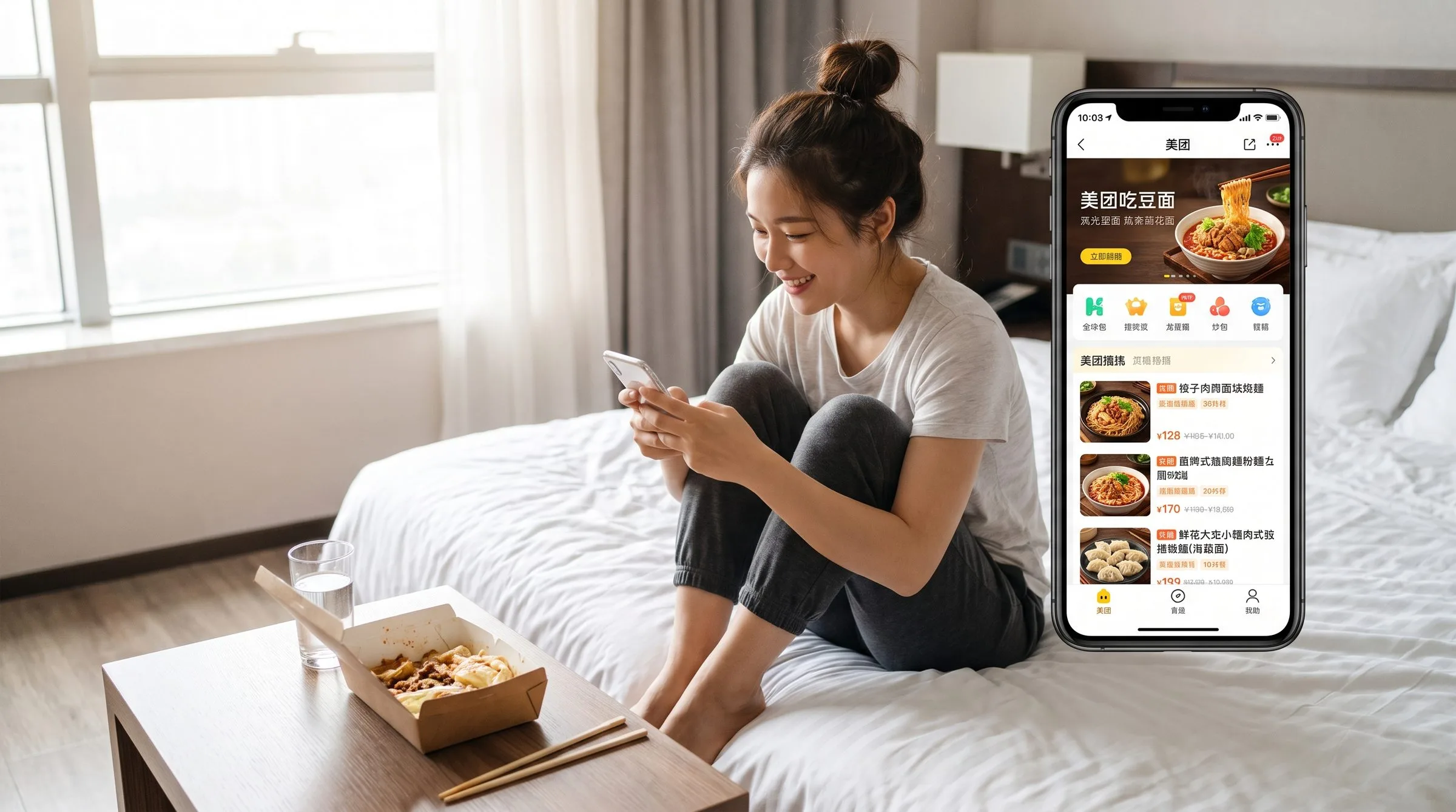
Meituan and Eleme: Ordering Food Delivery in China (2026)
Meituan and Eleme dominate Chinese food delivery — 95% of the market. Both accept foreign Visa/Mastercard via Alipay-linked accounts from 2026.
Two apps dominate Chinese food delivery: Meituan (美团) and Eleme (饿了么). Both accept foreign Visa/Mastercard via Alipay. Here’s how to use them in 5 minutes.
The apps themselves are half the problem - Meituan and Dianping are the same company’s two products and the choice between them matters more than anything else on this page.
Which to install
| App | Coverage | Best for |
|---|---|---|
| Meituan (美团) | All major cities, 70% market share | Restaurants, groceries, hotels, tourist areas |
| Eleme (饿了么) | All major cities, 25% market share | Late-night food, 24/7 convenience stores, Haidilao delivery |
Recommendation: Install both. They take 30 seconds each to install and don’t conflict. Most Chinese users have both.
The 8 standard Chinese phrases for food delivery
Save these in your phone’s notes:
| English | Chinese | Pronunciation |
|---|---|---|
| I’m allergic to nuts | 我对坚果过敏 | wǒ duì jiānguǒ guòmǐn |
| I’m allergic to seafood | 我对海鲜过敏 | wǒ duì hǎixiān guòmǐn |
| I’m vegetarian | 我是素食者 | wǒ shì sùshí zhě |
| No spice | 不要辣 | bú yào là |
| Less salt | 少盐 | shǎo yán |
| No MSG | 不要味精 | bú yào wèijīng |
| Please deliver to the front desk | 请送到前台 | qǐng sòng dào qiántái |
| Leave at the door, no contact | 放在门口,不要按门铃 | fàng zài ménkǒu, bú yào àn ménlíng |
5 things that surprise foreigners
- The delivery fee is not optional — ¥1-3 for most orders, added automatically. You cannot opt out. It’s considered a “tip built into the price” by most Chinese users.
- There’s no rating system for restaurants like Yelp — Meituan and Eleme have ratings, but they’re aggregated from all Chinese users, so a 4.5 in Meituan is roughly equivalent to a 4.5 on Google Maps. Trust the photos more than the reviews.
- Foreigners pay 5-15% more than locals — Chinese bank accounts get “full reduction” discounts (满减) like 满50减15 (spend ¥50, get ¥15 off). Foreigners without Chinese bank accounts don’t qualify. The advertised price is what you pay.
- Tip is not expected — don’t add a tip. The delivery fee is the only cost beyond the food price. Tipping in China is reserved for hotel bellhops and private guides.
- The map shows the rider’s actual GPS location in real time — refreshing every 5-10 seconds. You’ll see the rider stop at restaurants, pick up other orders (rider may have 3-4 orders on one trip), and finally head to your address.
What you can order (not just food)
- Restaurants — local restaurants, chains, fast food, hot pot
- Convenience stores — 7-Eleven, Lawson, FamilyMart, 24/7
- Groceries — fresh produce, packaged food, alcohol
- Pharmacy (药店) — over-the-counter medicine, but prescription requires Chinese hospital visit
- Flowers — within 1-2 hours delivery, ¥50-200
- Hot pot ingredients — Haidilao delivery in 30+ cities, ¥150-300
- Coffee — Luckin, Manner, %Arabica, ¥15-30 per cup
- Bubble tea — HEYTEA, Nayuki, Mixue, ¥10-20
How long does delivery take?
- Urban tier-1 (Beijing, Shanghai, Guangzhou, Shenzhen): 25-40 minutes
- Tier-2 cities (Chengdu, Hangzhou, Wuhan): 25-45 minutes
- Tier-3 and below: 30-60 minutes
- Late night (11pm-6am): 40-75 minutes (fewer riders)
- Rush hours (12-1pm, 6-7pm): 35-55 minutes (more traffic, more orders)
- 24/7 convenience stores: 30-50 minutes anytime
What’s the cost like?
A typical food delivery order in 2026:
- Restaurant meal (single person): ¥25-50 for noodles/rice bowl; ¥50-100 for hot pot or full dinner
- Coffee: ¥15-30 per cup
- Groceries (small basket): ¥30-80
- Pharmacy item: ¥10-50
Add ¥1-3 delivery fee per order, ¥2-5 for the platform service fee (if not VIP). Most orders have a minimum spend of ¥20.
Related guides
- Alipay for Foreigners 2026 — Required setup
- WeChat Pay for Foreigners — Alternative payment setup
- Cash or Card in China 2026 — When to use what
- First Time in China 2026 — Full first-trip setup
Step by step
-
Set up Alipay with your foreign Visa or Mastercard (do this first, 5 min)
Both Meituan and Eleme use Alipay as the default payment method. You need Alipay installed, set up with your passport, and linked to a foreign Visa or Mastercard. If you haven't done this, follow the Alipay for Foreigners 2026 guide. Without Alipay, the food delivery apps accept only UnionPay cards (rare for foreigners) or WeChat Pay (more complex setup).
-
Install Meituan (recommended for foreigners)
Download Meituan (美团) from the App Store or Google Play. Open the app, tap the profile icon (top right), then tap the phone number field. Enter your international phone number (with country code, e.g., +1 555 123 4567). You'll receive a 6-digit SMS code — enter it. The app may ask for a 'real name verification' — enter your passport name as it appears. Once logged in, tap the 'Pay' tab and link your Alipay account. Meituan is more foreigner-friendly because it has more English UI elements and a larger international restaurant selection.
-
Set your delivery address (the only foreigner-specific gotcha)
Go to the home screen, tap the address bar at the top, then tap the + button. You can type the address in English and the app will suggest Chinese addresses, OR you can paste the Chinese address of your hotel (from your Trip.com/Booking.com confirmation). The map will show your location. Add a 'note' in the 'note to rider' field: '请送到[hotel name]前台' (please deliver to the front desk of [hotel name]). This is the universal instruction for hotel delivery in China — the rider will go to the front desk, not try to enter your room.
-
Browse and order (with or without English UI)
Both apps have a '美食' (food) section with restaurants near you. Most menus are in Chinese with photos — the photos are usually the easiest way to identify dishes. Tap a dish to add to cart, then tap the cart icon (bottom right) to review. The 'note to restaurant' field is where you put dietary restrictions in Chinese (I have 8 standard phrases below). When ready, tap '提交订单' (place order). The app will ask for payment method — confirm Alipay is selected, and the app will redirect to Alipay to confirm.
-
Track your order and tip (don't tip)
After placing the order, you'll see a map with the rider's location and estimated arrival time. Most deliveries take 25-40 minutes. Don't tip — it's not customary in China for food delivery. The app adds a ¥1-3 'delivery fee' (配送费) automatically. If the rider calls you, your phone will show a Chinese number; you can use Google Translate's voice mode to answer, or just say '请送到前台' (please deliver to the front desk).
-
Use Eleme for 24/7 convenience store delivery (Haidilao, Lawson, 7-Eleven, etc.)
Eleme (饿了么) has stronger coverage of 24/7 convenience stores and late-night food. If you need a midnight snack, late-night pharmacy, or a Haidilao hot pot delivery, Eleme wins. The setup is identical to Meituan. Both apps work side by side — install both, use whichever has better restaurant selection for the cuisine you want. Most Chinese people have both installed.
FAQ
-
Do I need a Chinese phone number to use Meituan or Eleme?
No. Both apps accept international phone numbers for signup as of 2026. Use the number from your eSIM (Airalo, Holafly) or the roaming number from your home carrier. The app sends a 6-digit SMS code for verification. If your home number doesn't receive the SMS (some countries block Chinese-sent SMS), use the eSIM number. The verification is once-only; after that, you can use the app offline and re-login anytime with the same number. -
Can I order to my hotel address?
Yes. Both apps let you type a delivery address or pick from a map. For foreigners, the easiest approach is to copy the full Chinese address of your hotel (from your Trip.com or Booking.com booking confirmation) and paste it into the address field. The app will auto-complete or recognize the building name. Add the hotel name in English in the 'note to driver' field ('请送到酒店前台' + the English name of your hotel) so the driver knows where to go. Some hotels have a delivery locker at the front desk; check with the reception. -
What about dietary restrictions and allergies?
Both apps let you add a 'note to restaurant' (给商家留言) when ordering. Translate your restrictions into Chinese first: 我对坚果过敏 (I'm allergic to nuts), 我是素食者 (I'm vegetarian), 不要辣 (no spice), 少盐 (less salt), 不要味精 (no MSG). The kitchen sees the note when preparing the order. About 80% of restaurants honor the note; 20% ignore it. For severe allergies, prefer chain restaurants (Haidilao, Element Fresh, Wagas) which have standardized preparation protocols.
Related guides
- Food & Dietary
How to Eat Well in China for Under ¥50 a Day (2026)
Verified 2026 budget food playbook: 苍蝇馆子, 沙县小吃, university canteens, and the ¥30-50/day 3-meal plan across 7 cities.
9min read
- Food & Dietary
China With Dietary Restrictions 2026: A Practical Guide
Vegetarian, halal and gluten-free eating work in China with preparation — 8 cuisines ranked, 5 best cities, and 20 key phrases.
- Food & Dietary
Beijing Hutong Food Tour: The 8 Best Stops for a 3-Hour Walk
A curated 3-hour hutong food walk with 8 stops, from douzhir (豆汁儿) and chao gan (炒肝) to luzhu (卤煮) — ¥120-180 per person.
8min read
- Food & Dietary
Cantonese Dim Sum Guide: 12 Essential Dishes + Tea Etiquette
Cantonese dim sum for visitors: the 12 essential dishes, ordering from the cart, yum cha tea etiquette, and where to eat in Guangzhou and Hong Kong.
11min read
- Food & Dietary
Chengdu's Three Famous Snacks: Dan Dan, Zhong, Long
Dan dan noodles ¥8-15, Zhong dumplings ¥12-20 and Long chao shou wontons ¥10-18 — try each at its namesake restaurant in central Chengdu.
7min read
- Food & Dietary
Chengdu Hotpot 2026: A Local Guide
The 9-grid pot has heat zones: meat in the high-heat corners, vegetables in the centre. Order a half-and-half pot ¥80-120 and rinse meat in oil first.
9min read